
Menu
More information
WebinarsAbout usContact usTerms of use
LabRulez s.r.o. All rights reserved. Content available under a CC BY-SA 4.0 Attribution-ShareAlike


Article | Academy
Micro-Snyder Column vs Nitrogen Blowdown: Choosing the Right Concentration Method for EPA Applications
Micro-Snyder column or nitrogen blowdown? Explore the advantages, limitations, and EPA applications of two widely used concentration techniques for environmental and trace analysis.
Th, 4.6.2026
Organomation


Article | Product
Tackling Today’s Toughest Pollutants: Emerging POPs Analysis With GC-MS Technology
Persistent organic pollutants (POPs) are a growing challenge for environmental laboratories. Discover how GC-HRAM MS and non-targeted screening help identify both regulated and previously unknown contaminants.
Tu, 26.5.2026
Thermo Fisher Scientific
Scientific article | Science and research
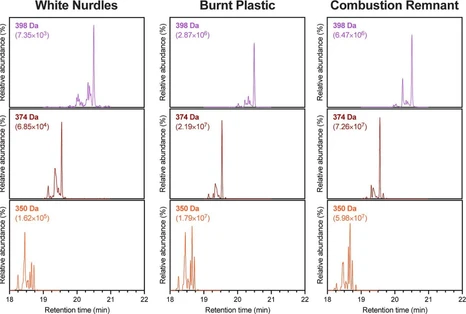
Gas Chromatography-Atmospheric Pressure Chemical Ionization (GC-APCI) Expands the Analytical Window for Detection of Large PAHs (≥24 Ringed-Carbons) in Pyroplastics and Other Environmental Matrices
This study develops a GC-APCI-MS/MS method for detecting large PAHs in pyroplastics, identifying potential markers of burned plastic pollution.
Mo, 11.5.2026
LabRulez

Interview | Science and research
Tracking Toxic PCBs in River Water using Gas Chromatography–Electron Capture Detection
Francais Femi Oloy discusses PCB monitoring in Nigerian rivers, including GC-ECD analysis, liquid–liquid extraction, sample cleanup, and challenges in trace pollutant detection.
Fr, 8.5.2026
Organomation
Article | Environment
Microplastics and Nanomaterials: Understanding Emerging Contaminants in Environmental Testing
Comprehensive overview of microplastic pollution analysis, from extraction workflows and contamination control to nitrogen evaporation and advanced GC-MS, LC-MS/MS, and Py-GC-MS techniques.
We, 8.4.2026
Organomation
Scientific article | Science and research
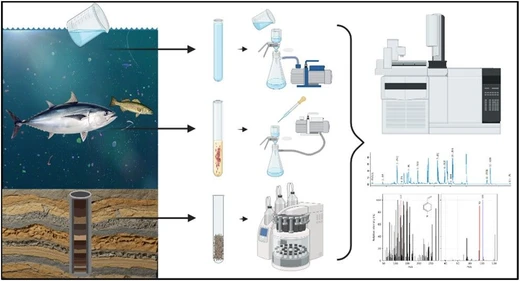
Rapid and Sensitive Quantification of Nano- and Microplastics in Water, Sediment, and Biological Tissue by Pyrolysis-Gas Chromatography Tandem Mass Spectrometry with Dynamic Reaction Monitoring
This study presents a sensitive Py-GC–MS/MS method using dynamic reaction monitoring to quantify nano- and microplastics in water, sediment, and biota at nanogram levels.
Mo, 2.2.2026
LabRulez

Article | Environment
Protecting Europe's Waters: Reliable Sample Prep for Water Framework Directive Compliance
Stringent Water Framework Directive requirements drive high analytical sensitivity. EQS limits, GC-MS determination of priority substances, and the critical role of sample preparation in practice.
Th, 15.1.2026
Organomation

Article | Science and research
Long-Term Air Monitoring Shows Pesticides Aren’t Gone—They’re Coming Back
A decade-long study from the Czech National Atmospheric Observatory shows that banned pesticides persist in the air decades later, driven by soil re-emission and slow environmental degradation.
Th, 8.1.2026
RECETOX - Centrum pro výzkum toxických látek v prostředí

Article | Plastics
From the Ocean to the Laboratory: How Scalable Pyrolysis-GC/MS Reveals the Hidden Story of Microplastics
Scalable Pyrolysis-GC/MS workflows reveal how microplastics move through the environment and the human body, from routine monitoring to high-resolution Orbitrap-based exposure science.
Tu, 6.1.2026
Thermo Fisher Scientific




Other projects

Follow us


More information
WebinarsAbout usContact usTerms of use
LabRulez s.r.o. All rights reserved. Content available under a CC BY-SA 4.0 Attribution-ShareAlike