Persistence-Directed Testing of Chemicals Discharged from Offshore Oil Platforms Combined with Nontargeted Analysis
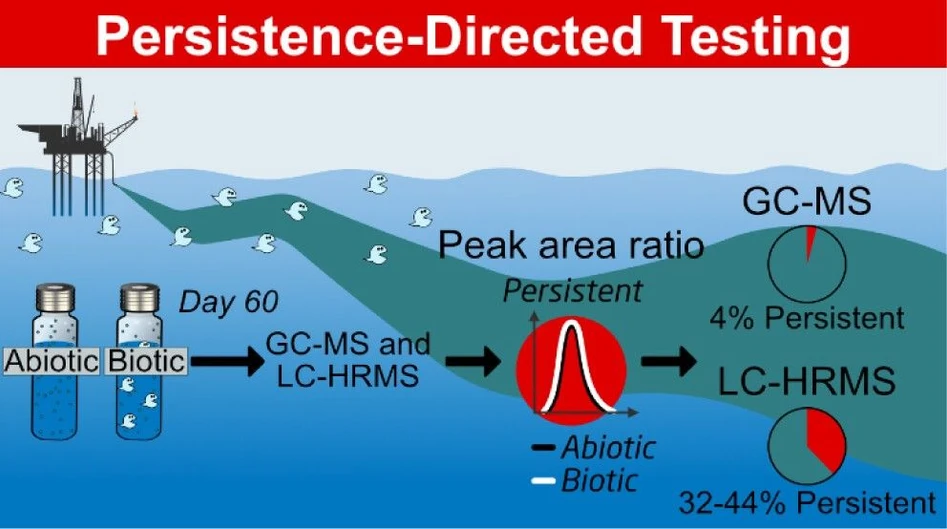
Environ. Sci. Technol. 2025, 59, 44, 24000–24011: Graphical abstract
Persistent chemicals released into marine environments pose long-term and potentially irreversible risks, particularly when discharged as complex mixtures in large volumes. To address this challenge, we introduce a persistence-directed testing approach that combines environmentally relevant biodegradation experiments with nontarget analytical techniques to better characterize persistent chemical burdens.
Produced waters from two offshore oil platforms in the North Sea were used as case studies. After 60 days of incubation under biotic and abiotic conditions, nontarget analyses using SPME–GC-MS and SPE–LC-HRMS identified over 600 chemicals passing quality control. Persistent compounds accounted for 4% of GC-MS detections and 32–44% of LC-HRMS detections, with several annotated as N-substituted aromatic structures. These results demonstrate the effectiveness of persistence-directed testing for revealing previously unidentified persistent chemicals and underscore the need for improved treatment of offshore produced water discharges.
The original article
Persistence-Directed Testing of Chemicals Discharged from Offshore Oil Platforms Combined with Nontargeted Analysis
Mette T. Møller*, Heidi Birch, Karina K. Sjøholm, Stefano Papazian, Aina C. Wennberg, Bénilde Bonnefille, Pia M. Kronsbein, Malcolm A. Kelland, Jonathan W. Martin, and Philipp Mayer
Environ. Sci. Technol. 2025, 59, 44, 24000–24011
https://doi.org/10.1021/acs.est.5c08802
licensed under CC-BY 4.0
Selected sections from the article follow. Formats and hyperlinks were adapted from the original.
In this study, we introduce “Persistence-Directed Testing”, a concept inspired by effect-directed analysis (EDA). In EDA toxic chemicals in complex mixtures from contaminated environments are singled out by combining fractionation procedures, biotesting, and sensitive chemical analytical methods to identify toxicants. (13,14) In persistence-directed testing, persistent chemicals in complex discharges are singled out and potentially identified by combining biodegradation tests, sensitive chemical analytical techniques, and focused data treatment schemes.
The biodegradation testing method is an advancement of a recently developed biodegradation kinetic testing method, a modified OECD 309. The method was developed for chemicals in mixtures at low concentrations, including hydrophobic and volatile chemicals. (15,16) In recent years the method has continuously been advanced from testing composed mixtures (15) to testing samples of unknown or variable composition, complex reaction products, or biological materials (UVCBs), such as petroleum mixtures and essential oils. (17,18) In the most recent progression of the method, it was used for testing the biodegradation kinetics of chemicals in complex mixtures being discharged to the environment, using native microorganisms in the receiving environment as inoculum. (19) With this method, biodegradation kinetics were successfully obtained for more than a hundred chemicals discharged from an offshore oil platform measured with solid-phase microextraction (SPME) gas chromatography-mass spectrometry (GC-MS). (19)
The novelty of the persistent-directed testing in the present study is the design of the test and data treatment for persistence rather than biodegradation. This was achieved by combining a discharge sample (complex chemical mixture) and a seawater sample (native microorganisms), for determining the number, fraction, and, if possible, also the identity of those chemicals that are not degraded at the end of the test and are thus found persistent. The experiments were analyzed with both SPME GC-MS and nontarget solid-phase extraction (SPE) liquid chromatography-high-resolution mass spectrometry (LC-HRMS), in order to extend the chemical space coverage and achieve a more comprehensive persistence assessment.
Nontarget analysis (NTA) techniques have developed and advanced rapidly in recent years. (20,21) It is now possible to detect thousands of chemicals in a sample without predetermining targets. By analyzing the sample with HRMS, the exact mass of both the precursor and molecular fragments of each feature detected can be obtained, (22) which can be used for identification or annotation at various confidence levels. (23) Limitations of NTA are that exact identification (confidence level 1) and quantification is difficult and time-consuming. (21) In recent years, new developments of NTA workflows and software tools, such as in silico structure predictions (24,25) and feature-based molecular networking (FBMN), (26,27) allow increasingly more automated and higher-throughput molecular annotations (Level 2), structural elucidation (Level 3), and molecular formula assignments (Level 4). This has been successfully showcased for environmental applications. (28−30)
In the present study, we combine biodegradation testing with NTA to directly enable the simultaneous persistence assessment of a large number of chemicals, while providing identification information across varying levels of confidence.
The hypotheses were: 1) environmentally relevant biodegradation tests combined with advanced analytical methods can reveal persistent chemicals in complex discharges, and 2) based on a recent feasibility study, (19) we expect a much higher fraction of persistent chemicals in produced water within the group of polar substances detectable by LC, compared to nonpolar chemicals detectable by GC. We also anticipate that NTA, combined with advanced computational workflows, can allow to reach a deeper molecular-level understanding of the persistent chemicals discovered in complex discharges.
2. Materials and Methods
2.8. Sample Preparation and Chemical Analysis
2.8.1. Solid-Phase Microextraction Coupled to GC-MS
After 60 days, test systems were transferred directly from the incubator to the GC autosampler (PAL RSI 85; CTC Analytics AG, Switzerland) without any pretreatment or conservation. Automated SPME, with a 30 μm PDMS fiber (Supelco, USA), was applied to unopened test systems by direct immersion. The SPME was thermally desorbed on the GC column (122-5562UI DB-5 ms Ultra Inert column, 60 m × 0.25 mm × 0.25 μm, Agilent), where the analytes were separated by the GC (7890B; Agilent Technologies, USA). They were then detected by the MS (5977A MSD; Agilent Technologies, USA), in electron ionization full-scan mode (m/z 50–500) to include a large number of nonpolar chemicals in produced water. The analytical method is described in detail in Møller et al. (2024). (19) The 1:200 dilution from both platforms was analyzed on day 60. On the following 4 days, the remaining dilutions from both platforms were analyzed, due to the number of samples and the analysis time per sample. Each GC-MS analysis run consisted of triplicate alternating biotic and abiotic test systems at one dilution from one platform, with blanks at the beginning and the end. The biotic and abiotic test systems analyzed directly after each other were used as pairs for calculating the peak area ratios.
2.8.3. LC-HRMS Analysis
Analyses by LC-HRMS for nontarget qualitative profiling were performed using a Vanquish Horizon system interfaced with heated electrospray ionization (HESI) to an Orbitrap Exploris 480 (Thermo Fisher). Each sample was acquired twice using ionization in positive (HESI+) and negative (HESI−) modes. Clean extracts were injected (25 μL) on a C18 Waters Acquity column (UPLC BEH C18, 3.0 mm × 100 mm, 1.7 μm particle) combined with an Acquity precolumn (BEH C18, 2.1 mm × 5 mm, 1.7 μm). Reverse-phase chromatography was performed using LC-MS grade (Optima) mobile phases (A) Milli-Q water with 1 mM ammonium fluoride (NH4F), and (B) 100% MeOH. Spectral acquisition alternated between full-scan MS1 (m/z 90–1000, ∼1.5 Hz, nominal resolution 240,000 at m/z 200) and nontarget data-independent (DIA) MS2 acquisition using four sequential precursor isolation windows of 250 m/z (i.e., m/z 89–341, 339–591, 589–841, 839–1091). Additional details are presented in SI 3.
3. Results and Discussion
3.2. Primary Biodegradation and Persistence Assessment
Primary biodegradation and persistence were assessed at a dilution of 1:200 based on peak area ratios (biotic/abiotic) of test systems analyzed (GC) or extracted (LC) on day 60. Features were categorized as persistent, when all triplicate peak area ratios were greater than 0.5, corresponding to less than 50% biodegradation (see Section 2.9.2). The results for Platform B are presented in Figure 3 (Platform A results and results including the standard error of the mean; see SI 11).
 Environ. Sci. Technol. 2025, 59, 44, 24000–24011: Figure 3. Biodegradation and persistence assessment of chemicals in produced water from Platform B at 1:200 dilution from mean (n= 3) peak area ratio. A) Features measured with GC-MS and B) Features measured with LC-HRMS. Green = primary biodegraded, yellow = ambiguous, and red = persistent (see Section 2.9.2).
Assessment of the GC-MS data resulted in 3–4% persistent features for Platform A (6/144 features) and Platform B (10/279 features) (Figure 3A and SI 11), consistent with previous GC-MS results from a biodegradation experiment conducted one year earlier with produced water from Platform A, where the persistent fraction was also 4%. (19) In the present study, additional assessment performed on LC-HRMS data yielded 32% persistent features (61 of 191 features) for Platform A and 44% persistent features (183 of 416 features) for Platform B (Figure 3B and SI 11). Although the chemical space covered by the two analytical methods has only minor overlap, (41) some chemicals might still be detected by both GC-MS and LC-HRMS, as for instance was shown for the potentially persistent chemical N-butylbenzenesulfonamide, in our previous feasibility study. (19) The large extent of biodegradation (>95%) observed in the GC-MS data set shows that microorganisms in the test systems were active (degrading).
In the GC-MS data set, 20 of the petrochemicals in the reference mixture were identified in the produced water samples from both platforms, and they were all biodegraded (benzene and toluene elute too early to be included). No spectral library matches were found for the few persistent features in the GC-MS data sets, which thus remained unidentified. In comparison, many more persistent features were detected by LC-HRMS, and the high-resolution MS data was leveraged for tentative identification of these chemicals using a combination of different workflows.
3.3. Tentative Identification of Chemicals in Produced Water (LC-HRMS)
3.3.1. Suspect Screening of Production Chemicals
In total, 55 production chemicals were included in the suspect list (SI 7), and 7 of these were annotated in a high-concentration sample of the produced water (1:10 dilution) at either Platform A, B, or both (accurate mass deviation <0.005, as described in Section 2.11.1). The annotated molecular structures are presented in Figure 4A. These 7 production chemicals did not pass the quality control filter at 1:200 dilution since their peaks were below the blank area cutoff at this dilution. Therefore, this study cannot conclude whether these are primary biodegraded or persistent.
 Environ. Sci. Technol. 2025, 59, 44, 24000–24011: Figure 4. Comprehensive characterization of chemicals in produced water. Examples of tentative identifications resulting from different data analysis workflows are shown. A) Suspect screening of production chemicals. B) Spectral library matching. C) Feature-Based Molecular Networking (FBMN) combined with in silico structural predictions in SIRIUS (considering maximum top-6 proposed structures). D) Molecular formula computed in SIRIUS. Suspect screening, spectral library matching, and molecular formula assignments were performed for both LC-HRMS HESI+ and HESI– data sets. The FBMN in (C) shows one example of a cluster from HESI+ (top) and one cluster from HESI– (bottom). Molecular structures highlighted in red correspond to chemicals categorized as persistent. Identification confidence levels refer to Schymanski et al. (2014). (23)
3.6. Persistence-Directed Testing
This study introduces persistence-directed testing and validates the hypothesis that environmentally relevant biodegradation tests combined with advanced analytical methods can reveal persistent chemicals in complex discharges. A limitation of this study is that the chemicals categorized as “biodegraded” only cover primary biodegradation and not potential persistent metabolites. More research is needed to assess persistent metabolites, e.g., by analyzing peaks that are significantly more abundant in biotic test systems compared to abiotic test systems after 60 days of incubation. If persistent metabolites are found, backtracking the parent molecule in the discharge can be challenging but is possible to approach using predicted degradation pathways, e.g., from specific mass shifts (e.g., 15.996 Da for oxygen attachment) as suggested by Tisler et al. (2022), (46) or using dedicated software such as BioTransformer (https://biotransformer.ca/) or EnviPath (https://envipath.org/).
To improve the method, future studies could use sterilized inocula and discharge samples as abiotic controls. Furthermore, as analytical sensitivity increases, future studies can potentially come closer to investigating how the biodegradation process is affected by the extreme dilutions occurring in the ocean, and thereby improving environmental relevance even further.
The persistence-directed testing approach introduced in this study can be used to assess the extent of the problem of persistent chemicals in various types of discharges. An advantage of the approach is that a complex mixture of chemicals can be assessed in one biodegradation study, while the highly time-consuming work of feature identification can be narrowed down by focusing on persistent features. If persistence-directed testing approaches are adopted more widely and identification of the persistent fraction becomes easier with the very rapid development of the NTA field, it will become more and more difficult to unnoticed discharge large quantities of persistent chemicals. The approach can also lead to the identification of new groups of persistent molecules and an improved understanding of persistence in the environment.