News from LabRulezGCMS Library - Week 46, 2025
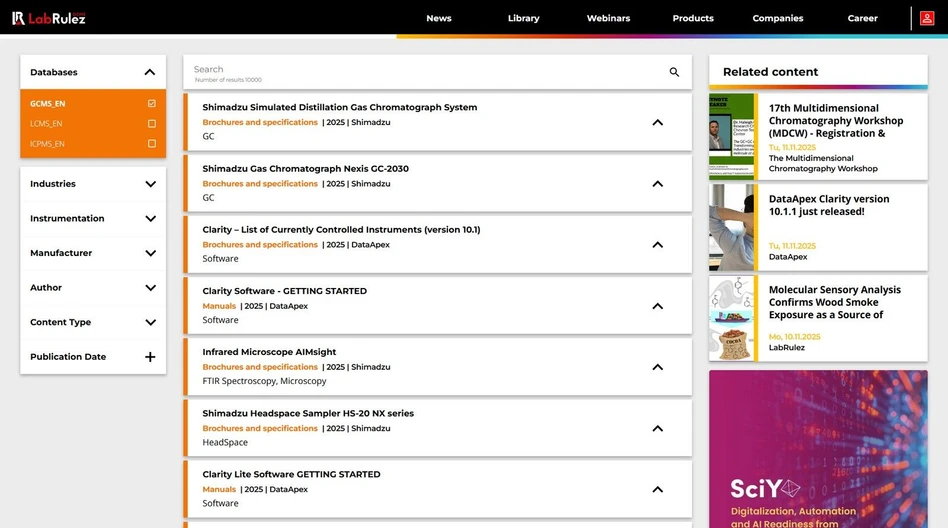
LabRulez: News from LabRulezGCMS Library - Week 46, 2025
Our Library never stops expanding. What are the most recent contributions to LabRulezGCMS Library in the week of 10th November 2025? Check out new documents from the field of the gas phase, especially GC and GC/MS techniques!
👉 SEARCH THE LARGEST REPOSITORY OF DOCUMENTS ABOUT GCMS AND RELATED TECHNIQUES
👉 Need info about different analytical techniques? Peek into LabRulezLCMS or LabRulezICPMS libraries.
This week we bring you applicaton notes by Agilent Technologies, EST Analytical and Shimadzu!
1. Agilent Technologies: Improved Thermal Stability Leads to Retention Time Stability and Data Accuracy for the Analysis of Pesticides
- Application note
- Full PDF for download
The analysis of trace-level pesticides is required by many governmental regulatory authorities at varying concentrations and can include hundreds of target analytes. As many of the matrices tested are complex and the analytes active, a robust and inert gas chromatography method is required.1 Heavy matrices can be difficult for analytical gas chromatography columns, and higher temperatures may be required to elute the matrix off of the column. To avoid damage from high temperatures and heavy matrix, a thermally stable and ultra inert analytical column phase is needed to successfully perform this analysis. The Agilent J&W 5Q series of gas chromatography columns provide the most thermally stable column available and offer inertness for difficult analytes.2 The increased thermal stability not only dramatically reduces column bleed but also allows for less spectral interference at higher temperatures, leading to less need for background subtraction when searching analyte spectra against commercially available libraries.
While column bleed is a normal phenomenon, the increase of the baseline due to column bleed is an indication of the column phase breaking down and leading to retention time shifts. Retention time shifting can be especially difficult with the analysis of pesticides, since sensitive detectors such as mass spectrometers and triple quadrupole systems collected in selected ion mode (SIM) or multiple reaction monitoring (MRM) mode are required to achieve lower limits of detection. In both SIM and MRM collection methods, time segment windows are stated for analytes of interest, and if a retention time shifts earlier, it can move out of the collection window and require time to update the analytical collection method. By using a GC column with increased thermal stability, such as the Agilent J&W DB-5Q or the Agilent J&W HP-5Q, the column will be more robust to thermal and matrix damage. These columns will also maintain consistent retention times over long periods of analytical stress.
Retention time locking is a useful tool in the analysis of pesticides, as it can adjust column flow or pressure to normalize retention times, so that the retention times of the analytes are the same from system to system or column to column.3,4 When columns with identical selectivity are interchanged, after a single injection of a test mix, the analysis can be relocked and the column flow adjusted, based on the initial calibration, to be identical as in the original method. This eliminates the need to constantly update retention times in analytical methods for SIM or MRM windows or data processing methods when replacing analytical columns.
When analyzing pesticides in heavy matrix, a guard column can serve two additional benefits. The guard column can help protect the analytical column from heavy matrix damage and can improve solvent and sample focusing. It is recommended to use nonpolar solvents when working with nonpolar column phases, such as the DB-5Q and HP-5Q columns. Recently it has become more common to prepare heavy matrices for pesticide analysis using QuEChERs-type preparations, with a final solvent of acetonitrile. Solvent-column phase polarity mismatch can lead to improper solvent focusing and wettability leading to improper peak shape, especially when working with columns that have low free silanol content on the deactivated surface of the fused silica. Use of a guard column can help to refocus the solvent and analytes to maintain proper peak shape.5
The Agilent 7010D GC/TQ uses the new Agilent High Efficiency Source (HES) 2.0 equipped with a novel dipolar RF lens that redirects carrier gas and low mass ions by > 95%, helping to reduce noise and extend instrument robustness while maintaining sensitivity.6 When using DB-5Q and HP‑5Q columns in conjunction with the HES 2.0, it is possible to increase the overall robustness of the workflow for the analysis of pesticides over a wide dynamic range of analyte concentrations.
Experimental
An Agilent 8890 GC coupled with an Agilent 5977B GC/MSD with an Inert Extractor Source was used for acquisition of data and MassHunter 10.0 Qualitative Analysis software was used for data analysis. NIST20 library was used to confirm peak identification. A retention gap of one meter was used as a guard column to help protect the analytical column from heavy matrix and to aid in solvent focusing.
Results and discussion
The analysis of pesticides requires retention time stability as well as consistency from analytical column to analytical column. To compare the analytical performance of an Agilent J&W DB-5Q to an Agilent J&W DB-5ms UI GC column for the analysis of pesticides, a standard was first analyzed on a DB-5ms UI and the retention time locked for chlorpyrifosmethyl. The DB-5ms UI column was then replaced with a DB-5Q, and once the column was conditioned, the representative pesticide mix was again analyzed and relocked to the appropriate retention time for chlorpyrifos-methyl and analyzed again. Figure 1 demonstrates the identical selectivity of the DB-5ms UI to the DB-5Q phases and the ability to relock an existing analytical method when upgrading columns and compatibility with existing retention time locking libraries.
Additionally, when comparing the baseline of the DB-5Q to the DB-5ms UI column at the upper temperature limit of the chromatographic method, the increased thermal stability of the DB-5Q allows for a significant decrease in column bleed at upper temperature limits (Figure 1).
Conclusion
This application note demonstrated that the Agilent J&W DB-5Q column has identical selectivity to the Agilent J&W DB-5ms UI column, allowing for seamless adoption and use with existing retention time locking methods. The robust DB-5Q column phase maintained retention time stability even when analyzing heavy matrices and temperature cycling. The increased thermal stability not only decreased the baseline at higher temperatures but also allowed for less spectral interference and high library match factor scores. The analytical performance of the Agilent J&W DB-5Q column coupled with the Agilent 7010D with the HES 2.0 ion source allows for optimal sensitivity and wide dynamic range of pesticide compounds.
2. EST Analytical: Automated Sampling of Methanol Extractions
- Application note
- Full PDF for download
Environmental labs are required to perform methanol extractions on highly contaminated solid waste samples. Additionally, these extractions are used for difficult matrices, for example oily waste samples, that are also soluble in methanol. Due to the variety of matrices that can be extracted with methanol there are assorted hurdles to cross in order to automate the sampling process. One of these obstacles is how the matrix can absorb the extraction solvent. For example, many soil samples require more methanol; due to the soil expanding with the solvent addition. Adding more methanol aids in rectifying this issue however, when automating sampling, the added methanol coupled with the soil expansion needs to be accommodated. For this reason, EST Analytical created software for the Centurion WS that allows the user to program the needle depth to different distances. In doing this, laboratories are able to sample soils at higher depths in order to adjust for sample absorption and at lower depths for samples that do not require the added solvent. In order to test volatile compounds in methanol extractions, a portion of the extract needs to be sampled from the vial, diluted, and purged on a purge and trap concentrator. This examination will look at the automated sampling of three different soil matrices.
Experimental:
The Centurion WS autosampler with the syringe option and the Evolution purge and trap concentrator were set up to run methanol extractions. Since this is a volatile analysis, a Vocarb 3000 (K) trap was used for the analytical trap. The sampling system was configured to an Agilent 7890A Gas Chromatograph (GC) and an Agilent 5975C inert XL Mass Spectrometer (MS). The column selected for this analysis was a Restek Rxi®-624 Sil MS, with dimensions of 30m x 0.25mm I.D. x 1.4µm film thickness. Experimental parameters used for this analysis are listed in Tables 1 and 2.
Conclusions:
The system produced excellent results. The curve and the compound response factors met all of the method requirements. The overall precision was less than 5% RSD while the system showed an average recovery of 94%. When examining the expected analyte concentration to the extracted sand results, it was found that the average recovery was approximately 102%. Thus, the automated extraction performed extremely well. When comparing the three different matrices it was found that they all displayed similar recoveries, however the sand matrix did perform the best of the three as expected since sand tends not to absorb analytes as readily as other matrices. Finally, the ability to control the needle depth on extraction samples was a great benefit for the different matrices as the system exhibited no issues with needle clogging due to the higher needle depth when performing the potting soil extractions. As demonstrated from this study, the Centurion WS automated extraction capability would be an asset to any lab performing extractions.
3. Shimadzu: Fatty Acid Analysis of Edible Oils by GC
Comparing Helium and Hydrogen as Carrier Gases
Comparing Analysis by GC with a Simple Screening Analysis by LC-MS
- Application note
- Full PDF for download
There are a variety of edible oils that are sold commercially for a range of uses. They are almost entirely composed of compounds called triacylglycerols (neutral lipids), which consist of three fatty acids bound to a glycerol molecule. Because fatty acids affect the functional characteristics of food, determining the fatty acid composition of food is an important area of analysis. In this Application News, the Brevis GC-2050 (GC-FID) is used to determine the fatty acid composition of commercially available edible oils, and the use of hydrogen as a carrier gas is examined and compared with helium. This Application News also analyzes the same edible oils analyzed by LC-MS in a previous Application News1) and comparesthe results.
Equipment
GC-FID analysis was performed using the Brevis GC-2050 gas chromatograph (Fig.1) , which is designed to be highly compact, with an installation footprint 35 % smaller than the previous model. The Brevis GC-2050 is also equipped with a carrier gas saving mode that reduces carrier gas consumption. The carrier gas saving mode reduced the use of helium carrier gas by around 89 % and hydrogen carrier gas by around 79 % in the analyses described in this article. Hydrogen carrier gas also reduced analysis times by around 25 %.
Results from Real-World Sample Analysis
Edible oils were derivatized and analyzed using both helium and hydrogen carrier gases. Peaks that could not be identified with the calibration standard (37 FAME mixture) were analyzed by GC-MS to determine their carbon number and degree of unsaturation. (Labeled as isomer.) Fig. 4 shows the chromatograms (partial) obtained from analyzing linseed oil with helium and hydrogen carrier gases. Similar separation was achieved with both gases.
Comparing GC-FID and FIA-MS
Tables 5 and 6 compare the results of analyzing eight vegetable oils for fatty acids by FIA-MS (screening analysis) and GC-FID (a helium carrier). The results reveal characteristic features of the vegetable oils, such as the most abundant fatty acids, and that coconut oil contains fatty acids with relatively low carbon numbers. More information about the screening analysis performed with a single quadrupole mass spectrometer can be found in Shimadzu Application News 01-00674-EN. 1)
Conclusion
In this Application News, the Brevis GC-2050 was used to determine the fatty acid composition of edible oils. Fatty acid analysis is typically performed using helium as the carrier gas, but in this study, hydrogen was used. This reduced analysis times while producing results that compared favorably with helium. Given the current supply issues associated with helium, hydrogen should be considered as an alternative to helium.
The results also show that fatty acid compositions determined by FIA-MS correlate well with results obtained by GC-FID. And because the sample pretreatment only requires sample dilution, analysis by FIA-MS is rapid, taking just 1 minute. Therefore, FIAMS seems particularly well-suited to the screening of large numbers of samples or when there is an urgent need to verify quality or safety