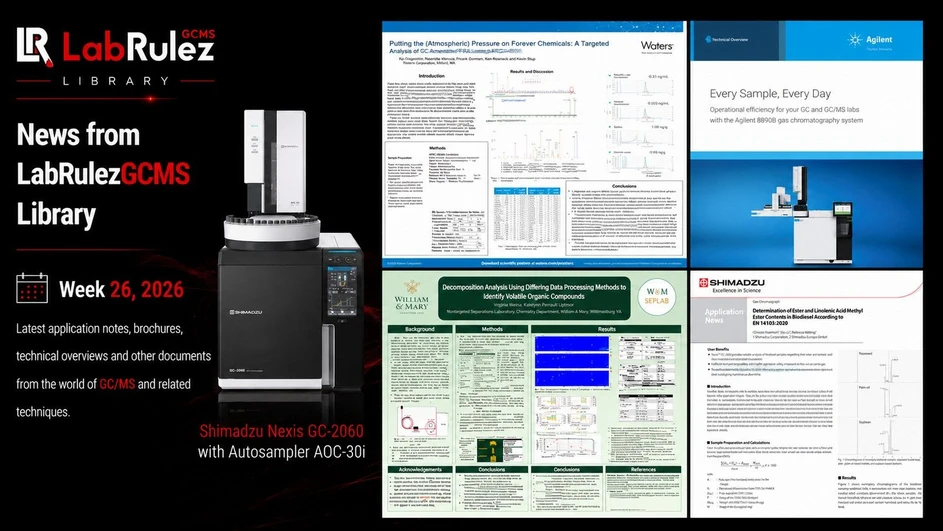
News from LabRulezGCMS Library - Week 26, 2026
LabRulez / AI: News from LabRulezGCMS Library - Week 26, 2026
Our Library never stops expanding. What are the most recent contributions to LabRulezGCMS Library in the week of 22nd June 2026? Check out new documents from the field of the gas phase, especially GC and GC/MS techniques!
👉 SEARCH THE LARGEST REPOSITORY OF DOCUMENTS ABOUT GCMS AND RELATED TECHNIQUES
👉 Need info about different analytical techniques? Peek into LabRulezLCMS or LabRulezICPMS libraries.
This week we bring you brochure by Agilent Technologies, application note by Shimadzu and posters by MDCW / William & Mary and Waters Corporation / ASMS!
1. Agilent Technologies: Operational efficiency for your GC and GC/MS labs with the Agilent 8890B gas chromatography system
- Brochure
- Full PDF for download
Analyze more samples every day with faster cycle times
The 8890B GC provides faster maximum oven temperature ramps and cooldown rates for conventional dual-channel GC. If you want even faster cycle times, an optional rapid cooling fan is available.
Achieve excellent repeatability across multiple injections
Consistent retention time and area count performance are the cornerstone of what you can expect from the 8890B GC. The system also meets all specifications required for regulatory methods such as USP Method <467> (residual solvents).
Shine a new light on your connections and components
Make maintenance easier and faster with a built-in oven light that illuminates the internal space on the 8890B GC. That means you can perform tasks like troubleshooting and column installation in less time—and with fewer errors.
Boost GC performance with capillary flow technology
- Backflush significantly reduces timing between injections, increasing productivity.
- Purged Ultimate unions provide leak-free connections, reducing downtime.
- Flow splitters enable data collection from up to three detectors.
- New CFT calculators let you download calculated setpoints to your method—avoiding time-consuming, error-prone manual input.
- Multidimensional chromatography:
- Deans Switch facilitates heart cutting, enabling resolution of trace compound in complex matrices.
- GC x GC flow modulation enables multidimensional chromatography without the need for cryogen
Helium conservation module
Extend the life of your helium tanks by up to 30 times. The Agilent helium conservation module allows you to use helium for your GC runs and switch to a different gas (typically nitrogen) when your GC is idle. That means you can achieve better control of laboratory operating expenses and avoid workflow disruptions.
Alternative carrier gas support
Alternative carrier gases like hydrogen and nitrogen are popular low-cost options.
The Agilent Hydrogen Sensor Module Series 2 option adds built-in peace of mind when operating with H2 gas.
The Agilent HydroInert source minimizes sensitivity loss and spectral anomalies associated with H2. It also:
- Maintains spectral fidelity, even for compounds highly susceptible to hydrogenation.
- Improves peak shape for high-boilers, especially polycyclic aromatic hydrocarbons (PAHs)
2. MDCW / William & Mary: Decomposition Analysis Using Differing Data Processing Methods to Identify Volatile Organic Compounds
- Poster
- Full PDF for download
When a body decomposes it emits volatile organic compounds (VOCs). VOCs from decomposing remains have been studied before,1 however there is a gap that remains in the knowledge on VOCs that evolve from submerged decomposing remains. 2 In this study, submerged animal tissue was tested to see how the VOCs can be utilized in forensic settings.
This study used data obtained last summer using comprehensive two-dimensional gas chromatography – time-of-flight mass spectrometry (GC×GC-TOFMS). Pigs (Sus scrofa domesticus) are often used as analogs in decomposition studies due to similarities with humans. 3 In this study, pork belly samples were submerged in mason jars filled with water and stored at different temperatures. The GC×GC-TOFMS instrument was used to collect odor from above water samples for a period of twelve days.
GC×GC is often used to analyze complex odor profiles. When analyzing samples with GC×GC, there is a lack of standardization to process the data acquired from time trials. There is a need to discover effective ways to track VOCs for chemical identification and longitudinal analysis.
The goal of this research was to compare different software approaches to analyze GC×GC longitudinal data to achieve accurate analyte identification, representation of data over time, and effective class characterization.
Methods
For the first four days, 5 mL of water was taken and run on the GC×GC-TOFMS. Thereafter, the samples were sampled and run every three days until day twelve. Data were analyzed initially using ChromaTOF (LECO Corporation). The samples were then analyzed using ChromaTOF Tile and ChromaTOF Sync 2D to compare how they can be used in a forensic setting.
Peak tables were curated in Tile and Sync 2D. Then, ChromaTOF was used as a guide to confirm which peaks were identified correctly. If the compound was correctly identified, the peak would be accepted or kept on the table. If not correctly identified, the peak would either be rejected or deleted. Once the tables were complete from the different software approaches, they were exported to Excel for further comparison.
In excel, the relevant hits that were identified as decomposition VOCs were compared across the software approaches. The compounds that were most commonly found were compared to existing literature on decomposition VOCs. From there, two tables were built; where one table was compounds confirmed with literature and the other table was compounds not confirmed with literature.
Comparison between software approaches included looking at different criteria to see which method was the most effective and efficient. The criteria included how long the software approach took, the number of compounds found in each software approach, the accuracy of peak area in the software approach compared to ChromaTOF data, and principal component analysis (PCA) comparison to see which software approach was best used for forensic practice or research.
Conclusions
Sync 2D showed the capability of showing trends in decomposition compounds
- This software approach can be used in research environment where longitudinal data is needed to determine the trends of decomposition data
- Best purpose: research applications requiring longitudinal tracking
Coefficient of Variance’s and Fold Change’s PCA plots showed their ability for clear class differentiation
- The two software approaches can be used to distinguish water containing decomposition in a crime scene
- Best purpose: comparison at a single point and time [detailed analysis]
Fisher Ratio showed a proficiency in identifying top differentiating compounds and showed aptitude for class differentiation
- The software approach would be helpful for cursory analysis for crime scene evidence
- Best purpose: quick comparison of biggest difference for swift identification
3. Shimadzu: Determination of Ester and Linolenic Acid Methyl Ester Contents in Biodiesel According to EN 14103:2020
- Application note
- Full PDF for download
User Benefits
- NexisTM GC-2060 provides reliable analysis of biodiesel samples regarding their ester and linolenic acid methyl ester contents using hydrogen as a cost-effective carrier gas
- It delivers excellent repeatability and provides appropriate safety measures for the use of hydrogen as carrier gas
- The optional multi-mode injection unit (MMI) offers performance equivalent to a conventional split-splitlessinjection unit (SPL), significantly reducing maintenance downtime
Biofuels play an important role in enabling countriesto meet their greenhouse gas reduction targets. They can be produced from a range of raw materials, including plant oils, animal fats, and used cooking oils. Biodiesel is mainly being produced from rapeseed, soybean, and palm oils. Due to this diversity of feedstocks, continuous quality control is necessary as the quality of the raw material has an enormousimpact on the quality of the biodiesel.
The EN 14103:2020 describes the determination of total ester content and linolenic acid methyl ester content in biodiesel by means of gas chromatography with flame ionization detection (GC-FID). The total ester content covers a range of fatty acid methyl esters (FAME) from C6 to C24, and linolenic acid methyl ester is investigated separately as interfering reactive compound that might influence long-term stability of the biodiesel. According to the standard, the total ester content must be greater than 90 % (m/m) and the linolenic acid methyl ester content shall be between 1 and 15 % (m/m)1.
This study shows the analysis of biodiesel originating from rapeseed,soybean, and palm oil using the Nexis GC-2060.
Multi-Mode Injection Unit as Alternative
Shimadzu’s multi-mode injection unit (MMI) offers reliable splitsplitless mode functionality over a broad range of carbon numbers. It allows analysis of biodiesel samples with high repeatability and provides chromatographic results comparable to those measured with SPL as dedicated split-splitless injection unit. The use of MMI significantly shortens maintenance downtime from tens of minutes for a classical split-splitless injection unit to just a few minutes. Figure 3 gives a direct comparison of an exemplary rapeseed-based biodiesel sample measured with SPL (top) and MMI (bottom).
Conclusion
Nexis GC-2060 provides reliable analysis of biodiesel samples regarding their ester and linolenic acid methyl ester content according to EN 14103:2020, covering the various ester types commonly in use. It allows repeatable analysis using hydrogen as a cost-effective carrier gas. The optional multi-mode injection unit (MMI) can be selected as alternative to a classical splitsplitlessinjection unit (SPL).
4. Waters Corporation / ASMS: Putting the (Atmospheric) Pressure on Forever Chemicals: A Targeted Analysis of GC Amenable PFAS using APGC–MS/MS
- Poster
- Full PDF for download
This poster presents a targeted analytical method for the determination of gas chromatography (GC)-amenable PFAS compounds using atmospheric pressure gas chromatography coupled with tandem mass spectrometry (APGC-MS/MS). The study addresses a key limitation of conventional LC-MS/MS methods, which are highly effective for many PFAS but less suitable for more volatile species such as fluorotelomer alcohols (FTOHs), fluorotelomer acrylates (FTAcr), and fluorotelomer acetates (FTOAc). By incorporating GC-MS/MS analysis, laboratories can obtain a more complete characterization of PFAS contamination across environmental, biological, and food-contact materials.
The analytical workflow utilized an Agilent 8890 gas chromatograph equipped with an autosampler and coupled to a Waters Xevo TQ Absolute tandem mass spectrometer operated with APGC ionization in positive-ion mode. Separation was performed on an Rtx-200 capillary column, while data acquisition and quantification were managed using waters_connect software. Unlike traditional electron ionization (EI), APGC generated intact protonated molecular ions, significantly improving sensitivity and selectivity for GC-amenable PFAS. A method covering 35 PFAS compounds was developed, achieving lower limits of quantification (LLOQs) of 0.025–0.1 ng/mL for most analytes.
Several sample types were evaluated, including wastewater, surface water, soil, fish tissue, shrimp, and food-packaging materials. Environmental and biological samples were prepared according to EPA Method 1633A and had previously been analyzed by LC-MS/MS, allowing the GC-MS/MS method to serve as a complementary technique. Food-packaging samples were extracted with methanol containing ammonium hydroxide and analyzed for targeted PFAS. While no target PFAS were detected in the tested packaging materials, multiple GC-amenable PFAS were found in environmental samples. Fluorotelomer alcohols were the most frequently detected compounds, with wastewater and ski-wax-impacted soils showing the highest concentrations.
The results demonstrate that APGC-MS/MS provides a sensitive and robust solution for the analysis of volatile PFAS classes that may be missed by LC-MS/MS alone. The method delivered accurate quantification, effective chromatographic separation, and reliable recovery in spiked samples. The authors conclude that combining APGC-MS/MS with established LC-MS/MS workflows enables a more comprehensive assessment of PFAS contamination, particularly for emerging fluorotelomer compounds and other GC-amenable PFAS that are increasingly relevant in environmental monitoring and food-packaging investigations.