News from LabRulezGCMS Library - Week 23, 2026
LabRulez / AI: News from LabRulezGCMS Library - Week 23, 2026
Our Library never stops expanding. What are the most recent contributions to LabRulezGCMS Library in the week of 1st June 2026? Check out new documents from the field of the gas phase, especially GC and GC/MS techniques!
👉 SEARCH THE LARGEST REPOSITORY OF DOCUMENTS ABOUT GCMS AND RELATED TECHNIQUES
👉 Need info about different analytical techniques? Peek into LabRulezLCMS or LabRulezICPMS libraries.
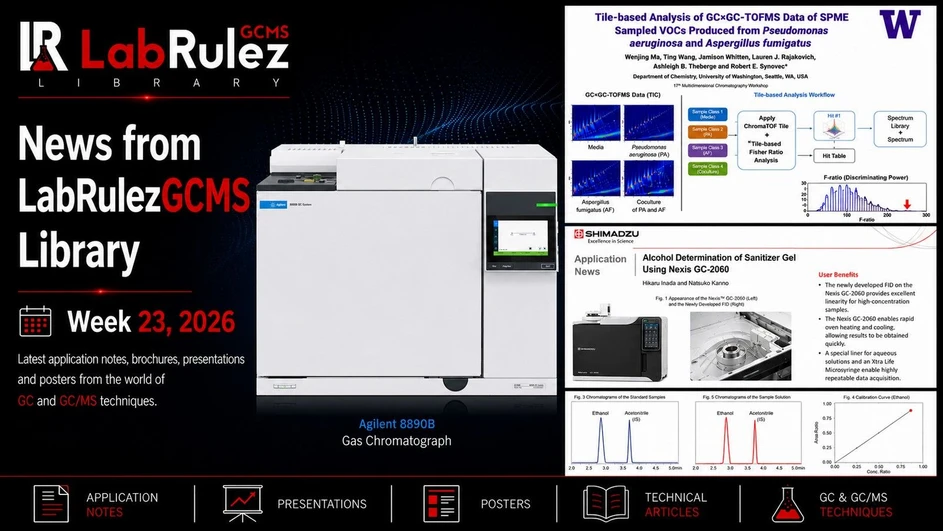
This week we bring you brochure by Agilent Technologies, application note by Shimadzu, and presentation by MDCW / University of Washington!
1. Agilent Technologies: Agilent 8890B Gas Chromatograph
- Brochure
- Full PDF for download
The Agilent 8890B GC delivers high‑performance gas chromatography through advanced electronic pneumatic control, precise oven temperature management, and Agilent capillary flow technology, which provides reliable, leak‑free, in‑oven connections and supports flexible system configurations with minimal method development time.
An upgrade, more responsive 7-inch capacitive touchscreen and a full Agilent GC Assist interface, offer real-time status, configuration, signal monitoring, and remote access for setup, troubleshooting, leak checking, maintenance, and method management across devices.
Sustainability features include programmable sleep and wake modes to reduce resource consumption, along with gas and power usage calculators that track method‑level efficiency. Known for reliability and long life, Agilent GC systems are supported by a 10‑year use guarantee to ensure a low cost of ownership.
GC system capabilities
- Retention time repeatability: < 0.008% or < 0.0008 minutes
- Area repeatability: < 0.5% RSD
Built-in intelligence autonomously monitors the health of the system, alerts the user of potential issues before they affect chromatographic performance, and offers helpful step-by-step guides to resolve issues.
The 7-inch touch screen gives a visual report of the system configuration, letting you update the active method, perform maintenance routines, and check GC instrument status.
The GC Assist interface provides remote connectivity enabling you to monitor your smart GC system, check system logs, and perform diagnostics tests, from inside or outside the laboratory.
Maintenance and service modes, including autonomous leak checks, are easily accessed from the touchscreen and browser interface.
Atmospheric pressure and temperature compensation are built into every system, so results do not change, even when the laboratory environment does.
Automatic liquid sampling is fully integrated into mainframe control and includes up to 3-layer sandwich injections and sample preparation capabilities such as heating, mixing, standard addition, and derivatizations.
Simultaneously supports
- Two inlets
- Five detectors
- Four detectors (with additional large valve oven option)
- Support for up to 10 valves
- Six GC column Smart Key ports
Instrument dimensions
- Height: 49 cm (19.2 in)
- Width: 58 cm (22.9 in) with EPC inlet and detectors; 68 cm (26.8 in) with detector as TCD or with certain valving options mounted on the left side of the GC
- Depth: 51 cm (20.2 in)
- Typical weight: 49 kg (108 lb)
Maintenance and support services
- Integrated early maintenance counters that allow planned maintenance and help eliminate unnecessary downtime
- Instrument events or shutdowns displayed on keyboard display or data system
- Remote diagnostics
- Performance verification services
- Easy parts identification and part number finder software (standalone software, does not require Agilent CDS)
2. MDCW / University of Washington: Tile-based Analysis of GC×GC-TOFMS Data of SPME Sampled VOCs Produced from Pseudomonas aeruginosa and Aspergillus fumigatus
- Presentation
- Full PDF for download
This presentation describes a novel chemometric approach for analyzing complex GC×GC-TOFMS datasets generated from volatile organic compounds (VOCs) released by the pathogens Pseudomonas aeruginosa and Aspergillus fumigatus. These microorganisms frequently coexist in the lungs of cystic fibrosis patients, where their interactions are associated with worsening respiratory function and poorer clinical outcomes. The study aims to identify VOC biomarkers that distinguish microbial monocultures, cocultures, and growth media controls, providing insights into pathogen interactions and potential diagnostic markers.
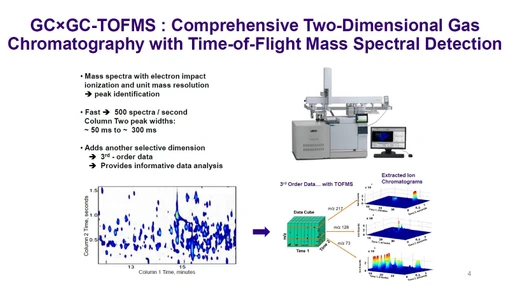
To achieve this, the researchers combined solid-phase microextraction (SPME) sampling with comprehensive two-dimensional gas chromatography coupled to time-of-flight mass spectrometry (GC×GC-TOFMS). This analytical platform offers high chromatographic resolution, rapid spectral acquisition rates of up to 500 spectra per second, and rich three-dimensional datasets containing chromatographic and mass spectral information. However, each chromatogram can contain more than one million data points, creating significant challenges for data processing and interpretation.
The core of the work focuses on tile-based feature selection methods implemented through the ChromaTOF Tile software. The primary approach, tile-based Fisher Ratio (F-ratio) analysis, identifies analytes that differ statistically between sample classes by comparing between-class and within-class variance. Using this strategy, the authors discovered 576 VOC features capable of differentiating growth media, P. aeruginosa monocultures, A. fumigatus monocultures, and cocultures. Additional pairwise statistical testing was then used to determine which specific classes were responsible for the observed differences. Representative VOCs characteristic of each class were identified, including heptanal for P. aeruginosa, 1-octen-3-ol for A. fumigatus, and several unique compounds associated with coculture conditions.
The presentation also addresses practical challenges associated with high-throughput experimentation, where replicate measurements may be limited by time, cost, or sample availability. To overcome these constraints, the team developed complementary tile-based coefficient of variation (CV) and fold-change (FC) approaches that can identify important analytes using as little as a single replicate per sample class. The authors conclude that selecting the appropriate feature-selection strategy—F-ratio, CV, or fold-change—depends on the experimental design and available data. Future work will focus on advanced analyte identification using chemometric tools such as PARAFAC, enabling deeper biological interpretation of microbial VOC signatures and their relevance to cystic fibrosis research.
3. Shimadzu: Alcohol Determination of Sanitizer Gel Using Nexis GC-2060
- Application note
- Full PDF for download
User Benefits
- The newly developed FID on the Nexis GC-2060 provides excellent linearity for high-concentration samples.
- The Nexis GC-2060 enables rapid oven heating and cooling, allowing results to be obtained quickly.
- A special liner for aqueous solutions and an Xtra Life Microsyringe enable highly repeatable data acquisition
Methods for alcohol determination are specified in USP (United States Pharmacopeia) General Chapters <611> ALCOHOL DETERMINATION, which describes both a distillation and a gas chromatography method. In USP <611>, Method II (gas chromatography) includes a capillary column method (Method IIb).
For GC analysis of samples containing a large amount of water (e.g., sanitizing ethanol), sample vaporization may become unstable, resulting in abnormal peak shapes and poor repeatability. In addition, with a standard micro-syringe for AOC, the plunger may become stiff during aspiration and dispensing of aqueoussolutions, which can degrade repeatability.
This article presents an example of alcohol determination in sanitizing ethanol using the Nexis GC-2060 equipped with a newly developed FID. The Nexis GC-2060 can be configured with a newly developed FID that has high sensitivity and excellent linearity. In addition, a special liner for aqueous solutions and an Xtra Life Microsyringe were used to achieve repeatable analysis.
Nexis GC-2060 and the Newly Developed FID
The Nexis GC-2060 is a gas chromatograph that combines world-class analytical performance with workflow optimization based on the latest technologies. Rapid oven heating and cooling shorten analysis cycle time and improve throughput. The GC-2060 can also be equipped with a newly developed FID (Fig. 1). This FID offers world-class sensitivity and improved linearity.
Conclusion
The alcohol concentration in a commercially available sanitizing gel was determined using the Nexis GC-2060 equipped with the newly developed FID. The results met the system suitability requirements of USP <611> Method IIb, confirming the effectiveness of the Nexis GC2060 equipped with the new FID, along with the special liner for aqueous solutions, and the Xtra Life Microsyringe for repeatable analysis of aqueoussamples