News from LabRulezGCMS Library - Week 27, 2026

LabRulez / AI: News from LabRulezGCMS Library - Week 27, 2026
Our Library never stops expanding. What are the most recent contributions to LabRulezGCMS Library in the week of 29th June 2026? Check out new documents from the field of the gas phase, especially GC and GC/MS techniques!
👉 SEARCH THE LARGEST REPOSITORY OF DOCUMENTS ABOUT GCMS AND RELATED TECHNIQUES
👉 Need info about different analytical techniques? Peek into LabRulezLCMS or LabRulezICPMS libraries.
This week we bring you application note by Agilent Technologies, presentation by MDCW / William & Mary and posters by Shimadzu and Thermo Fisher Scientific / ASMS!
1. Agilent Technologies: Residual Solvents Analysis Based on the 2025 USP <467> and Chinese Pharmacopoeia (ChP 0861)
- Application note
- Full PDF for download
Using the Agilent 8697 headspace sampler and Agilent 8890B GC system
Residual solvents are routinely introduced during pharmaceutical manufacturing as part of synthesis, purification, or formulation processes. Because these volatile organic compounds may pose toxicological risks, their levels must be carefully monitored to ensure patient safety and regulatory compliance. As a result, residual solvent analysis remains a critical component of quality control throughout the pharmaceutical development and manufacturing lifecycle.
USP <467> provides a harmonized framework for residual solvent analysis, defining solvent classifications, concentration limits, and analytical requirements.1 In September 2025, USP <467> was revised to reflect updated toxicological evaluations and regulatory expectations. The revised chapter expanded the class 2B solvent list and introduced performance requirements for newly added compounds, including tertiary butyl alcohol and cyclopentyl methyl ether (CPME). These updates increase the analytical scope of residual solvent testing and place greater emphasis on consistent system performance and suitability verification. In China, residual solvent control is governed by General Chapter 0861 of the Chinese Pharmacopoeia (ChP 0861)2 , which adopts a risk based classification system consistent with the International Council for Harmonisation (ICH) Q3C.3 Although the Chinese Pharmacopoeia uses different terminology for analytical procedures, its regulatory intent, solvent classification, and control principles are harmonized with USP <467>.
Gas chromatography with headspace sampling is widely used for residual solvent determination due to its robustness and suitability for volatile analytes. Alongside evolving regulatory requirements, modern GC systems have increasingly focused on intelligent operation to support method execution and compliance. The Agilent 8890B gas chromatograph incorporates GC Assist to help users perform a performance check of the GC system. When performance criteria are not met, the GC system provides alerts to notify the user. Upon user instruction, the GC can initiate a guided troubleshooting workflow, supporting step-by-step fault diagnosis through autonomous diagnostic functions, helping both experienced and less experienced analysts resolve issues efficiently during routine operation. In this application note, a headspace GC/FID method is presented for the determination of class 1, 2A, and the expanded class 2B residual solvents. This study demonstrates how updated regulatory requirements can be addressed using an intelligent GC platform that supports reliable system performance assessment, simplified troubleshooting, and consistent analytical performance.
Experimental
The experimental conditions described in this study follow the general chromatographic principles outlined in USP <467> procedures A and B. They are also consistent with the recommended headspace GC methods described in ChP 0861. In this work, the screening and confirmation concepts of procedures A and B were implemented simultaneously through a dual-column, dual-FID/GC configuration. Samples were introduced by an Agilent 8697 headspace sampler to an 8890B GC and equally split to an Agilent DB-Select 624 UI and a DB-WAX UI column for parallel detection, as shown in Figure 1. Comparable chromatographic performance was achieved with both helium and nitrogen carrier gases. Data were acquired using Agilent OpenLab CDS version 2.8, and noise was determined using a peak-to-peak (PtoP) approach for calculation of signal-to-noise ratios for target analytes.
Conclusion
This application note demonstrates a harmonized headspace GC/FID workflow suitable for residual solvent analysis in compliance with both the 2025 revision of United States Pharmacopoeia (USP) <467> and the Chinese Pharmacopoeia (ChP 2025, General Chapter 0861). By implementing a dual‑column, dual-FID configuration on a single inlet, screening and confirmatory analyses can be performed simultaneously, significantly reducing total analysis time compared to traditional sequential approaches while maintaining orthogonal separation selectivity. The integrated Agilent 8697 headspace sampler and 8890B GC platform provides consistent chromatographic performance with both helium and nitrogen carrier gases, supporting flexible laboratory operation without compromising data quality. Beyond analytical performance, the intelligent capabilities of the 8890B GC enhance operational reliability and simplify daily use. Through continuous interaction with the user, the built‑in GC Assist function operates in a guided, wizard‑like manner, leading users step by step through the troubleshooting process for effective fault diagnosis. Together, these features enable a compliant, time-efficient, and user-friendly solution for residual solvent testing under the latest USP <467> and ChP 0861 requirements.
2. MDCW / William & Mary: Developing a Combined Approach to Green Gunshot Residue Analysis in the Forensic Laboratory
- Presentation
- Full PDF for download
Developing a Combined Approach to Green Gunshot Residue Analysis in the Forensic Laboratory presents a multidisciplinary strategy for improving the forensic analysis of "green" gunshot residue (GSR), which originates from lead-free ammunition. Traditional GSR analysis relies heavily on the detection of lead, barium, and antimony particles using scanning electron microscopy with energy-dispersive X-ray spectroscopy (SEM-EDS). However, environmentally friendly ammunition replaces these heavy metals with more common elements, making conventional forensic protocols less effective. The authors therefore propose combining inorganic GSR (IGSR) characterization by SEM-EDS with organic GSR (OGSR) analysis using comprehensive two-dimensional gas chromatography coupled with mass spectrometry (GC×GC-MS).
The presentation first describes the development of a new SEM-EDS characterization strategy tailored to green GSR particles. Instead of relying solely on the elemental composition defined by existing OSAC guidelines, the approach incorporates both particle morphology and elemental complexity. In parallel, the researchers optimized an extraction procedure for organic residues and developed a dedicated GC×GC-MS method. Method optimization focused on key chromatographic parameters such as inlet temperature, modulation period, carrier gas selection, and oven temperature program. Compared with previously published methods, the optimized workflow provided higher peak capacity, improved analyte resolution, and enhanced detection of characteristic OGSR compounds.
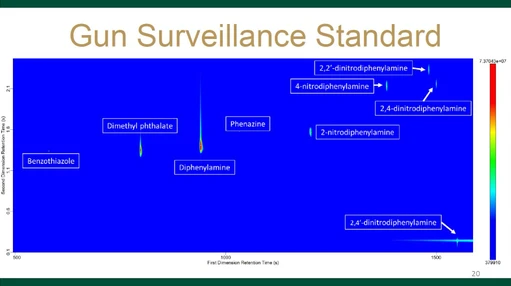
To verify the analytical performance, the optimized GC×GC-MS method was evaluated using several reference standards, including phthalates, nitroaromatic explosives, nitroglycerin, and a multi-component gun surveillance standard. The resulting two-dimensional chromatograms demonstrated excellent separation and clear identification of compounds relevant to firearm discharge residues, confirming that the method can reliably detect a broad range of organic GSR markers. The combination of enhanced chromatographic separation with mass spectrometric detection offers substantially greater resolving power than conventional one-dimensional GC-MS, making it particularly valuable for complex forensic samples.
The authors conclude that integrating SEM-EDS with GC×GC-MS provides a more comprehensive approach to modern GSR analysis, particularly for lead-free ammunition. The study successfully established a characterization strategy for inorganic green GSR, optimized extraction and chromatographic conditions for organic GSR, and verified the visibility and identification of target analytes using certified standards. Future work will focus on further method validation, incorporating retention indices and sorbent-based extraction techniques, and strengthening the scientific robustness of the approach to support forensic evidence under Rule 702, thereby improving the reliability and courtroom acceptance of green GSR analyses.
3. Shimadzu / ASMS: Impact of Soil Matrix on Microplastics Analysis by Py-GC/MS
- Poster
- Full PDF for download
The matrix is not just background—it actively participates in pyrolysis chemistry. Lignin-rich soils can co-pyrolyze, producing compounds that overlap with common PS or PVC markers, complicating interpretation. Matrix variability is substantial, with clear chemical and physical differences between forest soils, agricultural land, river sediments, and landfill cover materials. Soil particles act as sinks and sorbents, interacting with microplastics and altering degradation pathways. Sample preparation can introduce bias, and in some cases does more harm than good.
In this poster, we present a method to improve quantitative accuracy in Py-GCMS microplastics analysis by assessing the matrix effect, while also addressing key challenges in the qualitative identification
Experimental Methods
- Three soil samples were collected from different locations (Figure 1) and homogenized using a mortar/pestle.
- From each sample, 200g were dried in a vial for 3 hours at 40C and 2mg was weighed into a PY cup.
- Targeted microplastics include PE, PP, PS, ABS, PMMA, PC, PVC, N6, and N66. The percentage distribution of polymers in the MPs-CaCO3 standard, as well as the mass of each analyte in a 4 mg standard within a CaCO3 diluent, is shown in Figure 1.
- These were analyzed using a PY-GCMS instrument, shown in Figure 2.
- A 5-point calibration curve was prepared, in triplicate, by weighing 0.2mg, 0.4mg, 0.8mg, 2.0mg, and 4.0mg from Frontier’s Low calibration standard mix of microplastics.
- A matrix-matched calibration curve was generated by spiking sample B with the same concentration as the calibration levels.
- Samples were analyzed, and analytes in the sample were quantified in µg, calculated using the calibration curve of known standard concentration.
- Recovery studies were performed in blank samples to evaluate matrix effect for the targeted analytes. For this, a 2mg sample was weighed in triplicate, and 2mg of the standard mix was combined with 2mg of CaCO3 diluent.
Conclusions
Future work will focus on improving microplastic identification by using multiple markers to reduce false positives, while advancing polymer identification tools and spectral libraries to better handle high-background matrix interferences.
Sample preparation is an important factor, and it needs to be considered and studied for different sample types, including environmental and clinical samples
4. Thermo Fisher Scientific / ASMS: Untargeted analysis of volatile PFAS in indoor air by thermal desorption GC high resolution Orbitrap Mass Spectrometer
- Poster
- Full PDF for download
Per- and polyfluoroalkyl substances (PFAS) are persistent “forever chemicals” widely used in consumer products and commonly detected in indoor air. Volatile PFAS can originate from treated materials and degrade into harmful compounds linked to adverse health effects. Thermal desorption (TD) enables efficient air monitoring by preconcentrating volatile compounds for direct GC-MS analysis. Coupling TD with high-resolution Orbitrap GC-MS and advanced data processing allows comprehensive, untargeted screening of PFAS, supporting improved indoor air quality assessment.
Materials and methods
Sample preparation
- PFAS standards prepared in methanol and spiked onto sorbent tubes
- Indoor air sampled (35 L) from carpeted, non-carpeted, and cleaning storage areas
- Air collected using sorbent tubes with pumped sampling (TD-compatible). Test method(s)
- Samples analyzed using thermal desorption (TD)–GC-MS (Orbitrap Exploris GC)
- TD preconcentration followed by GC separation and HRAM full-scan acquisition (EI/CI)
- Method enabled untargeted screening of volatile compounds.
Data analysis
- Data processed using Thermo Scientific Chromeleon CDS, FreeStyle, and Compound Discoverer Software
- Workflow included peak detection, deconvolution, and library matching.
Conclusions
- TD-GC Orbitrap MS enables sensitive, untargeted detection of volatile PFAS in indoor air with minimal sample preparation
- HRAM data combined with advanced software workflows provides confident identification and efficient data filtering
- Higher PFAS levels observed in carpeted and cleaning areas, highlighting indoor sources and exposure risk