News from LabRulezGCMS Library - Week 17, 2026
LabRulez: News from LabRulezGCMS Library - Week 17, 2026
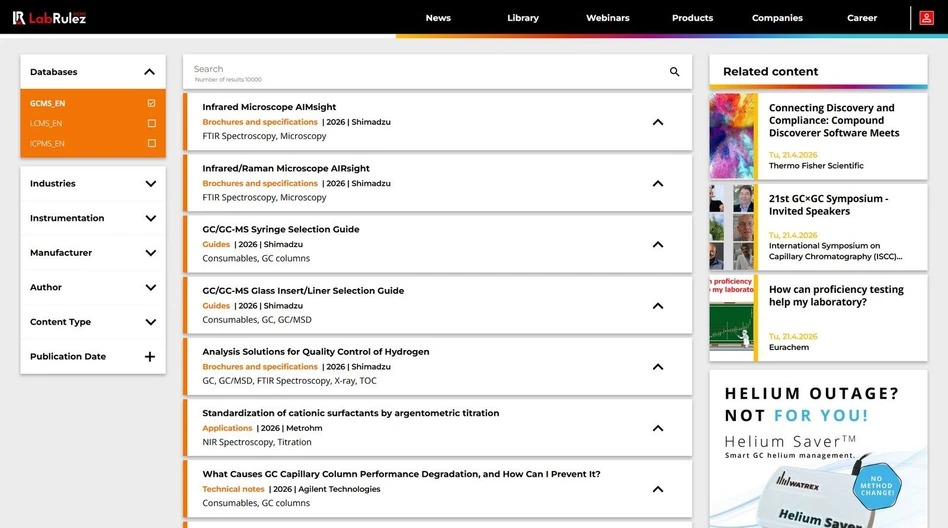
Our Library never stops expanding. What are the most recent contributions to LabRulezGCMS Library in the week of 20th April 2026? Check out new documents from the field of the gas phase, especially GC and GC/MS techniques!
👉 SEARCH THE LARGEST REPOSITORY OF DOCUMENTS ABOUT GCMS AND RELATED TECHNIQUES
👉 Need info about different analytical techniques? Peek into LabRulezLCMS or LabRulezICPMS libraries.
This week we bring you application notes by Agilent Technologies and Shimadzu, brochure by BaySpec and presentation by MDCW / William & Mary!
1. Agilent Technologies: Analysis of Aromatic Amines in Textile Samples
Using hydrogen carrier gas and an Agilent 8890 gas chromatography system coupled with an Agilent 5977C GC/MSD with an Agilent HydroInert source
- Application note
- Full PDF for download
Azo dyes, characterized by the azo group (–N=N–), represent the largest class of synthetic organic colorants, accounting for approximately 70% of the global dye market with over 3,000 variants in use.1 Their widespread application in textiles, leather, plastics, cosmetics, food, and pharmaceuticals is attributed to their low cost, colorfastness, and structural versatility. Global textile dye production exceeded 1 million tons in 2020.1 Despite their industrial significance, azo dyes pose serious environmental and health concerns.1,2 Up to 15% of these dyes are discharged into wastewater or solid waste streams, and as much as 40% may be lost during textile processing. Resistant to degradation, they persist in ecosystems and can release harmful aromatic amines under certain conditions.1 Numerous GC/MS-based analytical methods are available for the estimation of amine compounds. These methods use helium as the carrier gas. For a sustainable analytical solution, there is a need for an alternative carrier gas to overcome the challenges occurring due to helium scarcity.
The method adopted for this application note demonstrates the use of hydrogen as a carrier gas in the Agilent 8890 gas chromatography system coupled with the Agilent 5977C GC/MSD using a HydroInert source for the quantification of aromatic amines residues in textile samples.
Experimental
Conclusion
This application note presents key strategies for the analysis of amines using GC/MS with hydrogen as the carrier gas, while maintaining sensitivity to meet the maximum residue limits (MRLs) as mentioned in part 1 of ISO:14362. The method includes an Agilent J&W DB-35ms column (20 m × 0.18 mm, 0.18 µm) and a hydrogen‑compatible electron ionization source, the Agilent HydroInert source. The optimized setup with hydrogen showed good chromatographic resolution. The HydroInert source was shown to provide good sensitivity. The method presented here allowed for the quantitation of 24 target amines analytes at concentrations ranging from 0.25 to 20 µg/mL in an aqueous standard. Good repeatability was found with %RSD values below 5 for 22 of the 24 compounds. Real world textile samples were also analyzed using the same method and three target compounds—aniline, o-toluidine, and benzidine—were observed as present in those samples.
2. BaySpec: Ion-K9 The World’s First Portable, Non-Contact Trace Vapor Detector
- Brochure
- Full PDF for download
The Ion-K9 represents a breakthrough in trace detection technology as the world’s first portable, non-contact vapor detector. Designed for rapid and reliable field deployment, this system enables real-time identification of trace-level threats without the need for direct sample contact. By utilizing advanced vapor sampling and mass spectrometry, it provides a safe and efficient solution for detecting hazardous substances in security, forensic, and environmental applications .
At the core of the Ion-K9 is a miniature linear ion trap mass analyzer combined with a non-radioactive ionization source, allowing detection of a wide range of explosives and narcotics. The system achieves ultra-high sensitivity down to parts-per-trillion levels (pptv), ensuring reliable identification of compounds such as TNT, RDX, fentanyl, and methamphetamine. Its ability to operate in both positive and negative ion modes further enhances detection flexibility across diverse chemical classes .
The instrument is engineered for operational reliability in real-world environments, offering a low false alarm rate below 0.001% while maintaining detection rates above 99.999%. An integrated Intel® Core™ i7 system with a touchscreen interface provides intuitive operation and immediate visual feedback, enabling users to quickly assess whether a threat is present and access detailed analytical data when needed .
With its compact, portable design and capability for battery operation, the Ion-K9 is well suited for deployment in airports, border control, law enforcement, and emergency response scenarios. By combining high sensitivity, rapid analysis, and non-contact sampling, it delivers a powerful tool for modern security and analytical workflows, ensuring both efficiency and operator safety in demanding environments.
3. MDCW / William & Mary: Developing a Combined Approach to Green Gunshot Residue Analysis in the Forensic Laboratory
- Presentation
- Full PDF for download
The growing adoption of environmentally friendly (“green”) ammunition presents new analytical challenges for forensic laboratories, particularly in the detection of gunshot residue (GSR). Traditional approaches rely heavily on identifying inorganic particles containing heavy metals such as lead, barium, and antimony. However, green ammunition eliminates these markers, producing residues composed of more ubiquitous materials that are significantly harder to detect and interpret. This shift necessitates the development of new analytical strategies capable of identifying both inorganic and organic components of GSR.
To address this challenge, a combined analytical approach integrating scanning electron microscopy with energy-dispersive X-ray spectroscopy (SEM-EDS) and comprehensive two-dimensional gas chromatography (GC×GC) was developed. SEM-EDS enables detailed morphological and elemental characterization of particles, identifying features such as size, shape, and elemental composition. In parallel, GC×GC provides enhanced separation and detection of organic gunshot residue (OGSR), offering significantly improved resolution and peak capacity compared to conventional one-dimensional GC methods.
Method development focused on optimizing GC×GC parameters, including inlet temperature, modulation period, and chromatographic conditions, to improve analyte detectability. As illustrated by chromatographic data, optimized conditions led to better separation and increased visibility of key compounds compared to standard methods. The approach was validated using multiple standards, including phthalates, nitroaromatic compounds, nitroglycerin, and gun surveillance mixtures, demonstrating reliable identification of relevant analytes in complex matrices.
Overall, this integrated workflow represents a promising strategy for modern GSR analysis, particularly for samples derived from green ammunition. By combining inorganic particle characterization with advanced organic residue analysis, the method enhances analytical confidence and expands the capability of forensic laboratories. Future work will focus on further method refinement, including sorbent-based extraction techniques and the incorporation of retention indices, to strengthen robustness and support admissibility under forensic standards.
4. Shimadzu: Simple Aroma Component Analysis Using Nexis GC-2060 with a Multi-Mode Inlet (MMI) Detectors
- Application note
- Full PDF for download
User Benefits
- By installing an MMI in a Nexis GC-2060 system, a wide variety of injection methods can be used .
- By using a MonoTrap silica monolith sorbent to collect aroma components, highly sensitive analysis can be achieved without cumbersome extraction procedures.
- With the MMI thermal desorption/extraction mode, aroma components can be analyzed without dedicated sample-preparation equipment.
Given that aroma is an important attribute of foods, gas chromatography (GC) and gas chromatography–mass spectrometry (GC-MS) are often used for qualitative and quantitative analysis of aroma components. Aroma components are typically collected from foods using headspace sampling, solid-phase microextraction (SPME), or liquid extraction methods, but for this article, a MonoTrap silica monolith sorbent was used to collect aroma components from alcoholic beverages. With the MonoTrap, aroma components can be collected and concentrated without cumbersome extraction procedures, enabling highly sensitive analysis.
In this case, aroma components were analyzed using a Nexis GC-2060 gas chromatograph system equipped with a MultiMode Inlet (MMI). The MMI is a newly developed inlet that supports a wide range of injection methods. This article describes using the thermal desorption/extraction mode, one of the methods available with the MMI, to desorb the aroma components collected on the MonoTrap sorbent and inject them into the GC unit. That enabled highly sensitive aroma analysis while reducing analysis costs, without using dedicated sample-preparation equipment.
Overview of the Multi-Mode Inlet (MMI)
The Nexis GC-2060 can be equipped with a Multi-Mode Inlet (MMI) (Fig. 1 (right)), a new type of inlet . The MMI is a newly developed inlet that allows many injection methods to be used with a single inlet—not only the commonly used split/splitless injection methods, but also programmed temperature vaporizing (PTV) injection, direct injection, large volume injection, and thermal desorption/extraction methods . It supports a wide range of applications across many fields, including analyzing pesticide residues in foods using largevolume injection and aroma analysis using thermal desorption. Because the MMI enables rapid temperature ramping at rates up to 1200 °C/min, it can suppress peak broadening. In addition, by selecting optional cooling with compressed air or liquid nitrogen, analysis cycle times can be shortened with fast cooling. The GC-2060 also comes standard with the “Easy sTop” function, which allows inlet maintenance to be performed immediately with simple steps, enabling smooth maintenance operations, such as insert replacement, even after cooling.
Conclusion
By analyzing aroma components using the Nexis GC-2060 in combination with a Multi-Mode Inlet (MMI) and a MonoTrap silica monolith sorbent, aroma characteristics of respective alcoholic beverages could be analyzed and evaluated easily without dedicated sample-preparation equipment and without performing cumbersome extraction procedures. Acknowledgements We would like to express our sincere gratitude to President Shiro Yamada and Mr. Dai Takai of Far Yeast Brewing Co., Ltd., and to President Narihiro Suzuki and Mr. Takuma Yamamiya of ISEKADO (Isekadoya Brewery) for their cooperation in conducting these measurements.