News from LabRulezGCMS Library - Week 22, 2026
LabRulez / AI: News from LabRulezGCMS Library - Week 22, 2026
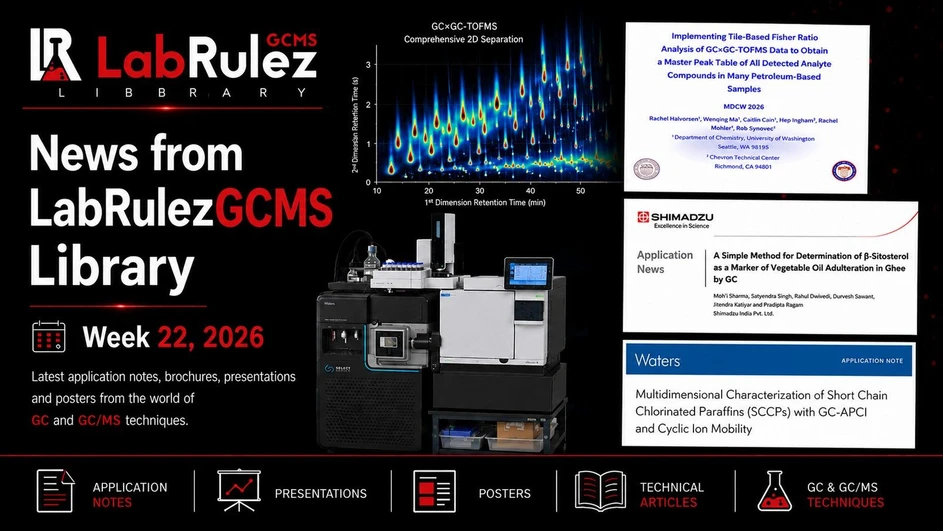
Our Library never stops expanding. What are the most recent contributions to LabRulezGCMS Library in the week of 25th May 2026? Check out new documents from the field of the gas phase, especially GC and GC/MS techniques!
👉 SEARCH THE LARGEST REPOSITORY OF DOCUMENTS ABOUT GCMS AND RELATED TECHNIQUES
👉 Need info about different analytical techniques? Peek into LabRulezLCMS or LabRulezICPMS libraries.
This week we bring you application note by Shimadzu, presentation by MDCW / University of Washington and poster by Waters Corporation!
1. MDCW / University of Washington: Implementing Tile-Based Fisher Ratio Analysis of GC×GC-TOFMS Data to Obtain a Master Peak Table of All Detected Analyte Compounds in Many Petroleum-Based Samples
- Presentation
- Full PDF for download
This presentation describes the development of a new chemometric workflow for processing GC×GC-TOFMS (comprehensive two-dimensional gas chromatography coupled with time-of-flight mass spectrometry) data from petroleum-derived fuels. The work was conducted by researchers from the University of Washington in collaboration with Chevron Technical Center and focuses on creating a comprehensive Master Peak Table (MPT) containing all detectable analytes across multiple fuel sample classes. The motivation was that moving from conventional GC to GC×GC dramatically increased chromatographic peak capacity and resolution, but also created a need for more sophisticated data analysis methods capable of handling the much larger number of detected compounds.
The analytical platform employed GC×GC-TOFMS with a thermal-flow modulator and a TOF mass spectrometer detector. Fuel samples were analyzed using an Rxi-1 column (30 m × 0.25 mm × 0.25 μm) in the first dimension and an Rxi-17MS column (2.0 m × 0.18 mm × 0.20 μm) in the second dimension. The sample set included multiple petroleum products such as hydrobates, reformates, naphthas, FCC gasoline, and blank samples. Log-scale chromatograms revealed numerous late-eluting trace compounds and significant compositional differences between fuel batches that were not readily visible in conventional chromatographic representations.
To process these highly complex datasets, the researchers implemented a tile-based Fisher Ratio (F-ratio) chemometric approach using ChromaTOF Tile software. The method divides GC×GC chromatograms into small tiles and identifies regions where analyte signals differ significantly between sample classes by comparing between-class and within-class variance. Instead of relying solely on F-ratio ranking, the workflow incorporates statistical testing against blank samples. Three blank chromatograms were used to establish tile-specific confidence intervals and p-test thresholds, allowing the system to determine whether detected signals represent genuine compounds rather than background noise. This strategy enabled the creation of a unified master peak table while minimizing problems caused by retention-time shifts and reducing the need for manual user intervention.
Application of the method generated 719 statistically significant analyte hits across the fuel classes and demonstrated excellent reproducibility, with only 6.3% of classifications showing inconsistent behavior among replicates. Detected compounds included hydrocarbons and aromatic species such as 1-methylnaphthalene, 1,2,4-trimethylbenzene, β-vatirenene, 2-octene, and tetramethylheptadecane, whose occurrence patterns aligned well with expected fuel chemistry. The resulting master peak table contained both shared and sample-specific compounds and provided a much more comprehensive representation of petroleum composition than conventional workflows. The authors conclude that the approach should be broadly applicable to other complex sample types and could be extended using alternative chemometric metrics beyond Fisher Ratio analysis to address different experimental objectives.
2. Shimadzu: A Simple Method for Determination of β-Sitosterol as a Marker of Vegetable Oil Adulteration in Ghee by GC
- Application note
- Full PDF for download
User Benefits
- ShimadzuNexis GC-2030 can be effectivelyused for determination of adulteration of Ghee with vegetable oil.
- The NexisGC-2030 easily meets the acceptancecriteria as per the proposed FSSAI method no.01.097:2022.
- This method is suitable for routine food industry analysis and academic research.
The most common milk product in Indian cuisine is ghee or clarified butter. Due to its high cost, ghee is adulterated with vegetable oil, to gain commercial benefits. β-sitosterol, a common phytosterol, found in a variety of natural sources, including vegetable fat or oil from plants (Figure 1). It is used as a marker of vegetable oil adulteration in ghee1.
The primary goal of this study is to assess the vegetable oil adulteration in ghee by analyzing β-Sitosterol as a marker using gas chromatography (GC). This will establish a foundation for the rapid detection of ghee adulteration. In this study, a simple, sensitive, and inexpensive method is developed for extraction of β-Sitosterol from ghee which is then subjected to gas chromatography with flame ionization detection for quantitation. The effects of several important parameters influencing the extraction efficiencies of β-Sitosterol including water-immiscible organic solvent (type and volume), volume of water, sonication time, surfactant (type and concentration), and organic modifier (type and volume) were investigated. This method is ideal for routine analysis in the food industry during the manufacturing, processing, and commercial testing of milk fat samples, or for academic research purposes.
Sample Preparation and Analysis Conditions
Standard and sample preparations were conducted following the guidelines outlined in the proposed FSSAI method No. 01.097:20222. The analysis was performed using a Shimadzu Nexis GC-2030 equipped with a Flame Ionization Detector (FID), as shown in Figure 2. The specific configuration and analytical conditions used during the study are provided in Table 1.
Conclusion
A gas chromatography–based method using GC-2030 was developed for the estimation of β-Sitosterol in ghee. The method exhibits a detection limit of 2 %, enabling the identification of vegetable oil adulteration in ghee at levels as low as 2 %. At this adulteration level, the signal of β-Sitosterol achieved a signal-to-noise (S/N) greater than 3, confirming the reliability of detection at the established limit. This method provides a reliable and effective approach for the quantification of β-Sitosterol, which serves as a marker for vegetable oil adulteration in ghee.
3. Waters Corporation: Multidimensional Characterization of Short Chain Chlorinated Paraffins (SCCPs) with GC-APCI and Cyclic Ion Mobility
- Poster
- Full PDF for download
This poster presents a multidimensional analytical approach for the characterization of short-chain chlorinated paraffins (SCCPs), a class of persistent environmental pollutants included in the Stockholm Convention due to their environmental persistence and bioaccumulation potential. SCCPs are highly complex mixtures of chlorinated hydrocarbons containing thousands of possible congeners, making their analysis particularly challenging. The study evaluates the use of gas chromatography coupled with atmospheric pressure chemical ionization, cyclic ion mobility spectrometry, and high-resolution mass spectrometry (GC-APCI-IMS-HRMS) as a powerful platform for improved SCCP characterization.
The analytical instrumentation consisted of a modified Agilent 8890 gas chromatograph equipped with an Rxi-5SilMS capillary column (30 m × 0.25 mm × 0.25 μm) and connected to a Waters SELECT SERIES Cyclic IMS high-resolution mass spectrometer using an Atmospheric Pressure GC (APGC) ion source. Unlike conventional electron ionization methods, APCI was operated in negative-ion mode with a chloroform modifier, promoting the formation of characteristic [M+Cl]⁻ molecular ions. This significantly reduced fragmentation and provided strong molecular-ion signals, improving both qualitative identification and quantitative analysis of SCCP homologues.
Using three commercial SCCP technical mixtures (51.5%, 55%, and 63% chlorine content), the researchers demonstrated that GC-APCI-HRMS could selectively detect SCCP homologues according to carbon-chain length and degree of chlorination. Although substantial chromatographic overlap was observed among many homologues, the addition of ion mobility spectrometry (IMS) introduced a valuable extra separation dimension. Distinct drift-time versus m/z trendlines were observed for compounds sharing the same number of chlorine atoms, allowing homologues to be grouped and characterized more effectively than by chromatographic retention and mass spectrometry alone. The IMS data also enabled estimation of the relative abundance of individual homologue groups within each technical mixture.
The authors further explored the resolving power of the cyclic IMS device by employing multiple ion-mobility passes (up to eight cycles) to investigate individual SCCP congeners. While complete separation of individual congeners within a homologue group was not achieved, higher ion-mobility resolution revealed measurable differences between early- and late-eluting species and provided additional insight into compositional differences among SCCP mixtures. The study concludes that combining GC-APCI, cyclic ion mobility spectrometry, and high-resolution mass spectrometry offers a powerful multidimensional workflow for the characterization of complex chlorinated paraffin mixtures and may improve environmental monitoring and future regulatory analysis of these challenging contaminants.