Developing a Combined Approach to Green Gunshot Residue Analysis in the Forensic Laboratory (Barbara Grace Saunders, MDCW 2026)
- Photo: MDCW: Developing a Combined Approach to Green Gunshot Residue Analysis in the Forensic Laboratory (Barbara Grace Saunders, MDCW 2026)
- Video: LabRulez: Grace Saunders: SEM-ED X-Ray spectroscopy & GC×GC for green gunshot residue analysis (MDCW 2026)
🎤 Presenter: Barbara Grace Saunders (William & Mary, Williamsburg, USA)
Abstract
Gunshot residue (GSR) is expelled as a "plume" of vaporized material during a firearm discharge event. As it disperses, condenses, and settles on surfaces in vicinity of the discharge, it creates chemical depositions that provide essential information for forensic casework involving criminal firearm usage.
GSR contains organic (OGSR) and inorganic (IGSR) components, both of which may carry evidentiary value. Traditional analyses involve the targeted point analysis of IGSR via scanning electron microscopy - energy dispersive x-ray spectroscopy (SEM-EDS), and conclusions are drawn based on a well-established elemental and morphological profile "characteristic" to IGSR. This method has lost impact as a standard for forensic analysis due to increased use of "green" - heavy metal-free - ammunition, which omits the lead, barium, and antimony that are traditionally seen as the "characteristic" markers of GSR.
This study aimed to develop a holistic approach to the analysis of GSR using both SEM-EDS as a targeted approach to IGSR analysis and comprehensive two-dimensional gas chromatography – time-of-flight mass spectrometry (GC×GC-TOFMS) as a nontargeted approach to OGSR analysis. GSR samples were collected from the hands of shooters at a police firearms recertification training using the tape lift method. SEM-EDS was used to identify IGSR and develop new morphological and elemental profiles for heavy metal-free residues. OGSR components have been positively identified through sample analysis via liquid extraction, chromatographic separation via GC×GC-TOFMS, and data processing.
Future work on this project will include the optimization of data processing methods and the development of SPME as an alternative sample extraction method.
Video Transcription
The transition toward environmentally friendly “green” ammunition is creating new challenges for forensic laboratories. Traditional gunshot residue (GSR) analysis relies heavily on the detection of heavy-metal-containing particles produced during firearm discharge. However, modern ammunition formulations increasingly eliminate these metals, making conventional forensic protocols less effective.
This study presents the development of a combined analytical strategy for the characterization of green gunshot residue (GSR) by integrating:
- Scanning Electron Microscopy with Energy Dispersive X-ray Spectroscopy (SEM-EDS) for inorganic GSR (IGSR)
- Comprehensive Two-Dimensional Gas Chromatography coupled to Time-of-Flight Mass Spectrometry (GC×GC-TOFMS) for organic GSR (OGSR)
The ultimate goal is to provide forensic laboratories with a more complete and defensible analytical approach for firearm discharge investigations.
Why Green Gunshot Residue Is a Challenge
Gunshot residue consists of particulate matter expelled from firearms during discharge. Rapid increases in temperature and pressure vaporize materials originating from:
- primer compositions
- bullets
- cartridge cases
- firearm components
These materials rapidly condense and deposit on:
- hands
- skin
- hair
- clothing
- nearby surfaces
Because GSR is directly associated with firearm discharge events, it remains an important source of forensic evidence.
Historically, forensic scientists have identified GSR using SEM-EDS, focusing on particles containing characteristic heavy metals.
However, ammunition manufacturers have increasingly removed heavy metals from primers due to health and environmental concerns. Modern green ammunition replaces traditional metallic components with more environmentally common elements, making classical identification criteria less reliable.
Project Objectives
The project was designed around three primary goals:
- Redevelop inorganic GSR classification criteria for green ammunition.
- Develop a robust GC×GC-TOFMS workflow for organic GSR analysis.
- Combine both approaches into a comprehensive forensic methodology suitable for future laboratory implementation.
Collection of Green GSR Samples
Samples were collected using standard forensic SEM-compatible collection kits.
Each kit consisted of:
- an airtight glass vial
- an aluminum SEM pin stub
- black carbon adhesive for particle collection
Sampling was performed by repeatedly dabbing the adhesive surface across:
- palms
- backs of hands
- forearms
of volunteers.
To ensure authentic green GSR samples, collection took place during police firearms recertification training at a local firing range. All ammunition used was verified as green ammunition.
Redevelopment of Green IGSR Characterization by SEM-EDS
The first phase focused on updating SEM-EDS criteria for green ammunition residues.
Analysis of numerous samples revealed morphological and elemental characteristics that differed from traditional heavy-metal-containing GSR particles.
One notable observation was that many candidate particles exhibited a characteristic “sparkling” appearance against the SEM background. These particles often contained elevated metallic content, although not necessarily heavy metals.
The resulting profiles provided a more reliable framework for identifying inorganic components of green GSR.
Nevertheless, the approach still involved a degree of analyst judgment, motivating the development of a more objective complementary analytical strategy based on organic residue analysis.
Why GC×GC-TOFMS Was Selected
The second phase focused on characterization of organic gunshot residue (OGSR).
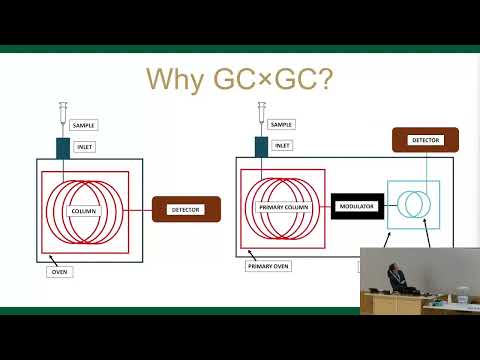
Compared with conventional one-dimensional GC, GC×GC offers:
- increased chromatographic peak capacity
- enhanced separation power
- improved resolution of structurally similar compounds
- better discrimination of constitutional isomers
These advantages are particularly valuable for forensic samples, where highly complex mixtures often contain numerous nitroaromatic compounds and energetic materials.
The instrumentation used was a:
which combines comprehensive two-dimensional gas chromatography with high-resolution time-of-flight mass spectrometric detection.
Development of the Organic GSR Extraction Method
Organic residues were extracted using a liquid extraction procedure adapted from OSAC recommendations for GC-MS analysis.
The workflow included:
- Extraction in methanol
- Evaporation to dryness under nitrogen
- Reconstitution
- Transfer into GC×GC-compatible vials
Additional vortexing and sonication steps were incorporated to maximize analyte recovery.
Comparison of Extraction Procedures
The newly developed in-house method was compared with a literature-based extraction protocol.
The results demonstrated that the in-house procedure:
- recovered more analytes
- produced higher peak intensities
- generated a larger average number of chromatographic peaks
Important target compounds such as:
- diphenylamine
- skin matrix compounds
- nitroaromatic species
were detected at significantly higher abundance levels.
Consequently, the in-house extraction method was selected for all subsequent experiments.
Optimization of the GC×GC Method
Carrier Gas Selection
Initial experiments compared helium and hydrogen carrier gases.
Hydrogen provided:
- improved chromatographic expansion
- better compound visibility
- enhanced separation
Therefore, hydrogen was selected for the final method.
Inlet Temperature Optimization
Two inlet temperatures were evaluated:
- 170 °C
- 200 °C
Although the lower temperature generated a larger number of detected analytes overall, critical GSR target compounds such as:
- nitroglycerin (ethylene glycol dinitrate)
- diphenylamine
showed lower responses or were not detected.
As a result, 200 °C was selected as the optimal inlet temperature.
Modulation Period Optimization
Three modulation periods were compared: 2.0 s / 2.5 s / 3.0 s
- Two-Second Modulation: Produced wraparound effects where analytes could not fully elute within a modulation cycle.
- Three-Second Modulation: Created excessive unused chromatographic space and compressed analyte distributions.
- Two-and-a-Half-Second Modulation: Provided the best balance between resolution and chromatographic efficiency.
Therefore, 2.5 seconds was selected as the final modulation period.
Validation Using Analytical Standards
The optimized GC×GC method was validated using several reference standards.
Seven-Component Phthalate Standard
All seven analytes were successfully identified.
The compounds exhibited:
- excellent chromatographic resolution
- reproducible retention behavior
- clear separation across both chromatographic dimensions
These retention regions subsequently helped identify corresponding compounds in authentic GSR samples.
Twelve-Component Nitroaromatic Standard
All twelve analytes were successfully identified.
Particularly important was the clear separation of compounds such as:
- TNT
- DNT
- nitrotoluenes
which frequently appear in explosive and propellant formulations.
This experiment demonstrated the superior resolving power of GC×GC compared with conventional one-dimensional GC.
Nitroglycerin Standard
Nitroglycerin was successfully detected and its retention coordinates established.
These retention characteristics will serve as reference markers for future identification in authentic GSR samples.
Gun Surveillance Standard
The final validation mixture contained nine known compounds.
Seven components were successfully identified.
Two unexpected compounds:
- phenazine
- benzothiazole
appeared in the chromatograms, while one expected analyte overlapped with column bleed.
Although further refinement is required, the preliminary results demonstrated promising analytical performance.
Major Outcomes of the Study
The project has already produced several significant achievements:
Inorganic GSR Analysis
- Redesigned SEM-EDS classification profiles for green ammunition residues
- Improved characterization of heavy-metal-free particles
Organic GSR Analysis
- Optimized methanol-based extraction procedure
- Fully developed GC×GC-TOFMS analytical workflow
- Improved detection of key OGSR markers
- Verified retention behavior of multiple relevant analytes
Integrated Forensic Strategy
- Combined IGSR and OGSR characterization
- Enhanced confidence in green GSR identification
- Improved potential for courtroom-defensible evidence interpretation
Future Work
Although the method successfully distinguishes the presence or absence of green GSR, additional validation remains necessary before routine forensic implementation.
Future investigations will focus on:
- comparison of sorbent-based extraction approaches with methanol extraction
- acquisition of retention indices for stronger compound confirmation
- further validation of target analyte identities
- increased method robustness for forensic casework
The ultimate objective is to establish a validated methodology suitable for routine forensic laboratory deployment in the era of green ammunition.
Conclusion
This study demonstrates that combining SEM-EDS and GC×GC-TOFMS provides a promising framework for the forensic analysis of modern green gunshot residue. By integrating inorganic and organic residue characterization, forensic scientists can generate a more comprehensive evidential profile of firearm discharge events. The optimized extraction protocol, chromatographic conditions, and preliminary validation results show strong potential for future implementation in forensic laboratories, helping maintain the evidential value of GSR as ammunition technologies continue to evolve.
This text has been automatically transcribed from a video presentation using AI technology. It may contain inaccuracies and is not guaranteed to be 100% correct.
-Workshop-LOGO_s.webp)