NIST26 EI GC/MS Software and Libraries
- Photo: James Little: NIST26 EI GC/MS Software and Libraries
- Video: James Little: (2 minutes) Exciting New Integrated Processing Tools in NIST26 Mass Spec Software Release!
With the V4.0 (2026) release, NIST has further enhanced its EI library search program with integrated GC/MS chromatogram analysis and improved deconvolution workflows. This represents a significant advance, strengthening the already central role of EI libraries in GC/MS and further improving confidence in compound identification.
 James Little: V4 of NIST EI Search (2026)
In earlier versions, GC/MS workflows required more manual interaction between deconvolution and library searching. In V4.0 (2026), the deconvolution and subsequent library searching are now tightly integrated into the main NIST search program. This providies a more streamlined and user-friendly approach to component identification and data review. Spectra from vendor software can still be used to import spectra
Plus the stand-alone NIST AMDIS application remains unchanged.
A novel approach is included to support accurate mass EI data deconvolution and library searching. It employs an interger-modified AMDIS-like algorithm for deconvolution. The external atand-alone AMDIS program does not support accurate mass data processing.
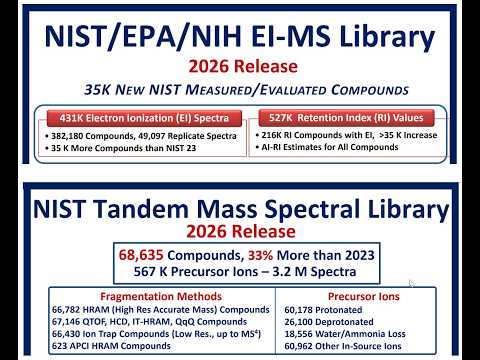
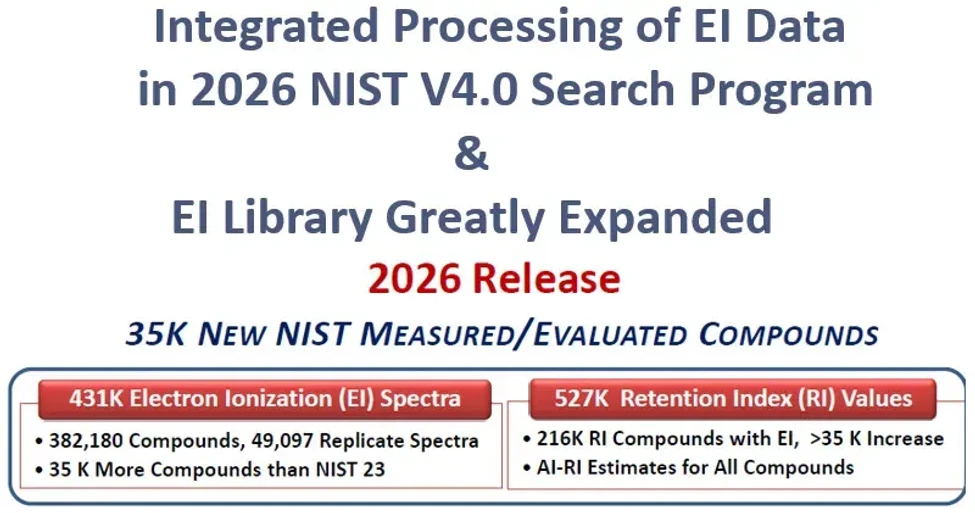
Together, these enhanced GC/MS analysis capabilities and the continued expansion of the NIST/EPA/NIH EI-MS Library create a powerful combination for compound identification. The library now includes 382,180 compounds and 431k EI spectra, with ~35k newly measured compounds, along with extensive retention index (RI) data (527k values) to support identification.
This series of webinars and supporting resources demonstrates the use of the NIST software suite for EI library searching and GC/MS data analysis. The material is intended for a broad range of scientists working in medical, environmental, industrial, forensic, and biological applications.
Much of the documentation (videos and Handouts) previously written for V3.0 and V2.4 will still be useful to new users of the NIST Search Software.