The QuadJet SD is a comprehensive GC×GC-FID solution designed to reveal the true chemical composition of complex real-world samples. By combining the universal sensitivity of flame ionization detection (FID) with the dramatically increased chromatographic resolution of comprehensive two-dimensional gas chromatography (GC×GC), QuadJet SD minimizes coelution-driven bias and delivers a far more accurate representation of sample composition than conventional one-dimensional GC.
Unlike straight GC-FID, where unresolved peaks inflate detector response and introduce systematic error, GC×GC separates compounds using two orthogonal mechanisms within a single run. True GC×GC instruments—such as the QuadJet SD from LECO—use active modulation to quantitatively slice the effluent from the first column and refocus it onto the second column. This approach preserves quantitative integrity while unlocking orders-of-magnitude gains in peak capacity and signal-to-noise ratio.
Key Benefits
- Enhanced separation power for highly complex mixtures
- Reduced noise and bias error compared to conventional GC-FID
- Integrated ChromaTOF-based software for acquisition, processing, classification, and reporting in one environment
- Classification tools that simplify component identification
- Cryogen-free modulation option eliminates the need for liquid nitrogen dewars
Theory of Operation
In GC-FID analysis, compound quantitation relies on peak area. As sample complexity increases—diesel fuels being a classic example with thousands of constituents—the likelihood of coelution rises sharply. Coeluting compounds produce artificially elevated FID responses, leading to high-bias errors.
GC×GC overcomes this limitation by performing two independent chromatographic separations in a single experiment. Thanks to the orthogonal selectivity of the two columns, compounds that coelute in the first dimension are efficiently separated in the second. In the QuadJet SD, eluting peaks from the primary column are quantitatively segmented by the modulator and cryo-focused before entering the secondary column, generating extremely narrow second-dimension peaks—often as short as 50 ms—while maintaining accurate quantitation.
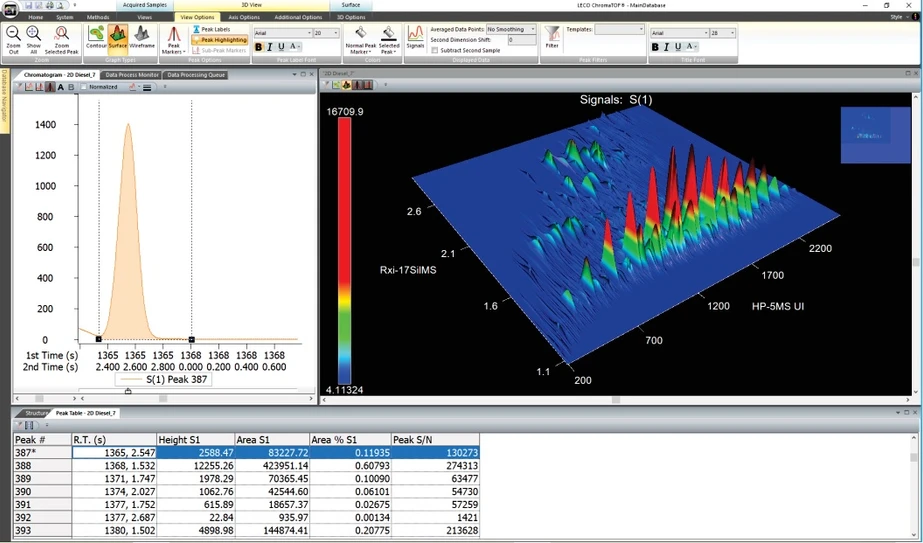 LECO: QuadJet™ SD 2 – Processing of acquired GC×GC data using LECO ChromaTOF software
Thermal Modulation
Thermal modulation represents the highest-performance approach for GC×GC, and LECO’s implementation sets the benchmark for ruggedness, reliability, and analytical performance. The QuadJet SD employs a dual-stage, quad-jet thermal modulator positioned between the two columns. This design enables on-column cryo-focusing, dramatically improving peak detectability and resolving power, and delivering an order-of-magnitude improvement in signal-to-noise.
For laboratories seeking lower operating costs and simplified workflows, a consumable-free thermal modulator (no liquid nitrogen) is available. This option maintains excellent performance for moderately volatile compounds while eliminating cryogen handling.
Modulators and Instrument Options
- Thermal modulator choices:
- Liquid-nitrogen-cooled thermal modulator
- Consumable-free thermal modulator
- Optional inlets: S/SL, PTV, and MMI
Designed with productivity in mind, the QuadJet SD combines ease of use with an industry-leading secondary oven for the second-dimension column. For laboratories ready to move beyond conventional GC and truly see what has been hidden by coelution, QuadJet SD delivers the next dimension in analytical insight.