Analytical Challenges and Strategies for Compound Identification Using Gas Chromatography–Ion Mobility Spectrometry
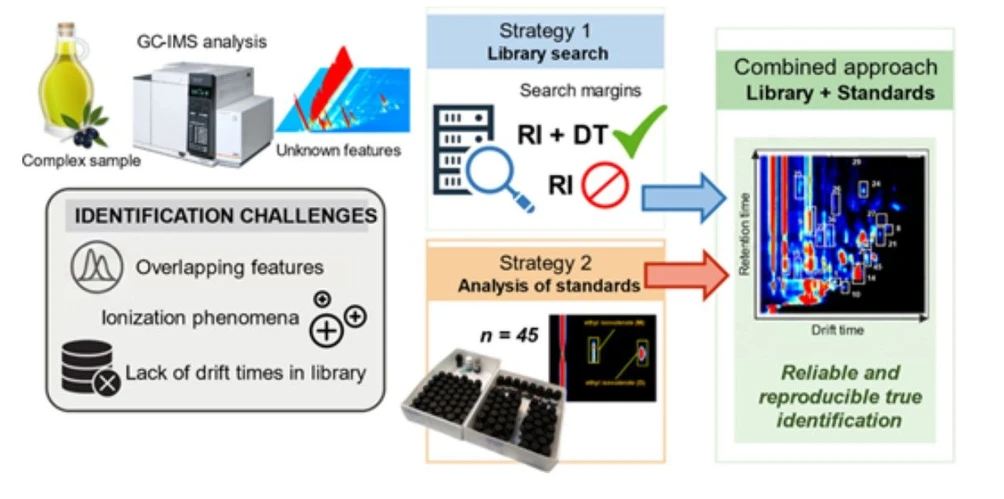
Anal. Chem. (2026): Graphical abstract
This study systematically evaluates the challenges and strategies involved in identifying volatile organic compounds (VOCs) by gas chromatography–ion mobility spectrometry (GC-IMS). Using a mixture of 45 standards and virgin olive oil as model systems, the authors assessed how retention index and drift time search margins influence library-based identification and demonstrated the limitations of relying on retention indices alone.
Analytical standards proved essential for resolving ambiguities caused by overlapping features and competitive ionization and for confirming compounds missing drift-time data in commercial libraries. Combining library searches with standard analysis produced more reliable identifications, leading to a simplified workflow and practical guidelines for reproducible GC-IMS compound identification.
The original article
Analytical Challenges and Strategies for Compound Identification Using Gas Chromatography–Ion Mobility Spectrometry
Andrés Martín-Gómez; María José Cardador; Laura Pérez-González; Lourdes Arce*
Anal. Chem. (2026)
licensed under CC-BY 4.0
Selected sections from the article follow. Formats and hyperlinks were adapted from the original.
The use of gas chromatography–ion mobility spectrometry (GC-IMS) has expanded rapidly in recent years. A search in the Web of Science database of the topic “GC-IMS” filtering to articles and reviews yielded 1733 publications through March 2026. Of these, roughly 91.2% have been published within the last five years (2021–2026). GC-IMS is a highly versatile technique whose main field of application is the classification of samples through their volatile profile, either with targeted or nontargeted methodologies, addressing identification of compounds or not. Its use has extended to many areas and a broad range of matrices, (1) such as the analysis of agri-food products (2, 3) and clinical diagnosis. (4) This rapid growth of articles published using GC-IMS has been accompanied by an increasing interest in data processing strategies for nontargeted multivariate approaches. Although these may introduce higher noise into the data, they minimize the risk of discarding relevant information. (5) In fact, comparisons between targeted and nontargeted models generally have shown better performance for the latter, (6−8) even though the outcome depends on the diversity and volume of samples analyzed. While less common, there is a growing interest in applying targeted GC-IMS approaches that take advantage of its high sensitivity, enabling the detection of analytes at very low concentration. As an example, targeted approaches have been successfully employed to identify and quantify ethanol to discriminate olive oil categories, (9) alkylpyrazines to monitor the roasting of hazelnut, (10) nitrosamines to determine the quality of drinking water, (11) and ethyl carbamate to ensure the safety of alcoholic beverages. (12) Beyond its established role in sample classification and fingerprinting, the intrinsically high sensitivity of IMS as a detector constitutes an analytical advantage often underappreciated. The IMS cell operates at atmospheric pressure and relies on soft chemical ionization (primarily proton exchange which, unlike the electron impact (EI) source of a conventional GC–MS, does not require analytes to be present above the concentrations needed to produce a detectable signal in full-scan mode. As a result, GC-IMS can detect volatile organic compounds (VOCs) at the subppb level directly from the sample headspace, without any preconcentration step.
This sensitivity advantage has important consequences for untargeted analysis. When VOCs are screened by HS-GC-MS, the detectable profile is limited to those analytes sufficiently abundant in the headspace. To extend coverage and improve sensitivity, HS-GC-MS is often coupled with preconcentration techniques such as SPME, which also introduces selectivity biases, depending on the fiber polarity. A medium-polar CAR-PDMS fiber, for instance, will preferentially retain organosulfur compounds and low-molecular-weight polar analytes, whereas other chemical classes may be poorly recovered even after optimization of extraction conditions. Changing fiber chemistry or exposure conditions will reveal a different subset of the volatile fraction, but no single fiber provides exhaustive coverage. Thus, the VOCs that remain invisible to a given analytical setup cannot be targeted for optimized extraction, simply because the analyst does not know they were present in the sample.
Alternative approaches to improve compound identification in GC-IMS involve the coupling of GC to MS and IMS in parallel, which provides an orthogonal dimension of information based on molecular mass and fragmentation patterns. The potential for detection of VOCs in complex matrices using GC-IMS is not comparable to that of GC-MS; IMS detectors are not able to fragment analytes. The combination of RIs (GC), DT (IMS), and mass spectral data (MS) can substantially increase confidence in compound assignment. A possible strategy consists of performing GC-IMS/MS analyses using two chromatographic columns with the same characteristics─separately─and correlating both datasets through RIs. (52) However, this is a suboptimal strategy, because this approach may introduce uncertainty due to RI shifts, even if a single column type is used. In contrast, parallel configurations in which GC is coupled simultaneously to IMS and MS using a single chromatographic column (53−55) provide a more robust approach, as all detectors analyze the same eluting compounds under identical conditions. This enables a truly orthogonal confirmation, reducing ambiguities associated with coelution and improving the reliability of compound identification. Despite these advantages, such coupled systems remain technically demanding due to the different operating conditions required by IMS (atmospheric pressure) and MS (vacuum), as well as their higher cost and complexity compared to the use of a single detector coupled to a GC, which may limit their accessibility for routine applications.
Therefore, in view of the notable rise in targeted GC-IMS applications and the presence of methodological ambiguities, there is a clear need for a systematic evaluation of current feature─and compound─identification practices. The main objective of this work is to establish evidence-based guidelines to identify with GC-IMS. Specifically, this study (a) examines the process of annotation using the currently available library of standards, and (b) evaluates the role of RI and DT values of analytical standards on true identification of GC-IMS features. Using virgin olive oil (VOO) as a real sample and a mixture of 45 standards, we aim to provide a framework for a more-reliable identification in GC-IMS.
Materials and Methods
Instrumentation
Analyses in GC-IMS were performed by using an integrated Agilent 7697A headspace sampler connected by a transfer line to an Agilent 8860 gas chromatograph (Agilent, Santa Clara, CA, USA) and a standalone ion mobility spectrometer (G.A.S. Gesellschaft für Analytische Sensorsysteme mbH, Dortmund, Germany) with a 9.8 cm drift tube and a 3H ionization source. Samples were incubated for 15 min at 60 °C. Then the vial was pressurized to 14 psi for 1.5 min and a 1 mL of the headspace volume was injected in split mode 1:5 during 30 s with a split flow of 5 mL/min. The sampling loop and transfer line were maintained at 100 and 110 °C, respectively. GC separation was carried out using a nonpolar 30 m HP-5 column (Agilent Technologies, Santa Clara, CA, USA) with stationary phase composition of 5%-phenyl-methylpolysiloxane with 0.32 mm of internal diameter and 0.5 μm of film thickness. Helium (99.999% purity, Air Liquide, Madrid, Spain) was used as a carrier gas with a constant flow rate of 1.0 mL/min. The oven temperature program was as follows: initial temperature of 40 °C held for 3 min, ramped to 100 °C at a rate of 5 °C/min, then increased to 130 °C at 15 °C/min. The final temperature (130 °C) was maintained until the end of the analysis, resulting in a total run time of 27 min.
Results and Discussion
Dual Approach for VOCs Identification: Library and Standard Validation
As previously stated, the use of the library provides a valuable starting point for compound identification in samples. When both RI and DTs values are available, the library can greatly facilitate VOC assignment. However, when many compounds share similar RI values, and no discriminating parameter such as DT is present, annotation is uncertain. In such cases, validation using analytical standards is essential. In the present study, VOO was selected as a model sample to evaluate the complementarity of both strategies for VOC identification. Its volatile fraction is highly diverse, comprising aldehydes, ketones, alcohols, and esters, which makes VOO a challenging but informative system for testing targeted identification approaches. (9, 22, 73) The standard mixture of 45 compounds, many of which have been reported in olive oil, (22) was used for comparison and confirmation of detected VOCs.
Figure 2 shows a topographic plot of the VOO sample analyzed by GC-IMS. A total of 167 features were located in the sample, 45 of which were assigned to monomers and/or dimers of 34 VOCs (see Table S1) using the library and/or standards. Of these 45 features, 38 corresponding to 28 VOCs were putatively identified using the library with the previously recommended search margins of ±5 for RI and ±0.02 for DT (only if DT values were available). In addition, 29 of the 45 features, corresponding to 21 VOCs, were identified using analytical standards. Of these 29 features, 22 were already identified using the library, which confirmed their identity. Seven features (corresponding to 6 VOCs) of the 29 features that were identified with standard analysis did so exclusively, thanks to this method, as they could not be identified using the library. It was the case of those of, e.g., 1-penten-3-ol, trans-penten-2-al, methyl butanoate, 3,3-dimethylbutan-1-ol, 3-methylbutan-1-ol, and benzaldehyde. The identification of these VOCs required standard analysis because their DT values were not available in the library. Likewise, a single feature was associated by the library to benzaldehyde and 1-octen-3-ol monomers (with DT values available for both compounds). In this case, the individual analysis of both standards was required to confirm benzaldehyde as the correct identity, as shown in Figure S2. On the other hand, the identity of 16 features (corresponding to 13 VOCs) of the 22 features that were identified using the library could not be confirmed using standards because their corresponding standards were not included in this study.
![Anal. Chem. (2026): Figure 2: GC-IMS topographic plot of the VOO sample analyzed. A total of 167 features were located. Legend: 1, butan-2-one (D); 2, pentan-2-one (D); 3, hexanal (D); 4, hexanal (M); 5, nonanal (D); 6, nonanal (M); 7, hexan-1-ol (D); 8, ethyl propanoate (D); 9, ethyl propanoate (M); 10, butanal (D); 11, diacetyl (D); 12, 6-methyl-5-hepten-2-one (M); 13, octanal (D); 14, ethyl acetate (D); 15, ethyl acetate (M); 16, 2-methylpyrazine (D); 17, acetic acid (D); 18, acetic acid (M); 19, heptanal (D); 20, heptanal (M); 21, pentanal (D); 22, pentanal (M); 23, 1-penten-3-ol (before RIP); 24, trans-penten-2-al (D); 25, trans-penten-2-al (M); 26, 3-methylbutan-1-ol (M); 27, methyl butanoate (D); 28, benzaldehyde (M); 29, 3,3-dimethylbutan-1-ol (M); 30, nonan-1-ol (M); 31, 2-hexen-1-ol (D); 32, 2-hexen-1-ol (M); 33, 3-methylbutyl acetate (D); 34, 1,8-cineole (D); 35, 1,8-cineole (M); 36, 2,3-pentanedione (M); 37, β-pinene (D); 38, β-pinene (M); 39, decan-2-one (M); 40, 2,5-dimethyl-4-hydroxy-3[2H]-furanone (M); 41, hexanoic acid (D); 42, ethenyl benzene (D); 43, cis-3-hexen-1-ol (M), 44: styrene (M), 45: butan-1-ol (D).](https://gcms.labrulez.com/labrulez-bucket-strapi-h3hsga3/Anal_Chem_2026_GC_IMS_topographic_plot_of_the_VOO_sample_analyzed_314b4dd56b_l.webp) Anal. Chem. (2026): Figure 2: GC-IMS topographic plot of the VOO sample analyzed. A total of 167 features were located. Legend: 1, butan-2-one (D); 2, pentan-2-one (D); 3, hexanal (D); 4, hexanal (M); 5, nonanal (D); 6, nonanal (M); 7, hexan-1-ol (D); 8, ethyl propanoate (D); 9, ethyl propanoate (M); 10, butanal (D); 11, diacetyl (D); 12, 6-methyl-5-hepten-2-one (M); 13, octanal (D); 14, ethyl acetate (D); 15, ethyl acetate (M); 16, 2-methylpyrazine (D); 17, acetic acid (D); 18, acetic acid (M); 19, heptanal (D); 20, heptanal (M); 21, pentanal (D); 22, pentanal (M); 23, 1-penten-3-ol (before RIP); 24, trans-penten-2-al (D); 25, trans-penten-2-al (M); 26, 3-methylbutan-1-ol (M); 27, methyl butanoate (D); 28, benzaldehyde (M); 29, 3,3-dimethylbutan-1-ol (M); 30, nonan-1-ol (M); 31, 2-hexen-1-ol (D); 32, 2-hexen-1-ol (M); 33, 3-methylbutyl acetate (D); 34, 1,8-cineole (D); 35, 1,8-cineole (M); 36, 2,3-pentanedione (M); 37, β-pinene (D); 38, β-pinene (M); 39, decan-2-one (M); 40, 2,5-dimethyl-4-hydroxy-3[2H]-furanone (M); 41, hexanoic acid (D); 42, ethenyl benzene (D); 43, cis-3-hexen-1-ol (M), 44: styrene (M), 45: butan-1-ol (D).
Anal. Chem. (2026): Figure 2: GC-IMS topographic plot of the VOO sample analyzed. A total of 167 features were located. Legend: 1, butan-2-one (D); 2, pentan-2-one (D); 3, hexanal (D); 4, hexanal (M); 5, nonanal (D); 6, nonanal (M); 7, hexan-1-ol (D); 8, ethyl propanoate (D); 9, ethyl propanoate (M); 10, butanal (D); 11, diacetyl (D); 12, 6-methyl-5-hepten-2-one (M); 13, octanal (D); 14, ethyl acetate (D); 15, ethyl acetate (M); 16, 2-methylpyrazine (D); 17, acetic acid (D); 18, acetic acid (M); 19, heptanal (D); 20, heptanal (M); 21, pentanal (D); 22, pentanal (M); 23, 1-penten-3-ol (before RIP); 24, trans-penten-2-al (D); 25, trans-penten-2-al (M); 26, 3-methylbutan-1-ol (M); 27, methyl butanoate (D); 28, benzaldehyde (M); 29, 3,3-dimethylbutan-1-ol (M); 30, nonan-1-ol (M); 31, 2-hexen-1-ol (D); 32, 2-hexen-1-ol (M); 33, 3-methylbutyl acetate (D); 34, 1,8-cineole (D); 35, 1,8-cineole (M); 36, 2,3-pentanedione (M); 37, β-pinene (D); 38, β-pinene (M); 39, decan-2-one (M); 40, 2,5-dimethyl-4-hydroxy-3[2H]-furanone (M); 41, hexanoic acid (D); 42, ethenyl benzene (D); 43, cis-3-hexen-1-ol (M), 44: styrene (M), 45: butan-1-ol (D).
A particularly illustrative case of the importance of validating with analytical standards is 3-methylbutan-1-ol (Figure 3). For the actual feature of its dimer, identified with the standard, the library originally suggested two additional candidates: the dimers of 2-methylbutan-1-ol and 4-methylpentan-2-one. However, as the library did not include DT values for 3-methylbutan-1-ol (monomer or dimer), this compound was not retrieved as a candidate. Nevertheless, comparison with its individual standard confirmed the presence of the 3-methylbutan-1-ol monomer.
 Anal. Chem. (2026): Figure 3: GC-IMS topographic plots (a) VOO sample, (b) 3-methylbutan-1-ol, (c) 2-methylbutan-1-ol, and (d) 4-methylpentan-2-one.
In summary, although 34 VOCs were identified in the VOO sample using the library and/or the analysis of standards, only the identity of 21 of these could be validated with certainty through a dual approach consisting on a library search and subsequent analysis of standards. Full confirmation of VOC identities would ultimately require either the injection of all analytical standards retrieved by the library and the use of more powerful instrumentation, such as high-resolution mass spectrometry. However, these strategies are both labor-intensive and costly, which limits their application in routine laboratories. Despite these considerations, in practice, a considerable number of studies rely solely on commercial libraries for identification (see Table 1), which keeps confidence in GC-IMS identification at level 2 at most (annotation).
Therefore, for identification to be feasible it is crucial to specify whether RIs alone or RIs and DTs were used, the search margins applied in the library and confirm the identification using standards. The number of features identified in complex samples and the reliability of this identification depends strongly on the chosen strategy. In the present study, the combined use of the library and analytical standards resulted in the putative identification of 45 features (26.9% of the 167 detected). Of these 45 identified features, only 29 were confirmed after the analysis of 45 standards, yielding a final validated identification rate of 17.4%. By contrast, other studies (included in Table 1) that relied exclusively on library matches have reported considerably higher rates of identified features, such as 92.06% (58 out of 63 features). (69) While others have successfully employed analytical standards for feature identification in GC-IMS workflows: As an example, in 2022, Li et al. analyzed standards using GC-MS, and the resulting assignments were then transferred to GC-IMS when retention times coincided. (45) Similarly, direct comparison of the RI and DT values of samples’ features with those of standards proved to be an effective strategy, without the need to rely on the library at all. (25)
The combined use of library-based annotation and subsequent confirmation with analytical standards proposed in this study is not without precedent in the GC-IMS literature, although a systematic evaluation of its implementation has been lacking. Several research groups have employed hybrid strategies in which a library search provided an initial set of candidates that are subsequently validated through independent injection of reference compounds. As examples, standard-based assignments have been also transferred from GC–MS to GC-IMS by correlating retention times, effectively using the first technique to extend the confirmed identification list of the second. (39) In addition, in 2025, Navarro-Laguna et al. compared HS-GC-IMS and HS-SPME-GC-MS for microbial VOC identification, using standard injection for Level 1 confirmation in both platforms demonstrating the complementarity of both techniques. (13) Notably, the GC-IMS library search in that study was performed including search margins as recommended in the present work, and all annotated compounds were confirmed with their corresponding analytical standards, an approach aligned with the dual workflow proposed here. Similarly, combined HS-GC-IMS and HS-GC-MS workflows in multiple food matrices have confirmed GC-IMS identifications with standards. (14)
In addition, in 2024, Weller and Parastar argued that GC-IMS is rapidly becoming a standard tool in volatile metabolomics workflows, but they noted that the absence of a formal identification framework analogous to those established in MS remains a gap limiting the comparability of published results. (74) The framework proposed in the present study (Table 2) directly addresses this gap by adapting the confidence levels originally proposed for HRMS to the capabilities of GC-IMS.
Conclusions
This study demonstrates the potential and the limitations of GC-IMS for the identification of VOCs features in complex matrices, addressing gaps in current literature regarding signal assignment on topographic plots. Our findings demonstrate that putative identification requires a multiparametric approach; relying exclusively on RI values is insufficient. Instead, DT values must be also in whenever available, applying precise search margins. This work proposes optimized search thresholds of ±0.02 for DT and ±5 for RI, to maximize identification accuracy, but these values should be revised when other methods are used.
A key contribution of this study is the experimental validation of a dual annotation strategy, showing that the combined use of library matching and analytical standards is necessary to achieve robust and unambiguous compound identification in complex matrices. In addition, this work introduces a structured framework for confidence levels in GC-IMS, inspired by mass spectrometry, which clarifies the distinction between putative annotation and confirmed identification. This contributes to a more consistent and harmonized interpretation of GC-IMS results across studies.
Beyond analytical considerations, we have detected a lack of transparency in published studies, where the absence of reported search parameters has compromised reproducibility, particularly when only a library was used for annotation. While the formation of monomers and dimers in GC-IMS enhances discrimination, our analysis confirms that overlapping signals and ion competition prevail. Consequently, library matching must be regarded just as a preliminary screening tool that requires further validation through analytical standards. This is crucial to reveal hidden interferences that may be overlooked by library-based approaches.
The application of this dual strategy to a VOO sample confirmed the inherent limitations of VOC identification with GC-IMS when the number of available analytical standards is finite. Out of 167 detected features detected in the test VOO sample, only 29, corresponding to 21 VOCs, were confirmed by both approaches, yielding a validated identification rate of approximately 17% under the experimental conditions of this study. This figure should not be interpreted as a universal performance ceiling for GC-IMS identification; rather, it reflects the coverage achievable when 45 standards, selected based on known constituents of olive oil and related matrices, are used to validate library candidates. Laboratories working with more comprehensive standard sets, or focusing on a narrower set of target analytes, may achieve substantially higher identification rates. Nevertheless, the result stands in contrast to the identification rates claimed in the recent (2015–2026) most-cited (>100) literature, where the reliance on library-only annotation without standard confirmation has led to reported rates of feature identification of up to 92%, a figure that this study suggests corresponds, at best, to Level 2 (putative annotation) rather than confirmed identification.
Ultimately, this work highlights that while enhanced libraries are vital, they cannot yet replace manual intervention. The adoption of a standardized protocol and the systematic use of analytical standards are imperative to transition GC-IMS to a confirmatory analytical method for complex samples. Future efforts should focus on the expansion of open-access DT databases and the implementation of more advanced deconvolution algorithms for GC-IMS features.