Characterization of the Major Odorants in Beer Brewed with Torulaspora delbrueckii─Differences to Beer Brewed with Saccharomyces cerevisiae
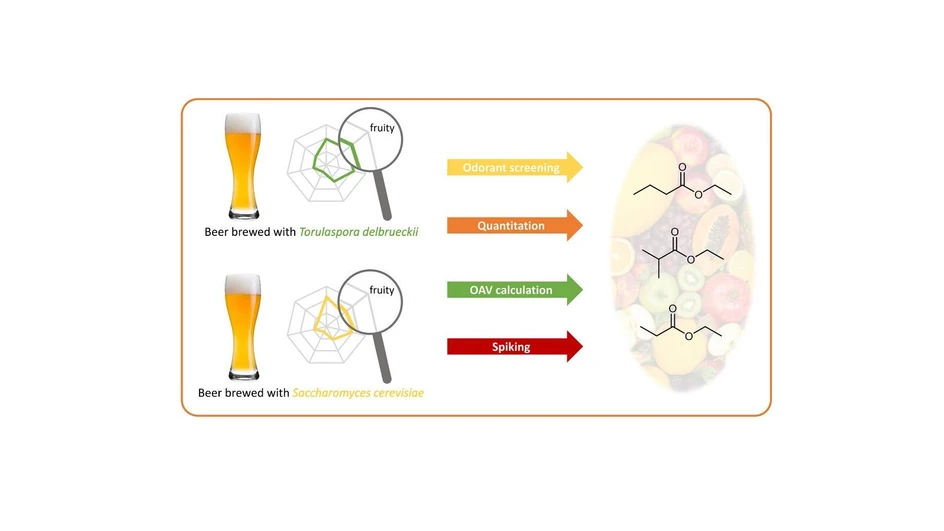
ACS Food Sci. Technol. 2026, 6, 1, 181–188: Graphical abstract
This study compares the aroma profiles of beers fermented with Torulaspora delbrueckii and Saccharomyces cerevisiae. Sensory evaluation revealed a more intense fruity character in the T. delbrueckii beer, supported by aroma extract dilution analysis identifying 32 odorants, with most exceeding their odor thresholds.
Key fruity esters, including ethyl butanoate, ethyl 2-methylpropanoate, and ethyl propanoate, showed higher odor activity values in the T. delbrueckii beer. Spiking experiments confirmed their contribution to the enhanced fruitiness, highlighting the impact of non-Saccharomyces yeasts on beer aroma.
The original article
Characterization of the Major Odorants in Beer Brewed with Torulaspora delbrueckii─Differences to Beer Brewed with Saccharomyces cerevisiae
Stephanie Frank, Robin Maier, and Martin Steinhaus*
ACS Food Sci. Technol. 2026, 6, 1, 181–188
https://doi.org/10.1021/acsfoodscitech.5c01133
licensed under CC-BY 4.0
Selected sections from the article follow. Formats and hyperlinks were adapted from the original.
The earliest evidence of beer production and consumption comes from China before 5000 BC, and the earliest indications of beer production in Europe date back to ∼ 3000 BC. Although yeast had unintentionally been used to produce beer back then, it was not until the 19th century that yeast was identified as the major active organism accomplishing the fermentation process. (1) Before the invention of the pure culture process in 1883 by Emil Christian Hansen, beer was the product of a spontaneous mixed fermentation and involved different species of yeast and bacteria. Each of them potentially contributed to the overall aroma of the beer. (2) Today, most beers worldwide are produced with the top-fermenting yeast Saccharomyces cerevisiae or the bottom-fermenting Saccharomyces pastorianus. (3) For a long time, extraneous yeasts were only considered spoilage organisms, (4,5) however, they recently generated interest for beer aroma diversification.
In most industrialized countries, beer sales and consumption have decreased continuously over the past few years. (6) To act against this negative trend, diversifying beer by developing special beers with aroma characteristics beyond the mainstream is a suitable option. This can be achieved by customization of raw materials and/or processing. The impact of specialty malts on beer aroma has already been studied on the level of the causative substances, and so has the contribution of novel hop varieties with unique aroma profiles in combination with different hopping techniques. (7−10) In contrast, knowledge about how non-Saccharomyces yeasts influence beer aroma is scarce at the molecular level.
In recent years, non-Saccharomyces yeasts have demonstrated great potential for producing new beer styles. (5) However, a majority of yeasts do not grow sufficiently in wort, and some produce unpleasant aromas. Michel et al. (4) developed a screening method to determine the fermentation ability of non-Saccharomyces yeasts by a combination of tests addressing, e.g., sugar utilization, hop and ethanol resistance, and propagation efficiency. The results particularly showed the outstanding suitability of Torulaspora delbrueckii strains for beer brewing.
T. delbrueckii is well-known in the wine industry, where it is used in single and mixed fermentations to produce wines intense in aroma. (11) Recent studies have shown that T. delbrueckii, when used in mixed fermentation with S. cerevisiae, can also produce beers with a pronounced fruity aroma corresponding with high amounts of acetyl esters, 3-methylbutan-1-ol, and ethyl butanoate. (12−18) Further data are available on the volatile compounds formed by T. delbrueckii in single fermentation of synthetic media (19,20) or wort. (17,21−24) However, in none of the studies, the aroma contribution of the volatile compounds formed by T. delbrueckii during beer making has been systematically evaluated. To fill this gap, our aim was to apply a molecular sensory science approach to identify the key odorants in a beer brewed with T. delbrueckii in parallel with a beer brewed with S. cerevisiae, serving as a reference. The volatiles were isolated from the beer samples by solvent-assisted flavor evaporation (SAFE) and screened for odor-active compounds by gas chromatography–olfactometry (GC–O) in combination with a comparative aroma extract dilution analysis (AEDA). A dilution analysis of static headspace samples was performed to additionally cover highly volatile odorants. After structure elucidation, major odorants were quantitated. Odor activity values (OAVs) revealed the compounds potentially crucial for the characteristic aroma of the Torulaspora beer, which were finally confirmed by a spiking experiment.
Materials and Methods
Gas Chromatography (GC)
The GC systems employed were detailed previously: GC–O/FID, (10) HS–GC–O/MS, (38) GC–MS, (39) GC×GC–MS, (28) and GC–GC–MS. (10) Further details are available in the Supporting Information file. For olfactometric detection in the GC–O/FID and HS–GC–O/MS approaches, a trained and experienced assessor placed the nose directly above the sniffing port and evaluated the effluent. Whenever an odor was detected, the retention time and the odor quality were recorded. All olfactometric analyses were conducted by three assessors with complementary olfactory capabilities, i.e., if one assessor exhibited a specific anosmia, at least one of the other two was normosmic. Awareness of one’s own anosmia was taught in weekly training sessions, which also included familiarization with a standardized flavor language. Retention index (RI) calculation was accomplished after GC analysis with a constant temperature gradient (6 °C/min) by linear interpolation from the retention time of the target odorant and the retention times of adjacent n-alkanes. (40)
Results and Discussion
Sensory Characteristics of the Beers
The quantitative olfactory profiles of both the reference beer brewed with S. cerevisiae and the special beer brewed with T. delbrueckii showed patterns fairly characteristic of top-fermented beers: high ratings for malty, floral, honey-like, and fruity in combination with moderate ratings for caramel-like, sweaty, and banana-like (Figure 1). Nevertheless, a closer look also revealed clear quantitative differences. Whereas the reference beer was dominated by the malty aroma note, the special beer was rated higher in the fruity aroma note, the caramel-like aroma note, and the banana-like aroma note. Overall, the most pronounced difference between the two beers was the stronger fruitiness of the special beer brewed with the Torulaspora yeast.
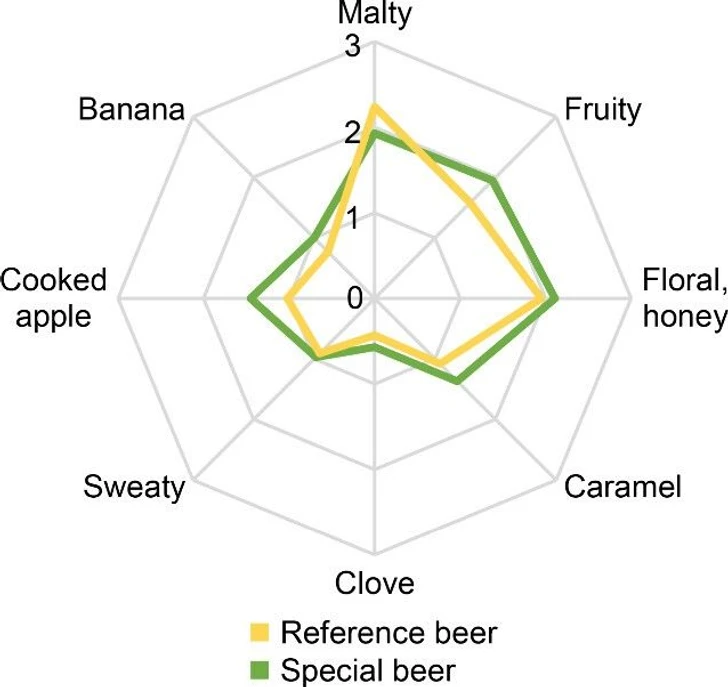 ACS Food Sci. Technol. 2026, 6, 1, 181–188: Figure 1. Quantitative olfactory profiles of the reference beer brewed with S. cerevisiae and the special beer brewed with T. delbrueckii. Assessors rated the intensity of each descriptor on a scale from 0 to 3 with 0.1 increments and 0 = not detectable, 1 = weak, 2 = moderate, and 3 = strong.
Odor-Active Compounds in the Beers
To approach the compounds that were responsible for the aroma difference between the reference beer brewed with S. cerevisiae and the special beer brewed with T. delbrueckii, we first screened the volatiles isolated from the beers by solvent extraction and SAFE using GC–O in combination with a comparative AEDA. As a result, we obtained 32 odor-active compounds, among which 31 were detected in both beers, and FD factors up to 16384 in the reference beer and up to 32768 in the special beer (Table 1). Structure assignments were achieved with the following approach: RIs on two columns with different polarity (DB-FFAP and DB-5) and odor descriptions were compared to published data, including those compiled in the Leibniz-LSB@TUM Odorant Database. (44) The resulting structure proposals were confirmed by parallel GC–O and GC–MS analyses of the beer volatile isolates and authentic reference compound solutions.
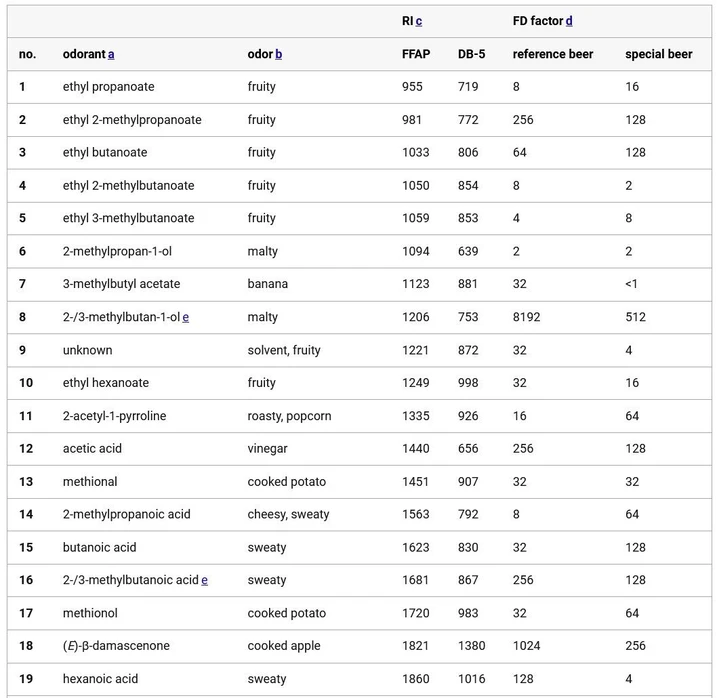 ACS Food Sci. Technol. 2026, 6, 1, 181–188: Table 1. Odorants in the Volatile Isolates Obtained from the Reference Beer Brewed with S. cerevisiae and the Special Beer Brewed with T. delbrueckii_Part 1
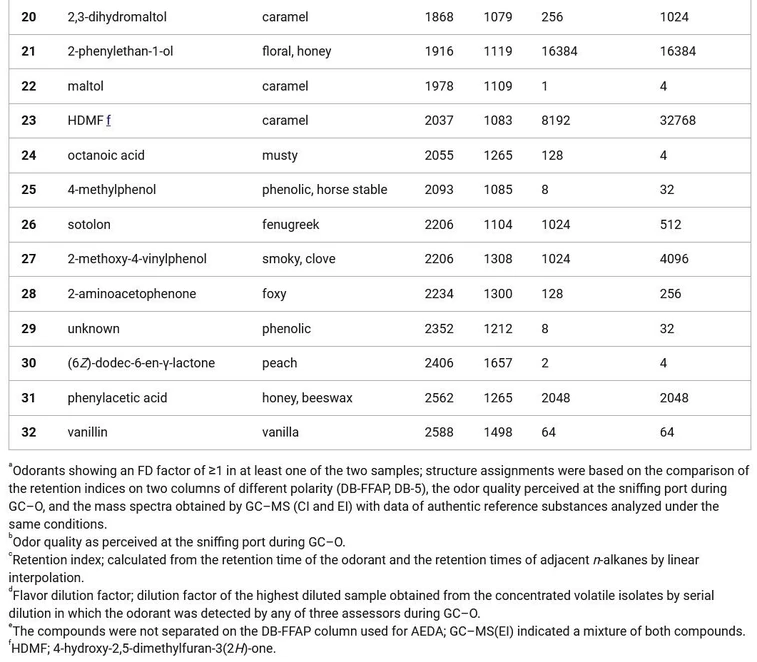 ACS Food Sci. Technol. 2026, 6, 1, 181–188: Table 1. Odorants in the Volatile Isolates Obtained from the Reference Beer Brewed with S. cerevisiae and the Special Beer Brewed with T. delbrueckii_Part 2
Using this approach, the structures of 30 out of 32 odorants in the beers were successfully assigned; only compounds 9 and 29, despite all efforts, remained unknown. The compound with the highest overall FD factor of 32768 was caramel-like smelling 4-hydroxy-2,5-dimethylfuran-3(2H)-one (HDMF; 23) in the special beer. With 8192 it also showed a high FD factor in the reference beer. HDMF is a well-known beer odorant thermally generated during malt production. (7) With an FD factor of 16384, the most potent odorant in the reference beer was floral, honey-like smelling 2-phenylethan-1-ol (21), followed by malty smelling 2- and 3-methylbutan-1-ol (8) with a combined FD factor of 8192. 2- and 3-methylbutan-1-ol were not separated on the GC column used for AEDA, but the mass spectra in EI mode indicated a mixture of both compounds. 2-Phenylethan-1-ol, 2-methylbutan-1-ol, and 3-methylbutan-1-ol also showed high FD factors in the special beer, namely 16384 and 512. These important beer odorants, (45,46) are formed as byproducts of yeast metabolism during fermentation. (47) Further five odorants with FD factors as high as 1024 to 4096 in at least one of the two beer samples were 2-methoxy-4-vinylphenol (27; smoky, clove-like; FD factors 1024 and 4096), phenylacetic acid (31; honey-like, beeswax-like; FD factors 2048 and 2048), sotolon (26; fenugreek-like; FD factors 1024 and 512), (E)-β-damascenone (18; cooked apple-like; FD factors 1024 and 256), and 2,3-dihydromaltol (20; caramel-like; FD factors 256 and 1024). All these compounds have been reported as beer odorants before. (10,46,48) The entire results of the odorant identification are summarized in Table 1. While the volatiles in beers brewed with T. delbrueckii have previously been analyzed by GC–FID (5,13−15,18,23) and GC–MS, (19,20,24) to our knowledge, this is the first study to apply activity-guided odorant screening using GC–O approaches.
Approximately half of the compounds compiled in Table 1 showed no substantial FD factor differences between the reference beer brewed with S. cerevisiae and the special beer brewed with T. delbrueckii. FD factors were either identical, such as for 2-phenylethan-1-ol (21; both 16384) and phenylacetic acid (31; both 2048), or differed only by a factor of 2, which cannot be considered an indication of a quantitative difference, e.g., for sotolon (26; 1024 vs 512) and ethyl 2-methylpropanoate (2; 256 vs 128). Among the compounds that showed substantial FD factor differences between the reference beer and the special beer were the important malty smelling beer odorants 2- and 3-methylbutan-1-ol with common FD factors of 8192 in the reference and 512 in the special beer. This difference corresponded well to a higher rating of the malty aroma note in the olfactory profile of the reference beer (cf. Figure 1). On the other hand, the FD factors of fruity smelling compounds were not able to explain the stronger fruitiness of the special beer brewed with T. delbrueckii. In fact, the fruity smelling esters ethyl propanoate (1), ethyl butanoate (3), and ethyl 3-methylbutanoate (5) showed higher FD factors in the special beer (16 vs 8, 128 vs 64, and 8 vs 4); however, other fruity smelling esters showed higher FD factors in the reference beer, namely ethyl 2-methylpropanoate (2; 256 vs 128), ethyl 2-methylbutanoate (4; 8 vs 2), and ethyl hexanoate (10; 32 vs 16). To clarify the compounds being causative for the more intense fruity aroma of the special beer, sensory experiments based on exact quantitative data would, therefore, be essential. Before starting these experiments, however, the screening for odor-active compounds in the beers was extended to the fraction of highly volatile compounds.
In summary, the use of T. delbrueckii for beer brewing resulted in a beer with an intense fruity aroma associated with higher concentrations of ethyl butanoate, ethyl 2-methylpropanoate, and ethyl propanoate than in the corresponding S. cerevisiae beer. Our study thus confirmed that the usage of non-Saccharomyces yeasts for beer brewing can be an appropriate tool for diversifying beer aroma and developing unique beers with aroma characteristics beyond the mainstream. However, further research is needed to substantiate our results, assess their reproducibility by analyzing biological replicates, and study the effects of different yeast strains.