News from LabRulezGCMS Library - Week 30, 2026
LabRulez / AI: News from LabRulezGCMS Library - Week 30, 2026
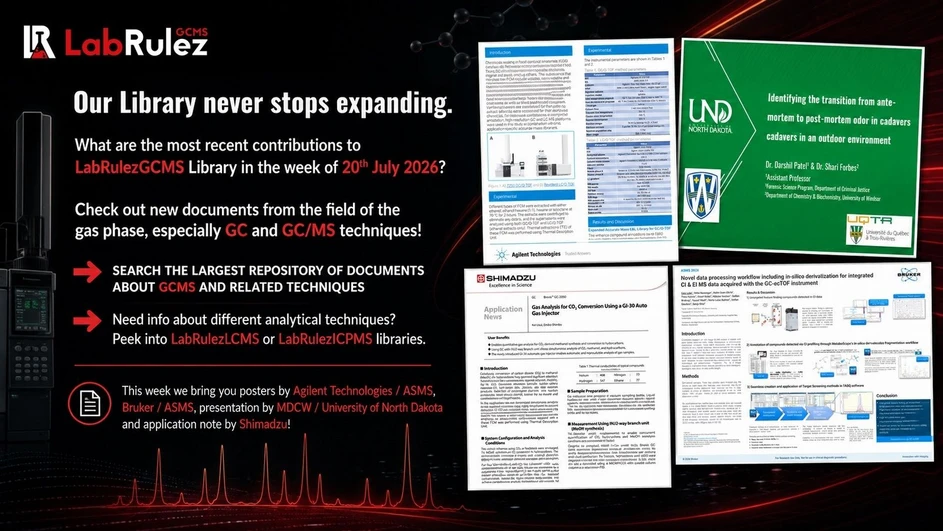
Our Library never stops expanding. What are the most recent contributions to LabRulezGCMS Library in the week of 20th July 2026? Check out new documents from the field of the gas phase, especially GC and GC/MS techniques!
👉 SEARCH THE LARGEST REPOSITORY OF DOCUMENTS ABOUT GCMS AND RELATED TECHNIQUES
👉 Need info about different analytical techniques? Peek into LabRulezLCMS or LabRulezICPMS libraries.
This week we bring you posters by Agilent Technologies / ASMS, Bruker / ASMS, presentation by MDCW / University of North Dakota and application note by Shimadzu!
1. Agilent Technologies / ASMS: Extractables Analysis of Food Contact Materials Using High-Resolution GC/MS and LC/MS
- Poster
- Full PDF for download
Chemicals residing in food contact materials (FCM) can migrate from packaging and containers into food. The FCM include a variety of materials including paper and plastic among others. The substances that migrate from FCM include volatile, semi-volatile and non-volatile compounds and therefore a combination of GC/MS and LC/MS techniques is needed for comprehensive analysis of potential migrants. In this study we evaluated different types of FCM including food vacuum sealer bags, heavy duty plastic food containers as well as lined paperboard containers. Various solvents were assessed for their ability to extract different classes of food packaging-derived chemicals. For increased confidence in compound annotation, high-resolution GC and LC MS platforms were used in this study in combination with application-specific accurate mass libraries.
Experimental
GC/Q-TOF
- MS: Agilent 7250 GC/Q-TOF
- GC: Agilent 8890 GC
- Column: Agilent DB-5Q, 30 m, 0.25 mm, 0.25 µm
LC/Q-TOF
- LC: Agilent 1290 Infinity II
- MS: Agilent Revident LC/Q-TOF
- Analytical column: Agilent Poroshell Aq-C18 2.1 x 150 mm, 2.7µm column
Conclusions
FCM extractions were optimized and successfully analyzed using a variety techniques based on highresolution GC/MS and LC/MS. Combination of different high resolution MS techniques helped to ensure a comprehensive E&L compound coverage. E&L focused accurate mass libraries were key to efficient data analysis.
2. Bruker / ASMS: Novel data processing workflow including in-silico derivatization for integrated CI & EI MS data acquired with the GC-ecTOF instrument
- Poster
- Full PDF for download
Combined suspect and non-target GC-MS analysis of volatile and semi-volatile compounds holds relevance for environmental monitoring & research, food, flavor & fragrance analysis as well as metabolomics studies. The combination of Chemical Ionization (CI) and Electron Ionization (EI) in the ecTOF instrument (Bruker Daltonics, Bremen, Germany) can improve the identification confidence of unknown compounds, especially in complex samples and when no standards are available. The simultaneous usage of two complementary ionization techniques brings additional advantages for quantification workflows. To leverage these benefits, a novel data processing approach has been developed, and applicability is shown in two study designs.
Methods
Derivatized samples from two studies were analyzed using the GC-ecTOF instrument. Data were converted to TSF format and processed with prototype versions of MetaboScape and TASQ. Untargeted feature detection was performed on the CI data stream, including de-isotoping, de-adducting for CI-specific ions [M-H]⁺, [M]⁺, [M+H]⁺, [M+NH₄]⁺, [M-CH3 ] + and retention time alignment across all samples.
Conclusion
- Untargeted feature finding and streamlined annotation of ecTOF supported by in-silico derivatization and in-silico fragmentation extends GC-MS analysis for metabolomics and non-target screening.
- In-silico derivatization permits complementary annotation for compounds lacking reference standards.
- Simplified process from identified markers in profiling experiments to target screening and quantitation methods.
3. MDCW / University of North Dakota: Identifying the transition from ante-mortem to post-mortem odor in cadavers cadavers in an outdoor environment
- Presentation
- Full PDF for download
This presentation investigates how the characteristic odor of a human body changes during the transition from life (ante-mortem) to decomposition (post-mortem). The researchers focused on identifying volatile organic compounds (VOCs) released during the early post-mortem period and determining when the scent profile changes from that of a living person to that associated with human remains. Understanding this transition is particularly important for improving search and rescue operations, where distinguishing between living victims and deceased individuals is essential for deploying search-and-rescue dogs and human remains detection dogs effectively.
To study this process, VOC samples were collected from body donors at both a morgue and an outdoor decomposition research facility (REST). Air samples were collected using sorbent tubes and ACTI-VOC pumps after controlled VOC accumulation and sampling periods. Chemical analysis was performed using thermal desorption comprehensive two-dimensional gas chromatography coupled with mass spectrometry (TD-GC×GC-MS). The analytical system employed a Restek Rxi®-624Sil MS first-dimension column and a Stabilwax® second-dimension column, with electron ionization (70 eV) mass spectrometry covering a mass range of 29–300 amu at an acquisition rate of 250 spectra/s. Data processing combined ChromaTOF software with RStudio for feature alignment, normalization, filtering, and manual verification of VOC profiles.
The study identified 827 volatile organic compounds, representing a wide range of chemical classes including nitrogen-containing compounds, esters, halogenated compounds, aromatics, alcohols, ketones, aldehydes, sulfur-containing compounds, ethers, and acids. By comparing experimentally detected VOCs with compounds previously reported in the literature for both living humans and decomposing remains, the researchers identified 33 trans-mortem VOCs that characterize the transition between ante-mortem and post-mortem odor. VOC profiles were then monitored throughout decomposition for individual donors, allowing the team to visualize how the relative contributions of ante-mortem, trans-mortem, and post-mortem compounds evolved over time.
The results showed that ante-mortem and trans-mortem VOCs remained detectable during the earliest stages after death, while post-mortem odor compounds became increasingly dominant after approximately Accumulated Degree Days (ADD) 73.4, corresponding to Experimental Day 3. The authors conclude that although these findings improve our understanding of early decomposition odor chemistry, additional studies across different environments and seasonal conditions are needed to standardize VOC-based approaches and further support forensic investigations and search-and-rescue applications.
4. Shimadzu: Gas Analysis for CO2 Conversion Using a GI-30 Auto Gas Injector
- Application note
- Full PDF for download
The catalytic conversion of carbon dioxide (CO2) to methanol (MeOH) and to hydrocarbons has garnered significant attention as a strategy to realize a sustainable chemical industry. Analytical targets in CO2 conversion studies typically include carbon monoxide (CO), hydrocarbons, alcohols, and other reaction products. Selection of appropriate column and detector combinations must therefore be guided by the nature and concentrations of target analytes.
In this application news, we demonstrate simultaneous analysis on two parallel columns by using INJ2-way branch unit to permit detection of CO and hydrocarbons together with alcohols such as MeOH. We also present a simplified measurement approach employing a single-column configuration equipped with a thermal conductivity detector(TCD).
System Configuration and Analysis Conditions
Two reaction schemes using CO2 as feedstock were envisaged: (1) MeOH synthesis and (2) conversion to hydrocarbons. The instrumentation comprised the Auto Gas Injector GI-30 and the SPI inlet, which minimizes air ingress and sample adsorption (Fig. 1).
For the MeOH synthesis application, a Jetanizer -FID—which permits detection of CO and CO2 that are not observable by a conventional FID—was employed. A MICROPACKED-ST packed column provides separation of CO from O2 (ambient contamination); however, higher-boiling hydrocarbons and alcohols such as MeOH are not eluted from this column. To achieve comprehensive analysis, the injector was splitted and an SH-Q-BOND capillary column was used to resolve hydrocarbons and MeOH concurrently. The injection-port splitting is implemented using dedicated hardware (Application News No. 01-00661-EN).
For the conversion to hydrocarbons scenario, when analytes are permanent gases and C3-or-smaller hydrocarbons, quantitative analysis can be performed with a single MICROPACKED-ST column coupled to a TCD. The TCD responds to differences in thermal conductivity between carrier and analyte gases; measuring low–thermal-conductivity species such as hydrocarbons requires a carrier gas with high thermal conductivity (helium or hydrogen) (Table 1). The Brevis GC-2050 TCD uses a single filament design, resulting in rapid baseline stabilization (~10 minutes), which is advantageous for routine operation.
Conclusion
Using INJ2-way branch unit enables simultaneous analyses using distinct column-detector combinations within a single chromatographic cycle, permitting comprehensive quantification of reaction products from CO2 conversion— ranging from CO and hydrocarbons to alcohols such as MeOH. For analyses restricted to hydrocarbons up to C3, a streamlined single-column TCD configuration provides sufficient separation and sensitivity. It should be noted that MeOH and hydrocarbons of carbon number ≥ C4 may adsorb or be retained on the MICROPACKED-ST column; periodic column conditioning is therefore recommended.