News from LabRulezGCMS Library - Week 32, 2026

LabRulez / AI: News from LabRulezGCMS Library - Week 32, 2026
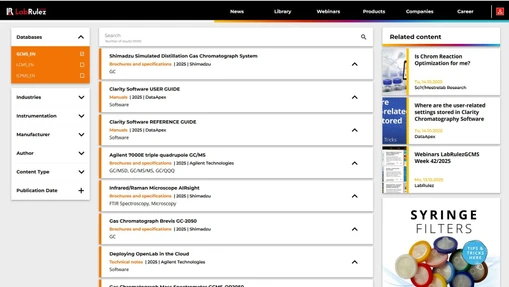
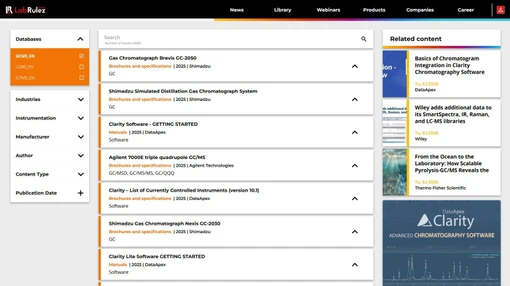
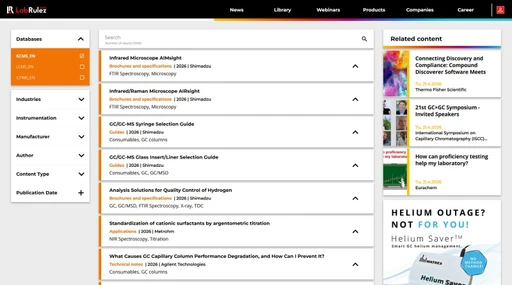
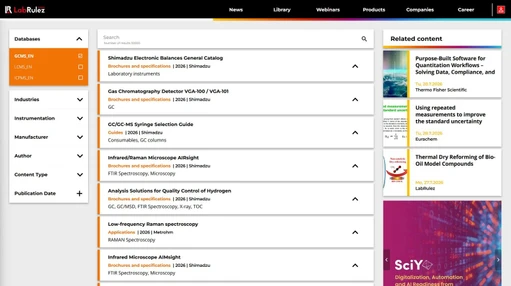
Our Library never stops expanding. What are the most recent contributions to LabRulezGCMS Library in the week of 3rd August 2026? Check out new documents from the field of the gas phase, especially GC and GC/MS techniques!
👉 SEARCH THE LARGEST REPOSITORY OF DOCUMENTS ABOUT GCMS AND RELATED TECHNIQUES
👉 Need info about different analytical techniques? Peek into LabRulezLCMS or LabRulezICPMS libraries.
This week we bring you application notes by Agilent Technologies and Shimadzu and presentation by MDCW / University of Alberta!
1. Agilent Technologies: Analysis of Trace Impurities in Monocyclic Aromatic Solvents Following ASTM D7504
Dual simultaneous analysis using the Agilent 8860B gas chromatograph
- Application note
- Full PDF for download
The production of high-purity monocyclic aromatic hydrocarbons, such as benzene, toluene, ethylbenzene, and xylenes (BTEX), is a cornerstone of the modern petrochemical industry. These compounds serve as essential feedstocks for the synthesis of plastics, resins, and textiles. Because even trace impurities can adversely affect downstream chemical reactions and product quality, rigorous analytical testing is required to ensure these intermediates meet strict commercial specifications.
ASTM D7504 is the industry-standard test method for determining the purity of, and trace impurities in, monocyclic aromatic hydrocarbons using gas chromatography (GC) with flame ionization detector (FID).1 This method is favored for its streamlined workflow; it utilizes effective carbon number (ECN) correction factors for area normalization. This eliminates the need for labor-intensive, multipoint calibrations for every individual impurity, allowing laboratories to calculate purity and quantify trace nonaromatics and aromatics with high precision.
The application scope of ASTM D7504 covers a wide array of aromatic liquids, including benzene, toluene, mixed xylenes, and styrene. To comply with the method's stringent performance requirements, the GC system must demonstrate:
- High sensitivity: A limit of quantitation (LOQ) of at least 0.0006% by mass.
- Good resolution: Maintaining a valley-to-peak ratio of no more than 50% for critical separations (such as p-xylene and m-xylene).
- Strict precision: Highly reproducible peak areas to ensure accurate purity calculations.
Implementing ASTM D7504 on a dual-channel GC/FID platform—where two independent analytical channels configured with identical injectors, columns, and detectors operate within a single GC oven—provides significant operational advantages:
- Enhanced laboratory throughput: By performing two injections simultaneously, the test lab can double its sample capacity per instrument, effectively reducing the cost-per-analysis and maximizing hardware ROI.
- Method flexibility and redundancy: A dual-channel set up allows a lab to run different sample types (such as toluene on the front channel and xylene on the back) in a single oven cycle. Furthermore, it provides an immediate "back up" channel to maintain uptime during routine maintenance.
For the system to be considered reliable, both channels should meet ASTM D7504 sensitivity, resolution, and precision requirements. In addition, both channels should yield consistent quantitative results for the same sample. The reproducibility limit (R) demonstrated in ASTM D7504 interlaboratory testing will be used to evaluate the result consistency between the two channels.
ASTM D7504 recommends helium and hydrogen as carrier gas. In China, major Chinese petrochemical companies often align their internal quality control standards directly with ASTM D7504 when testing for export of high-purity chemical intermediates. Because nitrogen is commonly used in China, they commonly adapt the ASTM D7504 method to use nitrogen carrier gas.
This application note demonstrates how dual-channel analysis on the Agilent 8860B GC, following ASTM D7504, delivers consistent and high-precision data using three types of carrier gas.
Experimental
An Agilent 8860B GC was configured with dual split/splitless inlets and dual flame ionization detectors (FIDs). The sample introduction was made by dual Agilent 7693A automatic liquid samplers (ALS) with high density turrets (16-vial). The analytical parameters and consumables are summarized in Tables 1 and 2. Data acquisition and analysis were conducted using Agilent OpenLab CDS version 2.8
Conclusion
The Agilent 8860B gas chromatography system configured with two identical analytical channels are applied for impurity analysis in monocyclic aromatic solvents using three carrier gases. Each analytical channel was evaluated according to the ASTM D7504 method in terms of resolution, sensitivity, quantitation precision, and recovery with satisfactory results. The quantitation results between the two channels are consistent with each other.
- Column resolution compounds pair demonstrated good separation with H/V no less than 5:1 for 300 ppm m-xylene and p-xylene solvent.
- The LODs achieved for benzene on each analytical channel are less than 0.0001%, exceeding the 0.0002% LOD required by ASTM D7504.
- The response and mass concentration precisions of most impurities in check standards are below 1%, meeting or exceeding the precision requirements in D7504.
- Excellent recovery results, ranging from 93 to 105%, was achieved for added impurities, indicating good quantification accuracy based on the 8860B GC system.
- The quantitation difference of all probe impurities between two channels is less than the reproducibility thresholds (R), demonstrating excellent across channel consistency
Besides great instrument performance, the Agilent OpenLab CDS software can realize ECN based normalization for easy and fast quantitation and report generation. The 8860B dual channel GC system coupled with the OpenLab CDS software provides an accurate and reliable analysis of impurities in monocyclic aromatic solvents with satisfactory precision. Lab productivity can be improved significantly compared to the single channel analytical system.
2. MDCW / University of Alberta: Leveraging Local Libraries for Positively Parsimonious Peak Tables
- Presentation
- Full PDF for download
James J. Harynuk’s presentation, “Leveraging Local Libraries for Positively Parsimonious Peak Tables,” explores how custom mass spectral libraries can simplify and improve compound identification in complex GC×GC-(HR)MS datasets. GC×GC-MS is widely applied in petroleum, environmental, food/flavour, and omics research, where samples can contain hundreds or thousands of peaks. While expanded separation space, cleaner spectra, retention patterns, and high-resolution accurate-mass data provide strong identification capabilities, converting large datasets into coherent peak tables with consistent compound assignments across multiple samples remains challenging.
The presentation demonstrates the approach using a field pea study investigating how nitrogen availability influences plant metabolism and volatile organic compounds. A conventional workflow based on peak finding and library searching can generate very large peak tables and inconsistent assignments. Incorporating retention indices (RI) and LECO’s Identification Grading System (IGS) substantially reduces the number of questionable peaks. In one example, a pea sample containing 789 detected peaks was reduced to 146 retained peaks after RI filtering and IGS scoring, producing a much more manageable dataset. However, conventional libraries still struggle with isomers and with compounds that repeatedly occur in a laboratory’s samples but cannot yet be confidently identified—the presentation calls these “unknown knowns.”
Harynuk therefore proposes building a custom local HRMS library containing not only standards and confidently identified compounds, but also reproducible unknown features. To qualify for inclusion, a peak should have a high-quality spectrum, S/N >100, chromatographic purity, occurrence in multiple technical replicates, an assigned retention index, and a unique identifier. Crucially, the exact chemical identity does not need to be known: an unknown but reproducible feature can receive an internal identifier such as “JJH-001” and be updated later as more information becomes available. This allows laboratories to retain analytically meaningful recurring signals instead of discarding them simply because a definitive library identification is unavailable.
The results show that combining a custom library with local RI data and IGS filtering improves both the consistency and efficiency of peak-table generation. Compounds with IGS scores ≥3.0 were generally assigned the same identification across samples when the custom library was used, while reliance on NIST and IGS alone produced less consistent results. After correcting only a small number of problematic identifications per peak table, retention-index errors for custom-library entries dropped dramatically—in the evaluated samples, typically to around 0.5–1.9 RI units. The key recommendation is therefore straightforward: build a custom MS library, include recurring “unknown knowns,” collect local retention-index data, and apply identification-quality filters to obtain cleaner and more consistent GC×GC-MS peak tables with substantially less manual effort.
3. Shimadzu: Simultaneous Analysis of Pesticide Residues in Food Using Triple Quadrupole GC-MS/MS with SPL Mode of a Multimode injection Unit (MMI)
- Application note
- Full PDF for download
User benefits
- The MMI’s rapid heating and cooling technology significantly reduces waiting time during inlet maintenance, improving instrument uptime.
- The Smart Pesticides Database enables automatic creation of analytical methods without the need for pesticide standards.
- Peakintelligence for GCMS uses AI-based peak processing to deliver highly accurate analysis with no parameter settings required
GC-MS/MS is an indispensable tool for the simultaneous analysis of pesticide residues in food. However, improving productivity in high-throughput workflows remains a persistent challenge. With the increasing use of simplified sample preparation methods such as QuEChERS, contamination of the inlet by matrix components is unavoidable, and frequent inlet maintenance, including liner replacement, is often required. Because this maintenance involves both cooling the inlet and waiting for temperature re-stabilization afterward, it can become a major source of instrument downtime.
The newly developed Multi-Mode Inlet (MMI) incorporates Shimadzu’s proprietary thermal insulation technology, providing excellent temperature stability together with rapid heating and cooling performance. While maintaining high data compatibility with conventional split/splitless inlets, the MMI significantly reduces the waiting time associated with inlet maintenance.
In this Application News, simultaneous multiresidue analysis in SPL mode is demonstrated for four food matrices with different characteristics - spinach, orange, avocado, and ginger - using the GCMS-TQ 8040 RX triple quadrupole GC-MS/MS equipped with the MMI.
Data Analysis
LabSolutions Insight, a quantitative data processing software package designed for high-throughput sample analysis, was used for data analysis, with Peakintelligence for GCMS applied as the peak integration algorithm (Fig. 6). Peakintelligence is an AI-based waveform processing algorithm that uses machine learning to emulate the peak processing performed by experienced analysts. It requires no operator-defined parameter settings and provides peak integration performance comparable to that of skilled users.
For more information on improving the efficiency of pesticide data analysis using Peakintelligence for GCMS, please refer to Application News 01-00585-EN, “Time-Saving Data Processing for Pesticide Residues with Peakintelligence for GCMS.”
Conclusion
In this Application News, an example of simultaneous multiresidue pesticide analysis in food using a triple quadrupole GC-MS/MS equipped with a Multi-Mode Inlet (MMI) was presented. By adopting the MMI, instrument downtime associated with inlet maintenance can be significantly reduced while maintaining high quantitative performance. In addition, by combining automated method creation with the Smart Pesticides Database and efficient data analysis using the AIbased waveform processing algorithm Peakintelligence for GCMS, highly accurate results were obtained even for complex food matrices. This system optimizes the overall analytical workflow, from method development and maintenance to data analysis, and can make a substantial contribution to improving productivity in high-throughput pesticide residue analysis.