News from LabRulezGCMS Library - Week 42, 2025
LabRulez: News from LabRulezGCMS Library - Week 42, 2025
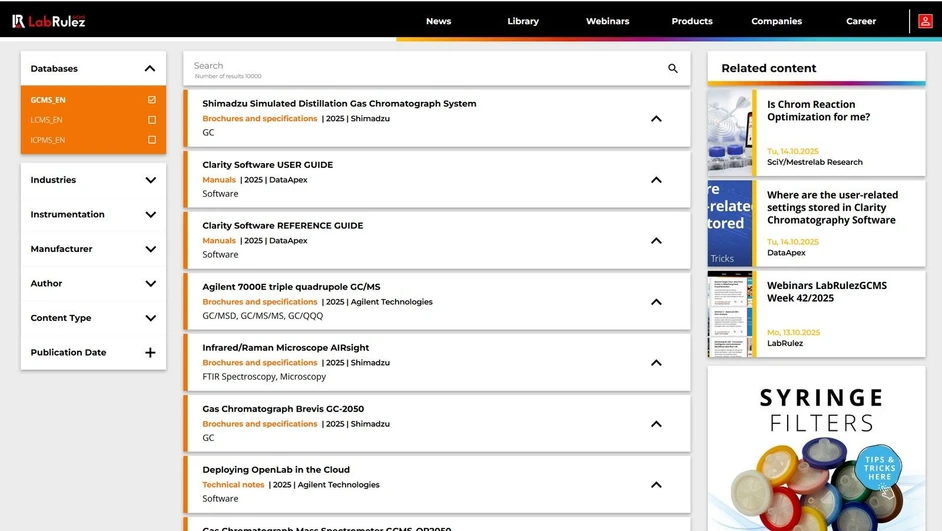
Our Library never stops expanding. What are the most recent contributions to LabRulezGCMS Library in the week of 13th October 2025? Check out new documents from the field of the gas phase, especially GC and GC/MS techniques!
👉 SEARCH THE LARGEST REPOSITORY OF DOCUMENTS ABOUT GCMS AND RELATED TECHNIQUES
👉 Need info about different analytical techniques? Peek into LabRulezLCMS or LabRulezICPMS libraries.
This week we bring you poster by Agilent Technologies / AOAC and application notes by EST Analytical, Shimadzu and Thermo Fisher Scientific!
1. Agilent Technologies / AOAC: Analysis of Pesticides in Spices with Hydrogen Carrier Gas
- Poster
- Full PDF for download
Spices are considered as one of the most challenging matrices for analysis of pesticides. Usually, the sample analysis involves 5-10 fold dilution to reduce the matrix load. Thus, lower instrument detection limits need to be achieved. Use of hydrogen as carrier gas can further pose changes in terms of sensitivity. This work describes the suitability of the hydroinert and HES ion source to achieve the required sensitivity. Samples were extracted using QuEChERS based approach followed by dispersive cleanup. Linearity was evaluated against matrix matched standards within the range of 0.5-50 ng/mL. Correlation coefficient (r2) for calibration ranging between 0.5 -50 ng/mL was found above 0.95. Precision study was carried out by injecting 6 replicates of pre-spiked samples at 10 ng/g. The average relative standard deviation (%RSD) was <20% with recoveries ranging from 72-125%. The advantages of the method include utilization of same retention time MRMs and collision energies. This allowed for easy transition from helium to hydrogen carrier gas.
Experimental
An Agilent 8890 GC coupled to a 7000 (with HydroInert source) / 7010 Triple Quadrupole GC/MS system equipped with High Efficiency Source (HES) was used. The GC system was equipped with a MultiMode Inlet (MMI) with air cooling and a back flushing system based on a Purged Ultimate Union controlled by a PSD module.
Results and Discussion
The oven temperature program used with H2 as the carrier gas was maintained identical to that used with He. The analytical method originally optimized for a 20- minute runtime using He was successfully adapted for H2. This ensured preservation of chromatographic resolution and retention time fidelity across carrier gas substitution, as evident from the elution order shown in Figure 3. The chromatograms indicate presence of high matrix load at initial 7 mins for all the spices. At RT 10-13 min, matrix load of and chilli was high. The matrix load from black pepper was very high throughout the runtime. Backflush of 7 min was used to remove the matrix.
Transitioning from He to H2 can often lead to reactions at the ion source resulting in spectral changes when compared with He. Therefore, EI sources with reduced or eliminated source reactivity such as HydroInert and HES is essential to minimize or prevent the undesirable insource reactions when using hydrogen. The tested mixture of pesticides were compared against the NIST library to ensure spectral fidelity. As evident form Figure 5, the library match percentages were acceptable and this the existing MRM database could be used for acquisition in MRM mode, without the requirement of any additional MRM development.
Conclusions
Agilent GC/TQ systems with HydroInert and HES sources delivered consistent sensitivity and spectral fidelity using hydrogen carrier gas, without re-optimizing MRM transitions or collision energies. Retention times and elution order were preserved across complex spice matrices. The systems achieved LOQs of 2.5 to 5 ppb after five-fold dilution, even in heavily loaded matrices like black pepper, confirming reliable quantitation in high-background spice samples.
2. EST Analytical: A Single Calibration Method for Water AND Soil Samples Performing EPA Method 8260
- Application note
- Full PDF for download
In order to run Method 8260 samples, a bromofluorobenzene (BFB) tune standard, matrix blank, calibration standard, and laboratory control standard all have to be run and pass method requirements every twelve hours. With the exception of the BFB standard, the other standards and blank matrices have to correspond to the samples to be analyzed. Due to this constraint, the analyst is required to run another three samples if the matrix is changed within the twelve hour time window. Moreover, the calibration must also match the sample matrix. These requirements are very time consuming and can limit laboratory profits. This application note will demonstrate a patented automated water sampling mode using the soil sampling station of the autosampler thus eliminating the need to have separate calibrations and standards for waters and soils.
Experimental
The sampling system used for this study was the EST Analytical Centurion WS autosampler and Evolution concentrator. The concentrator was affixed with a Vocarb 3000 trap and connected to an Agilent 7890A GC and 5975 inert XL MS. The GC was configured with a Restek Rxi-624 Sil MS 30m x 0.25mm x 1.4µm column. The experiments were run using the extraction mode of the Centurion WS. Refer to Table 1 for the sampling method parameters and Table 2 for GC/MS parameters.
Conclusion
The patented sampling process of the Centurion WS proved to be a reliable and accurate sampling method for running water samples in the soil mode. The curve linearity and method detection limits both met USEPA Method 8260 requirements, and the precision and accuracy results were excellent. The water extraction option offered with the Centurion WS will save laboratories time and money because only one set of standards, curves, etc. is required for both water and soil samples.
3. Shimadzu: Measurement of Volatile Organic Compounds in Water by Headspace GC-MS with Nitrogen Carrier Gas
- Application note
- Full PDF for download
Due to the health issues associated with volatile organic compounds (VOCs), standards and regulations are established for VOC levels in water. VOCs are preferably measured by methods that involve simple sample pretreatment, and headspace GC-MS is one of these methods commonly used to measure VOC levels. GC-MS is normally performed with helium carrier gas, but helium gas could require more cost and lead time to obtain for analytical use every year. There is a need for a GC-MS analysis method that can be performed using relatively inexpensive and readily available nitrogen carrier gas. While nitrogen carrier gas results in inferior analytical sensitivity compared with helium carrier gas, trap mode sampling can salvage the reduction of the sensitivity. This Application News presents an example measurement of VOCs in water using nitrogen carrier gas performed on the GCMS-QP2050 gas chromatograph mass spectrometer and the HS-20 NX headspace sampler in trap mode.
Samples and Analysis Conditions
Standard solutions were prepared by diluting 25 standard VOC mixture in methanol to 1, 2.5, 5, 10, 25, 50, 100, and 250 mg/L. The standard solutions were combined with internal standards 1,4-dioxane-d8 at 100 mg/L, fluorobenzene at 12.5 mg/L, and pbromofluorobenzene at 12.5 mg/L.
- GC-MS: GCMS-QP2050
- Head Space Sampler: HS-20 NX
Conclusion
VOC levels in water were measured using an HS-20 NX in trap mode and a GCMS-QP2050 with nitrogen carrier gas. Trap mode allowed VOCs to be measured in water with a high degree of sensitivity, even with nitrogen carrier gas.
4. Thermo Fisher Scientific: Enhanced trace moisture analysis in organic solvents using GC with multi-channel VUV detection
- Application note
- Full PDF for download
Monitoring water content in organic solvents is essential across various industries, notably in pharmaceutical manufacturing, where excess moisture can compromise active ingredient stability. Traditionally, Karl Fischer titration has been the benchmark technique, offering broad quantification capability. However, KF is limited by side reactions, reagent sensitivity, and incompatibility with high-throughput workflows. It also relies on hazardous solvents and extensive manual steps.
Gas chromatography provides an alternative means of quantifying water when paired with an appropriate detector. While FID and TCD have been used, they lack the selectivity and sensitivity required for trace moisture detection. Ionization-based detectors like PDD improve detection but suffer from dynamic range limitations.
The LUMA™ VUV detector (VUV Analytics, Inc.) overcomes these drawbacks by employing vacuum ultraviolet absorbance in the 118–240 nm range, where water exhibits strong and selective absorption. Unlike other GC detectors, LUMA combines universality, spectral selectivity, and ease of use in a single platform.
This work illustrates a GC method using a LUMA Multi-Channel VUV Absorbance detector to analyze moisture in acetonitrile from 250 ppb up to percent levels. This approach has several advantages over traditional techniques like Karl Fischer titration, including superior sensitivity for the analysis of trace levels of water in acetonitrile as well as percent levels. The achievable limit of detection for water in acetonitrile is 250 ppb, with method linearity over 0.25–100 ppm producing R² ≥ 0.999.
LUMA detector highlights
- Detection range: 125–1,050 nm VUV-UV-VIS
- Channel configuration: Up to 12 discrete absorbance bands simultaneously acquired
- Sensitivity: Low-ppb to percent level in a single method
- Installation: Compact, uses any carrier gas and no vacuum pumps
- Software integration: Fully controlled via Thermo Scientific™ Chromeleon™ Chromatography Data System (CDS)
These capabilities enable detection of water and organic solvents in a single injection—dramatically simplifying workflows in quality control laboratories.
Experimental
The LUMA detector can be easily installed on a Thermo Scientific™ TRACE™ 1600 Series GC and controlled in Chromeleon CDS, providing method settings, data acquisition, and reporting in a single software platform.
GC-VUV separation using the LUMA Multi-Channel Vacuum Ultraviolet Absorbance detector was based on a previously described method by VUV Analytics.¹ Method conditions for this experiment are described in Table 1.
A commercially available 100 ppm KF standard (water in xylene) was used to determine sensitivity, linearity, and repeatability. To minimize the impact of environmental moisture in this experiment, the same solution has been used to simulate different water levels through varying split ratios and injection volumes.
Seven concentration levels (0.25–100 ppm) were created using adjusted split ratios as summarized in Table 2. Five replicate injections were made at each level.
Key application benefits
- Replaces Karl Fischer titration for routine moisture analysis
- Simultaneous quantification of water and organic solvents
- Ideal for pharmaceutical QA/QC and regulatory environments
- Fast, automated workflows with no vacuum or specialty gases
This workflow is aligned with recent trends toward hybrid analytical techniques that reduce resource consumption and speed up decision-making in GMP labs.
Conclusion
The LUMA multi-channel VUV detector offers a transformative approach to moisture analysis in volatile organic solvents. It provides both trace-level sensitivity and wide dynamic range— enabling labs to consolidate workflows, eliminate time-consuming titrations, and enhance data reliability.
By expanding GC capability to encompass water detection, LUMA bridges a long-standing gap in chromatographic technology, delivering measurable gains in efficiency and analytical scope.
- The detector operates in the 125 nm to 1,050 nm region of the spectrum, where nearly all compounds absorb, making it a universal GC detector.
- The detector associates high sensitivity to high selectivity thanks to the simultaneous acquisition of 12 channels with different spectral range in the VUV spectrum.
- Working with up to 12 channels, the detector allows the determination of multiple analytes in a single injection. For example, water, solvents, and a range of impurities including potential genotoxic impurities (PGIs).
- In addition to having high sensitivity and selectivity, the LUMA detector is easy to use; it is controlled by Chromeleon CDS, fitting well into existing laboratory workflows, and does not require a vacuum pump or separate special carrier gases.