Oxidative Polymerization of Organic Compounds in the Presence of Iron-Bearing Minerals: Implications for Organic Preservation on Mars
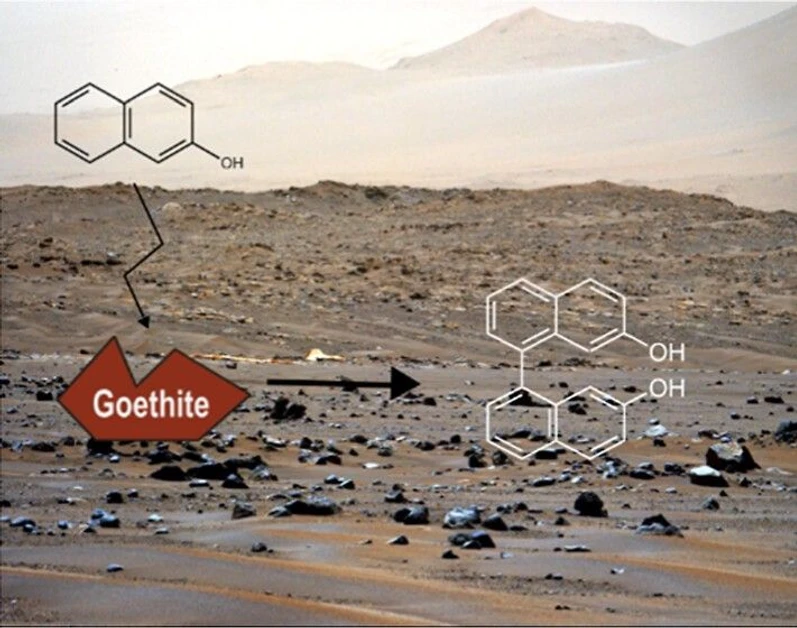
ACS Earth Space Chem. 2026, 10, 6, 1493–1506: Graphical abstract
This study investigates whether iron-bearing minerals common on Mars can promote the oxidative polymerization of organic compounds under Martian environmental conditions. Experiments showed that the iron oxyhydroxide goethite catalyzes the conversion of simple aromatic molecules into more stable dimeric and polymeric products.
The findings suggest that mineral-driven polymerization may significantly enhance the long-term preservation of organic matter on Mars. This mechanism provides new insight into the potential survival of molecular biosignatures and may help guide future landing site selection and sample collection strategies in the search for evidence of past life.
The original article
Oxidative Polymerization of Organic Compounds in the Presence of Iron-Bearing Minerals: Implications for Organic Preservation on Mars
John J. Gumbley*, Nizana Lau, Jonathan S. Watson, and Mark A. Sephton
ACS Earth Space Chem. 2026, 10, 6, 1493–1506
https://doi.org/10.1021/acsestair.6c00006
licensed under CC-BY 4.0
Selected sections from the article follow. Formats and hyperlinks were adapted from the original.
The search for past or present life on Mars commonly relies on the detection of the remains of organic biomolecules. (1−3) For the organic signals of life to be detected, they must first be preserved. Degradation by oxidation, irradiation or microbial activity is an ever-present risk for unprotected organic compounds. One way the kinetic persistence of organic compounds over geological time scales can be enhanced is through polymerization, which is the linking of monomers through addition and condensation reactions into larger molecules. (4−6) Compared to smaller organic compounds, polymers or macromolecules are more resistant to degradation. (7) Vulnerable functional groups may be shielded from attack if they reside in the interior of a macromolecule (5) while polymers become indigestible in an active biosphere if they are too big to be transported across cell membranes. (8) If polymerization results in aromatic compounds, resonance structures caused by electron delocalization are an effective stabilization mechanism (9) and, therefore, aromatic units are much less sensitive to ionizing radiation (10) and more resistant to degradation by heat. (11) Hence, the processes which promote polymerization are of great interest, including the recognition that certain inorganic reactants often found on Mars can initiate polymerization. (12)
Despite the passing of billions of years, the morphology of the modern surface of Mars is very similar to the late Noachian. The absence of plate tectonics, the hyperarid surface, thin atmosphere and lack of an active biosphere has limited weathering processes. (13) Evidence suggests that Mars hosted wet, warm and habitable enclaves for the first 500 million years after its formation some 4 billion years ago. (14−16) The modern surface, however, is hostile to life. (15,16) Average surface temperature is ∼−60 °C with pressure just 1% of that on Earth. (17) The extreme cold and low pressure coupled with a hyperarid environment and exposure to UV and cosmic radiation flux is expected to destroy or transform any exposed organics. (7,18,19) However, the idea that organic matter might survive on Mars was strengthened when aromatic organics were seen in Martian meteorites. (20) Later, in 2013, the Curiosity rover extracted more complex organic compounds from the ancient lakebed in Gale Crater (7) and in 2023 the Perseverance rover also detected possible organic signals on the floor of Jezero crater. (21−23)
Given the harsh surface conditions, if organic matter is to be preserved, from the deep geological past to the present day, it needs a refuge. Organic matter can be protected if it is incorporated into the rock record through adsorption, encapsulation or via chemical reactions that create covalent bonds between organic units and their mineral hosts. (24−27) In particular, organic cross-linking can produce higher molecular weight macromolecules that possess greater kinetic resistance to degradation over geological time scales. (5,6,12) One preservation pathway that is relatively unexplored in planetary science is oxidative polymerization, which is commonly initiated by atmospheric oxygen on Earth (28) but can also be promoted by ferric iron, abbreviated to Fe3+ or iron(III). (29) It has been previously demonstrated how oxidative polymerization can be assisted by mineral oxidants such as iron(III)-containing phyllosilicates making it a plausible mechanism for generating higher molecular weight organic networks on the phyllosilicate- and carbon-rich asteroids. (12)
In this study, we test the hypothesis that Fe(III)-bearing minerals under Mars-relevant conditions can promote oxidative coupling of simple aromatic compounds to form more recalcitrant organic products. We first examined a range of iron-rich materials commonly found on Mars (30) to obtain a qualitative indication of their potential to promote organic polymerizing reactions. Second, a quantitative assessment of oxidative coupling was performed by examining the reaction of 2-naphthol (C10H8O) with the iron(III) oxyhydroxide goethite (α-FeO(OH)). Experimental conditions were designed to approximate simplified Martian near-surface environments, including low pressure, limited water availability and exposure to UV radiation or elevated temperature. 2-Naphthol was selected as a model aromatic compound due to its known propensity to undergo oxidative coupling reactions while goethite was chosen due to its detection on Mars and its redox-active surface chemistry. (34−36) Following organic adsorption, previous studies indicate iron(III) at the mineral surface can be reduced to iron(II), with the cation radical generated by an unpaired electron on naphthol leading to a C–C bond linked dimer,1,1′-bi-2-naphthol also known as BINOL at the ortho position to the hydroxyl group and the liberation of hydrogen. (29,34−38) Further oxidative coupling to produce larger polymers is possible. (12) An appreciation of the propensity of Mars-relevant mineral oxidants to promote polymerization and preservation of organic compounds may assist in selection of astrobiology targets at multiple scales, including for landing sites, in situ measurements, or sampling locations for missions with the objective of detecting preserved organic signals.
2. Methods
2.3. Analysis
Organic reaction products were detected, characterized and quantified by gas chromatography–flame ionization detector (GC–FID) and gas chromatography–mass spectrometry (GC–MS). For the further analysis of goethite and iron(III) chloride at various naphthol wt % the internal standard (IS) was added prior to analysis by GC-FID and GC–MS.
GC-FID analysis was achieved on an Agilent Technologies 6890N GC System. Splitless injection (1 μL) was on a split/splitless injector at 270 °C. Separation was performed on a ZB-5 column (Zebron; 30 m × 0.25 mm × 0.25 μm). The GC oven temperature program was: 40 °C for 2 min then ramped at 5 °C min–1 to 310 °C and held for 14 min.
A separate run on the same GC-FID was performed with a high temperature column to investigate whether heavier macromolecules (trimers or oligomers) were present. At low temperatures larger molecules may not have eluted within the standard run time due to lower volatility and stronger interactions with the stationary phase. The shorter column length (15 m vs 30 m) and higher maximum temperature (330 °C vs 310 °C) enabled these higher molecular weight compounds to elute and be detected within the analytical time frame. Splitless injection (1 μL) was on a split/splitless injector at 280 °C. Separation was performed on a J&W DB-5ht column (Agilent; 15 m × 0.25 mm × 0.10 μm). The GC oven temperature program was: 40 °C for 2 min then ramped at 10 °C min–1 to 330 °C and held for 11 min.
GC–MS analysis: eluted molecules were also analyzed using an Agilent Technologies 7890-5975 GC–MS instrument. Injection was splitless at 270 °C, and a DB-5MS ultra inert (UI) column (J&W; 30 m × 0.25 mm × 0.25 μm) was used for separation. The GC oven was programmed 40 °C for 2 min then ramped at 5 °C min–1 to 310 °C and held for 6 min. Compound peak identification used the NIST mass spectral library and retention indices.
Peak identities were confirmed by comparing retention times and mass spectra to authentic standards of 2-naphthol and 1,1′-bi-2-naphthol (BINOL) dimer (Figures S4). Other compound assignments are considered tentative and based on NIST library matches.
Pyrolysis–GC–MS: To assess nonextractable organic material remaining on the mineral, pyrolysis–GC–MS was performed on representative DCM-exhausted goethite mineral residues. Approximately 5 mg of dried residue was deposited onto a quartz wool plug inside a quartz pyrolysis tube. Samples were heated in a pyroprobe to 650 °C at 20 °C ms–1 and held for 15 s under a helium flow. The resulting vapors were transferred to the GC–MS injector at 270 °C with a 10:1 split. Separation was achieved on the same DB-5MS UI column (30 m × 0.25 mm × 0.25 μm) using the GC–MS oven program described above. Mass spectra were collected in EI mode (70 eV) over m/z 50–550. Compounds in the pyrograms were assigned using the NIST mass spectral library; because pyrolysis produces fragment ions rather than intact molecules, these identifications are regarded as indicative of likely degradation products rather than definitive structures.
3. Results
2-naphthol generally decreased during the experiments as it converted to 1,1′-bi-2-naphthol or other products. The loss of 2-naphthol is displayed in Tables 1–3. The percentages shown represent the mean of replicate tubes for each experimental condition (heat, UV or control), with standard deviations provided where indicated. Figure 1 contrasts the amount of 2-naphthol recovered with the appearance of the dimer when goethite was reacted with the organic compound at various wt % and under different experimental conditions. Representative GC-FID and GC–MS total ion current chromatograms (TIC) are also shown in Figures 2 to 4. The molecular structures of the aromatic compounds discussed in this study are shown in Figure S11.
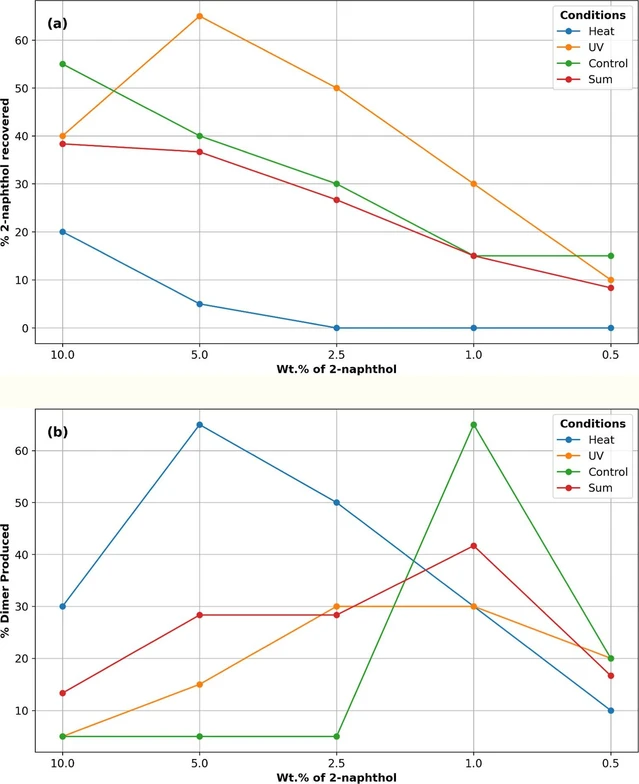 ACS Earth Space Chem. 2026, 10, 6, 1493–1506: Figure 1. (a) The percentage of the original weight of 2-naphthol recovered after reacting with goethite under various conditions. (b) The percentage of dimer produced from the initial weight of organic compound. In both plots the red line is an average of all three conditions.
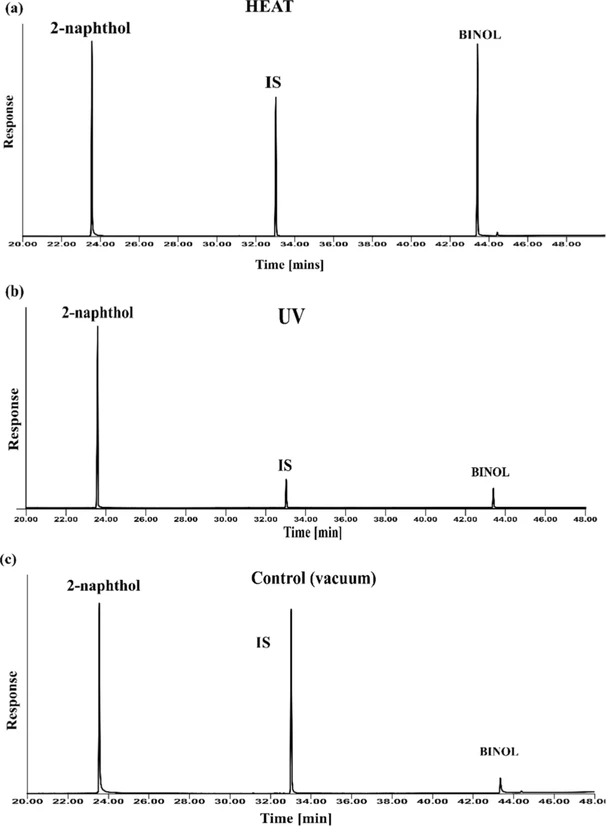 ACS Earth Space Chem. 2026, 10, 6, 1493–1506: Figure 2. Representative GC–FID chromatograms of reaction products obtained from 10 wt % 2-naphthol in the presence of goethite under different experimental conditions (a) heat (b) UV and (c) control. Peaks corresponding to 2-naphthol, the internal standard (IS), and 1,1′-bi-2-naphthol (BINOL) are indicated.
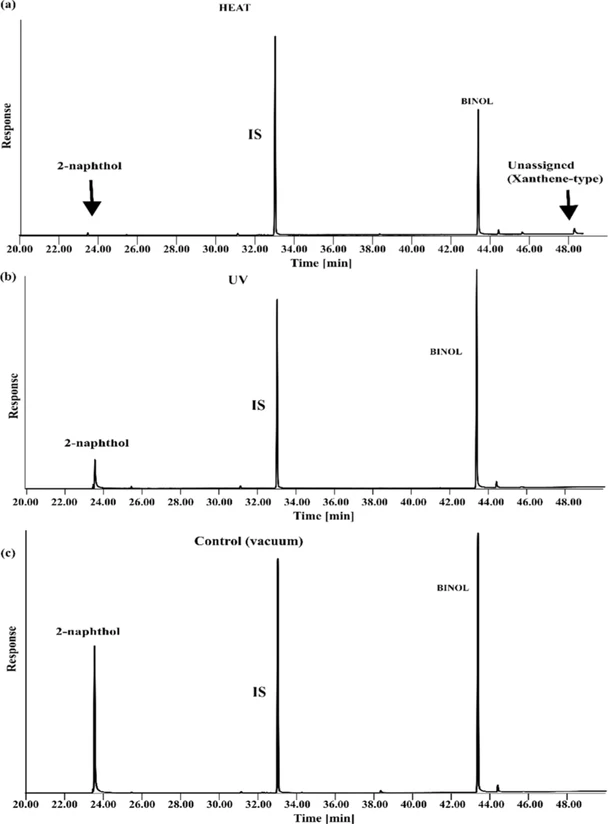 ACS Earth Space Chem. 2026, 10, 6, 1493–1506: Figure 3. Representative GC–FID chromatograms of reaction products obtained from 0.5 wt % 2-naphthol in the presence of goethite under different experimental conditions (a) heat (b) UV and (c) control. Peaks corresponding to 2-naphthol, the internal standard (IS), 1,1′-bi-2-naphthol (BINOL) and an unassigned (xanthene-type) product are indicated.
 ACS Earth Space Chem. 2026, 10, 6, 1493–1506: Figure 4. Representative GC–MS chromatograms of 2-naphthol reacted with iron(III) chloride at 10 wt % under (a) heat (b) UV irradiation and (c) control (vacuum) conditions. Peaks corresponding to 2-naphthol, the dimer product 1,1′-bi-2-naphthol (BINOL) and the internal standard (IS) are indicated. The internal standard peak is truncated.
4. Discussion
4.2. Qualitative Study of Organic Reaction Products
Qualitative studies can reveal which minerals will interact with organic matter to cause oxidative polymerization, we studied several iron-bearing minerals that may be found at the surface of Mars. Tables 1 and 3 highlight the importance of the iron(III) content and its availability in driving a coupling reaction. Goethite appears to be a particularly effective mineral for oxidative polymerization owing to the large specific surface area of the mineral and because its acicular crystals increase the availability of active sites. (63) The surface area can vary between ∼40 m2/g and ∼90 m2/g, depending on the distribution of different crystalline faces. (64,65) The availability of iron(III) at these active sites drives the oxidative coupling of 2-naphthol. (12) The organic compound is first adsorbed onto the surface primarily through the strong affinity of the hydroxyl group for the mineral surface. Deprotonation and the transfer of an electron from the oxygen reduce the ferric (iron(III)) to ferrous (iron(II)). The unpaired electron creates a cation radical on the organic compound which leads to linking of activated 2-naphthols via a carbon–carbon bond ortho to the hydroxyl group and the liberation of hydrogen. (26,31,38)
The ratio between the starting material wt % and the dimer product shows that surface area is the limiting factor in the coupling reaction. (32,59) In general, the loss of 2-naphthol (as shown in Tables 1 and 2) occurs more frequently as the ratio between mineral and organics is increased, reflecting the need for available reactive mineral sites for the reaction to proceed. At higher concentrations, the mineral surface sites become saturated and unreacted 2-naphthol remains.
Data from other minerals in our sample set reveal that their ability to promote oxidative coupling can vary (Table 1). The potential for partially serpentinized peridotite to promote oxidative coupling has not been reported previously. Partially serpentinized peridotite consists of ferromagnesian minerals olivine and pyroxenes that are rich in iron, allowing oxidative coupling via the same process described above, however, this occurs to a lesser extent because of the lower iron(III) content of the serpentinized peridotite.
The lack of reactivity with bastite serpentinite and tremolite serpentinite also supports the hypothesis that iron(III) content is the key component of oxidative coupling. During the process of serpentinization, peridotite minerals become hydrated, resulting in the removal of iron from the crystal structure to magnetite and disseminated grains. (66) Iron-containing phases are also preferentially weathered in serpentinites, leading to the loss of iron from the rock. (67) It appears, therefore, that unaltered or partly altered iron-bearing minerals are those which should be studied for potentially recalcitrant oxidative polymerization products.
5. Conclusion
This study demonstrates that Fe(III)-bearing minerals can actively transform aromatic compounds under simplified Mars-analog conditions. Heating and UV irradiation of 2-naphthol in contact with goethite produced both extractable dimers and a nonextractable, mineral-bound organic fraction that survived solvent removal and released aromatic fragments upon pyrolysis. These results provide experimental evidence that Fe(III) minerals can generate recalcitrant, cross-linked organic residues from simple aromatic precursors.
Goethite is widespread on Mars and forms in aqueous, potentially habitable environments. Our findings therefore identify a mineralogical mechanism by which organic compounds─whether delivered by IDPs and meteorites or generated endogenously─could undergo oxidative transformation to more stable, macromolecular residues. Such residues would be less vulnerable to photolysis and surface oxidants once incorporated into sediments, contributing to the long-term persistence of carbon on Mars.
A key outcome of this work is the demonstration that under the experimental conditions used here, UV irradiation alone can drive Fe(III)-mediated coupling under low-pressure conditions, extending the range of environments in which oxidative transformations could occur on Mars today. The formation of nonextractable, pyrolysis-active residues further suggests that Fe(III) minerals may help generate kerogen-like material independently of biological activity.
Because goethite is both a tracer of past water and an active participant in organic transformation, it represents a high-value target for future life-detection and organic-matter preservation studies on Mars. Our results support the view that Fe(III) oxyhydroxides are not passive hosts but chemically reactive surfaces capable of contributing to the formation and retention of complex organic residues over geological time scales.