PAH Induction upon Pyrolysis of Hydroxyl-Terminated Polybutadiene-Based Solid Rocket Fuels
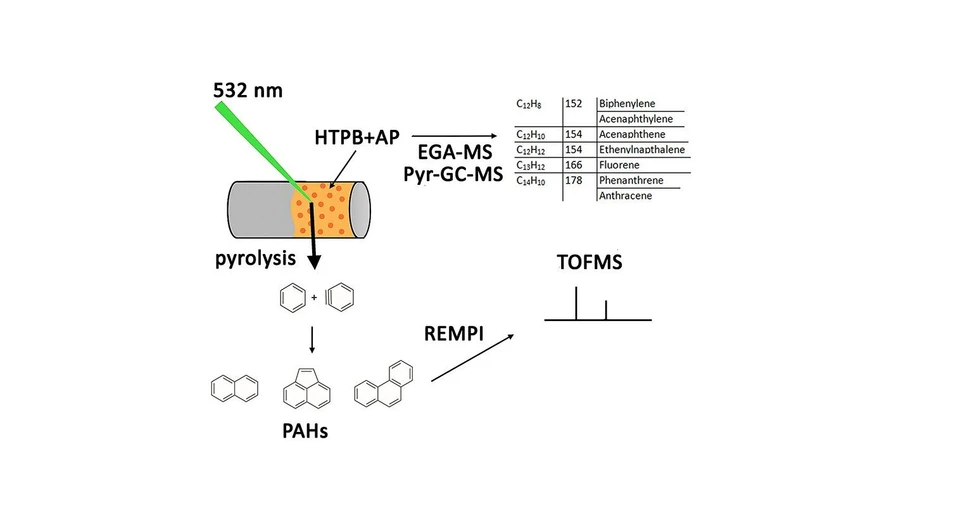
J. Phys. Chem. A 2025, 129, 28, 6356–6373: Graphical abstract
Using a molecular beam (MB) approach with TOFMS detection, we studied the pyrolysis of hydroxyl-terminated polybutadiene/ammonium perchlorate (HTPB/AP) mixtures under solid rocket motor conditions (>1000 °C, μs time scales). Unlike pure HTPB, the presence of AP induces formation of polycyclic aromatic hydrocarbons (PAHs) up to m/z 240–260, along with benzyne and benzene, while suppressing acyclic C6 products.
Evolved gas analysis (EGA-MS) and pyrolysis-GC-MS confirmed rapid PAH growth to four- and five-ring structures within tens of microseconds, revealing the key products and suggesting tentative pathways for their formation.
The original article
PAH Induction upon Pyrolysis of Hydroxyl-Terminated Polybutadiene-Based Solid Rocket Fuels
Valeriia Karpovych, Nataliia Haiduk, Eugene Oga, Nafisa Bala, Alena Kubátová, Evguenii Kozliak*, and Mark Sulkes*
J. Phys. Chem. A 2025, 129, 28, 6356–6373
https://doi.org/10.1021/acs.jpca.5c03340
licensed under CC-BY 4.0
Selected sections from the article follow. Formats and hyperlinks were adapted from the original.
Hydroxyl-terminated polybutadiene (HTPB) is used worldwide as solid fuel and binder in rockets and ramjets, in mixtures with ammonium perchlorate (AP, NH4ClO4), aluminum powder and minor additives, e.g., ballistic modifiers. (1−3) Typical solid rocket fuel consists primarily of submm AP particles suspended in a binder matrix consisting of diisocyanate cross-linked HTPB, often using methylene diphenyl diisocyanate (MDI) as a cross-linker. (2)
For accurate modeling of HTPB pyrolysis product combustion, knowledge of the actual chemical composition and speciation is essential. (1) Without this knowledge, models must be based on simplified chemical speciation, using generic low-molecular weight (MW) species, e.g., ethylene, to represent the complex organic composition. (3,4) To enable improvement in these models, a number of studies were conducted on the chemistry occurring during neat HTPB pyrolysis, focusing on product speciation. (5−9) In operating rocket motors, relevant temperatures range from ∼600 °C at the burning solid fuel surface to ∼1200 °C at the AP monopropellant flame, a separation in distance of only microns. (1) While temperatures in this range can be replicated by methods such as pyrolysis-gas chromatography with mass spectrometric detection (Pyr-GC-MS), the extremely steep thermal gradient inherent for combustion means that relevant heating rates can be as high as 106 °C/s. Since the time scale for chemistry in the Pyr-GC-MS studies is in the seconds range, it is not evident that the products detected in those studies (5−7) are actually relevant to combustion. Two studies using flash pyrolysis methods for faster heating were able to approach a heating rate of 103 °C/s, (8,9) still well short of the relevant rates. The foregoing studies were reported in the 1990s to 2000. A few subsequent experimental studies did not add any significantly new information, presumably because faster heating rates could not be attained. (10−12)
These slower methods fail to capture the chemistry occurring on true motor operation time scales, hence the need for our MB-based approach. We have recently repurposed standard supersonic gas expansion molecular beam (MB) methods such that they can be used to study pyrolysis product chemistry occurring on microsecond time scales, (13) now with temperatures and also heating rates relevant to operating rocket motors. Having applied these methods to investigate neat HTPB pyrolysis product chemistry, (14) it is not entirely surprising that the major product profiles we observed did not exactly match the ones obtained in the earlier studies, although generally, we detected similar products, species containing 2–7 carbon atoms. (It is likely that there were also C1 products, namely methane. However, its ionization potential of 12.6 eV (15) is higher than that we can detect with 118 nm photons of 10.5 eV.) Unlike results from prior publications obtained in the 800–850 °C range, where benzene and toluene were detected as substantial products, we observed little or none of them. By contrast, several mechanistically important radical species were identified. It was also observed that they processed further in time, stabilized by both hydrogenation and dehydrogenation. Hydrocarbon species containing three carbon atoms were abundant compared to prior studies, at the expense of higher-MW products, particularly 4-vinylcyclohexene, which was observed in a number of prior studies. (5−9) Thus, the knowledge gap in primary pyrolytic product identification was addressed. However, a knowledge gap still remains in terms of secondary pyrolytic products, those formed in association with chemical reactions. This study addresses that problem for aromatic species that we are able to detect using resonance enhanced multiphoton ionization (REMPI) methods on shorter time scales (16) while using evolved gas analysis with mass spectrometric detection (EGA-MS) to extend the time scale to significantly longer values. Then, Pyr-GC-MS was used for accurate identification of the PAH products formed to decipher the chemical mechanism of their formation.
Furthermore, the prior studies generally did not consider the impact of AP and the cross-linking of HTPB. Most of these works investigated pyrolysis of neat HTPB, with the implicit assumption that AP is merely a featureless oxidant. (5,6,8,9) Only the Pyr-GC-MS studies of Ganesh et al. (7) and Brill and Budenz, (4) conducted on much longer time scales, addressed the determination of HTPB plus AP decomposition products. (7) Ganesh et al. observed several low-MW PAHs when AP was present – and none when it was absent. PAHs are well-known soot precursors and environmental pollutants. Besides environmental concerns, soot accumulation initiated by PAH formation would impact possible reusable launchers, thus making the investigation of PAH formation practically relevant.
In our initial study of HTPB pyrolysis products, we employed 118 nm single photon ionization (SPI) for general product detection. (14) These products were predominantly aliphatic. For selective and sensitive detection of aromatic compounds (or just “arenes”), resonant two photon ionization is particularly useful, (16) an instance of REMPI. Here, the first photon has a wavelength in the vicinity of excited state absorbing levels of the aromatic species. For this purpose, 266 nm photons, the fourth harmonic of Nd:YAG lasers, are conveniently available; a second 266 nm photon is sufficient to reach the ionization states. REMPI can be orders of magnitude more sensitive than a nonresonant two photon ionization process (i.e., for species with no absorbing levels in the vicinity of 266 nm, typically the case for saturated aliphatic hydrocarbons), making it ideal for tracking aromatic species. For MB-based pyrolysis studies, we have previously employed this REMPI method for the detection of PAHs formed at short residence times in several other systems, including pyrolysis of triglycerides, 2,4-dinitrotoluene and lignin. (17−21)
Herein, we extended our studies on neat HTPB to consider pyrolysis products of diisocyanate cross-linked HTPB, with and without the inclusion of AP, using REMPI for sensitive detection of aromatic compounds. In this paper, we are principally concerned with their influence on the formation of polycyclic aromatic products, particularly PAHs.
Methods
EGA-MS and Pyr-GC-MS Experiments
To enable online pyrolysis experiments on a longer time scale, a PY-3030D multishot pyrolyzer with an autoshot sampler (Frontier Laboratories) was coupled to an Agilent 7890A GC system with a quadrupole 5975C MS detector (Agilent, Santa Clara, CA, USA). The experiments were conducted in two modes (i.e., EGA-MS and Pyr-GC-MS) as described below.
In the EGA-MS mode, the GC inlet was maintained at 300 °C in split mode (1:50) and the GC column was replaced with a deactivated tube (Ultra ALLOY-DTM, 0.15 mm ID × 3 m length, Frontier Laboratories) for direct analyte transfer from the pyrolyzer to the MS using helium as a carrier gas at a flow rate of 1.0 mL/min. Samples were isothermally pyrolyzed at 500, 600, 700, and 800 °C for 10 min each (the majority of the products evolved within 0.5 min). MS analysis was performed in full scan mode (10–700 m/z) using electron ionization (EI) at 70 eV with a rate of 7.2 s/scan.
The second mode, Pyr-GC-MS, was performed using a DB-5MS GC capillary column (32 m length, 0.25 mm ID, and 0.25 μm film thickness). Samples were pyrolyzed at 700 and 800 °C for 0.5 min each. The GC inlet was set to 300 °C in split mode (1:20), with helium as the carrier gas (1.0 mL/min). The GC oven temperature program started at 60 °C held for 1 min, followed by a ramp rate of 10 °C/min to 300 °C and held for 1 min, then 1 °C per minute to 320 °C and held at a final time of 4 min to enable sufficient separation of PAH isomers but for chrysene and triphenylene. MS analysis was conducted in full scan mode (10–700 m/z) using EI at 70 eV and a scan rate of 0.4 s/scan.
PAH identification was performed by matching retention times of some commercially available standards denoted as (S) and/or by matching the analyte MS spectrum to the NIST–2020 Library based on the percentage match denoted as T (% match). The minimum percent match observed was 70%.
Results and Discussion
118 nm SPI: The Influence of AP and Cross-Linking on TOFMS Profiles
In contrast to our previous paper, (14) which reported pyrolysis products of neat HTPB alone, herein we consider the case most relevant to solid rocket fuels, probing the pyrolytic products formed by MDI cross-linked HTPB with and without AP. The 118 nm SPI TOFMS of cross-linked HTPB with and without AP are shown in Figure 2B. The advantage of using 118 nm SPI is that it is nonselective; all products present should produce peaks, roughly in proportion to relative species population. With the exception of the new peaks at m/z 76 and 78 for the AP case, with a concomitant decrease in m/z 83–84 (all three being due to key C6 size products), the product peaks seen are similar in each case and also similar to the earlier observations of neat HTPB alone. (14) The disadvantage of SPI is that aromatic peaks at m/z > 100 were barely discernible, if at all discernible; REMPI was used in the next sections to enhance them. In each experiment, there can be some rod preparation dependent differences (e.g., distribution of different C4 compound peaks; 1,3-butadiene was often, but not always, hydrogenated or dehydrogenated).
 J. Phys. Chem. A 2025, 129, 28, 6356–6373: Figure 2. Effect of AP on pyrolysis products of HTPB, both cross-linked and neat. (A) 118 nm PI TOFMS with neat HTPB, then using two different HTPB:AP ratios. (B) 118 nm SPI TOFMS of MDI cross-linked HTPB versus MDI cross-linked HTPB with the addition of AP. A mixture of HTPB plus MDI was placed on a ceramic rod with the prior deposition of a graphite slurry; cross-linking subsequently occurred. AP was deposited on one portion of the rod. In each instance, 118 nm PI was conducted at the front edge of the He gas pulses.
Species of C3–C6 size appeared in 118 nm PI TOFMS (Figures 2 and 3), with peaks of ions produced by hydrocarbons and corresponding free radicals of a varied degree of unsaturation. The C3 species were represented with two major signals of m/z 40, C3H4 (either allene or propyne) and m/z 41, C3H5 (allyl radical). C4 products yielded a series of peaks ranging from m/z 49 (diacetylene radical) to 58 (butane, C4H10). C5 species also yielded a number of peaks, with a major one of m/z 65, C5H5, presumably the cyclopentadienyl radical. A peak at m/z 71, usually appearing on graphite but also sometimes observed on metal rods, is evidently due to a pentyl radical. Traces of C7 species were detected, represented by toluene, m/z 92. An interplay of hydrogenation and dehydrogenation reactions noted in our previous publication (14) resulted in significant C═C bond hydrogenation of certain products, e.g., m/z 57 and 58 among the C4 species, at the expense of the other compounds, which were significantly dehydrogenated, e.g., most of C5 and some C4 products. A qualitatively similar primary pyrolytic product composition was reported in earlier studies. (5−9)
 J. Phys. Chem. A 2025, 129, 28, 6356–6373: Figure 3. 118 nm PI TOFMS at the front edge of gas pulses following 532 nm rod ablation pulses for MDI cross-linked HTPB plus AP on a variety of rod surfaces with varied HTPB:AP ratios. While signals were always stronger on graphite matrices, in each instance, significant new product peaks at m/z 76 and 78 appeared.
Pyrolytic Product Identification via Pyr-GC-MS
Pyr-GC-MS requires longer heating times, but unlike EGA-MS, it enables product identification using the MS EI library, based on specific ion fragmentation patterns as well as retention time comparison with standards. Based on the EGA-MS results, Pyr-GC-MS analysis were performed on the samples at three isothermal temperatures, 700, 800, and 900 °C. The chromatograms, with the pertinent peaks marked with numbers, are shown in Figure 8. The PAHs identified are listed in Table 1. As shown under Materials and Methods, the PAH identification was conducted by both MS and matching the analyte retention time with that of the corresponding pure standard (whose chromatograms and mass spectra are shown in Figure S7a,b). The GC temperature program was sufficient to clearly separate and identify all of the observed PAHs, except for chrysene, for which a slightly different temperature gradient had to be applied (Figure S8). Additional PAH structures identified by Pyr-GC-MS are shown in Figure S9.
 J. Phys. Chem. A 2025, 129, 28, 6356–6373: Figure 8. Pyr-GC chromatograms obtained at 700, 800, and 900 °C. The peak labels correspond to those shown in Table 1 in the column shadowed in gray.
Conclusions
The formation of PAHs as a result of HTPB pyrolysis was observed. It occurs on a longer time scale in oxidant-free neat HTPB pyrolysis, but either the HTPB cross-linking or the addition of an oxidant, AP, shortens the time scale to microseconds. The role of AP is the facilitation of oxidation, i.e., dehydrogenation reactions, including the key pathways leading to the production of benzyne and similar “aryne” intermediates of larger size PAH formation. Once such a key PAH precursor is formed, it stabilizes via its addition reaction with a suitable aliphatic or aromatic product of HTPB pyrolysis to enable the PAH growth. The observed products may be accounted for by unsubstituted PAHs up to MW > 250–260 Da plus their alkylated (mostly methylated) derivatives and partial hydrogenation products. The process time scale appears to finish within tens of μs, given that PAHs of similar size were detected by short time scale TOFMS and much longer time scale EGA-MS and Pyr-GC-MS. This system may serve for future studies of benzyne-driven PAH growth. Given that PAHs were observed by Pyr-GC-MS in large amounts, being almost the only significant GC-elutable products of HTPB pyrolysis, the environmental impact of burning solid composite propellants may need serious consideration.