Dual-Column HS-GC-FID/FID Method for In-Depth Analysis of Low-Molecular-Weight Volatile Alcohols in Postmortem Biological Material
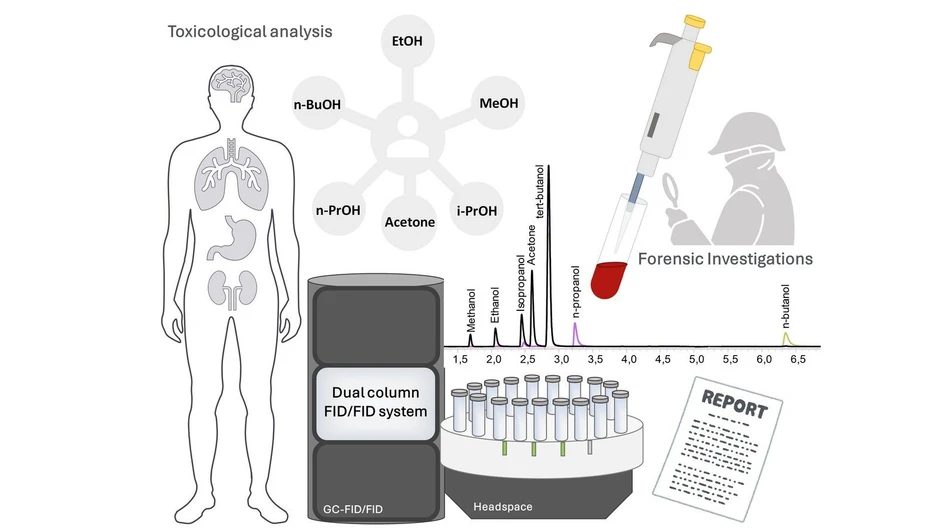
J. Xenobiot. 2026, 16(3), 80: Graphical abstract
This study describes the development and validation of a dual-column, dual-detector HS-GC-FID/FID method for the forensic analysis of ethanol and other low-molecular-weight volatile compounds in biological samples. The method demonstrated excellent linearity, low detection limits, high precision, and accuracy, and was successfully verified through international proficiency testing.
In addition to routine forensic application, the study reviews current practices in forensic alcohol analysis and highlights the lack of globally harmonized analytical standards. The authors propose essential methodological recommendations to improve the reliability and evidential value of ethanol determination in forensic toxicology.
The original article
Dual-Column HS-GC-FID/FID Method for In-Depth Analysis of Low-Molecular-Weight Volatile Alcohols in Postmortem Biological Material
Paweł Szpot, Olga Wachełko, Kaja Tusiewicz and Marcin Zawadzki
J. Xenobiot. 2026, 16(3), 80
https://doi.org/10.3390/jox16030080
licensed under CC-BY 4.0
Selected sections from the article follow. Formats and hyperlinks were adapted from the original.
The determination of low-molecular-weight volatile alcohols in postmortem material using headspace gas chromatography (HS-GC) is routinely performed in forensic laboratories. These analyses are important not only for law enforcement agencies in the broad sense, but also for insurance companies that decide on the payment of compensation under insurance policies. Typically, routine determination of alcohols such as methanol, ethanol, isopropanol, n-propanol, and n-butanol is sufficient to establish whether death occurred as a result of poisoning with these substances. In forensic toxicology practice, however, there are also situations in which the determination of additional chemical compounds in biological material proves to be essential. One such compound is acetone, the determination of which is crucial not only in cases of acetone or isopropanol poisoning (since acetone is a metabolite of the aforementioned alcohol) [1], but also in the diagnosis of ketosis caused by diabetes, hypothermia, or starvation [2]. Criminal cases can be complex, and therefore, to achieve a better understanding of the circumstances preceding death, toxicological analyses are sometimes extended to also include other compounds, such as acetaldehyde [3].
Postmortem blood toxicological analysis is of particular importance because it plays a key role in determining the cause of death, especially in cases of unexplained sudden death and deaths occurring under suspicious circumstances. Even a simple screening for volatile chemical compounds can, at an early stage, allow determination of whether death resulted from poisoning or was a consequence of an underlying disease suffered by the deceased (e.g., untreated diabetes) [4].
One of the fundamental assumptions in forensic toxicological investigations is that their results must have evidential value and withstand scrutiny in court. Only such results can be used, for example, to reconstruct the circumstances preceding death, determine the time of substance intake or the dose of a toxic agent, or assess whether the deceased was intoxicated. This is particularly important in cases of traffic accidents, occupational accidents, drownings, domestic violence, and deaths occurring during police custody. It is worth emphasizing that the interpretation of postmortem toxicological results requires particular caution due to the multitude of “confounding” factors, such as interindividual variability, substance stability, endogenous formation, the postmortem interval (PMI), and the circumstances of death. To avoid introducing additional variables that could further complicate interpretation, the applied analytical method must be reliable, i.e., accurate, selective, resistant to interference, and preferably verified through independent proficiency testing [5].
In gas chromatographic analysis of low-molecular-weight alcohols, either direct injection or the headspace technique is employed [6]. In the past, even highly invasive approaches were used, such as the direct injection of whole blood into the gas chromatograph injector [7]. However, the headspace technique has become the most widely used technique for the determination of alcohols in forensic laboratories. This preference can be attributed to several well-established advantages, most notably that the method allows the sample to be analyzed with minimal or no preparatory steps, irrespective of the biological matrix (e.g., without extraction or protein precipitation). Additional benefits include practically negligible matrix effects, elimination of the need for inlet liners, thereby minimizing the risk of contamination or carryover within the analytical system, and reduced deterioration of the chromatographic column compared with direct injection.
However, it should be noted that in the context of postmortem samples (particularly those collected from putrefied cadavers), the impact of decomposition on analyte partitioning cannot be precisely assessed. While headspace analysis generally exhibits negligible matrix effects, pre-death specimens from the same individual are rarely available for direct comparison, making it difficult to determine the extent to which postmortem changes might influence measurements. Moreover, the blood samples are subjected to multiple dilutions with an internal standard, which further minimizes potential matrix effects.
Despite numerous established methods for the determination of volatile alcohols in postmortem biological samples, current standard approaches often face limitations that can compromise forensic reliability. Single-column analyses may be prone to co-elution and interferences from structurally similar compounds, while reliance on a single detector increases the risk of undetected fluctuations and errors. Additionally, inappropriate selection of internal standards and postmortem formation of endogenous alcohols and other volatile compounds can further bias quantification. These issues highlight a critical gap, as widely adopted methods that integrate redundant analytical controls with validated procedures to minimize errors and ensure evidential reliability remain limited.
The aim of this study was to develop a method for the determination of methanol, acetone, ethanol, n-propanol, isopropanol, and n-butanol using headspace gas chromatography with dual columns and dual-flame ionization detectors. The practical applicability of the method was demonstrated using authentic forensic samples, including putrefaction fluid and antemortem blood. This study addresses the aforementioned gap by employing a dual-column/dual-FID approach, which allows cross-verification across two independent chromatographic conditions, thereby enhancing both the accuracy and reproducibility of forensic alcohol analysis. Furthermore, this paper aims to draw the attention of toxicologists worldwide to several critical factors that can significantly influence measured ethanol concentrations, potentially leading to legal and financial consequences, such as denial of compensation due to falsely elevated ethanol levels.
2. Materials and Methods
2.4. Apparatus
A Shimadzu GC-2010 Plus AF IVD system (Kyoto, Japan), fitted with an advanced flow controller (AFC), a split/splitless (SPL) inlet, and two flame ionization detectors (FID), was employed. Samples were processed and introduced via a Shimadzu HS-20 static headspace autosampler (Kyoto, Japan), with transfer to the GC through a single SPL inlet. The HS effluent was split equally (1:1) using a SilFlow® microfluidic platform (SHI-980-10593, Trajan, Ringwood, VIC, Australia) and directed onto two capillary columns: Zebron-BAC1 (30 m × 0.32 mm i.d., 1.8 μm film; Phenomenex, Torrance, CA, USA) and Zebron-BAC2 (30 m × 0.32 mm i.d., 1.2 μm film; Phenomenex, Torrance, CA, USA). Each column fed an independent FID channel, allowing concurrent acquisition from both separations. Headspace settings and chromatographic conditions for alcohol congener analysis followed those reported previously in [8].
3. Results
Validation results are shown in Table 2. All presented values fall within the acceptable range for toxicological analysis of biological materials, in accordance with the recommendations of the German Society of Toxicological and Forensic Chemistry (GTFCh) [10]. Quality-control samples were prepared at three concentrations (low, medium, and high relative to the calibration range) by spiking blank samples. Relative error (RE) values within ±15% and precision expressed as relative standard deviation (RSD) ≤ 15% were considered acceptable, in accordance with GTFCh recommendations. The method, developed in 2019, has been subjected to international proficiency testing for ETB Ethanol in blood (ARVECON) and has consistently achieved positive results in each test. Additionally, the developed method for the determination of ethyl alcohol in blood was evaluated and achieved positive results in other proficiency tests, namely: the AXIO LGC Proficiency Testing Scheme in Drugs in blood Quantitative analyte selection, PT-TX-BLD (accreditation ISO/IEC 17043) (LGC Group Limited, Guildford, UK). Furthermore, the HS-GC-FID/FID method has been successfully implemented for routine toxicological analysis in our laboratory during the past 6 years.
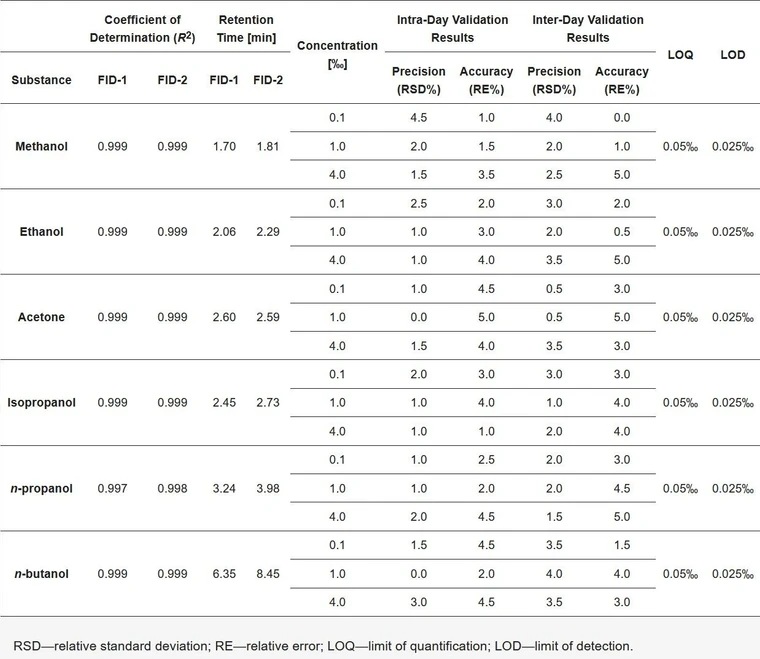 J. Xenobiot. 2026, 16(3), 80: Table 2. Validation results for six quantified volatile compounds: methanol, ethanol, acetone, isopropanol, n-propanol, and n-butanol.
Chromatograms of all compounds analyzed using the presented method, collected on two columns (Zebron ZB-BAC1 and Zebron ZB-BAC2), are shown in Figure 1. During routine toxicological examinations, we analyzed various biological fluids, including standard matrices such as whole blood, serum, plasma, vitreous humor, and urine, as well as less commonly studied matrices such as bile, putrefaction fluid, and gastric contents.
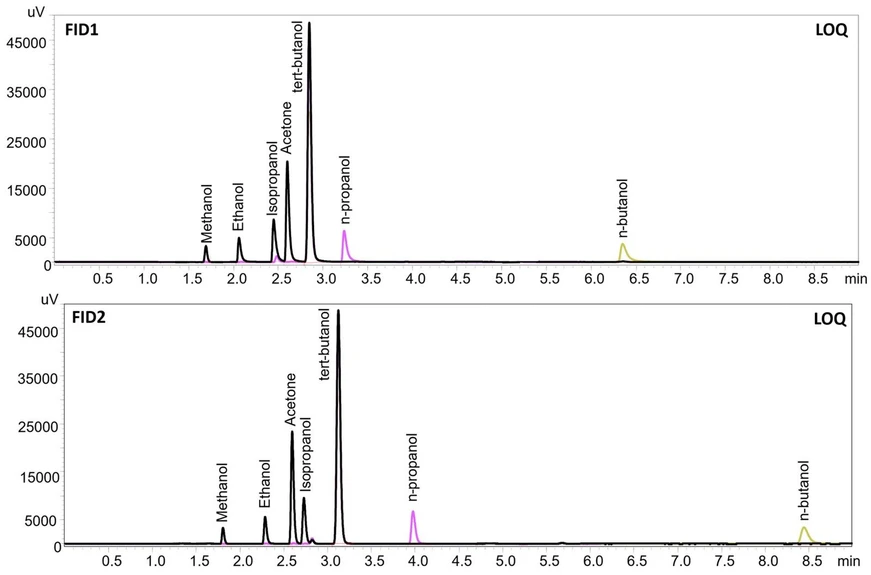 J. Xenobiot. 2026, 16(3), 80: Figure 1. Chromatograms of ISTD and LOQ of volatile compounds obtained from two columns (Zebron ZB-BAC1 and Zebron ZB-BAC2) and two flame ionization detectors. The retention time of tert-butanol (ISTD) on the first column was 2.848, and on the second it was 3.131.
Chromatograms from representative authentic cases are shown in Figure 2, including putrefaction fluid (containing 0.4‰ of ethanol) compared with a standard whole blood sample containing 1.38‰ ethanol.
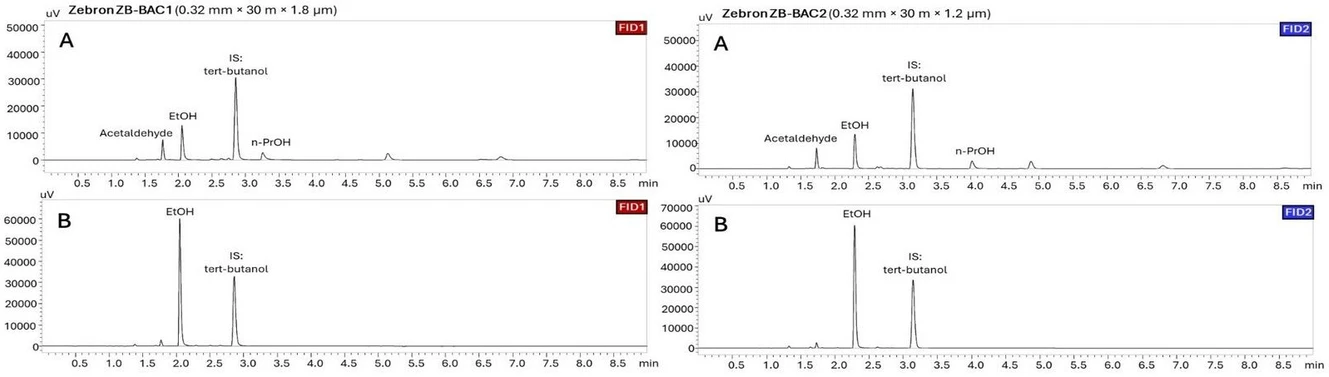 J. Xenobiot. 2026, 16(3), 80: Figure 2. (A) Chromatograms of putrefaction fluid (with ethanol concentration of 0.4‰); (B) chromatograms of antemortem blood sample (with ethanol concentration of 1.38‰). Results were provided for both columns: Zebron ZB-BAC1 and Zebron ZB-BAC2.
5. Conclusions
The findings presented in this study demonstrate that reliable forensic determination of ethanol and other volatile compounds requires a comprehensive analytical strategy that extends beyond routine instrumental analysis. Despite the long-standing use of alcohol determinations in forensic practice, significant methodological limitations persist, particularly with respect to selectivity, internal standard selection, and control of pre-analytical and analytical variables. Based on a critical evaluation of currently published methods and supported by experimental evidence and authentic forensic casework, several key methodological principles emerge as essential for ensuring the evidential reliability of ethanol analysis in forensic toxicology. These principles are summarized below:
- Using two columns with different polarities combined with two detectors.
- Avoiding internal standards such as n-propanol, n-butanol, and other substances that are formed postmortem in forensic investigations.
- Utilizing tert-butanol as an internal standard in forensic toxicological practice.
- Analysis of quality-control (QC) concentrations defined by law for DUI threshold limits, with verification that precision and accuracy remain within acceptable ranges.
- Ensuring that sample preparation is performed in facilities free from exposure to airborne organic solvent vapors, particularly methanol and ACN (which are routinely used for protein precipitation in other toxicological analyses).
- Preparation of analytical batches including two replicates of each sample, analyzed in a forward- and reverse-order sequence (e.g., samples 1–5 followed by 5–1) to verify analytical consistency.
- Verification of internal standards and blank samples in each batch to ensure the absence of contamination during the pre-analytical phase.
- Ensuring compliance with the acceptance criterion of a maximum 5% deviation between results, based on four measurements per sample.
- Careful chromatographic evaluation and critical assessment of peak shape, symmetry, and resolution to minimize the risk of undetected interferences, particularly when using detectors such as FID, where retention time is the sole discriminating parameter.
- Routine performance of independent proficiency tests to assess whether the method meets required accuracy and precision standards.
- Biological fluids intended for forensic toxicology testing should be collected in tubes containing sodium fluoride (NaF) and stored under controlled conditions in a refrigerator maintained at 2–8 °C.