News from LabRulezGCMS Library - Week 39, 2025
LabRulez: News from LabRulezGCMS Library - Week 39, 2025
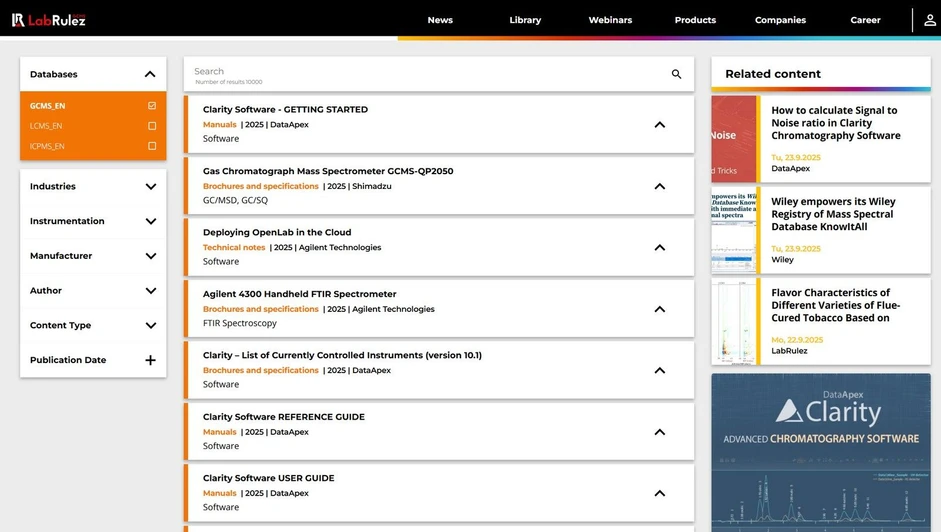
Our Library never stops expanding. What are the most recent contributions to LabRulezGCMS Library in the week of 22nd September 2025? Check out new documents from the field of the gas phase, especially GC and GC/MS techniques!
👉 SEARCH THE LARGEST REPOSITORY OF DOCUMENTS ABOUT GCMS AND RELATED TECHNIQUES
👉 Need info about different analytical techniques? Peek into LabRulezLCMS or LabRulezICPMS libraries.
This week we bring you application notes by Agilent Technologies, EST Analytical, Shimadzu and Thermo Fisher Scientific!
1. Agilent Technologies: A Chemometric Approach for Ambient Air Monitoring Using Thermal Desorption GC/MS
- Application note
- Full PDF for download
Monitoring VOCs is crucial for assessing air quality in industrial and urban settings. These compounds, which include propene, hexachlorobutadiene, and naphthalene, vary in volatility and encompass both polar and nonpolar chemicals. Recognizing the importance of standardized monitoring, the Bureau of Indian Standards (BIS) has developed specific methodologies for these compounds under the IS 5182 series.
IS 5182-27 focuses on the measurement of vapor-phase organic chemicals such as vinyl chloride and nC22 hydrocarbons in air and gaseous emissions. This method employs diffusive (passive) sampling onto sorbent tubes or cartridges, followed by TD (see Figure 1) and capillary GC analysis. The passive sampling approach offers advantages in terms of ease of deployment and cost-effectiveness, making it suitable for widespread monitoring applications.
To reveal relevant patterns and sources of variation in these large environmental datasets according to the IS-5182 guidance, this application note proposes chemometric analysis using the Markes TD100-xr automated thermal desorber (Figure 2) and the Agilent 8890 GC system with 5977C GC/MSD (Figure 3). Chemometrics is a discipline that uses mathematics, statistics, and formal logic to design or select optimal experimental procedures. Chemometric techniques commonly used for clustering are the hierarchical agglomerative cluster analysis and PCA with factor analysis.
Conclusion
This application note highlights the comparison of different air sampling strategies and shows their effect on qualitative and quantitative analysis of VOCs. Active (pumped) sampling helped with faster analysis, which is required for controlled and sensitive real-time monitoring of ambient air. Chromatograms of air sampled at various locations showed the presence of VOCs such as benzene, toluene, ethyl benzene, and xylenes. Many common and unique compounds were found at each location. The intensity of these compounds showed variations at different locations. Fewer compounds with lower intensities were observed in air samples from a residential area, whereas more compounds with higher intensities were observed in air samples from a traffic area.
Passive sampling was a comparatively cost‑effective and long-term approach and provided consistent replicate results. The chromatographic overlays of different sampling times indicated an increasing trend in peak intensities with respect to time. There was a considerable rise in peak intensities for the 1-week sampling period, as compared to 24-hour sampling. There was a slight rise in peak intensities for the 2-week sampling period, as compared to 1-week sampling. The PCA plot suggested the peak distribution obtained in each dataset. One-week sampling results showed consistent replicate results. Use of the chemometrics software Agilent Mass Profiler Professional added value by providing data visualization for interpretation.
2. EST Analytical: USEPA 524.2 Method Validation Using the Evolution Purge and Trap Concentrator and the Centurion WS Autosampler
- Application note
- Full PDF for download
USEPA Method 524.2 calls for purge and trap sampling coupled with a Gas Chromatograph (GC) and Mass Spectrometer (MS) for separation and analysis. It has an extensive list of compounds and requires lower detection limits due to its use in drinking water testing. A 20% relative standard deviation for compound response factors is required across the calibration curve while the calibration check standard analytes have to be within 30% of the expected concentration.
Currently, this method calls for a 5mL or 25mL purge volume and a four minute desorb time. These method requirements can pose a challenge for the analyst due to the amount of moisture that is created. The negative effects of the increased water vapor include instability of the chromatography, band eluting and poor peak shape to name a few. A side effect of this instability is sample re-runs and lost laboratory productivity. In addition, a common practice for mitigating moisture is increasing the GC inlet split rate. This poses yet another difficulty as the increased split rate can result in reduced sensitivity. EST Analytical’s eight port valve in the Evolution purge and trap concentrator aids in limiting the water exposure because the water management of the system is not part of the desorb pathway. This feature also enables laboratories to use a smaller split ratio at the GC inlet thus increasing sensitivity.
Experimental
The sampling system used for this study was the EST Analytical Evolution purge and trap concentrator and the Centurion WS autosampler. The concentrator was affixed with a Vocarb 3000 trap and connected to an Agilent 7890A GC and 5975C inert XL MS. The GC was configured with a Restek Rxi-624 Sil MS 30m x 0.25mm x 1.4µm column. Sampling parameters are listed in Table 1 while Table 2 enumerates the GC/MS parameters.
Conclusions
This study demonstrated the effectiveness of the Evolution/Centurion purge and trap sampling system. The results passed all of the USEPA Method 524.2 criteria for both linearity and detection limits. Since the Evolution bypasses the water management trap during the four minute desorb process, the amount of water effecting the experiments was limited. Furthermore, the forty to one split ratio at the GC inlet provided excellent detection limits as the system was more sensitive to the low level standard requirements of the method. The lower split rate has an added benefit of reducing laboratory helium consumption when setting it against other system’s higher split ratios. Finally, the precision and percent recovery results showed the reliability of the system in producing accurate experimental findings.
3. Shimadzu: Dual-Column Analysis of Blood AlcoholContent (BAC) Using Nitrogen Carrier Gas with Brevis GC-2050
- Application note
- Full PDF for download
Analysis of blood alcohol content (BAC) and other volatile organic compounds (VOCs) is essential for law enforcement agencies to determine alcohol intoxication and its role in traffic accidents, assaults, and injuries, as well as to identify the causes of certain criminal behaviors, poisonings, and so on.
Typically, this analysis is performed by a gas chromatograph (GC) that is combined with a headspace sampler (HS) and a flame ionization detector (FID). Since accurate results are essential with BAC analysis, 2 columns can be used with different separation characteristics so that cross-checking can be performed. By using an integrated HS-GC system equipped with 2 FIDs connecting to a dual-column configuration, crosschecking can be performed in a single analysis. In this system, the columns are directly connected to the transfer line using a 2-hole ferrule, which minimizes sample losses due to adsorption.
In addition to the high-end Nexis GC-2030, Shimadzu also offers the Brevis GC-2050 as a compact gas chromatography solution, and in this Application News, it is used with an HS-20 NX headspace sampler (Fig. 1) to perform BAC analysis. Hydrogen was used as the carrier gas in a similar experiment in Application News 01-00570, but in this experiment, nitrogen was used because it is a cheaper alternative carrier gas. Nitrogen generally has an adverse effect on separation, so this experiment also investigated the conditions for separation for 10 types of blood VOCs.
Separation of 10 Blood VOCs
A solution of 10 VOCs spiked with blood (0.1 mg/mL) was analyzed to determine the separation of methanol, acetaldehyde, ethanol, isopropyl alcohol, acetonitrile, acetone, tert-butanol, 1-propanol, methyl ethyl ketone, and ethyl acetate. The resulting chromatogram is shown in Fig. 6. All peaks were detected within 6.0 minutes in the BAC PLUS1 column and within 3.5 minutes in the BAC PLUS2 column, indicating good separation. The elution sequence of the 10 blood VOCs differed significantly between the columns, which enhanced the system’s qualitative capability. Table 4 shows the retention time of each compound and the repeatability (n=5) of the peak area ratio for the tert-butanol internal standard.
Conclusion
This experiment involved dual-column analysis of blood alcohol content (BAC) by the compact Brevis GC-2050 and the HS-20 NX. Dual-column configuration enables cross-checking in a single analysis. In addition, nitrogen was used as the carrier gas instead of helium. While hydrogen enables high-speed analysis, it also requires careful handling, so from the perspective of safety, installation of various optional tools such as hydrogen sensor and stop valve have been recommended. Nitrogen gas is relatively inexpensive and easy to handle, and this experiment demonstrated that it also provides reliable results while maintaining good separation.
4. Thermo Fisher Scientific: Routine analysis of 7N high purity gallium phosphide by Glow Discharge Mass Spectrometry
- Application note
- Full PDF for download
Gallium phosphide (GaP) is a semiconductor material used in electronic and optoelectronic devices, including light-emitting Diodes (LEDs), solar cells as well as high-frequency and high-power electronics1-5. GaP wafers offer several advances over traditional silicon wafers, including high efficiency, high-speed operation, and highpower handling capabilities4-5.
This application note describes the direct analysis of impurities in high purity gallium phosphide with sub-ppb detection limits using the Thermo Scientific Element GD PLUS GD Mass Spectrometer.
Experiment
The flat samples are analyzed directly, with no digestion required. Instrumental conditions for the analysis with the Element GD PLUS GD-MS are shown in Table 1. Potential sample surface contaminations were removed by short presputtering within the instrument.
Method development
The developed method ensures a reliable separation of interferences from the analyte ions. The interferences PO, POH and GaGa could potentially lead to falsely high Ti, Ba and Ce results. The formation of these interferences is low in the fast-flow source of the Element GD PLUS GD-MS: 69Ga69Ga/69Ga ≈ 1 ppm and ( 31P16O1 H + 31P17O)/31P ≈ 10 ppm. They can easily be resolved at Medium Mass Resolution (R = M / Δm = 4000). This is visualized in the mass scans shown in Figures 1 and 2 with much wider mass windows than later being used for quantification. Therefore, the Medium Mass Resolution of the Element GD PLUS GD-MS enables interference free measurements of Ti, Ba and Ce in GaP matrix.
Conclusions
Trace contaminations in 7N high purity gallium phosphide can be determined reliably and routinely with the Element GD PLUS GD-MS without prior digestion.
While most analytes like Ti, Ba and La are resolved from interferences in medium mass resolution (R = 4000), high mass resolution (R = 10000) is required for Ag because of the GaAr interference. Sub-ppb detection limits, even for elements like Sb and Ge, are achieved by neglectable formation of triatomic interferences and reduced abundance sensitivity. That is enabled by the fast-flow source design and the reverse Nier-Johnson geometry.
Semiquantitative quantification of element concentrations can be performed without standard reference materials using the standard RSF factor approach. The high sensitivity of the instrument, the reliable separation of interferences in medium and high mass resolution, the outstanding peak stability, the low formation of interferences and the low abundance sensitivity enable limits of detection of 0.05 to 1 ppb for most elements.
The sum of all impurities in the GaP sample was below 50 ppb, implying that a purity of 7N GaP can be assessed with the instrument.