

News from LabRulezGCMS Library - Week 24, 2026
LabRulez / AI: News from LabRulezGCMS Library - Week 24, 2026
Our Library never stops expanding. What are the most recent contributions to LabRulezGCMS Library in the week of 8th June 2026? Check out new documents from the field of the gas phase, especially GC and GC/MS techniques!
👉 SEARCH THE LARGEST REPOSITORY OF DOCUMENTS ABOUT GCMS AND RELATED TECHNIQUES
👉 Need info about different analytical techniques? Peek into LabRulezLCMS or LabRulezICPMS libraries.
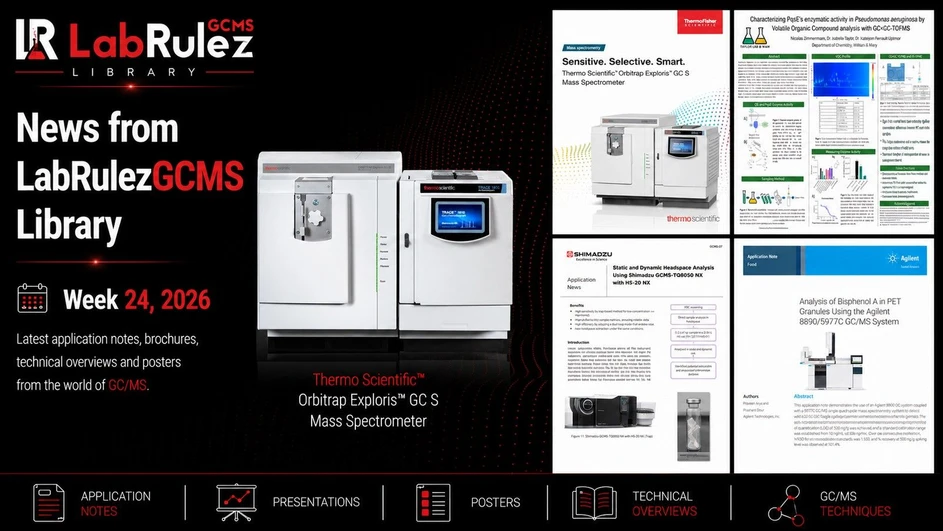
This week we bring you application notes by Agilent Technologies and Shimadzu, poster by MDCW / William & Mary and brochure by Thermo Fisher Scientific!
1. Agilent Technologies: Analysis of Bisphenol A in PET Granules Using the Agilent 8890/5977C GC/MS System
- Application note
- Full PDF for download
Polyethylene terephthalate (PET) is commonly used in the food and beverage industry, as it is easy to recycle. Contaminants in recycled PET, including acetaldehyde, benzene, limonene, and bisphenol A (BPA), can migrate from the packaging into the contents, potentially affecting the safety and quality of the products stored inside.1 Monitoring these contaminants is crucial for ensuring the quality of recycled PET products, as they can affect the physical, chemical, and sensory properties of recycled PET, potentially leading to product defects or health concerns.1 FSSAI officially permits the use of recycled PET (rPET) in food packaging, subject to strict safety and quality standards. This regulatory change was formalized through amendments notified in March 2025, effective immediately.2 All recycled plastics used in food contact applications must comply with stringent overall and specific migration limits to ensure no harmful chemical transfer into food. The recycling processes require validated decontamination steps to reduce contaminants to safe levels. Manufacturers must certify their packaging materials under FSSAI guidelines.
GC/MS plays a critical role in assessing the safety and suitability of recycled plastics for food‑contact applications. The method adopted in this work demonstrates the use of an Agilent 8890 GC system coupled with an Agilent 5977C GC/MS system for quantification of BPA in PET granules.
Conclusion
This application note presents key strategies for the analysis of BPA in PET granules using GC/MS. The calibration used here ranged from 10 to 500 ng/mL, and the LOQ of the method was demonstrated at 500 ng/g for a PET sample. Repeatable results were found for six successive replicates of matrix-based standards at 100 ng/mL. Satisfactory recoveries were obtained for the tested matrix at 500 ng/g spiked concentration levels. Thus, this study demonstrates the applicability of this method for routine analysis of PET samples for identification and quantification of BPA.
2. MDCW / William & Mary: Characterizing PqsE’s enzymatic activity in Pseudomonas aeruginosa by Volatile Organic Compound analysis with GC×GC-TOFMS
- Poster
- Full PDF for download
Pseudomonas aeruginosa is an opportunistic pathogen commonly associated with severe respiratory infections in immunocompromised patients. The pathogenic behaviors of P. aeruginosa are controlled by a cell-to-cell communication system called quorum sensing (QS). Many genes activated by QS include those responsible for forming biofilms and producing virulence factors. Interestingly, several virulence factors produced by P. aeruginosa are regulated by an interaction between a receptor, RhlR and a hydrolase, PqsE. Thus, the PqsE-RhlR interaction has become a target for antibiotic development and further characterization. Comprehensive two-dimensional gas chromatography paired with time-of-flight mass spectrometry (GC×GC-TOFMS) was chosen for metabolomic analysis as it is known for its high sensitivity and improved peak capacity. With GC×GC-TOFMS, the volatile organic compound (VOC), acetophenone, was discovered and utilized to measure dose-dependent inhibition of PqsE’s enzymatic activity in vivo by the small molecule inhibitor, Vorinostat. Furthermore, additional VOCs were identified that could add additional insight to PqsE’s function.
Experimental:
- GC/MS: Pegasus BTX (LECO) with LECO L-PAL3 Autosampler
- Software: ChromaTOF Tile
Summary
Eight VOCs identified that show statistically significant concentration differences between WT and D73A samples. The VOC acetophenone can be used to measure the enzymatic inhibition of PqsE in vivo. Vorinostat displayed a dose-dependent decrease in acetophenone levels.
3. Shimadzu: Extractable Study of Container Closure Pack Used to Store Oral Drug Product Using Dynamic Headspace Technique
- Application note
- Full PDF for download
User Benefits
- ASSP and simultaneous Scan/MRM analysis facilitating accurate qualitative identification and quantitation at the same time.
- Dynamic headspace enables concentrating the analytes in cold trap with multi-injection count and helps to achieve higher sensitivity overstatic headspace, especially for trace level quantitation.
Extractable and leachable (E & L) studies are becoming increasingly important in the pharmaceutical industry as it is a mandatory requirement from FDA during filing of the drug product. The purpose of E & L studies is to identify and evaluate possible toxicological risks. In this study, the regulatory references aim to identify traces of potential chemical substances. These substances may be harmful to patients due to their toxicity or may impact the activity of the drug product. Hence, to ensure the safety and efficacy of the drug throughout itsshelf-life, E & L studies play an important role.
What Are Extractables and Leachables?
Extractables are organic and inorganic chemical entities that are released from a pharmaceutical packaging/delivery system, packaging component, or packaging material of construction into an extraction solvent under laboratory conditions[1].
Leachables are foreign organic and inorganic chemical entities that are present in a packaged drug product because they have leached into the packaged drug product from a packaging/delivery system, packaging component, or packaging material of construction under normal conditions of storage and use or during accelerated drug product stability studies[1].
Methods of Analysis
In this method, fifteen standards were analyzed by GCMSTQ8050 NX with HS-20 NX (Trap) autosampler. For the method suitability, several important parameters like system suitability, linearity and precision were performed.
Conclusion
The chromatographic profile of solvent reflux experiment shows higher number of extractables than aqueous incubation. Furthermore, in aqueous incubation, the content of extractables is well below the AET level. Since, placebo of the ophthalmic drug product is completely aqueous, CCP used in the analysis is totally safe and can be used for the storage of Penicillin V.
Shimadzu’s GCMS-TQ provides high scan speed of 20000 amu/sec with ASSP technology enabling simultaneous SCAN/MRM analysis which is crucial in E&L study.
Generally, if the drug product falls under parenteral and oral drug product (PODP), evaluation threshold will be at higher side due to having wider SCT. However, AET for Penicillin V was at too low to evaluate with liquid injection and static headspace technique. This has been proved with the trap headspace technology.
To analyze the complete extractable profile with the sample screening is only possible with dynamic headspace as most of the extractables were not detected in the injection acquired with static headspace.
4. Thermo Fisher Scientific: Thermo Scientific™ Orbitrap Exploris™ GC S Mass Spectrometer
- Brochure
- Full PDF for download
The Thermo Scientific Orbitrap Exploris GC S is a high-resolution GC-MS system designed specifically for environmental and food safety laboratories performing analysis of persistent organic pollutants (POPs). Combining Orbitrap high-resolution accurate-mass (HRAM) technology with the proven Advanced Electron Ionization (AEI) source, the platform delivers exceptional sensitivity, selectivity, and robustness for demanding applications such as dioxins, dioxin-like PCBs, PFAS, pesticides, and emerging contaminants. The system is engineered to meet regulatory requirements while supporting multiple analytical workflows on a single instrument.
For dioxin and POPs analysis, the Orbitrap Exploris GC S offers performance traditionally associated with high-resolution magnetic sector instruments while providing a more streamlined and user-friendly workflow. The instrument achieves ultra-trace sensitivity, excellent repeatability, and regulatory-compliant mass resolution, supported by dedicated solutions including the TRACE Dioxin column, TriPlus RSH SMART autosampler, and Chromeleon Dioxin HRAM eWorkflow software. Automated method templates, built-in quality control checks, and compliance-ready reporting simplify implementation and routine operation, enabling laboratories to increase throughput while maintaining confidence in analytical results.
The platform also excels in pesticide screening and quantitation across complex food and environmental matrices. High-resolution full-scan acquisition, wide dynamic range, accurate-mass measurements, isotope pattern confirmation, and extensive spectral library matching allow confident identification and quantitation of hundreds of compounds in a single analysis. The ability to perform retrospective data analysis enables laboratories to answer new regulatory or research questions without reinjecting samples, providing flexibility for evolving analytical requirements.
Supporting the mass spectrometer is a complete analytical ecosystem that includes Chromeleon Chromatography Data System for compliant quantitation workflows, Compound Discoverer software for advanced unknown identification and statistical analysis, the modular TRACE 1600 Series GC, and the TriPlus RSH SMART robotic autosampler. Together, these components provide a highly automated, future-ready platform that maximizes uptime, simplifies maintenance through NeverVent and modular GC technologies, and delivers reliable HRAM data for both routine monitoring and advanced environmental research.


