News from LabRulezGCMS Library - Week 25, 2025
LabRulez: News from LabRulezGCMS Library - Week 25, 2025
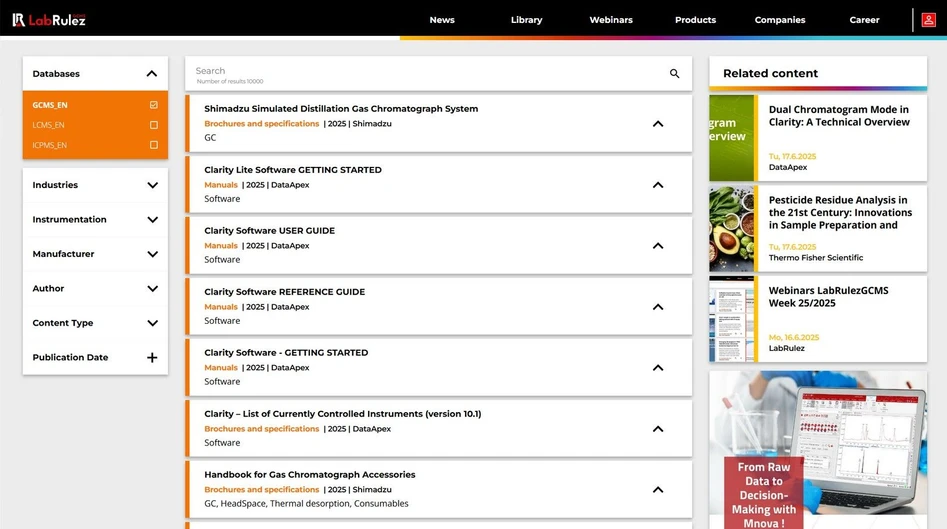
Our Library never stops expanding. What are the most recent contributions to LabRulezGCMS Library in the week of 16th June 2025? Check out new documents from the field of the gas phase, especially GC and GC/MS techniques!
👉 SEARCH THE LARGEST REPOSITORY OF DOCUMENTS ABOUT GCMS AND RELATED TECHNIQUES
👉 Need info about different analytical techniques? Peek into LabRulezLCMS or LabRulezICPMS libraries.
This week we bring you application notes by Shimadzu and Thermo Fisher Scientific, poster by Agilent Technologies and presentation by University of Alberta / MDCW!
1. Agilent Technologies: Comparative Analysis of Air Sampling Strategies for VOC Monitoring using TD- GCMS Along with Chemometrics Study to Enhance Understanding of Complex Samples
- Poster
- Full PDF for download
Monitoring volatile organic compounds (VOCs), is crucial for assessing air quality in industrial and urban environments. These compounds vary in volatility— from substances like propene to hexachlorobutadiene and naphthalene—and encompass both polar and non-polar chemicals. These pollutants, originating from industrial, vehicular, and urban sources, contribute to secondary aerosol formation and ground-level ozone, exacerbating air pollution.
- Sampling Methodologies: This study compares active and diffusive sampling techniques for VOCs in air.
- Active Sampling: Conducted at roadside, gas station, industrial, and residential sites using pumps to collect large air volumes, enhancing sensitivity for detecting low concentrations.
- Diffusive Sampling: Performed at industrial and residential areas without external equipment, suitable for remote locations and extended periods.
- Analysis: Samples were analyzed using Thermal Desorption-Gas Chromatography-Mass Spectrometry (TD-GC-MS), a solvent-free technique that preconcentrates analytes for automated injection into the GC-MS.
- Data Processing: Chemometric software tools, such as Mass Profiler Professional (MPP), were used for statistical analysis to process large datasets and identify patterns.
This study discusses the benefits of each sampling technique and their effectiveness in different locations, highlighting the importance of comprehensive air quality assessments.
Experimental
- Agilent 8890 & 5977C GCMS with Markes TD100-xr Thermal Desorber
Conclusions
This study highlights the comparison of different air sampling strategies and shows their effect on qualitative and quantitative analysis of VOCs. Key highlights are:
- Active (pumped) sampling helps in faster analysis which is required for instant air monitoring.
- Passive sampling is comparatively a long-term approach and provides consistent results.
- Use of chemometrics software (MPP) has added value by data visualization for interpretation
2. University of Alberta / MDCW: GC×GC-TOFMS metabolomics and exposomics for studying the impact of fetal and neonatal cannabis exposures
- Presentation
- Full PDF for download
The presentation by Ryland T. Giebelhaus and colleagues outlines an interdisciplinary study on the impact of prenatal and neonatal cannabis exposure on infant development, physiology, and metabolism. With cannabis use rising in Canada—particularly among pregnant individuals—this research aims to fill critical gaps in understanding how maternal cannabis consumption may influence early-life health outcomes. The study involves around 400 expectant mothers from the Edmonton area, half of whom report some cannabis exposure. It integrates expertise from physicians, psychologists, and analytical chemists, employing multiple data collection methods including urine and breast milk sampling, passive air samplers, and wearables like the Oura Ring.
A major analytical component of the study is untargeted metabolomics using comprehensive two-dimensional gas chromatography with time-of-flight mass spectrometry (GC×GC-TOFMS). The LECO BT instrument, with Rxi-5SilMS and Rtx-200MS columns and cryogenic modulation, is used for metabolic profiling. Samples undergo derivatization steps including methoximation and silylation. Analytical data are processed in ChromaTOF software and aligned using a prototype LECO tool. Initial results from 92 urine samples revealed over 3,300 metabolites, but no strong separation was observed between exposed and non-exposed groups. While one sample pair showed correlation with cannabichromene (CBC), most differential features remain unidentified and are not known cannabinoids.
To further investigate the absence of cannabinoid metabolites, high-resolution TOF-MS was employed with known standards. The team hypothesizes that cannabinoids may be trapped in glucuronide forms following phase-II metabolism, rendering them undetectable without prior enzymatic treatment. A β-glucuronidase assay is under development to address this limitation. Additional findings included the detection of acetaminophen and its metabolites in postpartum urine, illustrating the importance of contextual data interpretation.
In conclusion, the study presents the first urinary metabolomics results from a cannabis exposure cohort, highlighting the complexity of measuring and interpreting exposure in real-world settings. Ongoing efforts include expanding the dataset, improving metabolite identification, and extending analysis to breast milk and environmental samplers. These insights aim to inform families and health professionals with evidence-based data on early cannabis exposure.
3. Shimadzu: Acetaldehyde, Benzene, and Limonene in Recycled PET (rPET) Bottles by Headspace-GCMS
- Application note
- Full PDF for download
User Benefits:
- HS-20 NX headspace autosampler with short and inert transfer line allows for the measurement of acetaldehyde, benzene, and limonene in rPET without the need for complex solvent extraction.
- With an industry-leading max scan speed of 30,000 u/sec and Fast Automated Scan/SIM Type (FASST) functionality in GCMS-QP2050, it enables both qualitative and quantitative analysis of target contaminants in rPET.
Polyethylene terephthalate (PET) is widely used in various applications, particularly in the production of beverage bottles, due to its advantageous properties such as high strength, transparency, and recyclability. With growing environmental concerns related to plastic waste, recycled PET (rPET) has received increasing attention, especially in the context of foodcontact materials (FCMs). Ensuring the chemical safety and overall quality of rPET has gained a significant attention for both manufacturers and regulatory authorities. One of the critical aspects of rPET safety evaluation is the presence of volatile organic compounds (VOCs) that may migrate or leach into food or beverages, thereby affecting both consumer safety and productsensory attributes.
Among the VOCs of concern, acetaldehyde, benzene, and limonene are commonly monitored by manufacturers. Acetaldehyde is a byproduct of the thermal degradation of PET that can occur during the production process. Benzene, a carcinogenic compound, is sometimes found in rPET due to contact with polyvinyl chloride (PVC) during the recycling process of PET bottles1. Limonene, a flavor compound, may also be present in rPET, resulting from post-consumer contamination, such as using soft drink PET bottles as feedstock. While limonene is not toxic, its presence in rPET could affect the flavor profile of the food or drink packaged in the bottles. These compounds are of particular concern as non-intentionally added substances (NIAS) in recycled materials2.
The current application news utilizes headspace technique with single quadrupole GCMS to accurately identify and quantify the concentrations of acetaldehyde, benzene, and D-limonene in rPET samples.
Experimental
Instrumental and Analytical conditions
In this experiment, a headspace autosampler system, HS-20 NX (Loop Model) (Shimadzu Corporation, Japan) and a single quadrupole GCMS system, GCMS-QP2050 (Shimadzu Corporation, Japan) were used (Fig. 1). The details of the system and analytical conditions for the static headspace coupled with GCMS are shown in Table 1. Data acquisition and data processing were performed using LabSolutions GCMS software.
Result
Analysis Results
Six different brands of rPET bottle samples were analyzed using the proposed system. Table 6 summarizes the concentrations of acetaldehyde, benzene, and D-limonene per gram of rPET sample. Acetaldehyde was detected in all samples at low levels, less than 120 ng/g, which is well below the EU SCF specific migration limit (SML) of 6 mg/kg (equivalent to 6000 ng/g)3. Benzene was not detected in any of the samples. D-limonene was detected in some samples but only at very low concentrations, typically below 1 ng/g.
Conclusion
The analysis of acetaldehyde, benzene, and D-limonene in rPET using the HS-20 NX headspace autosampler coupled with the GCMS-QP2050 system demonstrated excellent analytical performance. The method achieved good recovery rates (80%– 120%) and allowed for the acquisition of both Scan and SIM data in a single run. Good repeatability was observed, with %RSD values below 3.5%, with excellent linearity of R² exceeding 0.999. The approach offers practical advantages for manufacturers and regulatory bodies in ensuring the safety and quality of rPET used in food packaging applications.
4. Thermo Fisher Scientific: A streamlined laboratory workflow for the analysis of common contaminants according to the U.S. EPA 8270E and 8081B methods using GC-MS/MS
- Application note
- Full PDF for download
Analytical testing laboratories dealing with environmental analysis must monitor diverse compound classes (SVOCs, pesticides, PCBs, etc.) in multiple matrices (drinking water, surface water, wastewater, soils, sludges) often requiring different instrument configurations and settings. This poses some challenges in terms of reduced productivity and sample throughput as well as increased time and costs for multiple platform maintenance, dedicated consumable usage, as well as staff training. Moreover, staff turnover or reduced laboratory personnel requires analysts to run multiple instrumentation and methods, adding unneeded complexity to their daily work.
Many U.S. EPA methods for environmental analysis recommend the use of gas chromatography coupled to analog detectors such as electron capture detection (ECD),1 nitrogen phosphorous detection (NPD),2 and photometric detection (FPD)3 because they provide a very specific detection for certain functional classes (e.g., organochlorine or organophosphorus pesticides). Despite their high specificity, extensive sample preparation and adequate chromatographic separation are required to differentiate between the target compounds and other co-eluting compounds or matrix interferences. This can result in sample reanalysis using alternative columns and conditions to confirm results. These reruns are often run by mass spectrometry to provide better identification and confirmations. A more effective approach is the use of triple quadrupole mass spectrometry (MS/MS). The selected rection monitoring (SRM) acquisition mode provides greater selectivity compared to single ion monitoring, allowing for simplified sample preparation protocols. Hundreds of analytes can be monitored within a single chromatographic run as typical ion transitions are monitored for each compound. This allows for confident identification of analytes at sub-ppb level sensitivities even without full chromatographic resolution between compounds. Furthermore, timed-SRM mode (t-SRM) allows the operator to process a specific method’s list of target analytes, set an acquisition window around each elution time, and subsequently optimize the mass spectrometers dwell time, leading not only to simpler data with smaller file sizes, but also better sensitivity. The adoption of such a platform that can be used for multiple analytical methods would improve laboratories’ sample throughput and productivity while reducing the cost of spare parts inventory and instrument management, streamlining operations.
In this study, the same Thermo Scientific™ TSQ™ 9610 GC-MS/MS system configuration was used for analysis of SVOCs and organochlorine pesticides according to the EPA 8270E and EPA 8081B methods. Overall method performance, including linearity, sensitivity, and precision, were evaluated thoroughly for use in a working water testing laboratory.
Experimental
In all the experiments described here, a TSQ 9610 triple quadrupole mass spectrometer equipped with NeverVent AEI ion source was coupled to a TRACE 1610 gas chromatograph equipped with a Thermo Scientific™ iConnect™ split/splitless (iConnect-SSL) injector and a Thermo Scientific™ AI/AS 1610 liquid autosampler. The same instrument configuration, chromatographic column, and consumables were used for assessing instrument compliance to EPA 8270E and EPA 8081B methods (Figure 1). A TriPlus RSH SMART autosampler was placed on the bench and used as an off-line sample preparation station for calibration curve dilution and internal standard addition. The use of an automated approach improved analyst’s safety by reducing exposure to toxic chemicals such as dichloromethane (DCM).
Chromatographic separation was achieved on a Thermo Scientific™ TraceGOLD™ TG-5SilMS capillary column 30 m × 0.25 mm × 0.25 μm (with integrated 5 m SafeGuard column, P/N 26096-1425). The “-Sil” indicates silylarene groups are incorporated in the polymer backbone, ensuring improved thermal stability and reduced susceptibility to oxidation, resulting in low column bleed and outstanding inertness.
Results and discussion
EPA Method 8270E
U.S. EPA Method 8270E is used to determine the concentration of semivolatile organic compounds, such as polycyclic aromatic hydrocarbons (PAHs), in many types of solid waste matrices, soils, air, and water samples by using gas chromatography coupled to mass spectrometry (GC-MS). One of the challenges of this method is that multiple analytes spanning wide concentration ranges must be analyzed in one single run, often leading to non-ideal calibration curves. The Thermo Scientific XLXR detector provides an extended dynamic range that allows laboratories to easily overcome this issue and provides wider calibration ranges, with better linearity, leading to more accurate and repeatable results. Moreover, since many diverse pesticides are listed in the EPA 8270E method, high selectivity is mandatory for a confident identification of compounds. The timed-selected reaction monitoring (t-SRM) acquisition mode allows for simultaneous acquisition of multiple characteristic ion transitions for each target analyte, maintaining high sensitivity combined with high selectivity to discriminate between the target compounds and matrix, thus ensuring a reliable and confident identification of analytes.
Conclusions
Modern environmental laboratories benefit greatly from the next generation of gas chromatography-mass spectrometry instrumentation that allows analysts to be more productive with simpler to use, more rugged, and more sensitive instrumentation. Advances in the Thermo Scientific line of GC-MS/MS allow for modernization of common environmental workflows for the analysis of SVOCs and organochlorine pesticides, as well as many more target analytes, all from a single, easy-to-use platform.
Modernizing instrumentation leads to simplified streamlined laboratory operations:
- Using a single hardware platform translates into increased sample throughput and the potential for consolidating multiple methods in a single GC run for streamlined operations.
- Harmonization of consumables and supplies, as well as decreasing the amount of expensive carrier gas, leads to more efficient lab operations and better ROI.
- A single software interface for acquisition, tuning, and reporting that can be used in an enterprise environment provides traceability and simplicity.
- Improved analyst’s safety while reducing the risk of errors and cross-contaminations through the use of automated sample preparation benefits all ranges of lab staff.
- Accelerated routine maintenance operation through the NeverVent technology, allows a user to maintain the system without breaking the vacuum, and the modular concept of the TRACE 1610 GC allows for flexible configurations and reduced instrument downtime.
- Future-proof analysis with the GC-MS/MS timed-SRM acquisition and the AEI ion source for lower limits of detection and confident compound identification and quantitation, far surpassing current regulations.