Smart Material Enables Efficient Plastic Recycling and Low-Cost Drug Manufacturing
CATRIN: Smart Material Enables Efficient Plastic Recycling and Low-Cost Drug Manufacturing
Two-in-one — this is one way to describe a new material developed by an international team of scientists including researchers from the Centre for Energy and Environmental Technologies at VSB – Technical University of Ostrava (CEET) and CATRIN at Palacký University. This versatile material, based on iron and carbon atoms, can not only convert plastic waste into useful products, but also reduce the cost of manufacturing important chemicals and pharmaceuticals. The researchers recently published their findings in the prestigious journal Nature Catalysis and are now planning to scale up production to a pilot-plant level.
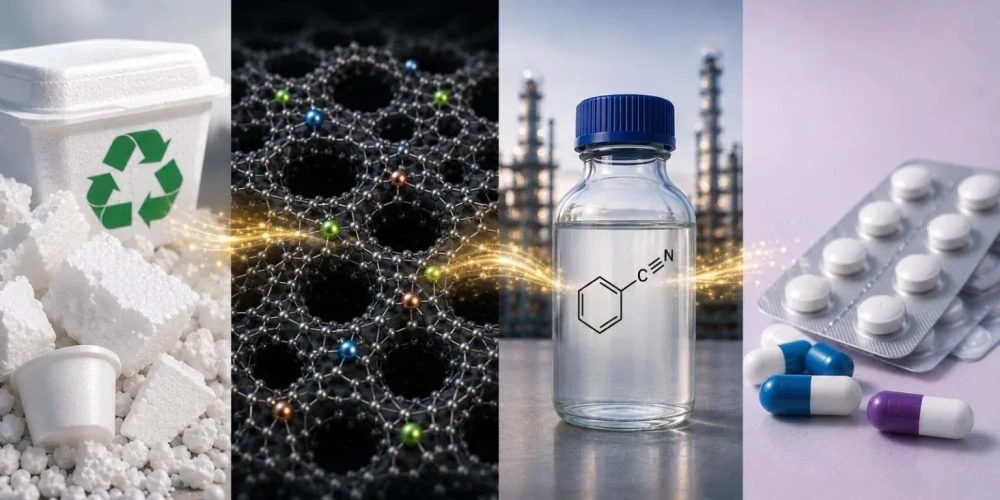
The scientists set out to help address one of today’s most pressing challenges: plastic recycling. They focused on polystyrene, global production of which exceeds 20 million tonnes annually, while only a negligible fraction – approximately one to three percent – is currently recycled. Existing recycling methods are either inefficient or technologically complex and environmentally unfriendly.
“Mechanical recycling of polystyrene leads to deterioration in product quality and limits its further applications. Pyrolysis is energy-intensive, requires very high temperatures, and the resulting chemical mixture must be purified through complex processes. That is why we developed an environmentally friendly low-temperature technology which, with the help of oxygen and ammonia, enables the production of benzonitrile. This is a highly valuable chemical used as a key building block in the production of pharmaceuticals, fertilizers, and other industrial chemicals,” said Radek Zbořil, one of the lead authors of the study affiliated with CEET and CATRIN.
CATRIN: Smart Material Enables Efficient Plastic Recycling and Low-Cost Drug Manufacturing
However, converting polystyrene and other organic compounds into nitriles is highly challenging because their chemical bonds are stable and difficult to break. The key to success was therefore the development of an efficient catalyst capable of lowering reaction temperatures while increasing the yield of the target product.
“The catalyst is based on iron atoms dispersed within a carbon support and stabilized by nitrogen and boron atoms. This specific chemical environment surrounding the atomic iron, together with the porous structure of the support, is essential for achieving efficient low-temperature conversion of polystyrene. The material can be easily produced on a large scale and, once the chemical process is completed, it can be recycled and reused. These factors are crucial for the advancement of industrial processes,” explained Jagadeesh Rajenahally, another corresponding author affiliated with CEET and the Leibniz Institute for Catalysis in Rostock, Germany.
The applications of the new catalyst extend far beyond polystyrene. It can also efficiently convert dozens of organic compounds into valuable nitriles used in chemistry and pharmaceuticals, for example in the production of antidepressants and diabetes medications. Its versatility, ease of production, lower energy consumption, and the significant cost reduction it offers for many chemical processes are expected to accelerate its adoption in industry. The scientists are therefore planning to scale up production to a pilot operation.
“The atomic catalyst is remarkably versatile. We successfully used it in the synthesis of around 60 valuable nitrile-based chemicals utilized in pharmaceuticals and industrial chemistry. We operate at significantly lower temperatures than current industrial production methods, and thanks to the controlled reaction pathway, we generate only minimal amounts of waste by-products. In a flow reactor, we demonstrated the material’s stability over many days during polystyrene conversion, which are very promising results for transferring the technology into practical applications,” Zbořil concluded.
The original article
Iron-based single-atom catalysts for selective ammoxidation of C(sp3)–H bonds and oxidative C–C cleavage reactions
Zhuang Ma (马壮), Nils Rockstroh, Zupeng Chen (陈祖鹏), Vishakha Goyal, Chakreshwara Kuloor, Stephan Bartling, Zdeněk Baďura, Jabor Rabeah, Lin Dong (董琳), Henrik Lund, Bing Nan (南兵), Radek Zbořil, Rajenahally V. Jagadeesh & Matthias Beller
Nat Catal 9, 389–403 (2026)
https://doi.org/10.1038/s41929-026-01513-y
licensed under CC-BY 4.0
Selected sections from the article follow. Formats and hyperlinks were adapted from the original.
Abstract
Ammoxidation of methylarenes using ammonia and air is the main method for the synthesis of aromatic nitriles in the chemical industry. Despite significant efforts in industry and academia, no general and selective catalyst based on less toxic and earth-abundant metals has been developed for this reaction. Here we report a single-atom iron-based material (Fe@BNC-800-L1) with Fe–N5–Bx configuration as an efficient sp3-hybridized C–H- and C–C bond oxidation catalyst. Due to the presence of Fe3+, B and N species, which are co-embedded in the micro-mesoporous carbon matrix, these materials show excellent activity for ammoxidation of methyl-substituted (hetero)arenes. Furthermore, highly selective C–C bond cleavage reactions of alkylarenes are presented, which complement the toolbox for nitrile synthesis. The generality of this presented Fe-based ammoxidation methodology is showcased by the straightforward and selective synthesis of >60 functionalized and structurally diverse nitriles, which are important precursors and key intermediates in organic synthesis with many applications in life sciences and industry.
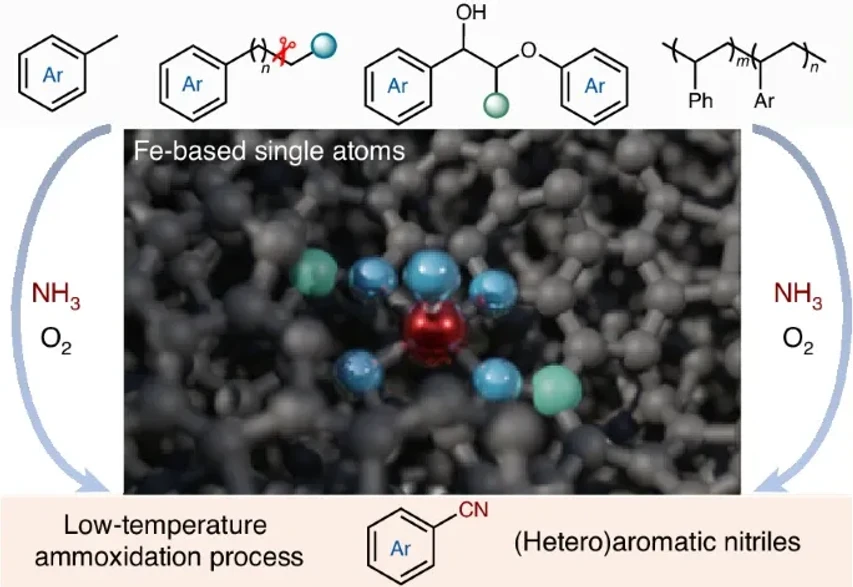 Nat Catal 9, 389–403 (2026): Graphical abstract
Methods
General procedure for the synthesis of nitriles from methyl and alkyl (hetero) arenes
Unless otherwise stated catalytic reactions of all substrates were performed with following procedure: a magnetic stirring bar, 0.5 mmol methylarene or alkylarene or lignin model compound and 50 mg Fe@BNC-800-L1 (2.46 mol% Fe) were transferred to an 8 ml glass vial. Next, 3 ml deionized water and 100 μl NH3(aq. 28–30%) were added and the vial was fitted with a septum, cap and needle. The reaction vials (8 vials each containing different substrates) were placed into a 300 ml autoclave. The autoclave was flushed with nitrogen (10 bar) twice and molecular oxygen (5 bar) twice and then it was pressurized with 5 bar oxygen. The autoclave was placed into an aluminium block preheated at 150 °C and the reactions were stirred for the required time. After the completion of the reactions, the autoclave was cooled to room temperature. The remaining oxygen was discharged and the vials containing the reaction products were removed from the autoclave. The solid catalyst was filtered off and washed thoroughly with ethyl acetate. Products in the filtrate were extracted with ethyl acetate and analysed using GC and GC-MS. The corresponding nitriles were purified by column chromatography. For selected products, yields were determined by GC. For GC analysis, the filtrate containing the products was extracted with ethyl acetate. To this ethyl acetate solution containing products, n-hexadecane (0.5 mmol) as a standard was added and then the products were analysed using GC. To confirm experimental reproducibility, all catalytic reactions including benchmark reactions and substrate scope evaluations, were performed at least two to three times to ensure reproducibility. The yields and selectivity data reported in the manuscript represent the average of these independent experiments. For example, the ammoxidation of 4-methylanisole (benchmark reaction) yielded 75 ± 3% in three independent experiments. Undoubtedly, safety aspects are of high importance in ammoxidations involving ammonia and oxygen in the reaction system. All catalytic reactions were carried out in a Parr autoclave equipped with an explosion-proof device and the autoclave was placed in a well-ventilated fume hood to conduct the reactions. After the reaction was completed, the autoclave was carefully removed and placed in an ice bath to cool down, and then the gases were slowly released. Further details of the procedure are provided in the Supplementary Information.
Due to low the boiling points of substrates 5, 9, 13, 28, 29, 30, 44 and 62, their catalytic reactions were performed individually in a glass-fitted 25 ml autoclave. The experimental procedure for these reactions is as follows: a magnetic stirring bar, 0.5 mmol methylarene or alkylarene and 50 mg Fe@BNC-800-L1 (2.46 mol% Fe) were transferred to a 25 ml autoclave (run one sample at a time). Next, 5 ml deionized water and 100 µl NH3(aq. 28–30%) were added. The autoclave was sealed and flushed with nitrogen (10 bar) twice and molecular oxygen (5 bar) twice and then it was pressurized with 5 bar oxygen. The autoclave was placed into an aluminium block preheated at 150 °C and the reactions were stirred for the required time. After the completion of the reactions, the autoclave was cooled to room temperature. The remaining oxygen was discharged and reaction products were removed from the autoclave. The solid catalyst was filtered off and washed thoroughly with ethyl acetate. The mixture was extracted with ethyl acetate and n-hexadecane as a standard was added. Finally, the products were analysed using GC and GC-MS. The corresponding nitriles were purified by column chromatography. For selected products, yields were determined by GC using the same procedure (see above).