GCMS
More information
WebinarsAbout usContact usTerms of use
LabRulez s.r.o. All rights reserved. Content available under a CC BY-SA 4.0 Attribution-ShareAlike
Author
CATRIN
CATRIN
The Czech Advanced Technology and Research Institute (CATRIN) at Palacký University is a cutting-edge scientific hub dedicated to advancing research in the fields of nanotechnology, biotechnology, and biomedicine. At its core, CATRIN boasts outstanding scientific teams, featuring international researchers. We emphasize interdisciplinarity, foster global collaborations, and work to translate our research findings into practical applications.
Tags
Article
Science and research
Plastics
LinkedIn Logo

A new generation of solar catalyst converts biomass into raw materials for bioplastics
Th, 22.1.2026
| Original article from: CATRIN / Martina Šaradínová
Scientists from CATRIN helped develop a new plasmonic photocatalyst that uses solar energy to efficiently convert biomass into key bioplastic precursors, marking a major step toward sustainable chemistry.
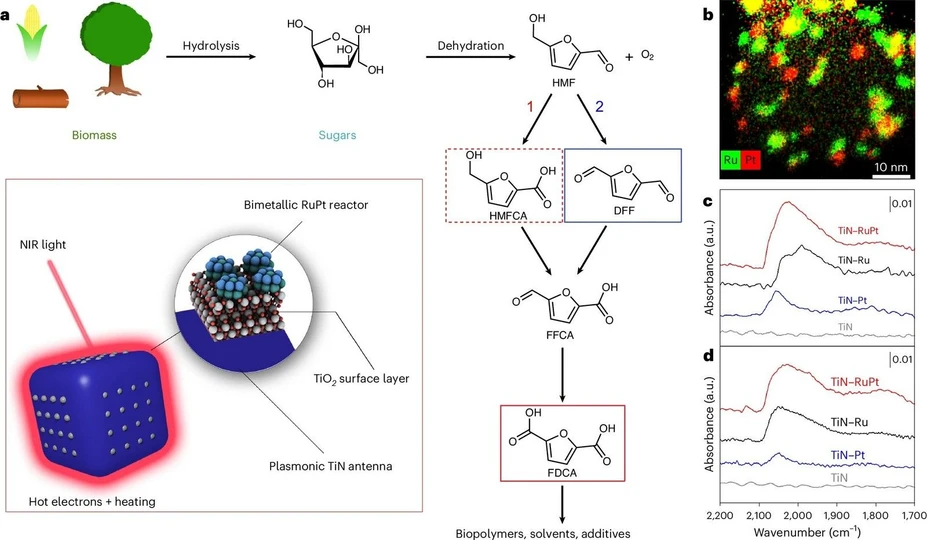
<p>Nat Catal 8, 1370–1381 (2025): Fig. 1: HMF oxidation over plasmonic TiN–RuPt photocatalysts and their characterization.</p>

Nat Catal 8, 1370–1381 (2025): Fig. 1: HMF oxidation over plasmonic TiN–RuPt photocatalysts and their characterization.

An international team of scientists, including experts from CATRIN at Palacký University, has developed a new type of plasmonic photocatalyst capable of converting biomass into key raw materials for bioplastic production with high efficiency and selectivity using solar energy. The research results, which represent a significant step towards more sustainable chemical manufacturing, have been published in the prestigious journal Nature Catalysis.

CATRIN: A new generation of solar catalyst converts biomass into raw materials for bioplasticsCATRIN: A new generation of solar catalyst converts biomass into raw materials for bioplastics

Biomass—organic material of plant or animal origin—is among the most promising renewable resources for the production of high value-added chemicals and materials. The research focused on the molecule 5-hydroxymethylfurfural (HMF), which is derived from sugars contained in plant biomass and is regarded as one of the key intermediates in modern biorefineries. Through controlled oxidation, HMF can be converted into 2,5-furandicarboxylic acid (FDCA), a compound that serves as a fundamental building block for biopolymers, such as PEF plastic, an environmentally friendly alternative to the widely used PET.

However, current industrial methods for producing this compound are technologically demanding. They often require strongly alkaline conditions, elevated temperatures, or increased pressure. Despite this, they suffer from low selectivity, leading to the formation of unwanted by-products and higher energy consumption. As a result, contemporary research is seeking new approaches that would allow this chemical transformation to be driven by light energy under milder and more environmentally friendly conditions.

The newly developed catalyst is based on a combination of nanostructured titanium nitride and extremely small nanoparticles of a ruthenium–platinum alloy. Titanium nitride acts as a material that very efficiently absorbs light, particularly its infrared component, converting it into energy-rich electrons and local heat. These effects subsequently promote the activation of molecular oxygen on the surface of the catalytically active nanoparticles, where the chemical reaction itself takes place.

The key aspect is that the individual components of the catalyst work together in perfect synergy. This allows us to control the oxidation of 5-hydroxymethylfurfural with great precision and achieve an almost complete conversion to the target product without the use of strong chemical additives or extreme reaction conditions. Compared with existing technologies, the process is significantly more selective, more energy-efficient, and produces substantially less waste,” said one of the corresponding authors of the study, Štěpán Kment from Palacký University.

The authors emphasise that this approach enables oxygen activation in a fundamentally different way than conventional catalytic systems. As a result, the reaction can be carried out in an aqueous environment without the addition of alkaline agents, while avoiding non-selective reactions that would otherwise lead to material losses. The outcome is a highly efficient and precisely controlled process suitable for future applications.

According to the researchers, this plasmonic catalytic platform represents a previously unexplored concept in the field of biomass conversion. “It opens up new opportunities for future biorefineries that could use solar energy and renewable feedstocks to produce plastics, solvents, and other chemical products with a significantly lower carbon footprint than current industrial technologies,” concluded Kment.

The research involved scientists from CATRIN at Palacký University, the Centre for Energy and Environmental Technologies, and the national supercomputing centre IT4Innovations at VSB–TUO, in collaboration with partners from China, Italy, and the United States.

The original article

Near-infrared plasmonic activation of molecular oxygen for selective oxidation of biomass derivatives

Manpreet Kaur, Sourav Rej, Jan Navrátil, Eva Yazmin Santiago, Michal Otyepka, Stefano Livraghi, Lorenzo Mino, Štěpán Kment, Zhikang Xu, Haibo Zhu, Paolo Fornasiero, Alexander O. Govorov, Piotr Błoński & Alberto Naldoni

Nat Catal 8, 1370–1381 (2025)

https://doi.org/10.1038/s41929-025-01454-y

licensed under CC-BY 4.0

Selected sections from the article follow. Formats and hyperlinks were adapted from the original.

Abstract

Upgrading biomass feedstock into higher-value chemicals is central to improve the sustainability of the chemical industry and to reduce its dependence on fossil raw materials. Heterogeneous photocatalysts are promising for the oxidation of 5-hydroxymethylfurfural (HMF) to 2,5-furandicarboxylic acid (FDCA), a biomass-derived molecular platform for biopolymers, but their FDCA selectivity is negligible without the aid of a base. Here we present a plasmonic photocatalyst integrating TiN nanocubes and bimetallic RuPt nanoparticles that in base-free conditions exhibits complete HMF conversion and selective FDCA formation due to an unconventional mechanism of molecular oxygen activation. This unique reactivity is enhanced by both photothermal heating and hot electrons, whose contribution is confirmed by kinetic isotopic effect experiments. Density functional theory calculations support a scenario in which the activated nanoparticle–oxygen complex facilitates the rate-determining step and enables an improved FDCA selectivity. Our results demonstrate the potential of plasmonic photocatalysts in the catalytic transformation of biomass.

CATRIN
LinkedIn Logo
 

Related content

Analysis of Aroma Components in Apples Using the Smart Aroma Database

Applications
| 2026 | Shimadzu
Instrumentation
GC/MSD, GC/SQ, HeadSpace
Manufacturer
Shimadzu
Industries
Food & Agriculture

Analysis of Acetaldehyde and Limonene in Recycled PET Using an HS-GCMS System (Carrier Gas: H2)

Applications
| 2026 | Shimadzu
Instrumentation
GC/MSD, GC/SQ, HeadSpace
Manufacturer
Shimadzu
Industries
Energy & Chemicals

What Causes GC Capillary Column Performance Degradation, and How Can I Prevent It?

Technical notes
| 2026 | Agilent Technologies
Instrumentation
Consumables, GC columns
Manufacturer
Agilent Technologies
Industries
Other

Aromatic Component Analysis of Gasoline According to ASTM D5580 Using the Brevis GC- 2050 Gas Chromatograph

Applications
| 2025 | Shimadzu
Instrumentation
GC
Manufacturer
Shimadzu
Industries
Energy & Chemicals

Micro GC Analysis of Permanent Gas Impurities in PEM Fuel Cell-Grade Hydrogen

Applications
| 2025 | Agilent Technologies
Instrumentation
GC
Manufacturer
Agilent Technologies
Industries
Energy & Chemicals
 

Related articles

Webinars LabRulezGCMS Week 07/2026
Article | Webinars

Webinars LabRulezGCMS Week 07/2026

3 webinars: AI in manufacturing, fermentation, functional food, mAb production, metabolite monitoring, process Raman, process analytics
LabRulez
tag
share
more
QuEChERS Combined with Low-Temperature Partitioning and GC–MS as an Analytical Strategy for the Determination of Multiclass Pesticide Residues in Cocoa Beans
Scientific article | Science and research

QuEChERS Combined with Low-Temperature Partitioning and GC–MS as an Analytical Strategy for the Determination of Multiclass Pesticide Residues in Cocoa Beans

This study combines QuEChERS and low-temperature partitioning with GC–MS to determine multiclass pesticide residues in cocoa beans with good sensitivity and recoveries.
LabRulez
tag
share
more
ISC 2026 Short Course 3 - Interpretation of Mass Spectra: Basic Introduction for Chromatographers
Article | Events

ISC 2026 Short Course 3 - Interpretation of Mass Spectra: Basic Introduction for Chromatographers

Short Course 3 at ISC 2026 offers a practical introduction to LC–MS spectral interpretation for chromatographers, covering ESI, APCI, APPI, adducts, isotope patterns, and MS/MS fundamentals.
International Symposium on Chromatography - (ISC)
tag
share
more
Eurachem/CITAC Workshop on Quality in Analytical Measurements 2026
Article | Events

Eurachem/CITAC Workshop on Quality in Analytical Measurements 2026

Eurachem Week 2026 brings training and workshops on measurement uncertainty, quality in analytical measurements, and results interpretation, combining theory, practical cases, and expert-led discussions.
Eurachem
tag
share
more
 

Related content

Analysis of Aroma Components in Apples Using the Smart Aroma Database

Applications
| 2026 | Shimadzu
Instrumentation
GC/MSD, GC/SQ, HeadSpace
Manufacturer
Shimadzu
Industries
Food & Agriculture

Analysis of Acetaldehyde and Limonene in Recycled PET Using an HS-GCMS System (Carrier Gas: H2)

Applications
| 2026 | Shimadzu
Instrumentation
GC/MSD, GC/SQ, HeadSpace
Manufacturer
Shimadzu
Industries
Energy & Chemicals

What Causes GC Capillary Column Performance Degradation, and How Can I Prevent It?

Technical notes
| 2026 | Agilent Technologies
Instrumentation
Consumables, GC columns
Manufacturer
Agilent Technologies
Industries
Other

Aromatic Component Analysis of Gasoline According to ASTM D5580 Using the Brevis GC- 2050 Gas Chromatograph

Applications
| 2025 | Shimadzu
Instrumentation
GC
Manufacturer
Shimadzu
Industries
Energy & Chemicals

Micro GC Analysis of Permanent Gas Impurities in PEM Fuel Cell-Grade Hydrogen

Applications
| 2025 | Agilent Technologies
Instrumentation
GC
Manufacturer
Agilent Technologies
Industries
Energy & Chemicals
 

Related articles

Webinars LabRulezGCMS Week 07/2026
Article | Webinars

Webinars LabRulezGCMS Week 07/2026

3 webinars: AI in manufacturing, fermentation, functional food, mAb production, metabolite monitoring, process Raman, process analytics
LabRulez
tag
share
more
QuEChERS Combined with Low-Temperature Partitioning and GC–MS as an Analytical Strategy for the Determination of Multiclass Pesticide Residues in Cocoa Beans
Scientific article | Science and research

QuEChERS Combined with Low-Temperature Partitioning and GC–MS as an Analytical Strategy for the Determination of Multiclass Pesticide Residues in Cocoa Beans

This study combines QuEChERS and low-temperature partitioning with GC–MS to determine multiclass pesticide residues in cocoa beans with good sensitivity and recoveries.
LabRulez
tag
share
more
ISC 2026 Short Course 3 - Interpretation of Mass Spectra: Basic Introduction for Chromatographers
Article | Events

ISC 2026 Short Course 3 - Interpretation of Mass Spectra: Basic Introduction for Chromatographers

Short Course 3 at ISC 2026 offers a practical introduction to LC–MS spectral interpretation for chromatographers, covering ESI, APCI, APPI, adducts, isotope patterns, and MS/MS fundamentals.
International Symposium on Chromatography - (ISC)
tag
share
more
Eurachem/CITAC Workshop on Quality in Analytical Measurements 2026
Article | Events

Eurachem/CITAC Workshop on Quality in Analytical Measurements 2026

Eurachem Week 2026 brings training and workshops on measurement uncertainty, quality in analytical measurements, and results interpretation, combining theory, practical cases, and expert-led discussions.
Eurachem
tag
share
more
 

Related content

Analysis of Aroma Components in Apples Using the Smart Aroma Database

Applications
| 2026 | Shimadzu
Instrumentation
GC/MSD, GC/SQ, HeadSpace
Manufacturer
Shimadzu
Industries
Food & Agriculture

Analysis of Acetaldehyde and Limonene in Recycled PET Using an HS-GCMS System (Carrier Gas: H2)

Applications
| 2026 | Shimadzu
Instrumentation
GC/MSD, GC/SQ, HeadSpace
Manufacturer
Shimadzu
Industries
Energy & Chemicals

What Causes GC Capillary Column Performance Degradation, and How Can I Prevent It?

Technical notes
| 2026 | Agilent Technologies
Instrumentation
Consumables, GC columns
Manufacturer
Agilent Technologies
Industries
Other

Aromatic Component Analysis of Gasoline According to ASTM D5580 Using the Brevis GC- 2050 Gas Chromatograph

Applications
| 2025 | Shimadzu
Instrumentation
GC
Manufacturer
Shimadzu
Industries
Energy & Chemicals

Micro GC Analysis of Permanent Gas Impurities in PEM Fuel Cell-Grade Hydrogen

Applications
| 2025 | Agilent Technologies
Instrumentation
GC
Manufacturer
Agilent Technologies
Industries
Energy & Chemicals
 

Related articles

Webinars LabRulezGCMS Week 07/2026
Article | Webinars

Webinars LabRulezGCMS Week 07/2026

3 webinars: AI in manufacturing, fermentation, functional food, mAb production, metabolite monitoring, process Raman, process analytics
LabRulez
tag
share
more
QuEChERS Combined with Low-Temperature Partitioning and GC–MS as an Analytical Strategy for the Determination of Multiclass Pesticide Residues in Cocoa Beans
Scientific article | Science and research

QuEChERS Combined with Low-Temperature Partitioning and GC–MS as an Analytical Strategy for the Determination of Multiclass Pesticide Residues in Cocoa Beans

This study combines QuEChERS and low-temperature partitioning with GC–MS to determine multiclass pesticide residues in cocoa beans with good sensitivity and recoveries.
LabRulez
tag
share
more
ISC 2026 Short Course 3 - Interpretation of Mass Spectra: Basic Introduction for Chromatographers
Article | Events

ISC 2026 Short Course 3 - Interpretation of Mass Spectra: Basic Introduction for Chromatographers

Short Course 3 at ISC 2026 offers a practical introduction to LC–MS spectral interpretation for chromatographers, covering ESI, APCI, APPI, adducts, isotope patterns, and MS/MS fundamentals.
International Symposium on Chromatography - (ISC)
tag
share
more
Eurachem/CITAC Workshop on Quality in Analytical Measurements 2026
Article | Events

Eurachem/CITAC Workshop on Quality in Analytical Measurements 2026

Eurachem Week 2026 brings training and workshops on measurement uncertainty, quality in analytical measurements, and results interpretation, combining theory, practical cases, and expert-led discussions.
Eurachem
tag
share
more
 

Related content

Analysis of Aroma Components in Apples Using the Smart Aroma Database

Applications
| 2026 | Shimadzu
Instrumentation
GC/MSD, GC/SQ, HeadSpace
Manufacturer
Shimadzu
Industries
Food & Agriculture

Analysis of Acetaldehyde and Limonene in Recycled PET Using an HS-GCMS System (Carrier Gas: H2)

Applications
| 2026 | Shimadzu
Instrumentation
GC/MSD, GC/SQ, HeadSpace
Manufacturer
Shimadzu
Industries
Energy & Chemicals

What Causes GC Capillary Column Performance Degradation, and How Can I Prevent It?

Technical notes
| 2026 | Agilent Technologies
Instrumentation
Consumables, GC columns
Manufacturer
Agilent Technologies
Industries
Other

Aromatic Component Analysis of Gasoline According to ASTM D5580 Using the Brevis GC- 2050 Gas Chromatograph

Applications
| 2025 | Shimadzu
Instrumentation
GC
Manufacturer
Shimadzu
Industries
Energy & Chemicals

Micro GC Analysis of Permanent Gas Impurities in PEM Fuel Cell-Grade Hydrogen

Applications
| 2025 | Agilent Technologies
Instrumentation
GC
Manufacturer
Agilent Technologies
Industries
Energy & Chemicals
 

Related articles

Webinars LabRulezGCMS Week 07/2026
Article | Webinars

Webinars LabRulezGCMS Week 07/2026

3 webinars: AI in manufacturing, fermentation, functional food, mAb production, metabolite monitoring, process Raman, process analytics
LabRulez
tag
share
more
QuEChERS Combined with Low-Temperature Partitioning and GC–MS as an Analytical Strategy for the Determination of Multiclass Pesticide Residues in Cocoa Beans
Scientific article | Science and research

QuEChERS Combined with Low-Temperature Partitioning and GC–MS as an Analytical Strategy for the Determination of Multiclass Pesticide Residues in Cocoa Beans

This study combines QuEChERS and low-temperature partitioning with GC–MS to determine multiclass pesticide residues in cocoa beans with good sensitivity and recoveries.
LabRulez
tag
share
more
ISC 2026 Short Course 3 - Interpretation of Mass Spectra: Basic Introduction for Chromatographers
Article | Events

ISC 2026 Short Course 3 - Interpretation of Mass Spectra: Basic Introduction for Chromatographers

Short Course 3 at ISC 2026 offers a practical introduction to LC–MS spectral interpretation for chromatographers, covering ESI, APCI, APPI, adducts, isotope patterns, and MS/MS fundamentals.
International Symposium on Chromatography - (ISC)
tag
share
more
Eurachem/CITAC Workshop on Quality in Analytical Measurements 2026
Article | Events

Eurachem/CITAC Workshop on Quality in Analytical Measurements 2026

Eurachem Week 2026 brings training and workshops on measurement uncertainty, quality in analytical measurements, and results interpretation, combining theory, practical cases, and expert-led discussions.
Eurachem
tag
share
more
Other projects
LCMS
ICPMS
Follow us
More information
WebinarsAbout usContact usTerms of use
LabRulez s.r.o. All rights reserved. Content available under a CC BY-SA 4.0 Attribution-ShareAlike