Inline Analysis of the Plastics Melt Emissions in Real Time During Mechanical Recycling Using the SIFT-MS Method
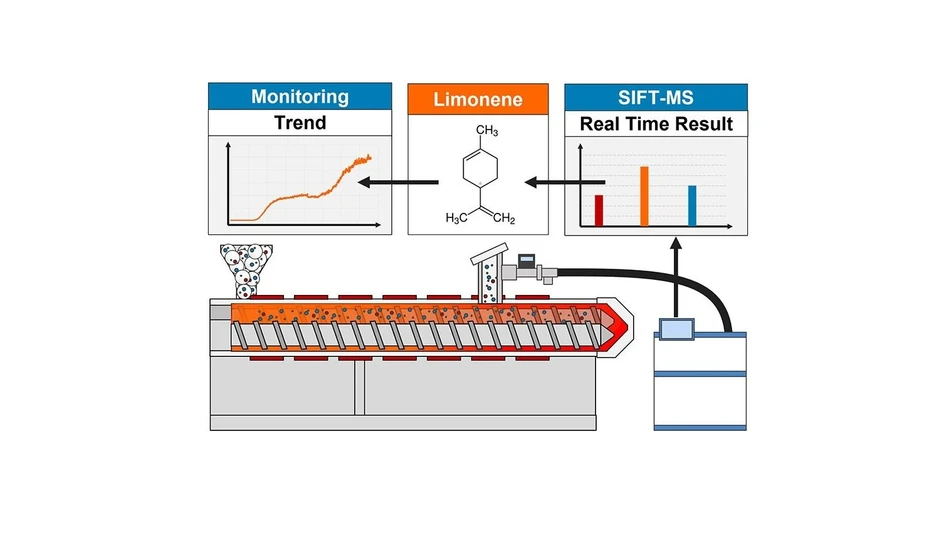
ACS Omega 2025, 10, 50, 61784–61792: Graphical abstract
This study evaluates Selected Ion Flow Tube Mass Spectrometry (SIFT-MS) for continuous inline monitoring of volatile organic compounds released during mechanical plastic recycling. Real-time measurements at the vacuum dome of a twin-screw extruder enabled identification and quantification of contaminants originating from additives, migration processes, and polymer degradation.
The measured VOC concentrations closely reflected contamination levels in the input materials, including compounds such as limonene and FDA-relevant model substances. These findings highlight the potential of SIFT-MS as a powerful tool for process monitoring, quality assurance, and traceability in recycled plastics intended for demanding applications such as food packaging, cosmetics, and automotive components.
The original article
Inline Analysis of the Plastics Melt Emissions in Real Time During Mechanical Recycling Using the SIFT-MS Method
Felix Mehrens*, Niklas Rode, Jacek Lecinski, Madina Shamsuyeva, Hans-Josef Endres, and David Müller
ACS Omega 2025, 10, 50, 61784–61792
https://doi.org/10.1021/acsomega.5c08107
licensed under CC-BY 4.0
Selected sections from the article follow. Formats and hyperlinks were adapted from the original.
Plastic products can be found in almost all areas of everyday life and in industry today. Thanks to their flexible, adjustable properties, low price and ease of manufacture, their areas of application vary from use in various packaging products to use in technical applications such as automotive, electrical and electronic systems, etc., thus increasingly substituting other materials. This is also reflected in the steadily increasing annual plastic production, which has increased from 245 million tons in 2008 to 413.8 million tons in 2023. (1) The majority of produced plastics, at 44%, are used to manufacture packaging products with a typical lifespan of less than one year. (2,3) The directly related increase in the amount of plastic waste shows the importance of the end-of-life treatment of these products. (4) Accordingly, forecasts indicate that the amount of plastic waste will increase from approximately 155.87 million tons in 2024 to 379.97 million tons in 2060. (5) Today, the majority of plastic waste is sent to landfill (46%) or incinerated (17%), leading to pollution and the release of greenhouse gases. (6) For this reason, the aim is to move toward a circular economy in which plastic can be reused through recycling at the end of its life cycle. Recycled materials therefore offer the opportunity to reduce the consumption of fossil resource while at the same time reducing the environmental impact and influencing factors of plastic products. (7) To achieve this, mechanical recycling has been established in industry as a process for producing recyclates from plastic waste, in which the shredded plastic is melted, filtered, degassed and then regranulated. (8−10)
State of the art analytical methods for identifying the VOCs in a plastic sample are based on gas chromatography–mass spectrometry (GC-MS), in which the volatile substances are separated in the chromatography column and then are identified by their mass-to-charge ratio (m/z-ratio) in the mass spectrometer. (17,27) The analysis methods differ mainly in the type of sample preparation used to extract the volatile substances from the polymer. Due to the minimal effort involved in terms of automation, headspace methods have become particularly prevalent here. In these methods, the volatile substances are transferred into the gas phase by heating the plastic samples and transported directly into the gas chromatography column. (27−29)
Consequently, there is a great demand for the development of methods testing the chemical composition of an entire batch of plastic recyclate with a detection limit at least comparable to GC-MS or better. For this reason, continuous monitoring of plastic quality during extrusion is necessary to ensure safe use of recyclates from inhomogeneous input streams. A promising solution is the real-time monitoring of the chemical quality by the online analysis of VOCs using the SIFT-MS technique (Selected Ion Flow Tube Mass Spectrometry) from a gas sample. (31) Due to the high temperatures in the extrusion process, the volatile substances diffuse into the gas phase and can be analyzed there, analogous to a headspace, if they are extracted. This method enables volatile substances such as VOCs, which tend to migrate, to be detected and analyzed directly in recycling process. This offers particular advantages here: it allows a continuous analysis of VOCs in real time. (32) Investigations by Langford and Perkins (33) showed the successful application of a SIFT-MS for use in analyzing the headspace of various recyclates and virgin polymers. This makes it a suitable method for continuously monitoring the chemical quality of recyclates in real time, as well as for evaluating both decontamination measures and the homogeneity of the material. (34)
This study aims to investigate the potential applications of SIFT-MS for measuring volatile substances in real time in the gas stream during the extrusion process. For this purpose, various materials with different types of contamination, such as limonene, were tested for VOCs. Limonene is considered a model compound because it is frequently found in recyclates and is a typical representative of VOCs. (19,35,36) The results should demonstrate how this technology can enhance the quality of recycled materials, thereby meeting the requirements for sustainable, resource-efficient plastic processing.
2. Material and Methods
2.2. Selected Ion Flow Tube Mass Spectrometry
SIFT-MS is based on the developments for the SIFT technique by Adams and Smith. (38) A schematic representation of the measurement principle of the SIFT-MS method is shown in Figure 2 and is explained below.
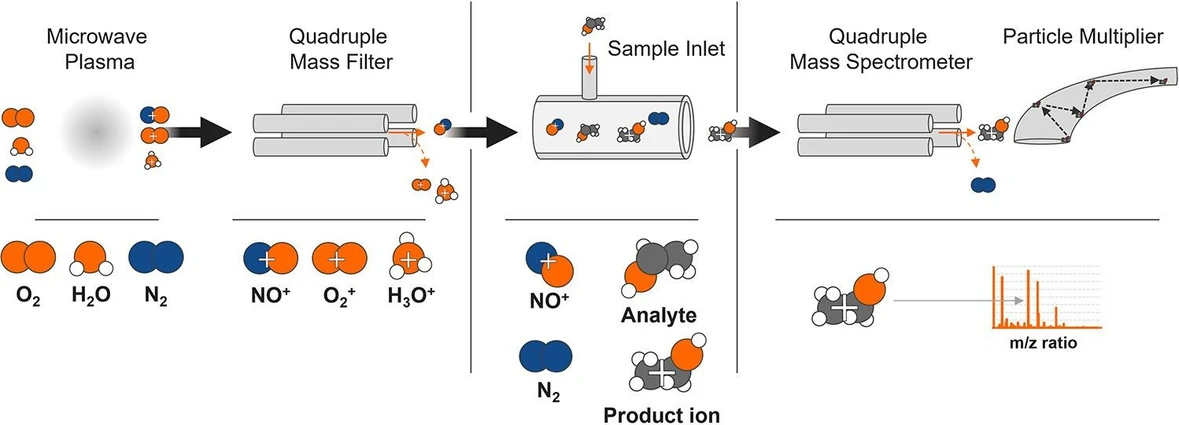 ACS Omega 2025, 10, 50, 61784–61792: Figure 2. Schematic diagrams of a selected ion flow tube-mass spectrometer instruments in reference to Syft Technologies.
In the first step, the reagent ions are produced by microwave discharge in a microwave plasma in a humid atmosphere. The ions are usually the cations H3O+, NO+ and O2+ or the anions O–, O2–, OH–, NO2– and NO3–. The advantage of these ions is that they rarely react with the components present in large numbers in the air, such as nitrogen or oxygen, but do react with a large proportion of the trace gases in a gas sample. The reagent ions are extracted from the ion source and the desired ions are filtered by a quadrupole mass filter and passed into the carrier gas, which is either helium or nitrogen. In the flow tube, the reagent ions then react with the VOC molecules from the introduced gas sample, resulting in the formation of the analyte ions. Subsequently, a downstream quadrupole mass spectrometer (QMS) and a particle multiplier are used to detect, identify and count the m/z-ratio of the product ions. Based on this information, the concentrations of each neutral analyte in the sample quantity can be calculated. (31,39,40)
The measurements can be carried out in a full-scan (FS) or selected ion mode (SIM). In the full scan mode, the entire spectrum of m/z-ratios of the ions is recorded, whereas in the selected ion mode, the QMS downstream of the flow tube acts as a filter, removing ions outside a defined m/z range. Analyzing only the product ions within the defined m/z range simplifies data evaluation and reduces the measurement time. (31,41)
3. Results and Discussion
The SIFT-MS measurements show a high degree of linearity when only one product ion with m/z = 136 of the NO+ reagent ions is considered. Figure 7 shows the normalized signal at 10,000 counts per second (cps) per 1 million reagents, as well as limonene concentration in relation to the three material fractions contaminated with limonene. The coefficient of determination R2 for the measured limonene signal is 0.997 and 0.9983 for the limonene concentration in the gas phase in relation to the amount of dosed limonene contaminated material.
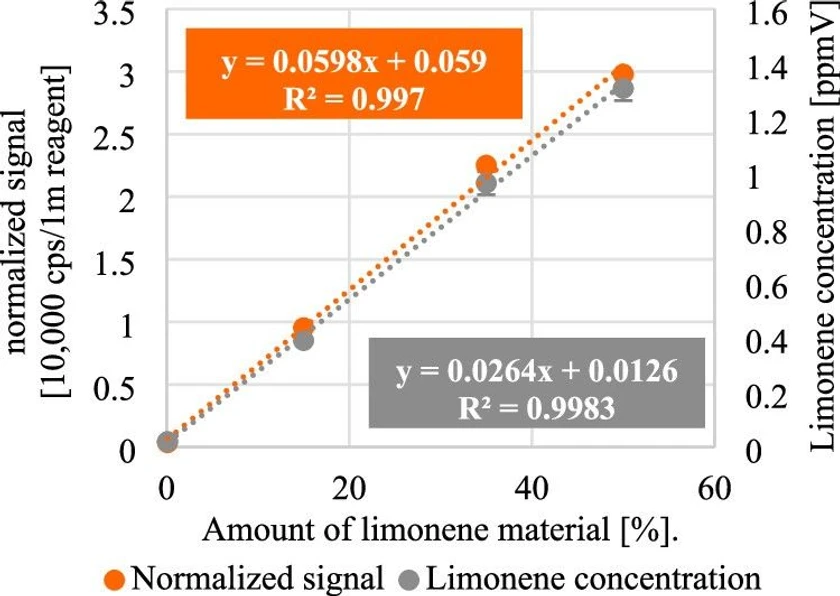 ACS Omega 2025, 10, 50, 61784–61792: Figure 7. Normalized limonene signal and concentration in the gas phase in relation to the amount of contaminated material with limonene for m/z = 136 for NO+ as reagent ion.
These results demonstrate that, under the same conditions, limonene diffuses into the gas phase from the plastic melt in a highly linear manner with respect to the input amount and concentration. This applies to both the signal and the quantitative concentration in the gas stream. The linear correlation demonstrates the stability of the method when analyzing different concentrations of VOCs in the input material. However, to determine the exact input concentration in the material, further factors must be considered, such as volatility of a substance, pressure prevailing in the gas phase, temperature or concentration equilibrium.
When measuring the gas phase emissions from the FDA material, toluene, chlorobenzene, methyl salicylate and cyclohexyl benzene were all measurable with each reagent. At the same time, no benzophenone or methyl stearate could be detected in the gas phase. It should be noted that, due to the maximum chosen FS measuring range of 250 m/z in the measuring setup, it was not possible to measure methyl stearate with a molecular mass of 298.5 g/mol. The detection was not expected in general due to the properties of methyl stearates and the factors affecting the volatility given in the setup. This is mainly because the boiling point of methyl stearate is 448 °C at 1 atm, which is significantly higher than the 220 °C temperatures prevailing in the extrusion process. Figure 8 shows the H3O+ reagent ions signal in relation to the m/z-ratio from 15 to 250 for the FDA (gray) material and the uncontaminated virgin PP (orange). The signal detected for the substances decreases as their volatility decreases and their molecular weight increases. This corresponds with the expectation that the quantity of substances with low volatility diffusing from the melt into the gas phase during the extrusion process decreases. At the same time, it is possible that, again, a certain amount has already condensed due to boiling points above the temperature of 120 °C of the heated line from the vacuum port to the SIFT-MS. Increasing the melt temperature and raising the temperature of the heated line, while applying a vacuum, can increase the amount of the substance diffusing out of the melt by preventing condensation. The increase in diffusion from the melt is related to the methods used to remove VOCs from the melt and has been documented in various publications. (49−51)
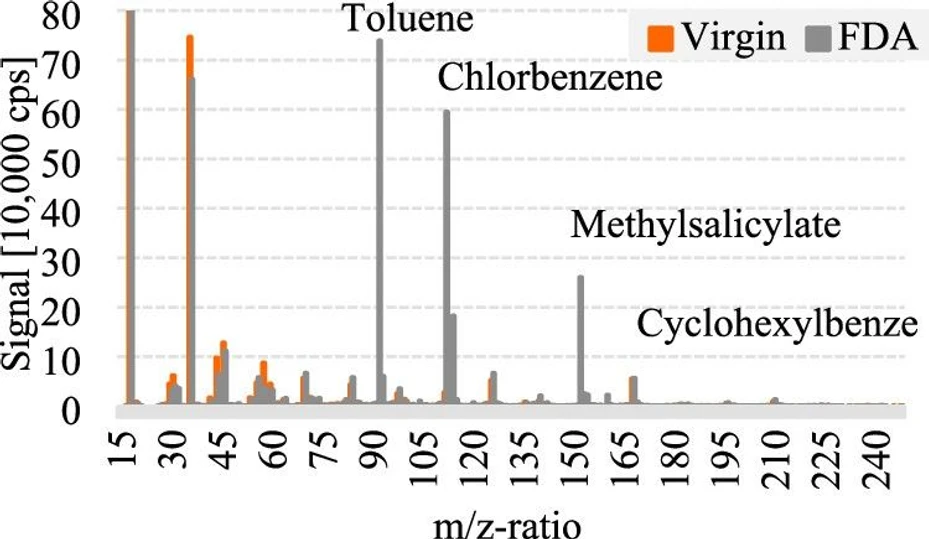 ACS Omega 2025, 10, 50, 61784–61792: Figure 8. Detected signal of H3O+ reagent ions for the m/z-ratios for the virgin and FDA material.
Based on the measurements on the DSD-324 material, an increase in the total concentration in the gas phase of the emissions was measured. Therefore, the amount of the measured substances increases in line with the DSD-324 amount in the compound. The reagent ions reacted completely due to the high concentration of VOCs in the input material. Consequently, the dilution had to be increased in proportion to the percentage of DSD-324 in the input. The measurements showed a clear detection of limonene in the gas stream of the material flow. Figure 9 also illustrates this, showing the dilution corrected quantitative amount of limonene in the gas sample in relation to the proportion of recycled material in the throughput.
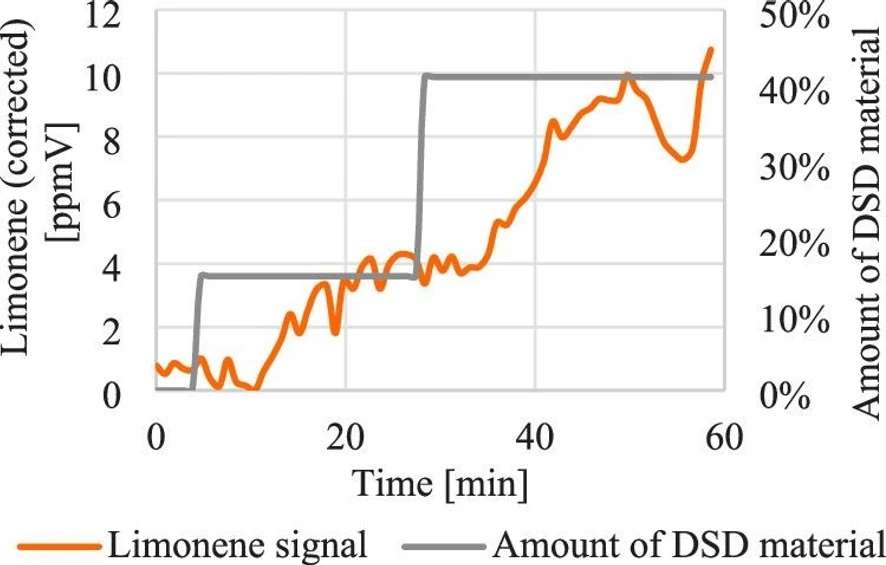 ACS Omega 2025, 10, 50, 61784–61792: Figure 9. Total quantity of limonene measured in the gas phase (dilution corrected) in relation to the amount of DSD-324 material dosed.
The limonene concentration increases in proportion to the amount of postconsumer PP in the input material, comparable to the results obtained from deliberately contaminated limonene material. At the same time, the measurement results are subject to greater signal fluctuations, which can be attributed to the higher level of inhomogeneity in the input material. Another difference is that changes in material dosing and the related limonene concentration take longer to detect. In both cases where the concentration was altered, it took around 8 min for a change to be detected. This resulted in the limonene concentration in the gas stream taking longer to reach equilibrium. Therefore, the detected limonene concentration in the gas stream required approximately 20 min to reach equilibrium. One potential explanation for these findings is the considerably lower initial concentration of limonene in the DSD-324 material and consequently in the entire compound. In combination with the elevated dilution, this results in a reduced quantity of limonene being analyzed by the SIFT-MS and a subsequent delay in detection. The measurement results also show significantly higher fluctuations than those obtained from homogeneously contaminated materials. This highlights the inhomogeneity, and therefore the varying levels of contamination, in the input streams from open loop collections. This confirms the hypothesis put forward in the introduction. Assuming that homogenization took place in the melt during the extrusion process and subsequently in the gas phase, the fluctuations observed here are smaller than in offline measurements. This illustrates the problem with analyzing small samples randomly taken from a produced batch and then transferring these results to the entire batch.
4. Conclusions
This study demonstrates the suitability of SIFT-MS as an effective real-time analytical method for detecting VOCs during the extrusion step of mechanical plastics recycling. By enabling continuous monitoring of the VOC emissions directly from the melt in the degassing step, the method offers information on the chemical quality of recycled materials. The results of the experimental setup demonstrate that the method can identify target components in the gas stream. Furthermore, a strong linear correlation was observed between the concentration of VOCs in the input material and their corresponding concentration and signal intensity in the gas phase. This confirms the quantitative capabilities of the method. However, high VOC concentrations may require substantial gas dilution to prevent depletion of reagent ions and ensure reliable quantification. At the same time, it can be deduced that substances in the ppb range can also be detected. The detectability of less volatile substances can be improved by increasing their diffusion into the gas phase from the melt. Process parameters such as temperature, vacuum level, and dilution rate were shown to significantly influence detection sensitivity, suggesting clear pathways for method optimization.
As a result, SIFT-MS provides a powerful tool for quality assurance in plastic recycling, particularly for applications with chemical safety requirements, such as food contact or cosmetic packaging. With regard to its use for quality control, it was shown that the method is suitable for determining the concentration of volatile target substances in real time. Deviations in concentration at the vacuum dome are detected within seconds, enabling almost continuous process monitoring. Future applications could include integration into the extrusion process control system, for example to respond immediately to quality deviations by stopping the process or changing setup parameters. This would guarantee a significant increase in safety, especially when using recycled materials in sensitive applications.
This feasibility study also provides a foundation for further research for the detection of VOCs in the extrusion process in real time using SIFT-MS. At the same time, it shows potential for optimization with regard to sampling and the measurement setup and parameters. As previously mentioned, future studies should investigate the correlation between the concentrations in the input material and the concentration measured in the gas stream. This is particularly dependent on the diffusion behavior of the VOCs from the melt into the gas phase. The rate of this process depends on the properties of the volatile substances, as well as the parameters of the extrusion process, such as temperature, the free surface area and the pressure in the sampling area.