News from LabRulezGCMS Library - Week 05, 2026
LabRulez: News from LabRulezGCMS Library - Week 05, 2026
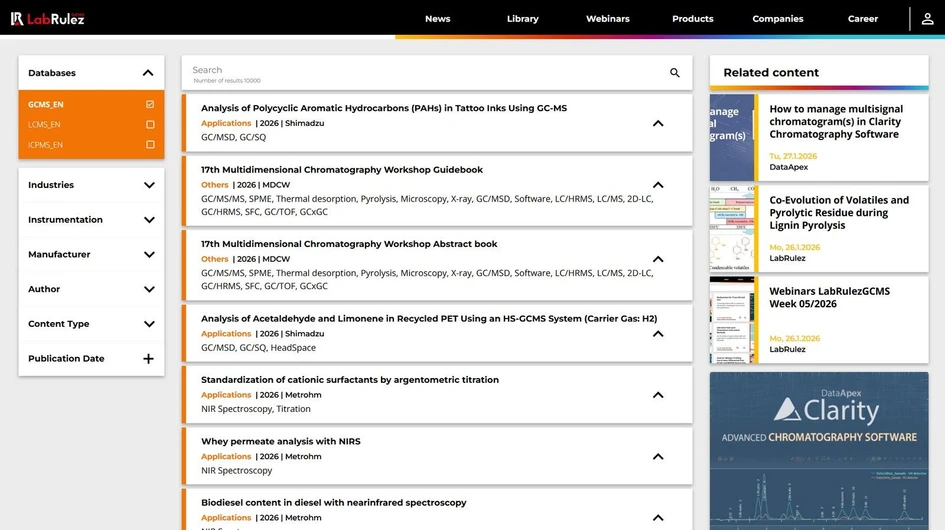
Our Library never stops expanding. What are the most recent contributions to LabRulezGCMS Library in the week of 26th January 2026? Check out new documents from the field of the gas phase, especially GC and GC/MS techniques!
👉 SEARCH THE LARGEST REPOSITORY OF DOCUMENTS ABOUT GCMS AND RELATED TECHNIQUES
👉 Need info about different analytical techniques? Peek into LabRulezLCMS or LabRulezICPMS libraries.
This week we bring you brochure by Agilent Technologies and application notes by BaySpec, Metrohm and Shimadzu!
1. Agilent Technologies: Maintain Power Grid Integrity - Agilent transformer oil gas analyzers
- Brochure
- Full PDF for download
Agilent transformer oil gas analyzers (TOGA) are designed to help utilities and service laboratories maintain power grid integrity by monitoring the condition of electrical transformers through dissolved gas analysis (DGA). Transformer oil degrades under electrical, thermal, and mechanical stress, generating characteristic gases whose composition and ratios provide early warning of developing faults. By reliably identifying and quantifying these gases, TOGA systems enable predictive maintenance, help prevent catastrophic transformer failures, and support informed asset management decisions.
The analyzers are built around the Agilent 8890 gas chromatograph and 8697 headspace sampler and are factory-configured, tested, and performance-verified for immediate deployment. They support ASTM D3612 methods A and C, offering flexible configurations for vacuum extraction or headspace sampling. Automated operation allows unattended analysis of up to 120 samples, while high-performance Agilent J&W PLOT columns ensure excellent separation, reproducibility, and reliable detection of key fault gases such as hydrogen, carbon oxides, methane, ethylene, acetylene, and higher hydrocarbons.
Agilent TOGA systems are delivered as complete workflow solutions, minimizing method development time and accelerating system validation. Intelligent instrument diagnostics, microchannel-based electronic pneumatic control, and remote access capabilities improve reliability, uptime, and ease of operation. Integrated quality-control procedures—from factory testing through on-site installation—ensure consistent performance and traceability from day one.
Data acquisition, analysis, and reporting are supported by OpenLab CDS, which provides a unified platform with high data integrity, streamlined workflows, and secure records management. Combined with Agilent’s extensive service, training, and support offerings, TOGA analyzers represent a robust, future-ready solution for dissolved gas analysis in transformer oil, helping protect critical energy infrastructure while reducing operational risk
2. BaySpec: Drug Screening using Compact Portable Device for Supervised Injection Sites
- Application note
- Full PDF for download
In response to the rising epidemic, some governments have passed bills making supervised injection sites (SIS) a potential avenue for reducing the rate of drug overdoses. SISs are health care facilities where staff are trained to provide health education, support and connections to services as well as intervening in serious adverse events such as drug overdoses. They provide a safe, hygienic and non-judgement environment in which individuals may consume illicit drugs without fear of arrest.
The benefits of SIS are to:
(1) prevent an overdose from becoming fatal through quick intervention, (2) reduce the frequency of public injection and publicly discarded syringes, (3) increase access to health services including substance use treatment, and (4) change behaviors associated with acquiring HIV and hepatitis.
The benefits of drug checking services within an SIS are:
(1) it provides the consumer information about the contents of their drugs prior to consumption allowing them take steps to reduce their risk of overdose, (2) it identifies when a highly toxic substance may be in the local drug supply so advisories can be issued to local service agencies and first responders, (3) it encourages use of supervised injection services and the benefits mentioned above, and (4) it detects novel substances or drug combinations that may impact the consumer.
Initially approved by the Canadian federal government in 2017, the nation now has four official SISs in operation in Ottawa and four sites approved in Toronto. While most SISs are prepared to respond quickly to overdoses, a better practice is to screen drugs for harmful impurities prior to injection. Some SISs are taking such precautions by providing the option for clients to test their drugs prior to injection with BaySpec’s Portability Mass Spectrometer, a low maintenance, cost effective, portable instrument weighing only 20 pounds.
3. Metrohm: Assessment of chocolate with Raman spectroscopy
- Application note
- Full PDF for download
Rapid quality control of different chocolate types
Application Note AN-RS-052 In 2024, the global chocolate market was valued at approximately $131 billion USD. It is projected to reach approximately $173 billion by 2030, implying a steady growth rate of roughly 4% [1]. This growth is driven by sustained consumer demand and is expected to continue rising.
Spectroscopy is increasingly utilized in chocolate manufacturing for quality control (QC), thanks to its ability to assess the composition of chocolate, providing a «fingerprint» spectrum that reveals its chemical details. Specifically, Raman can be used in QC to distinguish between types of chocolate, detect adulteration, measure crystallization and texture, and monitor the manufacturing process.
This Application Note outlines techniques for effectively collecting Raman spectra from various chocolates, providing a foundation for quality assessment and adulteration detection.
METHOD
Raman data collection with an i-Raman NxG 1064 laboratory Raman system (Figure 2) was optimized by adjusting integration time and laser power (Table 3) to determine the best conditions to maximize signal strength and minimize risk of sample melting.
All chocolate samples were analyzed by placing a piece of chocolate on the stage with a Raman probe securely locked above the sample (Figure 3). The optimal working distance was determined by adjusting the probe’s z-axis position while continuously monitoring the intensity of the Raman signal. Once the optimal focal distance is found, a distance regulator helps the operator position the probe on the sample to ensure consistent and reliable measurement.
CONCLUSION
This study highlights the capability of Raman spectroscopy for rapid, nondestructive measurements of chocolate quality indicators. PLS models demonstrate high predictive accuracy for both cocoarelated materials and sugar content. Increasing the number of samples and testing a broader range of chocolates would further improve the robustness and accuracy of the model. Overall, Raman spectroscopy, combined with chemometric modeling, offers a reliable QC method for routine and real-time chocolate analysis.
4. Shimadzu: Analysis of Acetaldehyde and Limonene in Recycled PET Using an HS-GCMS System (Carrier Gas: H2)
- Application note
- Full PDF for download
User Benefits
- The gas released from the polymer can be easily measured without dissolving the polymer in a solvent, by using a headspace sampler (HS).
- Using an HS-GC/MS system enables qualitative and quantitative analysis of target components in samples with a large number of contaminants that make it difficult to differentiate the targets from other components.
- Analysis costs can be reduced by using hydrogen as a carrier gas, which is more affordable and readily available than helium
Plastic is lightweight, strong, waterproof, and very convenient, making it an essential part of our modern lives. On the other hand, because it is a major contributor to environmental issues, such as ocean pollution and global warming, measures to reduce plastic usage are being undertaken in countries around the world. 1)
In Japan, the Plastic Resource Circulation Promotion Act2) came into effect in April 2022. The act does not regulate plastic but rather promotes the establishment of a sustainable circular economy by encouraging collaboration among businesses, local governments, and consumers throughout the overall process of designing, manufacturing, selling, collecting, and recycling plastic products.
One of these initiatives is the recycling of PET bottles for beverage use. When recycling beverage bottles, residual odors can be an issue, with substances like acetaldehyde from water bottles and limonene from citrus beverages known to persist in the containers. To address these residual substances, recycling companies are implementing unique strategies, one of which involves using gas chromatography-mass spectrometry (GC-MS) to quantify the residual materials. In this article, we present an example of qualitative and quantitative analysis of aldehydes and limonene in PET bottles using the GCMS-QP2020 NX/HS-20 NX, with hydrogen (H2) as the carrier gas.
Conclusion
By using hydrogen (H2) gas as the carrier gas, we were able to avoid the use of the hard-to-obtain helium gas. Additionally, by employing an HS-GC-MS system, we could qualitatively and quantitatively analyze acetaldehyde and limonene from PET without the need for cumbersome pretreatment.