Identifying the transition from antemortem to post-mortem odor in cadavers cadavers in an outdoor environment (Darshil Patel, MDCW 2026)
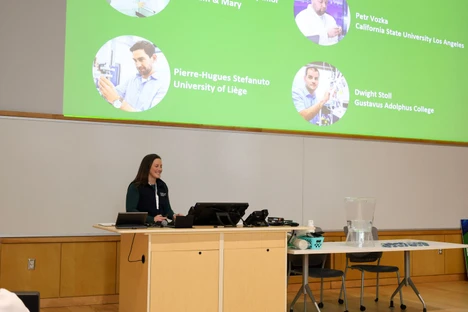
- Photo: MDCW: Identifying the transition from antemortem to post-mortem odor in cadavers cadavers in an outdoor environment (Darshil Patel, MDCW 2026)
- Video: LabRulez: Darshil Patel: Identifying the transition from ante- to post-mortem odor in cadavers (MDCW 2026)
🎤 Presenter: Darshil Patel (University of North Dakota)
Abstract
Flow-modulated two-dimensional gas chromatography (GCxGC) is an excellent solution for low-boiling point compounds that are difficult to separate by thermal modulation without cryogens. Pairing a quadrupole mass spectrometer (QMS) with GCxGC can offer better dynamic range, increased sensitivity, and lower cost to GCxGC applications, however, many MS instruments can not accept the high flow rate coming from flow-modulated GCxGC.
In this study, a flow modulator was installed in a QMS system designed to accept high GC flow rates, and tested using perfume and pesticide applications. Results detailing the sensitivity and effectiveness of the QMS system with high GCxGC flow input will be discussed, as well as a comparison to thermal modulation results from the same system.
Video Transcription
Darshil Patel opened the presentation by discussing the concept of human odor and its transition after death. He explained that living humans possess a unique antemortem scent composed of volatile organic compounds (VOCs) released from the skin through microbiome activity, sweat, and breath. After death, this odor profile gradually changes into what is known as postmortem odor. The exact timing and progression of this transition remain poorly understood.
The presenter emphasized the practical importance of understanding this transition in disaster victim recovery operations. Search-and-rescue dogs are trained to detect odors associated with living individuals, whereas human remains detection dogs are trained to identify postmortem odors. Determining when antemortem odor disappears and postmortem odor becomes dominant can improve the deployment and training of these specialized canine units.
Research Objectives
The study focused on the early postmortem period in humans and aimed to:
- Characterize VOCs released during the fresh stage of decomposition
- Track the evolution of donor VOC profiles over time
- Identify the transition point between antemortem and postmortem odor
Patel noted that prior to this research, only one study involving pig remains had examined odor transition during decomposition.
Human Decomposition Overview
The presenter reviewed the five major stages of decomposition:
- Fresh stage
- Bloat stage
- Active decay
- Dry remains
- Skeletonization
The research concentrated specifically on the fresh stage, encompassing the earliest postmortem interval.
During this stage, several immediate physiological changes occur:
- Algor mortis – cooling of the body
- Rigor mortis – stiffening of muscles
- Livor mortis – pooling of blood
At the microscopic level, decomposition involves:
- Autolysis – cellular breakdown
- Putrefaction – microbial degradation of tissues
These processes generate VOCs that collectively contribute to postmortem odor.
Experimental Design
Human Donors and Study Sites
The study examined three human donors (cadavers) and monitored their VOC profiles both:
- In the morgue
- At the REST outdoor decomposition research facility in Canada
REST is currently the only Canadian outdoor human decomposition research facility.
VOC Sampling Procedures
Morgue Sampling
Upon arrival at the morgue:
- Bodies arrived enclosed in shroud-like materials or body bags
- The bags were briefly opened to release VOCs accumulated during transportation
- Bags were resealed for 20 minutes to allow VOC accumulation
- VOCs were collected using:
- Tenax TA/Carbograph sorbent tubes
- Active low-flow sampling pumps
- Sampling conditions:
- 10-minute collection
- 100 mL/min flow rate
Background and body-bag controls were also collected.
REST Facility Sampling
At the outdoor decomposition facility:
- Donors were placed unclothed on their backs
- Anti-scavenging cages protected remains from animals
- During sampling:
- An aluminum hood was placed over the donor
- VOCs accumulated for 20 minutes
- VOCs were then collected onto sorbent tubes
Sampling conditions matched those used in the morgue to maintain methodological consistency.
Instrumentation and Analytical Workflow
GC×GC-TOFMS Analysis
Samples were analyzed using:
- LECO Pegasus BT system
- Mid-polar column combination with Stabilwax columns
An internal standard was injected into every sample.
Decomposition Standard Mix
Researchers also analyzed a decomposition standard mixture containing 25 compounds previously reported in human decomposition studies. This standard was used to monitor method performance and VOC evolution throughout the study.
Data Processing Workflow
Initial data processing was conducted using ChromaTOF software with the following criteria:
- Minimum signal-to-noise ratio: 100
- Spectral similarity match: ≥850
Further processing was completed in RStudio.
Data Filtering Steps
The workflow included:
- Exporting chromatographic peak tables as CSV files
- Classification into experimental and control samples
- Pairwise peak alignment
- Normalization to internal standards
- Removal of background contaminants
- Filtering out siloxanes and column-derived artifacts
- Manual verification using:
- ChromaTOF
- NIST libraries
Final datasets contained normalized peak areas for validated compounds only.
Decomposition Observations
The three donors displayed visibly different decomposition trajectories despite being exposed to similar environmental conditions. Patel emphasized that decomposition is highly variable and no two bodies decompose identically.
Early Postmortem VOC Profiles
The early decomposition VOC profiles contained multiple chemical classes. The most abundant were:
- Nitrogen-containing compounds
Acids were detected at relatively low abundance, which aligned with existing literature indicating acids typically become prominent during later decomposition stages.
Identification of VOC Categories
The researchers compared their VOC dataset with published literature describing:
- Antemortem VOCs from living humans
- Postmortem VOCs from decomposition studies
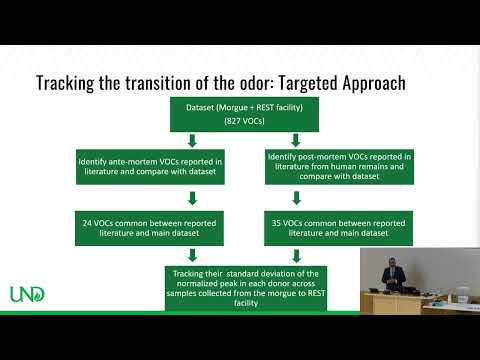
This comparison identified:
- 24 VOCs associated with antemortem odor
- 35 VOCs associated with postmortem odor
Additionally, a third category emerged:
- VOCs present in both antemortem and postmortem periods
These compounds were termed:
“Transmortem VOCs”
In living humans, these VOCs were linked to skin emissions, while in decomposition they appeared associated with microbial breakdown processes.
Transition of Odor Profiles
The presenter analyzed VOC evolution over time using accumulated degree days (ADD), calculated from ambient temperature measurements.
Key observations included:
- Antemortem VOCs persisted throughout the early postmortem period
- Transmortem VOCs were consistently detected
- Postmortem VOCs increased sharply during later experimental days
This pattern was observed consistently across all three donors.
Transition Point
Visual observations and chemical data both indicated that:
- Around experimental day 3
- Bodies began transitioning toward the bloat stage
- Postmortem VOC abundance increased substantially
The study therefore proposed that the odor transition begins approximately around day 3 of decomposition under the tested outdoor conditions.
Implications for Detection Dogs
The persistence of antemortem and transmortem VOCs during early decomposition may explain why search-and-rescue dogs occasionally alert to deceased victims.
Patel suggested that overlapping odor signatures could create confusion for canine detection systems in disaster scenarios.
Conclusions
The study demonstrated that:
- The transition from antemortem to postmortem odor can be chemically monitored
- Postmortem VOCs become dominant as decomposition progresses
- Environmental decomposition studies provide valuable insight into odor evolution
Patel emphasized that significantly more research is needed across:
- Different environments
- Seasonal conditions
- Additional donor populations
to fully understand human odor transition after death.
This text has been automatically transcribed from a video presentation using AI technology. It may contain inaccuracies and is not guaranteed to be 100% correct.
-Workshop-LOGO_s.webp)


_s.webp)