News from LabRulezGCMS Library - Week 20, 2026
LabRulez: News from LabRulezGCMS Library - Week 20, 2026
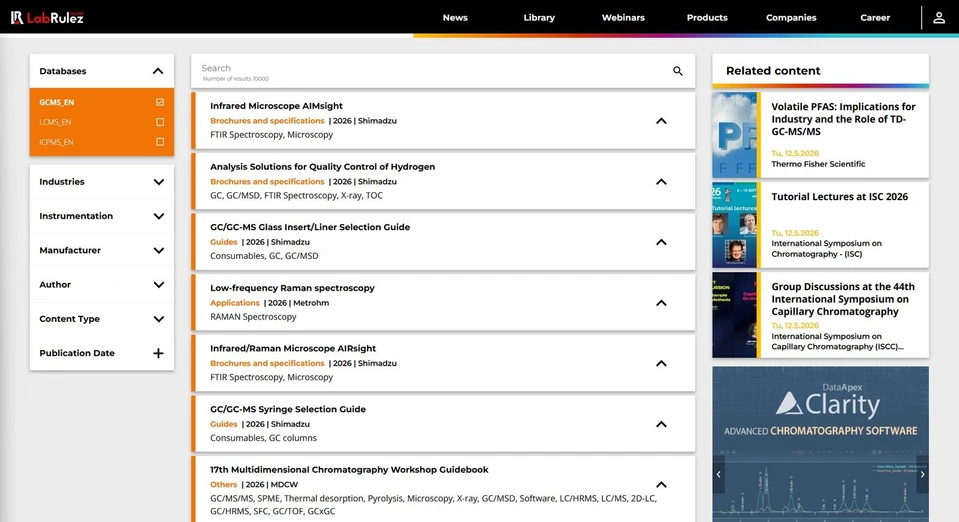
Our Library never stops expanding. What are the most recent contributions to LabRulezGCMS Library in the week of 11th May 2026? Check out new documents from the field of the gas phase, especially GC and GC/MS techniques!
👉 SEARCH THE LARGEST REPOSITORY OF DOCUMENTS ABOUT GCMS AND RELATED TECHNIQUES
👉 Need info about different analytical techniques? Peek into LabRulezLCMS or LabRulezICPMS libraries.
This week we bring you application note by Shimadzu, poster by MDCW / William & Mary and brochure by Thermo Fisher Scientific!
1. MDCW / William & Mary: Optimizing Solvent Selection and Data Reduction Workflows for GC×GC Fire Debris Analysis
- Poster
- Full PDF for download
What are Ignitable Liquid Residues (ILRs)?
- Chemical remains of ignitable liquids (IL) (e.g., gasoline or diesel) that did not fully burn during a fire
- ILRs are usually petroleum-based products and contain complex mixtures of volatile chemicals, like hydrocarbons
Forensic Analysis of ILRs
- Collection of porous materials like wood from the fire’s point of origin
- Must be stored in airtight containers to prevent volatile ILR from evaporation
- Passive headspace extraction onto activate charcoal strips (ACS) is used to extract ILRs from debris, and dichloromethane (DCM) is used to extracts ILRs from charcoal strips
- Emerging is the use of two-dimensional gas chromatography – time of fight - mass spectrometry (GC×GC-TOFMS), with higher separation and resolution
- Resulting chromatograms presents a pattern of peaks which can be used to identified specific type of accelerant used
Chemometrics
- The discipline that focuses on the application of statistical and mathematical methods to analyze chemical data and extract meaningful information (Bovens, 2019)
- Helps make sense of large datasets from analytical instruments, find pattens, and classify samples
Methods
Analytical Instrumentation
- LECO corporation BTX4D GC×GC-TOFMS with Paradigm Shift reverse fill-flush (RFF) flow modulator
Software
- ChromaTOF Sync 2D (LECO corporation)
- R Statistical Software
Conclusions
This study demonstrated that the use of chemometrics can be integrated into a data processing workflow to better understand data sets and create a streamlined process. Using UMAP, patterns identified that were not originally seen in PCA lead to the preferred solvents of ILR extraction being hexane and methanol. Since UMAP allowed visualization of local and global structures, groupings of gasoline samples allowed for better analysis of solvent effect.
2. Shimadzu: Multiresidue Pesticides Analysis in Solvent Extract of Annatto (Natural Color Additive) Using GCMSTQ8050 NX
- Application note
- Full PDF for download
User Benefits
- Accurate and reproducible trace level quantitation of pesticides in highly pigmented complex matrix using Ultra-fast GCMSTQ8050 NX and QuEChERS extraction
- Single-laboratory partial validated method for LOQ determination meeting regulatory guidelines
- Ease of instrumental method optimization using GCMS Smart Pesticides Database Ver.2 from Shimadzu Corporation
Annatto is an orange-red condiment and food colorant derived from the seeds of the achiote tree (Bixa Orellana) (Fig. 1). It is often used to impart a yellow to red-orange color to foods, but sometimes also for its flavor and aroma. Similar effects can be obtained by extracting some of the color and flavor principles from the seeds, which are then added to the food. Annatto and its extracts are now widely used in an artisanal or industrial scale as a coloring agent in many processed food products, such as cheeses, butter, baked goods, potatoes, snack foods, breakfast cereals, smoked fish etc. In these uses, Annatto is a natural alternative to synthetic food coloring compounds.
Owing to its large culinary uses and other diverse applications, use of chemical pesticides for its production in large quantities is imperative. Dye extraction process may result in concentration of pesticides and in turn contribute to adverse impact on human health when incorporated in various preparations. Hence quantitation of residual pesticides in Annatto extract becomes very important. As the oleoresin is a complex matrix, it is required to develop a rugged, sensitive and efficient method for extraction of residual pesticide and its analysis.
This study reports a highly sensitive method for simultaneous quantification of multiple pesticides in highly pigmented complex matrix of Annatto using modified QuEChERS[1] with triple quadrupole gas chromatography (GC-MS/MS) system.
Materials and Methods
For this study, customized reference standard mixture of most commonly observed pesticides in Annatto seeds was procured from Restek Corporation.
The calibration standards were analyzed from 0.5 to 1000 μg/L. Linearity was plotted by external standard method and using weighted regression of 1/C2. Sample was spiked at 3 levels i.e., 10, 25 and 100 μg/kg. Recovery samples were prepared in 6 replicates at each level. GCMS-TQ8050 NX (Fig. 2), manufactured by Shimadzu Corporation Japan, was used for quantitation. LabSolutions InsightTM was used for data processing, which helped in evaluating validation parameters with ease.
Conclusion
This study shows that the modified QuEChERS method combined with GC-MS/MS system is a reliable and efficient tool to quantify residual pesticides in Annatto extract sample. Although Annatto extract is a highly pigmented complex matrix, the modified QuEChERS method significantly reduces interference. Also, extremely sensitive Shimadzu GC-MS/MS allows trace level detection even after multifold dilution of sample. This helps in reducing contamination and enhancing ruggednessresulting in reproducible detection of analytes.
3. Thermo Fisher Scientific: Sentinel PRO 710 environmental mass spectrometer Precise real time gas analyzer for toxic volatile organic compounds
- Product specification
- Full PDF for download
The Thermo Scientific™ Sentinel PRO Environmental Mass Spectrometer is a highly reliable and versatile gas analyzer ideal for reporting the presence of toxic VOCs from fugitive emissions in industrial settings to ensure worker safety.
Fugitive emissions of toxic VOCs
Wherever there is potential danger for fugitive emissions of toxic organic vapors from a chemical production unit, regulating authorities often require plants to keep records of ambient vapor concentrations to protect workers from exposure. Various forms of capture include evacuated vessels, organic vapor monitors, or purge and trap devices, all of which require samples to be sent for analysis. Alternatively, electrochemical sensors or open path FT-IR spectroscopy can provide more immediate results. However, none of these technologies are capable of providing the spatial and temporal resolution required to qualify as actionable information.
Analytical platform
The primary feature of the Sentinel PRO mass spectrometer is the magnetic sector analyzer. This field-proven technology has demonstrated the strongest performance for industrial on-line gas analysis. Magnetic sector technology offers precision, accuracy, long intervals between calibrations. The new touchscreen interface further enhances usability, providing intuitive in-person operation, simplified maintenance, and real-time data viewing. Multi-role user permissions ensure security and control allowing operators to customize settings based on their specific needs.
Comprehensive data collection
With speed and precision, the Sentinel PRO analyzer monitors all the critical areas for short-term exposure levels of toxic VOCs, and also provides accurate and time-weighted average exposure data. With a high number of sample points available, many can be located close to potential leak points such as valve stems, etc., enabling leak detection and correction before any toxic hazard is created.
Membrane inlet mass spectrometry
The analyzer is fitted with a membrane inlet to reduce the pressure of the sample air from atmospheric to the working pressure of the enclosed ion source. This allows a method of sample introduction that greatly enhances the system’s sensitivity to VOCs. Since the membrane is more permeable to VOCs than to major air gases, it provides enrichment by several orders of magnitude, enabling detection as low as 5 ppb (species dependent) permits easy membrane replacement during annual routine maintenance to minimize downtime and increase productivity.