Author
The Multidimensional Chromatography Workshop
The Multidimensional Chromatography (MDC) Workshop draws experts in this exciting field to share and discuss their research.
Tags
Presentation
Video
LinkedIn Logo

Selection, Optimization, and Validation of Thermal Desorption for analysis of VOCs and PAHs in Combustion Emissions (Caleb Marx, MDCW 2026)
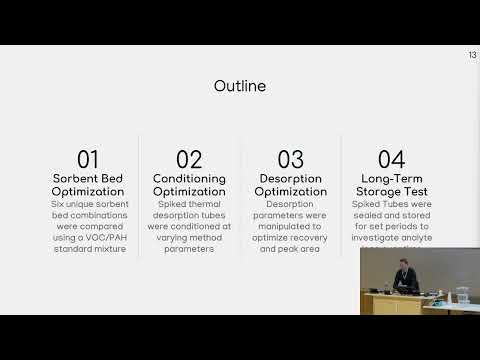
We, 6.5.2026
| Original article from: Multidimensional Chromatography Workshop (MDCW)
Thermal desorption coupled with GC×GC offers a powerful approach for wildfire smoke analysis, capturing gas-phase VOCs and complex organic profiles beyond conventional filter sampling.
Video placeholder
  • Photo: MDCW: Selection, Optimization, and Validation of Thermal Desorption for analysis of VOCs and PAHs in Combustion Emissions (Caleb Marx, MDCW 2026)
  • Video: LabRulez: Caleb Marx: Thermal desorption GC-MS for analysis of VOCs and PAHs in combustion smoke (MDCW 2026)
     

🎤 Presenter: Caleb Marx (University of Lethbridge)

💾 PDF presentation

Abstract

Smoke from fires releases large quantities of hazardous chemicals into the atmosphere causing poor air quality at local, regional, and global scales. Due to the complexity of smoke emissions, the health impacts from inhalation and dermal exposure vary with fuel type and combustion conditions. Accurate emissions characterization data is critical for understanding health risks associated with smoke exposure. To date, smoke characterization has been predominately conducted utilizing filter extracts and standard GC-MS. This method has several limitations including lengthy extraction times, excessive use of toxic solvents, and cluttered chromatograms resulting in peak coelution. The use of thermal desorption (TD) combined with two-dimensional gas chromatography offers an appealing alternative to traditional methods by improving recovery, eliminating solvent use, and enhancing chromatographic clarity through second dimension separation. However, limited work has been published optimizing these techniques for smoke emissions.

This research sought to optimize sorbent bed selection and TD method parameters to allow non targeted analysis of smoke emissions. We explored the application of 6 unique sorbent bed combinations to optimize analyte retention of smoke compounds with varying polarity and volatility. Following sorbent selection, a design of experiment approach was applied to optimize the analytical desorption parameters (time, temperature, and flow) and conditioning methodology (time, temperature). The method was validated using smoke collected from lab-scale combustion chamber under controlled conditions. This study establishes a strong analytical foundation to improve our understanding of both primary and secondary smoke emissions, supporting more accurate risk assessment and informing public health and environmental policy.

Video Transcription

Thermal Desorption–GC×GC for Wildfire Smoke Analysis

Wildland fires are a major global source of atmospheric contamination. Beyond the direct destruction caused by flames, wildfire smoke releases large amounts of carbon and a complex mixture of airborne pollutants that can travel hundreds of kilometers and affect air quality far from the fire source.

Smoke can be viewed as a highly complex chemical mixture containing particulate matter, inorganic gases such as carbon dioxide, carbon monoxide and nitrogen oxides, and a broad range of volatile organic compounds (VOCs). Of particular analytical interest are compounds such as BTEX and polycyclic aromatic hydrocarbons (PAHs), which are relevant to both environmental and human health impacts.

A key challenge is that smoke composition changes as it moves through the atmosphere. Primary VOCs emitted directly from combustion can undergo oxidation and contribute to secondary organic aerosol formation, shifting material from the gas phase into the particulate phase. This means that smoke characterization should consider both freshly emitted compounds and the chemical changes that occur during atmospheric aging.

Limitations of Conventional Filter Sampling

Filter sampling is widely used for wildfire smoke studies and remains a valuable approach for particulate matter characterization. Filters can be extracted for organic analysis, digested for metals, or used to determine particulate loading and size distributions.

However, filter sampling does not adequately capture gas-phase organic compounds. This is a significant limitation when the goal is to characterize the full chemical profile of smoke emissions. Thermal desorption offers a complementary approach by enabling collection and analysis of volatile and semi-volatile organic compounds, including compounds present in the gas phase.

Thermal Desorption as a Sampling Strategy

Thermal desorption uses sorbent-packed tubes to trap VOCs from air samples. These tubes may contain one or more sorbent materials, allowing the method to be tailored to a target volatility range. Common sorbent types include porous polymers such as Tenax TA, graphitized carbon black and carbon molecular sieves.

Sorbent selection is critical. Stronger sorbents can retain more volatile analytes, but they may also retain more water, which can complicate analysis. Multi-bed tubes can broaden the analyte range, but require careful optimization to balance analyte recovery, water retention and desorption efficiency.

After sampling, the thermal desorption tube is transferred to the laboratory, where heat and carrier gas release the trapped analytes into the analytical system.

Why GC×GC Matters for Smoke

Because wildfire smoke is chemically complex, comprehensive two-dimensional gas chromatography (GC×GC) is especially useful. In this work, thermal desorption was coupled with GC×GC using a non-polar first-dimension column, a semi-polar second-dimension column and flow modulation.

This configuration provides enhanced separation capacity for complex smoke samples, where one-dimensional GC may struggle with coelution. In the wildfire smoke application, each sample produced an average of approximately 166 unique peaks, highlighting the complexity of the matrix.

Method Optimization

The study optimized thermal desorption for smoke analysis through four main experiments:

  • sorbent bed selection
  • tube conditioning optimization
  • desorption parameter optimization
  • long-term storage stability

A combined liquid standard mixture was used, containing 41 target compounds across a broad range of retention indices, hydrophobicities and Henry’s law constants. Liquid standards were introduced onto thermal desorption tubes using a nitrogen stream, allowing controlled evaluation of recovery, linearity and detection limits.

Sorbent Selection and Concentration Effects

Six sorbent tube configurations were compared, including in-house and commercially packed tubes. Performance was evaluated using recovery, linearity and limits of detection.

An important observation was that sorbent performance depended on analyte concentration. At higher concentration, a Tenax TA/Carbopack X configuration showed strong retention performance across the target analytes. At lower concentration, a triple-bed tube performed better.

This concentration-dependent behavior is important for field applications. Urban air sampling, where analyte levels may be low, may benefit from a different sorbent strategy than wildfire smoke sampling, where concentrations can be much higher.

Conditioning and Desorption Optimization

Tube conditioning is the cleaning step that allows thermal desorption tubes to be reused. The study showed that conditioning temperature and time could be reduced below commonly recommended conditions while still removing retained analytes effectively. This can save laboratory time and may extend sorbent lifetime.

Desorption parameters, including time, temperature and trap flow, were also optimized. The results suggested that desorption conditions could be reduced without significantly affecting peak area. This is beneficial because lower desorption stress can preserve sorbent performance, reduce gas consumption and shorten analytical runs.

Some concentration-dependent effects were observed at the high and low ends of the calibration range, suggesting that further study of desorption conditions across concentration ranges may be valuable.

Storage Stability

A 35-day storage stability experiment was conducted across eight sampling intervals. No significant analyte loss was observed over the full storage period. This is a practically important finding for field sampling campaigns, where samples may need to be transported or stored before analysis.

Application to Wildfire Smoke

The optimized method was applied to smoke generated from combustion of white spruce in a controlled setup. Approximately one liter of emitted smoke was collected and analyzed by TD–GC×GC.

The method detected a complex chromatographic profile, with most peaks falling in the C6–C14 range. Of the 41 standard compounds, 19 were identified in the smoke samples, including PAHs and BTEX compounds. These analytes fell within the established linear range, supporting the suitability of the method for targeted and broader smoke characterization.

Conclusion

Thermal desorption coupled with GC×GC offers a powerful approach for wildfire smoke analysis, particularly because it can address gas-phase organic compounds that are not captured effectively by conventional filter sampling.

The work demonstrates that sorbent selection, conditioning, desorption parameters and storage stability all play important roles in method performance. The observed concentration dependence of sorbent behavior is especially relevant for adapting methods to different sampling scenarios, from urban air monitoring to high-concentration wildfire smoke studies.

Overall, optimized TD–GC×GC provides a robust platform for characterizing complex smoke emissions and improving understanding of how wildfire-derived organic compounds affect air quality and environmental exposure.

This text has been automatically transcribed from a video presentation using AI technology. It may contain inaccuracies and is not guaranteed to be 100% correct.

The Multidimensional Chromatography Workshop
LinkedIn Logo
 

Related content

Alcohol Determination of Sanitizer Gel Using Nexis GC-2060

Applications
| 2026 | Shimadzu
Instrumentation
GC
Manufacturer
Shimadzu
Industries
Pharma & Biopharma

Sensitive and Reproducible Determination of Nitrosamines by GC/MSD

Applications
| 2026 | Agilent Technologies
Instrumentation
GC/MSD, GC/SQ
Manufacturer
Agilent Technologies
Industries
Environmental

High-Throughput BTEX Analysis in Nail Products by SPME and GC/TQ

Applications
| 2026 | Agilent Technologies
Instrumentation
GC/MSD, GC/MS/MS, GC/QQQ, SPME
Manufacturer
Agilent Technologies
Industries
Materials Testing

Accurate multi-component blast furnace gas analysis maximizes iron production and minimizes coke consumption

Applications
| 2026 | Thermo Fisher Scientific
Instrumentation
GC/MSD
Manufacturer
Thermo Fisher Scientific
Industries
Energy & Chemicals

Gas Chromatograph Nexis GC-2060

Brochures and specifications
| 2026 | Shimadzu
Instrumentation
GC
Manufacturer
Shimadzu
Industries
Other
 

Related articles

Full Evaporative Vacuum Extraction─A Quantitative and Green Approach for Analysis of Semivolatile Organic Compounds in Drinking Water and Surface Water Using GC–MS
Article | Scientific article

Full Evaporative Vacuum Extraction─A Quantitative and Green Approach for Analysis of Semivolatile Organic Compounds in Drinking Water and Surface Water Using GC–MS

In the article in ACS Analytical Chemistry the authors describe a Full Evaporative Vacuum Extraction (FEVE) method for efficient analysis of a wide range of semivolatile organic compounds (SVOCs) in water.
LabRulez
tag
share
more
News from LabRulezGCMS Library - Week 24, 2025
Article | Application

News from LabRulezGCMS Library - Week 24, 2025

This week we bring you application notes by Agilent Technologies and Shimadzu and presentation by University of Liege / MDCW!
LabRulez
tag
share
more
17th MDCW 2026 (Day 2)
Article | Events

17th MDCW 2026 (Day 2)

Day 2 of MDCW 2026 highlighted the power of multidimensional chromatography, from plastic recycling and pyrolysis to GC×GC-MS automation, 2D-LC in biopharma, PFAS analysis, and thermal desorption.
The Multidimensional Chromatography Workshop
tag
share
more
News from LabRulezGCMS Library - Week 13, 2026
Article | Application

News from LabRulezGCMS Library - Week 13, 2026

This week we bring you application notes by Agilent Technologies, Shimadzu, and Thermo Fisher Scientific and presentation by MDCW / Mount Royal University!
LabRulez
tag
share
more
 

Related content

Alcohol Determination of Sanitizer Gel Using Nexis GC-2060

Applications
| 2026 | Shimadzu
Instrumentation
GC
Manufacturer
Shimadzu
Industries
Pharma & Biopharma

Sensitive and Reproducible Determination of Nitrosamines by GC/MSD

Applications
| 2026 | Agilent Technologies
Instrumentation
GC/MSD, GC/SQ
Manufacturer
Agilent Technologies
Industries
Environmental

High-Throughput BTEX Analysis in Nail Products by SPME and GC/TQ

Applications
| 2026 | Agilent Technologies
Instrumentation
GC/MSD, GC/MS/MS, GC/QQQ, SPME
Manufacturer
Agilent Technologies
Industries
Materials Testing

Accurate multi-component blast furnace gas analysis maximizes iron production and minimizes coke consumption

Applications
| 2026 | Thermo Fisher Scientific
Instrumentation
GC/MSD
Manufacturer
Thermo Fisher Scientific
Industries
Energy & Chemicals

Gas Chromatograph Nexis GC-2060

Brochures and specifications
| 2026 | Shimadzu
Instrumentation
GC
Manufacturer
Shimadzu
Industries
Other
 

Related articles

Full Evaporative Vacuum Extraction─A Quantitative and Green Approach for Analysis of Semivolatile Organic Compounds in Drinking Water and Surface Water Using GC–MS
Article | Scientific article

Full Evaporative Vacuum Extraction─A Quantitative and Green Approach for Analysis of Semivolatile Organic Compounds in Drinking Water and Surface Water Using GC–MS

In the article in ACS Analytical Chemistry the authors describe a Full Evaporative Vacuum Extraction (FEVE) method for efficient analysis of a wide range of semivolatile organic compounds (SVOCs) in water.
LabRulez
tag
share
more
News from LabRulezGCMS Library - Week 24, 2025
Article | Application

News from LabRulezGCMS Library - Week 24, 2025

This week we bring you application notes by Agilent Technologies and Shimadzu and presentation by University of Liege / MDCW!
LabRulez
tag
share
more
17th MDCW 2026 (Day 2)
Article | Events

17th MDCW 2026 (Day 2)

Day 2 of MDCW 2026 highlighted the power of multidimensional chromatography, from plastic recycling and pyrolysis to GC×GC-MS automation, 2D-LC in biopharma, PFAS analysis, and thermal desorption.
The Multidimensional Chromatography Workshop
tag
share
more
News from LabRulezGCMS Library - Week 13, 2026
Article | Application

News from LabRulezGCMS Library - Week 13, 2026

This week we bring you application notes by Agilent Technologies, Shimadzu, and Thermo Fisher Scientific and presentation by MDCW / Mount Royal University!
LabRulez
tag
share
more
 

Related content

Alcohol Determination of Sanitizer Gel Using Nexis GC-2060

Applications
| 2026 | Shimadzu
Instrumentation
GC
Manufacturer
Shimadzu
Industries
Pharma & Biopharma

Sensitive and Reproducible Determination of Nitrosamines by GC/MSD

Applications
| 2026 | Agilent Technologies
Instrumentation
GC/MSD, GC/SQ
Manufacturer
Agilent Technologies
Industries
Environmental

High-Throughput BTEX Analysis in Nail Products by SPME and GC/TQ

Applications
| 2026 | Agilent Technologies
Instrumentation
GC/MSD, GC/MS/MS, GC/QQQ, SPME
Manufacturer
Agilent Technologies
Industries
Materials Testing

Accurate multi-component blast furnace gas analysis maximizes iron production and minimizes coke consumption

Applications
| 2026 | Thermo Fisher Scientific
Instrumentation
GC/MSD
Manufacturer
Thermo Fisher Scientific
Industries
Energy & Chemicals

Gas Chromatograph Nexis GC-2060

Brochures and specifications
| 2026 | Shimadzu
Instrumentation
GC
Manufacturer
Shimadzu
Industries
Other
 

Related articles

Full Evaporative Vacuum Extraction─A Quantitative and Green Approach for Analysis of Semivolatile Organic Compounds in Drinking Water and Surface Water Using GC–MS
Article | Scientific article

Full Evaporative Vacuum Extraction─A Quantitative and Green Approach for Analysis of Semivolatile Organic Compounds in Drinking Water and Surface Water Using GC–MS

In the article in ACS Analytical Chemistry the authors describe a Full Evaporative Vacuum Extraction (FEVE) method for efficient analysis of a wide range of semivolatile organic compounds (SVOCs) in water.
LabRulez
tag
share
more
News from LabRulezGCMS Library - Week 24, 2025
Article | Application

News from LabRulezGCMS Library - Week 24, 2025

This week we bring you application notes by Agilent Technologies and Shimadzu and presentation by University of Liege / MDCW!
LabRulez
tag
share
more
17th MDCW 2026 (Day 2)
Article | Events

17th MDCW 2026 (Day 2)

Day 2 of MDCW 2026 highlighted the power of multidimensional chromatography, from plastic recycling and pyrolysis to GC×GC-MS automation, 2D-LC in biopharma, PFAS analysis, and thermal desorption.
The Multidimensional Chromatography Workshop
tag
share
more
News from LabRulezGCMS Library - Week 13, 2026
Article | Application

News from LabRulezGCMS Library - Week 13, 2026

This week we bring you application notes by Agilent Technologies, Shimadzu, and Thermo Fisher Scientific and presentation by MDCW / Mount Royal University!
LabRulez
tag
share
more
 

Related content

Alcohol Determination of Sanitizer Gel Using Nexis GC-2060

Applications
| 2026 | Shimadzu
Instrumentation
GC
Manufacturer
Shimadzu
Industries
Pharma & Biopharma

Sensitive and Reproducible Determination of Nitrosamines by GC/MSD

Applications
| 2026 | Agilent Technologies
Instrumentation
GC/MSD, GC/SQ
Manufacturer
Agilent Technologies
Industries
Environmental

High-Throughput BTEX Analysis in Nail Products by SPME and GC/TQ

Applications
| 2026 | Agilent Technologies
Instrumentation
GC/MSD, GC/MS/MS, GC/QQQ, SPME
Manufacturer
Agilent Technologies
Industries
Materials Testing

Accurate multi-component blast furnace gas analysis maximizes iron production and minimizes coke consumption

Applications
| 2026 | Thermo Fisher Scientific
Instrumentation
GC/MSD
Manufacturer
Thermo Fisher Scientific
Industries
Energy & Chemicals

Gas Chromatograph Nexis GC-2060

Brochures and specifications
| 2026 | Shimadzu
Instrumentation
GC
Manufacturer
Shimadzu
Industries
Other
 

Related articles

Full Evaporative Vacuum Extraction─A Quantitative and Green Approach for Analysis of Semivolatile Organic Compounds in Drinking Water and Surface Water Using GC–MS
Article | Scientific article

Full Evaporative Vacuum Extraction─A Quantitative and Green Approach for Analysis of Semivolatile Organic Compounds in Drinking Water and Surface Water Using GC–MS

In the article in ACS Analytical Chemistry the authors describe a Full Evaporative Vacuum Extraction (FEVE) method for efficient analysis of a wide range of semivolatile organic compounds (SVOCs) in water.
LabRulez
tag
share
more
News from LabRulezGCMS Library - Week 24, 2025
Article | Application

News from LabRulezGCMS Library - Week 24, 2025

This week we bring you application notes by Agilent Technologies and Shimadzu and presentation by University of Liege / MDCW!
LabRulez
tag
share
more
17th MDCW 2026 (Day 2)
Article | Events

17th MDCW 2026 (Day 2)

Day 2 of MDCW 2026 highlighted the power of multidimensional chromatography, from plastic recycling and pyrolysis to GC×GC-MS automation, 2D-LC in biopharma, PFAS analysis, and thermal desorption.
The Multidimensional Chromatography Workshop
tag
share
more
News from LabRulezGCMS Library - Week 13, 2026
Article | Application

News from LabRulezGCMS Library - Week 13, 2026

This week we bring you application notes by Agilent Technologies, Shimadzu, and Thermo Fisher Scientific and presentation by MDCW / Mount Royal University!
LabRulez
tag
share
more
Other projects
LCMS
ICPMS
Follow us
FacebookX (Twitter)LinkedInYouTube
More information
WebinarsAbout usContact usTerms of use
LabRulez s.r.o. All rights reserved. Content available under a CC BY-SA 4.0 Attribution-ShareAlike