News from LabRulezGCMS Library - Week 18, 2026
LabRulez: News from LabRulezGCMS Library - Week 18, 2026
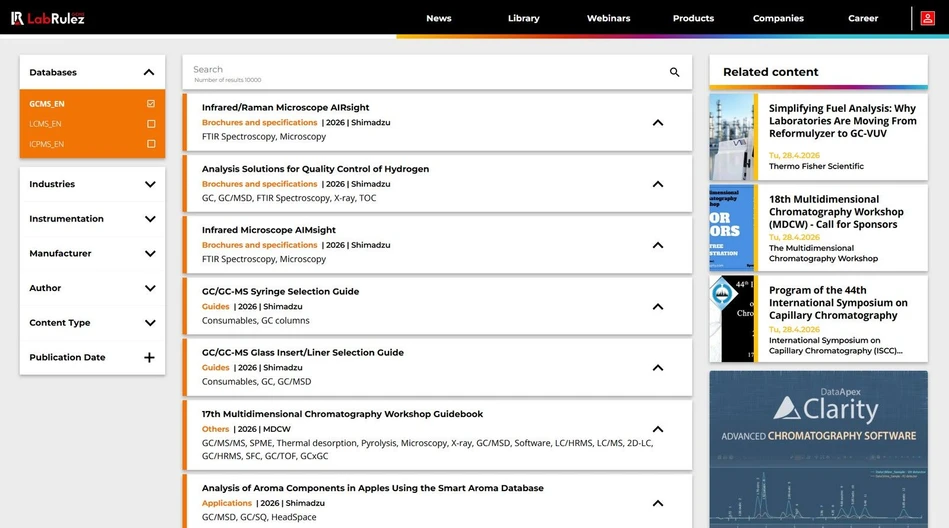
Our Library never stops expanding. What are the most recent contributions to LabRulezGCMS Library in the week of 27th April 2026? Check out new documents from the field of the gas phase, especially GC and GC/MS techniques!
👉 SEARCH THE LARGEST REPOSITORY OF DOCUMENTS ABOUT GCMS AND RELATED TECHNIQUES
👉 Need info about different analytical techniques? Peek into LabRulezLCMS or LabRulezICPMS libraries.
This week we bring you application note by Shimadzu, scientific article by BaySpec, poster by MDCW / JEOL and technical note by Thermo Fisher Scientific!
1. BaySpec: PNNL and BaySpec Launch Compact Mass Spectrometry System for Rapid Narcotics Detection
- Scientific article
- Full PDF for download
The U.S. Department of Energy’s Pacific Northwest National Laboratory’s (PNNL) VaporID, which is a newly developed portable air sampling system incorporating a miniaturized mass spectrometer (MS), can detect trace levels of fentanyl, methamphetamine, cocaine, and even explosives like TNT with great accuracy, the laboratory announced in a press release (1). Because of its success, BaySpec, an optical products manufacturer, is commercializing this instrument, which will be produced later in 2025 (1,2).
The new system employs a technique known as noncontact detection, which collects airborne molecules and analyzes them in real time using a miniature mass spectrometer (1). The VaporID device was first developed in 2020. The device won GeekWire’s Innovation of the Year award that same year (2). At the 2025 American Society for Mass Spectrometry (ASMS) conference in Baltimore Maryland, Krisztian Torma, a BaySpec scientist and one of the lead developers, presented the latest test results of the device. The VaporID device was field-tested at the U.S.–Mexico border crossing in Nogales, Arizona. Working with the U.S. Customs and Border Protection (CBP) agency, the device was able to successfully identify trace amounts of fentanyl, as well as other narcotics including MDMA (ecstasy), methamphetamine, ketamine, and cocaine (1).
Fentanyl, explosives, and other drugs have low vapor pressure, which means that they do not willingly evaporate and release very few molecules into the air. Given the fact that there are often other interfering chemicals in the air, this presents a detection challenge. The VaporID system overcomes this hurdle by filtering out irrelevant vapors and enhancing signal clarity (1).
The success of the VaporID system is the result of a two-year collaboration between PNNL and BaySpec. With plans to commercialize the system by the end of the year, BaySpec aims to bring this advanced narcotics and explosives detection tool into routine use at ports of entry, airports, shipping facilities, and public event venues (1).
2. MDCW / JEOL: ANALYSIS OF AROMA COMPOUNDS IN SPICES BY COMPREHENSIVE TWO-DIMENSIONAL GAS CHROMATOGRAPHY/TIME-OF-FLIGHT MASS SPECTROMETRY WITH MACHINE LEARNING-BASED STRUCTURE ELUCIDATION AND MOLECULAR FORMULA ESTIMATION
- Poster
- Full PDF for download
In GCxGC-MS, compound identification is commonly performed by searching the NIST database (DB) using electron ionization (EI) data. However, some compounds are not registered in the NIST DB. In addition, molecular formula estimation from molecular ions obtained by soft ionization often results in a large number of candidate formulas. To address these issues, we developed two machine learning (ML)–based methods for molecular formula recommendation and structural formula estimation. In this study, these methods are applied to the analysis of aroma compounds in spices using SPME-GCxGC-TOFMS.
Experiments
- Sample: 0.25 mg dried cardamom seeds
- GC-HRTOFMS: JMS-T2000GC (JEOL)
- SPME Fiber: DVB/CAR/PDMS fiber (20 mm, 50/30 μm) at 50°C for 30 min.
- GCxGC Thermal modulator: INSIGHT-Thermal (Sepsolve)
- Modulation period: 6 s
- Column: BPX5 30 m, 0.25 mm. 0.25 µm × Rxi-17Sil MS 3.4 m, 0.15 mm, 0.15µm
- Ionization: Electron ionization (EI) and Field ionization (FI).
- Data processing: msFineAnalysis AI (JEOL)
Conclusion
We reported two machine learning (ML)-based methods for molecular formula recommendation and structural formula estimation, and applied them to the analysis of aroma compounds. Our method is considered effective for rapid structural estimation of unknown compounds in GCxGC-MS measurements.
3. Shimadzu: HS-GC Analysis of Sake Aroma Compounds Using Hydrogen Carrier Gas
- Application note
- Full PDF for download
User Benefits
- Aroma compounds in alcoholic beverages can be quantified easily and cost-effectively.
- The HS-20 NX headspace sampler enables simple, high-sensitivity analysis of aroma compounds.
- Using hydrogen as the carrier gas reduces costs while maintaining separation performance.
Aroma is a crucial component of sake. Therefore, during the sake production process, it is essential to preserve the sake’s aroma profile. One key step in sake production is pasteurization (“hiire”), in which unpasteurized sake is heated to sterilize it, deactivate enzymes, and halt fermentation. This pasteurization step is known to impair the aroma of sake if it is carried out for too long or at too high a temperature. In this analysis, a Nexis GC-2030 gas chromatograph was combined with an HS-20 NX headspace sampler (Fig. 1) to quantify individual aroma compounds in sake before and after pasteurization.
Headspace gas chromatography (HS-GC) is an effective method for analyzing volatile compounds, including aromas. HS-GC requires no pretreatment (e.g., derivatization), and sample preparation is straightforward: simply place the sample in a vial and perform the analysis.
Hydrogen, which is inexpensive and readily available, was used as the carrier gas. Using H2 gas as the carrier reduces analysis costs while maintaining high separation performance over a wide range of linear velocities. However, because hydrogen is flammable, it must be handled with care. The Nexis GC-2030, Brevis GC-2050, and Nexis GC-2060 gas chromatographs can be equipped with an optional hydrogen sensor that measures H2 concentration in the column oven. If the hydrogen sensor detects a leak, the system shiftsto standby mode or automatically powers off, helping prevent accidents before they occur.
Conclusion
By combining the Nexis GC-2030 gas chromatograph with the HS-20 NX headspace sampler, the aroma compounds can be easily quantified without pretreatment such as derivatization. In addition, using inexpensive, readily available H2 as the carrier gas reduces analysis costs while maintaining high separation performance. Because the Nexis GC-2030 can be equipped with an optional hydrogen sensor, analyses using H2 carrier gas can be performed safely.
4. Thermo Fisher Scientific: “Outside the box” Raman spectroscopy: Remote measurements for bulk samples
- Technical note
- Full PDF for download
The effectiveness of Raman spectroscopy depends, in general, on focusing the excitation laser onto the sample. However, there are many cases where a traditional spectrometer’s working distance is not sufficient to achieve this, in which case a focus-independent, long-distance collection proves invaluable. One potential application of this focus-independent “remote” measurement is high-throughput plastics recycling, where many differently sized plastics are passed along at a fixed distance and screened for specific material identification. Similarly, any potential use cases of samples inside a glove box or within a hazardous environment may benefit from long-distance collection, because the laboratory grade spectrometer can be kept clear of the sample enclosure while providing excellent spectral signal. It should be noted that each unique application comes with its own optical beam path and laser safety requirements.
In addition to this particular modality, the Thermo Scientific™ DXR3 Flex Raman Spectrometer provides excellent experimental versatility with micro scale, bulk sampling, and fiber probe collection modes also available. Shown below is a longdistance analytical setup in which the DXR3 Flex Raman spectrometer passes the unfocused laser beam through a quartz shielding window onto a polystyrene sample (Figure 1). The relationship between pathlength/sample mounting preparation and spectral signal is investigated below, to validate the use of a long-distance collection mode as a viable alternative to more traditional, focus-dependent analysis. It is worth mentioning the practice of standoff Raman spectroscopy, a technique designed to provide Raman data at distances ranging from 1 m to several hundred meters. However, these systems often require significantly different components than a standard Raman spectrometer, such as pulsed lasers, gated detectors, UV excitation wavelengths, and telescopic focusing elements.¹ The work described here performs measurements at a distance with a simple, off-the-shelf, benchtop spectrometer.
Practical use case: recycled plastic identification
One of the major benefits of this long-distance measurement technique is being able to handle samples of various sizes and thicknesses without needing to adjust the laser focus for specific samples. The following results simulate a potential use case where remote Raman spectroscopy is used to rapidly identify the plastic materials of various sizes. The samples were fixed at a 50 cm pathlength, and collection times were set at 10 s.
All three samples show clear and identifiable Raman signals. The plastic drum is identified as polyethylene, while the water bottle is a specific, BPA-free polycarbonate alternative. The plastic bag is multilayered, with signals from both polyethylene and polycarbonate, along with a visible fluorescence peak at 2150 cm-1. All of these different polymers are spectroscopically identifiable, and at a range of different sample thicknesses. These results provide an excellent view into the use of this technique on non-reference samples. This is just one example of a potential use for the long-distance collection mode, a mode which enables much greater versatility in experimental design and instrument placement.