News from LabRulezGCMS Library - Week 10, 2026
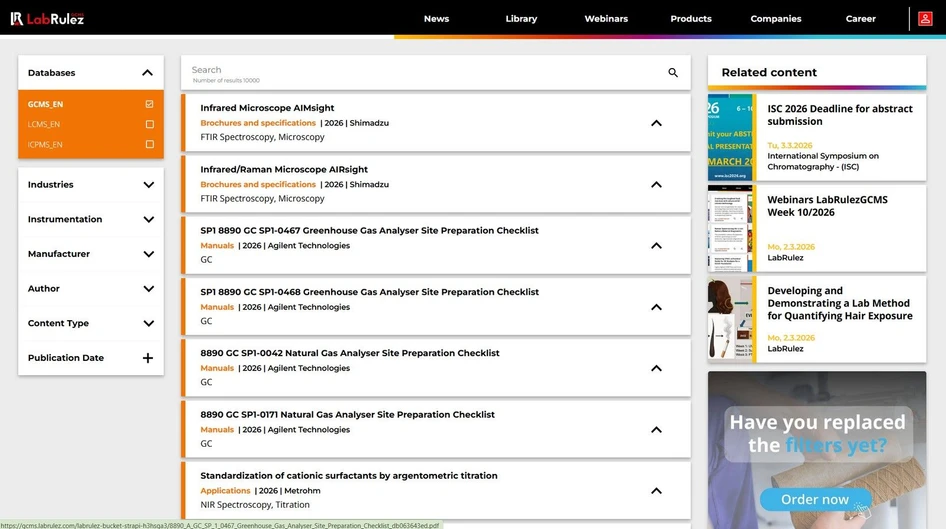
LabRulez: News from LabRulezGCMS Library - Week 10, 2026
Our Library never stops expanding. What are the most recent contributions to LabRulezGCMS Library in the week of 2nd March 2026? Check out new documents from the field of the gas phase, especially GC and GC/MS techniques!
👉 SEARCH THE LARGEST REPOSITORY OF DOCUMENTS ABOUT GCMS AND RELATED TECHNIQUES
👉 Need info about different analytical techniques? Peek into LabRulezLCMS or LabRulezICPMS libraries.
This week we bring you application notes by Agilent Technologies, BaySpec and Shimadzu and presentation by MDCW / JEOL!
1. Agilent Technologies: Total Hydrocarbon Impurity Analysis in PEM Fuel Cell Grade Hydrogen Using the Agilent 8890 GC-FID System
- Application note
- Full PDF for download
High-purity hydrogen is crucial for the optimal and long-term performance of fuel cells. Different than the industry grade hydrogen used for chemicals, refining, and metal processing, where small amounts of impurities are acceptable. Fuel cell hydrogen is required to meet the species-specific impurity limits described in the specifications. Such impurities include hydrocarbons, sulfur-containing compounds, ammonia, permanent gases, halogens, and formaldehyde. Each group of compounds has its own regulation limit. The limits are defined based on their impact on the fuel cell lifetime and performance. ISO 14687 and SAE J2719 are the most recognized standards for regulation of fuel cell hydrogen quality.
Multiple testing points are implemented throughout the whole supply chain of fuel cell grade hydrogen—from its production, storage, and distribution to its final application. The analytical approaches employed depend on the impurity type and the corresponding limit. Among the varied contaminants, hydrocarbon impurity is controlled based on THC amount (excluding methane because it has a separate specific limit) and the quality limit as specified in ISO 14687 and SAE J2719 (2 ppm).
There are two ways to analyze THCs in hydrogen. One is to separate and detect each hydrocarbon, then add their concentrations to get the THC amount (excluding methane). This analytical approach is recommended by the GB/T 44238-2024 test method.1 The other way is by eluting all hydrocarbons as a single peak and quantitating the peak according to methane's response factor (RF). The total THC is then obtained by subtracting the methane amount, which is analyzed by a separate method.
In this application note, THC impurity was tested using the second approach. An Agilent 8890 GC with FID system were used for THC analysis, and the Agilent 990 Micro GC was used for methane measurement. The methane analysis solution is published in application note 5994-8830EN.2 Here, we will showcase THC analysis using the 8890 GC-FID system.
Experimental
The 8890 GC is configured with one gas sampling valve, a split/splitless (S/SL) inlet, and a flame ionization detector (FID), as shown in Figure 1. The fixed volume of gas sample is injected into the S/SL inlet and part of the sample flows into an uncoated capillary column, then elutes off as a single peak for detection. Table 1 lists experimental conditions for the analysis. The standard gases shown in Table 2 are used to verify system precision, generate methane's RF, and calculate method detection limit (MDL).
Conclusion
This application note demonstrates THC analysis in fuel cell hydrogen using the Agilent 8890 GC-FID system. The hydrocarbons eluted as a single peak on an uncoated column and were quantitated using methane's RF. The method repeatability and reproducibility were around 2%. Method accuracy was better than 120%. The MDL was 0.97 ppm. All results met the analytical requirements of regulating THC in fuel cell grade hydrogen according to SAE J2719 and ISO 14687.
The applied analytical approach requires methane analysis by a separate method, which can be realized using the Agilent 990 Micro GC or using a coated column followed by FID detection on another channel of the 8890 GC system.
2. BaySpec: Rapid Detection of Trace Levels of Deoxynivalenol in Wheat Flour by Portable Miniature Linear Ion Trap Mass Spectrometry
- Application note
- Full PDF for download
Deoxynivalenol (Cas:51481‐10‐8), also known as DON, is a trichothecene mycotoxin that is widely found in grains such as wheat, barley, and rice. The molecular structure of DON is provided in figure 1. DON is linked to two plant pathogens: Fusarium graminearum (wheat and corn), and Fusarium ear blight (corn only). DON inhibits the synthesis of DNA / RNA as well as protein synthesis at the ribosomal level, ultimately resulting in the loss of yield and contamination of seeds. An acute dose of DON can induce vomiting (emesis) in pigs, whereas at lower concentrations in the diet, it reduces growth and feed consumption (anorexia).1 The U.S. FDA has established DON advisory levels to provide safe food and feed at concentrations of < 10 ppm to < 1 ppm depending on application.2
Because DON is difficult to derivatize, this compound is typically analyzed via thin‐layer chromatography (TLC) or high performance liquid chromatography (HPLC).3 While TLC is simple, fast, and economical, this analytical technique does not provide high accuracy nor consistent results on a day‐to‐day basis. HPLC improves on accuracy and consistency but requires large quantities of costly solvents and produces large volumes of hazardous waste. Depending on sampling requirements and system performance, the annual maintenance costs for a standard HPLC instrument can run ~$10‐20k per year.4 Furthermore, although HPLC systems can be easy to use when properly configured, a trained professional is typically needed for troubleshooting, maintenance, and developing new methods.
Two samples were analyzed in a recent case study for an agricultural firm based in Canada. One sample contained 200 mg of wheat powder, while the other sample was 1 mg of the pure DON compound. Measurements were taken on a BaySpec PortabilityTM Mass Spectrometer (Figure 2) with both thermal desorption (TD) electrospray ionization (ESI) and atmospheric pressure chemical ionization (APCI) methods. Samples were tested “dry” either by probing the surface of the sample vials or by spreading the powder onto a clean surface and swabbing. An enlarged image of the sampling probe with a small amount of wheat powder is shown in Figure 3.
3. MDCW / JEOL: Structural elucidation using GCxGC-TOFMS and machine learning for unknown metabolites in HeLa cell
- Presentation
- Full PDF for download
The presentation by Masaaki Ubukata focuses on advancing structural elucidation of unknown metabolites in HeLa cells using comprehensive two-dimensional gas chromatography coupled with high-resolution time-of-flight mass spectrometry (GC×GC-HRTOFMS) and machine learning. The work addresses a major limitation in metabolomics: while GC-MS offers highly reproducible EI fragmentation and strong library support, only a tiny fraction of known chemical space is represented in standard databases such as NIST (about 0.3% of compounds). To overcome this gap, the team developed an AI-based approach capable of predicting EI mass spectra and retention indices for over 200 million compounds, creating a large in-silico spectral library for unknown identification.
The workflow integrates accurate mass measurements from GC-HRTOFMS with both electron ionization (EI) and soft ionization data. Molecular formulas are first determined using isotopic patterns and fragment ion accuracy, then candidate structures are narrowed using predicted retention indices and compared against AI-predicted EI spectra ranked by cosine similarity. Model performance has steadily improved, reaching an average cosine similarity of 0.86, with correct structures ranked first in 56% of evaluation cases and within the top 10 in 87% of cases. This demonstrates strong capability for resolving unknown compounds beyond conventional library searches.
The approach was applied to HeLa cell metabolomics, a well-established human cell model. Using GC×GC separation, more than 800 metabolites were detected. Importantly, the system successfully identified N-methyl-uridine monophosphate (N-methyl UMP), a biologically relevant RNA-modification-related metabolite not registered in the NIST database. After molecular formula determination and AI ranking, N-methyl UMP was identified as the top candidate among 53 structural isomers sharing the same formula, demonstrating the practical strength of combining high-resolution MS, soft ionization, and AI-based spectral prediction.
In conclusion, the study highlights the synergistic power of three technologies: high-resolution GC-TOFMS, soft ionization techniques, and AI-driven structural analysis. Together, they significantly enhance the identification of unknown metabolites in non-targeted metabolomics and provide a scalable solution for exploring chemical space far beyond existing experimental spectral libraries.
4. Shimadzu: Analysis of Aroma Components in Apples Using the Smart Aroma Database
- Application note
- Full PDF for download
User Benefits
- The Smart Aroma Database enables straightforward qualitative analysis of aroma components.
- The HS-20 NX headspace sampler allows for high-sensitivity and convenient analysis of the aroma components in fresh apples.
- Multivariate analysis facilitates an objective evaluation of aroma component differences between samples.
The aroma components of fruits are one of the key factors that determine their flavor and taste, serving as a significant criterion for consumers when choosing fruits. These aroma components vary based on the type and variety of the fruit, its ripeness, production area, and cultivation environment. The complex interplay of these factors shapes the unique flavors of individual fruits. Therefore, the analysis of aroma components plays an important role in quality control and the development of new fruit varieties. The compounds that make up the aroma of fruits are diverse, including both volatile and non-volatile components, and their numbers can range from dozens to hundreds. These components, which include alcohols, esters, ketones, and acids, possess various chemical structures and contribute to the aroma of the fruit. Gas chromatography mass spectrometry (GC/MS) offers an effective method for objectively evaluating the relationship between aroma and aroma components. This article describes an example of analyzing the aroma components in apples using a GCMS-QP2050 gas chromatograph mass spectrometer in combination with an HS20 NX headspace sampler (Fig. 1).
Multivariate Analysis
Three types of apples, with five samples each (for a total of 15 samples), were measured once. The obtained data were analyzed using SIMCA17 multivariate data analysis software (Informatics Co., Ltd.) to perform principal component analysis (PCA) and hierarchical clustering analysis. The PCA score plot (Fig. 2), loading plot (Fig. 3), and the dendrogram from the hierarchical clustering analysis (Fig. 4) are shown.
Based on the PCA score plot, the contribution rate of the first principal component (horizontal axis) is 85.6 %, and the contribution rate of the second principal component (vertical axis) is 10.2 %, totaling 95.8 %. The clear separation of the plots by apple type indicates that there are differences in the aroma of the three varieties. Additionally, the results of the hierarchical clustering analysis show that Jonagold (A) and (B) have relatively similar compositions of aroma components.
Table 3 shows the aroma components that are relatively abundant in Jonagold (A) along with the sensory information for each aroma component registered in the Smart Aroma Database.
Conclusion
We analyzed the aroma components of three types of commercially available apples using a GCMS-QP2050 gas chromatograph mass spectrometer. By utilizing an HS-20 NX headspace sampler, we were able to analyze the aroma components of fresh apples with high sensitivity, and the Smart Aroma Database made the process convenient.
We consider that scientifically analyzing the differences in aroma components based on factors such as fruit type, variety, ripeness, production area, and cultivation environment is beneficial for quality management and the development of new varieties.