GCMS
More information
WebinarsAbout usContact usTerms of use
LabRulez s.r.o. All rights reserved. Content available under a CC BY-SA 4.0 Attribution-ShareAlike
Author
LabRulez
LabRulez
Everything from the world of analytical chemistry in one place. We connect people in solving their problems. At Labrulez you will find all the necessary information easily, quickly and clearly. Stop searching and start finding.
Tags
Article
Application
Poster
LinkedIn Logo

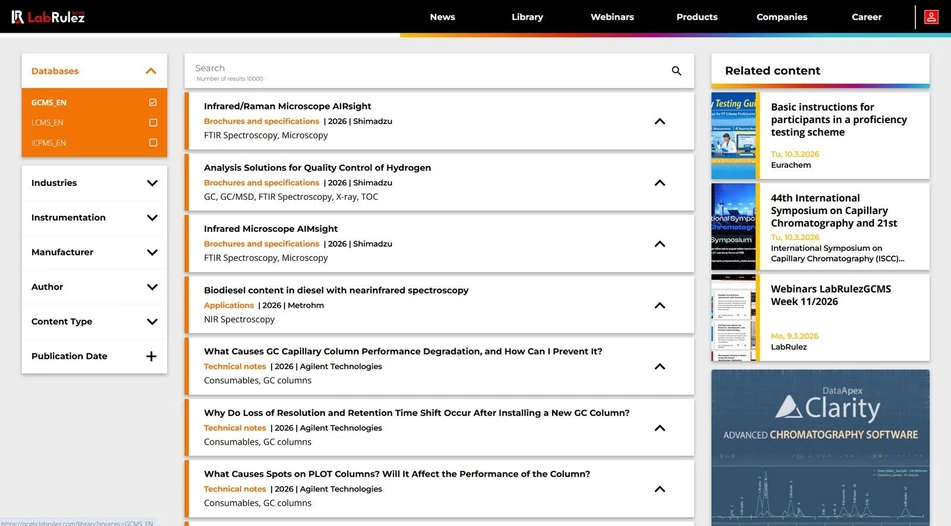
News from LabRulezGCMS Library - Week 11, 2026
We, 11.3.2026
| Original article from: LabRulezGCMS Library
This week we bring you application notes by Agilent Technologies, Shimadzu and Thermo Fisher Scientific and poster by MDCW / C³AL!
<p><strong>LabRulez:</strong> News from LabRulezGCMS Library - Week 11, 2026</p>

LabRulez: News from LabRulezGCMS Library - Week 11, 2026

Our Library never stops expanding. What are the most recent contributions to LabRulezGCMS Library in the week of 9th March 2026? Check out new documents from the field of the gas phase, especially GC and GC/MS techniques!

👉 SEARCH THE LARGEST REPOSITORY OF DOCUMENTS ABOUT GCMS AND RELATED TECHNIQUES

👉 Need info about different analytical techniques? Peek into LabRulezLCMS or LabRulezICPMS libraries.

This week we bring you application notes by Agilent Technologies, Shimadzu and Thermo Fisher Scientific and poster by MDCW / C³AL!

1. Agilent Technologies: Quantitative Volatile PFAS Analysis in Textiles

Per- and polyfluoroalkyl substances (PFAS) are a group of manmade chemicals widely used in textiles for their water, stain, and oil-repellent properties. For decades, the textile industry has been using PFAS for enhancing fabric durability and performance.1,2 Scientific studies have raised concerns about its potential risks to health.3-5 

As awareness of these risks has intensified, regulations like REACH/POPs have introduced stringent limits and, in many cases, initiated phase-outs of PFAS usage.6 Industry-driven standards, such as the ZDHC Manufacturing Restricted Substances List, OEKO-TEX Standard 100, AFIRM Restricted Substance List, and Bluesign standards and criteria complement regulations and reflect a global shift toward stricter compliance.7-10 Analytical standards like EN 17681-1:2025 provide test methods for PFAS in textiles.11 To keep pace with evolving regulations and industry initiatives, robust and highly sensitive analytical methods are essential for accurate PFAS detection and quantification in complex textile matrices. This study demonstrates the ability of the Agilent 8890 GC coupled with the Agilent 7010D GC/TQ system to detect and quantify more than 30 volatile PFAS analytes across various textile matrices, with comprehensive evaluation of sensitivity, accuracy, and precision.

Experimental

Instrumentation An 8890 GC with a 7010D GC/TQ equipped with an HES 2.0 ion source was used for this analysis. An Agilent MMI inlet and splitless liner (part number 5190-2293) were used, and chromatographic separation was performed using an Agilent J&W DB-624 column, 30 m × 0.25 mm, 1.40 μm (part number 122-1334UI). The instrument setup is shown in Figure 1. The acquisition method for 34 native PFAS and four internal mix standards (ISTD), including GC condition and TQ parameters, were described in a previous application note.12

Sample analysis

PFAS are widely used in textile materials due to their exceptional resistance to heat, water, and oil.1,2,13 In this study, PFAS compounds—specifically 8:2 FTOH and 10:2 FTOH, were detected above MDLs in sample waterproof shorts, as shown in Figure 5. However, the concentrations of these two compounds remained within the formulation limits set by ZDHC. Although FTOHs are not explicitly listed as individual compounds under the EU POPs regulation, they fall under restrictions applied to related substances such as PFOA, PFCA, and PFHxA. These results demonstrate that the developed method enables accurate and reliable detection of PFAS in apparel products, providing valuable data to support regulatory bodies in risk management and the establishment of appropriate limits.

Conclusion 

An accurate and robust method was developed using an Agilent 8890 GC coupled with an Agilent 7010D GC/TQ system for the analysis of volatile PFAS in textiles, following the established analytical guidelines. The workflow delivered excellent performance, achieving sub-ppb MDLs for all targets and LOQs of 10 µg/kg for more than 80% of compounds. These results confirm high extraction efficiency and exceptional sensitivity for PFAS in textile matrices. Recovery precision (%RSD) remained within 20% across sample preparations, underscoring method reproducibility and suitability for routine, high-throughput PFAS analysis in materials such as textiles

2. MDCW / C³AL: Microplastics as Vectors of Organic Contaminants on Southern California Beaches: A TD/Py-GC×CG-TOFMS Study

Microplastics are increasingly recognized as widespread environmental pollutants that can act as carriers of organic contaminants in marine ecosystems. In this study, researchers from California State University, Los Angeles investigated microplastics collected from several Southern California locations—including Santa Monica State Beach, Doheny State Beach, the Los Angeles River, and the Salton Sea—to better understand the types of organic compounds associated with these particles. The analysis was performed using thermal desorption/pyrolysis comprehensive two-dimensional gas chromatography coupled with time-of-flight mass spectrometry (TD/Py-GC×GC-TOFMS), a powerful analytical approach for characterizing complex mixtures of organic compounds.

The results revealed a wide range of organic compounds adsorbed onto microplastic particles, including alkanes, alkenes, alcohols, aromatic and polyaromatic compounds, as well as nitrogen- and sulfur-containing species. Significant variability in contaminant profiles was observed across sampling sites, reflecting differences in local pollution sources and environmental conditions. For example, Santa Monica State Beach samples showed the highest total number of detected compounds, while other sites exhibited distinct chemical signatures linked to their surrounding environments.

Overall, the study highlights the important role microplastics can play as vectors for transporting organic contaminants in aquatic environments. The findings demonstrate the usefulness of advanced GC×GC-TOFMS techniques for detailed characterization of contaminants associated with microplastics and contribute to a better understanding of their environmental impact and potential risks to marine ecosystems.

3. Shimadzu: Effectiveness of the MonoTrap Collection Method for VOC Analysis in Exhaled Breath Using GC-MS

User Benefits
  • Comprehensive analysis of VOCs from non-invasive breath samples is feasible with this system.
  • No equipment such as sampling pumps is required, enabling breath collection in remote locations.
  • Internal standards support consistent comparison of analytical results across sample groups.

Exhaled breath is a non-invasive sample that is easy to collect and imposes minimal burden on subjects. It is known to contain volatile organic compounds (VOCs) that reflect metabolic states and disease conditions within the body. More than 1,000 types of VOCs exist in breath, and numerous studies have reported the search for breath markers across various disease areas, including inflammatory diseases¹) , cancer²) , and metabolic disorders³) . Consequently, extensive research is being conducted in the field of breathomics. 

While GC-MS is widely used for comprehensive and highly sensitive analysis of trace components in breath, differences in pretreatment steps, such as sample collection, affect measurement results. Therefore, optimizing analytical protocols to enhance reproducibility and consistency is essential. 

This Application Note compares breath collection methods using Tenax tubes and MonoTrap using a thermal desorption-GC-MS system (Fig. 1) to determine the optimal collection method. Additionally, breath samples from healthy subjects and subjects with inflammatory conditions were analyzed using this analytical system to evaluate the usefulness of measuring and comparing VOC profiles with this approach.

Analytical Conditions

After collection, MonoTrap and Tenax collection tubes were thermally desorbed using the TD-30R thermal desorption device and analyzed by GC-MS (GCMS-QP2020 NX). Toluene-d8 was added as an internal standard to confirm analytical stability. Detailed analytical conditions are shown in Table 1.

Summary

This application news evaluated a breath VOC analysis system using thermal desorption–GC–MS with MonoTrap. MonoTrap detected a larger number of VOCs in exhaled breath from healthy subjects compared with the conventional Tenax tube method. Optimization of collection conditions indicated that static collection using one MonoTrap for 24 h is a practical and efficient protocol. Under these conditions, differences in VOC profiles were observed between healthy subjects and subjects with inflammatory conditions. MonoTrap enables breath collection without sampling pumps, and collected samples can be easily stored and transported, making the method suitable for remote sampling. Overall, this system demonstrated the capability for comprehensive VOC profiling of exhaled breath.

4. Thermo Fisher Scientific : Rapid analysis of organochlorine pesticides (OCPs) in soil samples using the EXTREVA ASE accelerated solvent extractor

Organochlorine pesticides (OCPs) are persistent environmental contaminants historically used to control pests in agriculture and other applications. Due to their long-term stability and toxicity, many OCPs have been banned or strictly regulated following international agreements such as the Stockholm Convention. Nevertheless, these compounds can remain in environmental matrices like soil for long periods, making reliable analytical methods essential for environmental monitoring. This application note describes a workflow for the determination of OCPs in soil samples using the Thermo Scientific EXTREVA ASE accelerated solvent extraction system, designed to automate and streamline the traditionally labor-intensive sample preparation process.

Experimental approach

Soil samples were prepared by mixing clean loamy soil with diatomaceous earth to improve extraction efficiency and prevent sample compaction. The samples were extracted using the EXTREVA ASE system with an acetone–hexane solvent mixture under controlled temperature and pressure conditions. The system integrates gas-assisted accelerated solvent extraction with automated solvent evaporation, enabling simultaneous extraction of multiple samples with minimal operator intervention. After extraction and concentration to a defined final volume, the analytes were quantified using gas chromatography with electron capture detection (GC-ECD). Calibration standards were prepared across a concentration range of 0.01–0.2 µg/mL to ensure accurate quantification of 20 target OCP compounds.

Results and performance

The developed workflow demonstrated excellent analytical performance. All target pesticides were well separated in the GC-ECD analysis with a total run time of less than 27 minutes. Extraction recoveries for soil samples fortified at 250 µg/kg ranged between 80% and 121%, meeting the US EPA recommended acceptance criteria of 70–130%. Reproducibility was also strong, with relative standard deviations below 20% for all analytes. Carryover between samples remained very low (<0.6%), indicating effective rinsing and minimal cross-contamination. Additional tests confirmed that thermally sensitive compounds such as endrin and DDT showed minimal degradation during extraction.

Conclusion

The EXTREVA ASE system provides a fast and highly automated workflow for the determination of organochlorine pesticides in soil samples. By integrating extraction, solvent evaporation, and endpoint volume control in a single instrument, the system reduces manual handling, lowers solvent consumption, and significantly shortens sample preparation time. The method enables reliable determination of 20 OCPs with high recovery, low carryover, and excellent reproducibility, supporting rapid environmental monitoring workflows and compliance with established US EPA analytical methods.

LabRulez
LinkedIn Logo
 

Related content

Quantitative Volatile PFAS Analysis in Textiles

Applications
| 2026 | Agilent Technologies
Instrumentation
GC/MSD, GC/MS/MS, GC/QQQ
Manufacturer
Agilent Technologies
Industries
Materials Testing

Effectiveness of the MonoTrap Collection Method for VOC Analysis in Exhaled Breath Using GC-MS

Applications
| 2026 | Shimadzu
Instrumentation
GC/MSD, Thermal desorption, GC/SQ
Manufacturer
Shimadzu
Industries
Clinical Research

Rapid analysis of organochlorine pesticides (OCPs) in soil samples using the EXTREVA ASE accelerated solvent extractor

Applications
| 2026 | Thermo Fisher Scientific
Instrumentation
Sample Preparation, GC
Manufacturer
Thermo Fisher Scientific
Industries
Environmental

Total Hydrocarbon Impurity Analysis in PEM Fuel Cell Grade Hydrogen Using the Agilent 8890 GC-FID System

Applications
| 2026 | Agilent Technologies
Instrumentation
GC
Manufacturer
Agilent Technologies
Industries
Energy & Chemicals

Analysis of Aroma Components in Apples Using the Smart Aroma Database

Applications
| 2026 | Shimadzu
Instrumentation
GC/MSD, GC/SQ, HeadSpace
Manufacturer
Shimadzu
Industries
Food & Agriculture
 

Related articles

Webinars LabRulezGCMS Week 11/2026
Article | Webinars

Webinars LabRulezGCMS Week 11/2026

7 webinars: AI lab automation, battery diagnostics, microplastics spectroscopy, PFAS regulation, Raman spectroscopy, SPME extraction, vibrational spectroscopy, Water Framework Directive
LabRulez
tag
share
more
44th International Symposium on Capillary Chromatography and 21st GCxGC Symposium - Registration and Deadline for Poster Presentation Abstract Submission
Article | Events

44th International Symposium on Capillary Chromatography and 21st GCxGC Symposium - Registration and Deadline for Poster Presentation Abstract Submission

Registration and abstract submission are open for the 44th ISCC & 21st GC×GC Symposium (May 17–22, 2026, Riva del Garda). Submit your poster abstract by March 15, 2026.
International Symposium on Capillary Chromatography (ISCC) and GCxGC Symposium
tag
share
more
Basic instructions for participants in a proficiency testing scheme
Article | Science and research

Basic instructions for participants in a proficiency testing scheme

A practical checklist for laboratories participating in proficiency testing (PT) schemes. Learn the key steps—from receiving PT samples to reviewing reports and implementing corrective actions.
Eurachem
tag
share
more
Sniff smarter: Empowering GC–O with trap-based enrichment and GC×GC for advanced aroma profiling (Lina Mikaliunaite, MDCW 2026)
Presentation | Video

Sniff smarter: Empowering GC–O with trap-based enrichment and GC×GC for advanced aroma profiling (Lina Mikaliunaite, MDCW 2026)

Integrating GC-O with GC×GC enables a direct link between chemical data and sensory perception. Sample enrichment, two-dimensional separation, and chemometrics improve aroma analysis.
The Multidimensional Chromatography Workshop
tag
share
more
 

Related content

Quantitative Volatile PFAS Analysis in Textiles

Applications
| 2026 | Agilent Technologies
Instrumentation
GC/MSD, GC/MS/MS, GC/QQQ
Manufacturer
Agilent Technologies
Industries
Materials Testing

Effectiveness of the MonoTrap Collection Method for VOC Analysis in Exhaled Breath Using GC-MS

Applications
| 2026 | Shimadzu
Instrumentation
GC/MSD, Thermal desorption, GC/SQ
Manufacturer
Shimadzu
Industries
Clinical Research

Rapid analysis of organochlorine pesticides (OCPs) in soil samples using the EXTREVA ASE accelerated solvent extractor

Applications
| 2026 | Thermo Fisher Scientific
Instrumentation
Sample Preparation, GC
Manufacturer
Thermo Fisher Scientific
Industries
Environmental

Total Hydrocarbon Impurity Analysis in PEM Fuel Cell Grade Hydrogen Using the Agilent 8890 GC-FID System

Applications
| 2026 | Agilent Technologies
Instrumentation
GC
Manufacturer
Agilent Technologies
Industries
Energy & Chemicals

Analysis of Aroma Components in Apples Using the Smart Aroma Database

Applications
| 2026 | Shimadzu
Instrumentation
GC/MSD, GC/SQ, HeadSpace
Manufacturer
Shimadzu
Industries
Food & Agriculture
 

Related articles

Webinars LabRulezGCMS Week 11/2026
Article | Webinars

Webinars LabRulezGCMS Week 11/2026

7 webinars: AI lab automation, battery diagnostics, microplastics spectroscopy, PFAS regulation, Raman spectroscopy, SPME extraction, vibrational spectroscopy, Water Framework Directive
LabRulez
tag
share
more
44th International Symposium on Capillary Chromatography and 21st GCxGC Symposium - Registration and Deadline for Poster Presentation Abstract Submission
Article | Events

44th International Symposium on Capillary Chromatography and 21st GCxGC Symposium - Registration and Deadline for Poster Presentation Abstract Submission

Registration and abstract submission are open for the 44th ISCC & 21st GC×GC Symposium (May 17–22, 2026, Riva del Garda). Submit your poster abstract by March 15, 2026.
International Symposium on Capillary Chromatography (ISCC) and GCxGC Symposium
tag
share
more
Basic instructions for participants in a proficiency testing scheme
Article | Science and research

Basic instructions for participants in a proficiency testing scheme

A practical checklist for laboratories participating in proficiency testing (PT) schemes. Learn the key steps—from receiving PT samples to reviewing reports and implementing corrective actions.
Eurachem
tag
share
more
Sniff smarter: Empowering GC–O with trap-based enrichment and GC×GC for advanced aroma profiling (Lina Mikaliunaite, MDCW 2026)
Presentation | Video

Sniff smarter: Empowering GC–O with trap-based enrichment and GC×GC for advanced aroma profiling (Lina Mikaliunaite, MDCW 2026)

Integrating GC-O with GC×GC enables a direct link between chemical data and sensory perception. Sample enrichment, two-dimensional separation, and chemometrics improve aroma analysis.
The Multidimensional Chromatography Workshop
tag
share
more
 

Related content

Quantitative Volatile PFAS Analysis in Textiles

Applications
| 2026 | Agilent Technologies
Instrumentation
GC/MSD, GC/MS/MS, GC/QQQ
Manufacturer
Agilent Technologies
Industries
Materials Testing

Effectiveness of the MonoTrap Collection Method for VOC Analysis in Exhaled Breath Using GC-MS

Applications
| 2026 | Shimadzu
Instrumentation
GC/MSD, Thermal desorption, GC/SQ
Manufacturer
Shimadzu
Industries
Clinical Research

Rapid analysis of organochlorine pesticides (OCPs) in soil samples using the EXTREVA ASE accelerated solvent extractor

Applications
| 2026 | Thermo Fisher Scientific
Instrumentation
Sample Preparation, GC
Manufacturer
Thermo Fisher Scientific
Industries
Environmental

Total Hydrocarbon Impurity Analysis in PEM Fuel Cell Grade Hydrogen Using the Agilent 8890 GC-FID System

Applications
| 2026 | Agilent Technologies
Instrumentation
GC
Manufacturer
Agilent Technologies
Industries
Energy & Chemicals

Analysis of Aroma Components in Apples Using the Smart Aroma Database

Applications
| 2026 | Shimadzu
Instrumentation
GC/MSD, GC/SQ, HeadSpace
Manufacturer
Shimadzu
Industries
Food & Agriculture
 

Related articles

Webinars LabRulezGCMS Week 11/2026
Article | Webinars

Webinars LabRulezGCMS Week 11/2026

7 webinars: AI lab automation, battery diagnostics, microplastics spectroscopy, PFAS regulation, Raman spectroscopy, SPME extraction, vibrational spectroscopy, Water Framework Directive
LabRulez
tag
share
more
44th International Symposium on Capillary Chromatography and 21st GCxGC Symposium - Registration and Deadline for Poster Presentation Abstract Submission
Article | Events

44th International Symposium on Capillary Chromatography and 21st GCxGC Symposium - Registration and Deadline for Poster Presentation Abstract Submission

Registration and abstract submission are open for the 44th ISCC & 21st GC×GC Symposium (May 17–22, 2026, Riva del Garda). Submit your poster abstract by March 15, 2026.
International Symposium on Capillary Chromatography (ISCC) and GCxGC Symposium
tag
share
more
Basic instructions for participants in a proficiency testing scheme
Article | Science and research

Basic instructions for participants in a proficiency testing scheme

A practical checklist for laboratories participating in proficiency testing (PT) schemes. Learn the key steps—from receiving PT samples to reviewing reports and implementing corrective actions.
Eurachem
tag
share
more
Sniff smarter: Empowering GC–O with trap-based enrichment and GC×GC for advanced aroma profiling (Lina Mikaliunaite, MDCW 2026)
Presentation | Video

Sniff smarter: Empowering GC–O with trap-based enrichment and GC×GC for advanced aroma profiling (Lina Mikaliunaite, MDCW 2026)

Integrating GC-O with GC×GC enables a direct link between chemical data and sensory perception. Sample enrichment, two-dimensional separation, and chemometrics improve aroma analysis.
The Multidimensional Chromatography Workshop
tag
share
more
 

Related content

Quantitative Volatile PFAS Analysis in Textiles

Applications
| 2026 | Agilent Technologies
Instrumentation
GC/MSD, GC/MS/MS, GC/QQQ
Manufacturer
Agilent Technologies
Industries
Materials Testing

Effectiveness of the MonoTrap Collection Method for VOC Analysis in Exhaled Breath Using GC-MS

Applications
| 2026 | Shimadzu
Instrumentation
GC/MSD, Thermal desorption, GC/SQ
Manufacturer
Shimadzu
Industries
Clinical Research

Rapid analysis of organochlorine pesticides (OCPs) in soil samples using the EXTREVA ASE accelerated solvent extractor

Applications
| 2026 | Thermo Fisher Scientific
Instrumentation
Sample Preparation, GC
Manufacturer
Thermo Fisher Scientific
Industries
Environmental

Total Hydrocarbon Impurity Analysis in PEM Fuel Cell Grade Hydrogen Using the Agilent 8890 GC-FID System

Applications
| 2026 | Agilent Technologies
Instrumentation
GC
Manufacturer
Agilent Technologies
Industries
Energy & Chemicals

Analysis of Aroma Components in Apples Using the Smart Aroma Database

Applications
| 2026 | Shimadzu
Instrumentation
GC/MSD, GC/SQ, HeadSpace
Manufacturer
Shimadzu
Industries
Food & Agriculture
 

Related articles

Webinars LabRulezGCMS Week 11/2026
Article | Webinars

Webinars LabRulezGCMS Week 11/2026

7 webinars: AI lab automation, battery diagnostics, microplastics spectroscopy, PFAS regulation, Raman spectroscopy, SPME extraction, vibrational spectroscopy, Water Framework Directive
LabRulez
tag
share
more
44th International Symposium on Capillary Chromatography and 21st GCxGC Symposium - Registration and Deadline for Poster Presentation Abstract Submission
Article | Events

44th International Symposium on Capillary Chromatography and 21st GCxGC Symposium - Registration and Deadline for Poster Presentation Abstract Submission

Registration and abstract submission are open for the 44th ISCC & 21st GC×GC Symposium (May 17–22, 2026, Riva del Garda). Submit your poster abstract by March 15, 2026.
International Symposium on Capillary Chromatography (ISCC) and GCxGC Symposium
tag
share
more
Basic instructions for participants in a proficiency testing scheme
Article | Science and research

Basic instructions for participants in a proficiency testing scheme

A practical checklist for laboratories participating in proficiency testing (PT) schemes. Learn the key steps—from receiving PT samples to reviewing reports and implementing corrective actions.
Eurachem
tag
share
more
Sniff smarter: Empowering GC–O with trap-based enrichment and GC×GC for advanced aroma profiling (Lina Mikaliunaite, MDCW 2026)
Presentation | Video

Sniff smarter: Empowering GC–O with trap-based enrichment and GC×GC for advanced aroma profiling (Lina Mikaliunaite, MDCW 2026)

Integrating GC-O with GC×GC enables a direct link between chemical data and sensory perception. Sample enrichment, two-dimensional separation, and chemometrics improve aroma analysis.
The Multidimensional Chromatography Workshop
tag
share
more
Other projects
LCMS
ICPMS
Follow us
FacebookX (Twitter)LinkedInYouTube
More information
WebinarsAbout usContact usTerms of use
LabRulez s.r.o. All rights reserved. Content available under a CC BY-SA 4.0 Attribution-ShareAlike