News from LabRulezGCMS Library - Week 35, 2025
LabRulez: News from LabRulezGCMS Library - Week 35, 2025
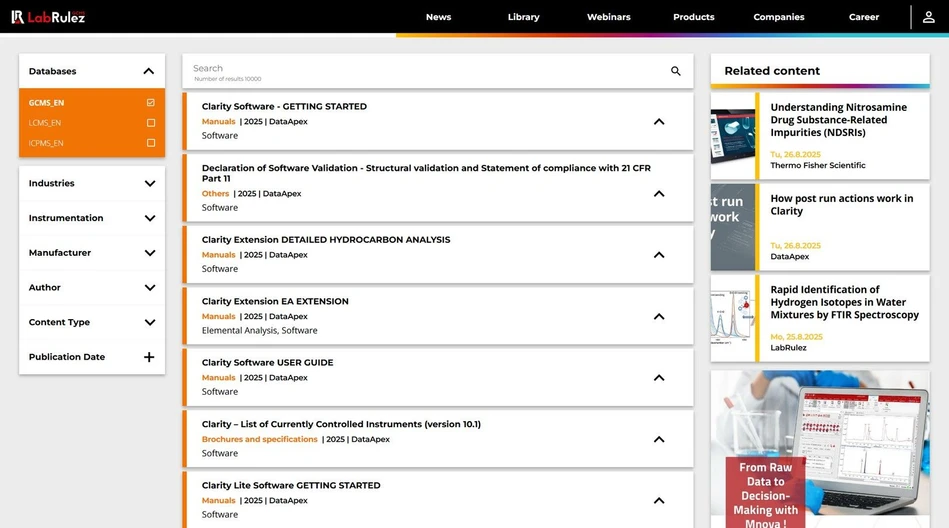
Our Library never stops expanding. What are the most recent contributions to LabRulezGCMS Library in the week of 25th August 2025? Check out new documents from the field of the gas phase, especially GC and GC/MS techniques!
👉 SEARCH THE LARGEST REPOSITORY OF DOCUMENTS ABOUT GCMS AND RELATED TECHNIQUES
👉 Need info about different analytical techniques? Peek into LabRulezLCMS or LabRulezICPMS libraries.
This week we bring you application notes by Agilent Technologies and Shimadzu!
1. Agilent Technologies: A More Sustainable Analysis of Ethylene Oxide and 1,4-Dioxane
in Surfactants with Hydrogen Carrier Gas
Using an Agilent 5977B GC/MSD with an Agilent HydroInert Source
- Application note
- Full PDF for download
EO and 1,4-dioxane are key industrial chemicals, frequently found in the production of surfactants. During alkoxylation processes, residual raw materials or byproducts, such as EO and 1,4-dioxane, may remain in the final surfactant product (Figure 1). Although manufacturers have made significant strides in reducing these byproducts, increasing regulatory scrutiny on EO and 1,4-dioxane underscores the need for precise analytical methods to detect these compounds at low concentrations.1–4 Thus, there is an urgent need to develop methods that can accurately quantify these compounds at levels as low as 0.1 ppm in consumer products.
This study presents a method for the detection of EO and 1,4-dioxane using GC/MS with an HS sampler and a HydroInert source for hydrogen carrier gas. The use of hydrogen instead of helium not only addresses the global helium shortage but also ensures excellent sensitivity and linearity, while maintaining the integrity of the analytical process. The HydroInert source further eliminates chemical reactions often associated with hydrogen in mass spectrometry, offering a sustainable and reliable solution. The method developed in this study successfully quantifies both EO and 1,4-dioxane at the low concentrations required by current regulations, offering an accurate, reliable approach for compliance in surfactant manufacturing.
Experimental
This work was carried out using an Agilent 7890 GC with helium carrier gas and an Agilent 8890 GC with hydrogen carrier gas. Both GC systems were configured with an Agilent 5977B GC/MSD and PAL3 autosampler for headspace sampling. For the analysis using hydrogen carrier gas, the GC/MSD was fitted with a HydroInert source. The HydroInert source produces spectra in hydrogen that closely match those from helium-based libraries, such as NIST. This ensures spectral fidelity, allowing the same quantification and qualifier ions used in helium methods to be applied in SIM and MRM modes with hydrogen. Method parameters are shown in Table 1.
Conclusion
This work establishes a first of its kind method using hydrogen carrier gas to reliably measure ethylene oxide and 1,4-dioxane in surfactants. Mass spectrometry detection was optimized for use with hydrogen by installing an Agilent HydroInert source. The HydroInert source helps to avoid sensitivity loss and spectral anomalies that are common with hydrogen carrier gas applications, resulting in suitable linearity, precision, accuracy, and LOQs for this analysis.
2. Shimadzu: How Long Does A Perfume Last on Skin? – Fragrance Analysis by GCMS-QP2050 and Smart Aroma Database
- Application note
- Full PDF for download
User Benefits
- Achieve highly accurate and reproducible analysis of aroma compounds on human skin, ensuring reliable data for evaluating perfume performance.
- Smart Aroma Database simplifies the qualitative and quantitative analysis process, reducing the time and effort required for data interpretation.
The duration on how long fragrance lasts on human skin is a critical factor in the development and evaluation of perfumes. Gas Chromatography Mass Spectrometry (GC-MS) is a powerful analytical technique that allows for the detailed analysis of volatile and semi-volatile compounds, making it an ideal tool for studying fragrance. In this application note, a study was performed to examine fragrance on human skin at different durations after applying a perfume. Here, we explore the use of a Monolithic Material Sorptive Extraction (MMSE) MonoTrap, a sorptive extraction device to extract fragrance from human skin, followed by analysis using Shimadzu GCMS-QP2050 (Fig.1). Additionally, Smart Aroma Database was used to simplify the method development.
Experimental
Instrumental and Analytical Conditions
GCMS-QP2050 (Shimadzu Corporation, Japan) was employed in this work (Fig. 1). The details of the system configuration is shown in Table 1. Sample acquisition was done by following the analytical method from Shimadzu Smart Aroma Database. MonoTrap SG DCC18 was purchased from GL Sciences, Japan (catalog no. 1050-70002).
Results & Discussion
Fragrance Compounds Detection
The scan total ion chromatogram (TIC) of the diluted perfume sample is shown in Fig. 4. A total of 60 out of the 498 fragrance compounds in Smart Aroma Database were detected. These compounds were then monitored for this study. Fig. 5 shows a few mass chromatograms of the monitored fragrance compounds.
On-skin Fragrance Study
The on-skin fragrance study was conducted to evaluate the persistence of perfume compounds over time. Sampling was performed at three distinct time points: 15 minutes, 1 hour, and 6 hours after applying the perfume (as described in Fig. 2). Fig. 6 shows the percentage of compounds detected (out of 60 compounds) in these three different time points.
Conclusion
In this study, we demonstrate the effectiveness of using GCMSQP2050 with Smart Aroma Database and Monotrap adsorbent to analyze the behavior of perfume fragrance on human skin. The result shows decrease percentage of number of compounds detected over time. The peak area of most compounds were reduced as well. Sampling repeatability shows that 57 out of 58 detected aroma compounds exhibiting %RSD values below 20% (n=3).