The End of Cheap Helium? How Geopolitics Is Transforming GC/GC-MS Laboratories
Watrex Praha: The End of Cheap Helium? How Geopolitics Is Transforming GC/GC-MS Laboratories
Helium is, in the field of gas chromatography (GC) and gas chromatography–mass spectrometry (GC/MS), a practically irreplaceable carrier gas. Its chemical inertness, low viscosity, and favorable diffusion properties enable high separation efficiency and reproducibility of analyses. In recent years, however, helium has become an increasingly scarce and expensive resource—a trend that was significantly accelerated in 2026 by geopolitical developments.
Helium as a Limited and Strategic Resource
Helium is naturally formed through radioactive decay in the Earth’s crust, and its extraction is closely tied to natural gas production. Unlike other technical gases, it cannot be economically synthesized, and once released into the atmosphere, it is irretrievably lost. Production is also geographically concentrated, with key producers including the United States, Qatar, Algeria, and Russia.
This combination of limited availability and dependence on energy infrastructure makes helium a commodity highly sensitive to geopolitical fluctuations.
The Current Conflict as a Key Accelerator of the Crisis
While previous “helium crises” were primarily caused by technical or logistical issues, the current situation is fundamentally shaped by conflict in the Middle East, particularly in connection with Iran. At present, this conflict represents the most significant destabilizing factor in the global helium market.
A key aspect is the disruption of production and exports from Qatar, which accounts for approximately 30–35% of global helium production. Operational limitations in the Ras Laffan area have led to the loss of a substantial portion of global supply. The situation is further exacerbated by instability in the Strait of Hormuz, which serves as the main export route for Qatari helium.
As a result, two critical factors are occurring simultaneously:
- reduced production
- disrupted logistics flows
From the perspective of the helium market, this combination is exceptionally severe and leads to an actual shortage of supply—not merely price volatility.
Current Price Developments and Outlook
The above factors have led to a sharp increase in helium prices across the market:
- spot prices have risen by approximately 80–100% within a few months
- contract prices for the laboratory sector have typically increased by 30–50%
- in some regions, supply limitations and allocation regimes are being introduced
Historically, helium prices were in the range of hundreds of USD per 1,000 scf. Under continued conflict conditions, the current estimated price range is 1,500–2,000 USD per 1,000 scf, with potential for further growth. This suggests a shift from cyclical fluctuations to a structurally higher price level.
Impacts on GC and GC/MS Laboratories
Laboratories using GC and GC/MS are among the most affected segments. In these settings, helium is not merely an operating cost but a key parameter influencing:
- separation efficiency
- detection sensitivity
- method stability and validity
Alternative gases such as hydrogen or nitrogen represent possible solutions, but they often involve trade-offs in terms of safety or chromatographic performance.
The current situation therefore leads to several practical consequences:
- a significant increase in operating costs
- pressure to optimize helium consumption
- risk of limiting analytical operations in case of gas shortages
As a result, helium consumption is shifting from a matter of economic optimization to one of ensuring operational continuity.
Efficient Helium Use as a Key Strategy
Given that helium remains difficult to replace in GC/MS applications, laboratories are focusing on using it more efficiently. An important fact is that chromatographs often consume helium even outside active analytical operation, such as during nights or weekends.
Optimizing operating modes thus represents a relatively simple but highly effective way to reduce consumption without compromising analytical quality.
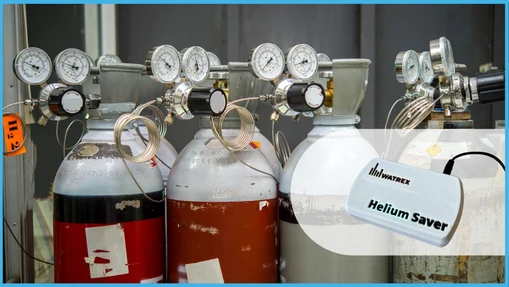
One example of a technological approach to consumption optimization is the Helium Saver™ system developed by Watrex Praha.
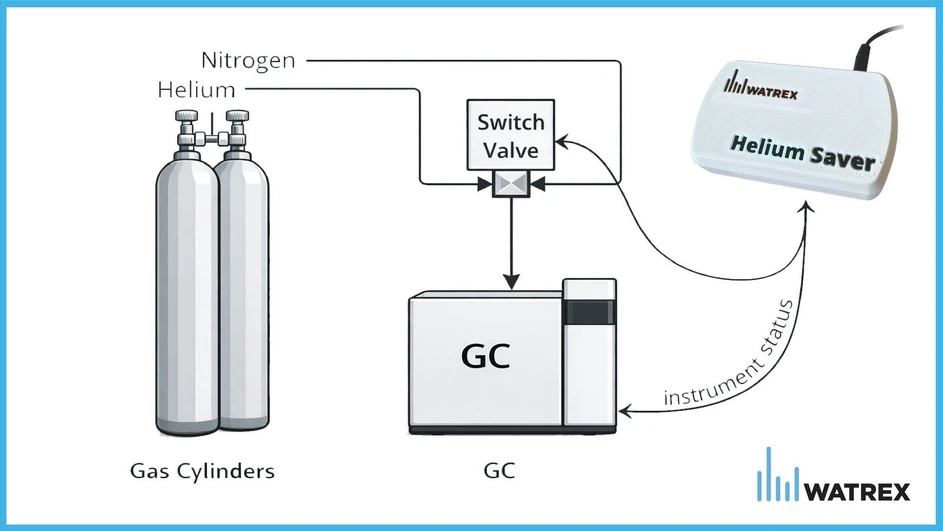 Watrex Praha: Fig. 2: Helium Saver by Watrex Praha and its typical setup.
This system automatically switches between helium and nitrogen based on a predefined schedule:
- helium is used during analyses
- nitrogen is used outside working hours
- before analyses begin, the chromatograph is automatically purged with helium
This ensures that analytical conditions remain fully preserved, while significantly reducing helium consumption outside active operation.
At current prices, the investment in a Helium Saver can be comparable to just a few helium cylinders, while delivering long-term savings. No method changes are required, no compromises in analytical results are necessary, and implementation has an immediate impact on operating costs.
If helium supply or cost is becoming a problem in your laboratory, it may be time to reconsider how it is used. In the current context, this solution is not merely a costreduction tool but an important element in ensuring stable laboratory operation.
Conclusion
Due to limited availability and geopolitical factors, helium is becoming a strategic resource whose price and availability are increasingly unpredictable. The current conflict in the Middle East represents the most significant supply disruption in decades and has a direct impact on analytical practice.
For GC and GC/MS laboratories, this means the need to adapt. In addition to methodological adjustments and potential use of alternative gases, optimizing helium consumption appears to be the most effective approach. Helium Saver enables efficient use of helium and thus plays an important role not only economically but also operationally.
Interested in Helium Saver? Contact us for more information or a non-binding quotation at [email protected].