Green Chromatography in Practice: How to Reduce Helium Consumption in GC Without Compromising Data Quality
Watrex Prague: Green Chromatography in Practice: How to Reduce Helium Consumption in GC Without Compromising Data Quality
Helium as a Critical Resource in Gas Chromatography
Gas chromatography is among the analytical techniques with the highest helium consumption. In routine laboratory operation, helium is used not only during analytical runs themselves, but also during method development, stabilization modes, standby operation, and instrument maintenance. Taken together, GC and GC–MS systems account for a significant share of total helium consumption in analytical laboratories.
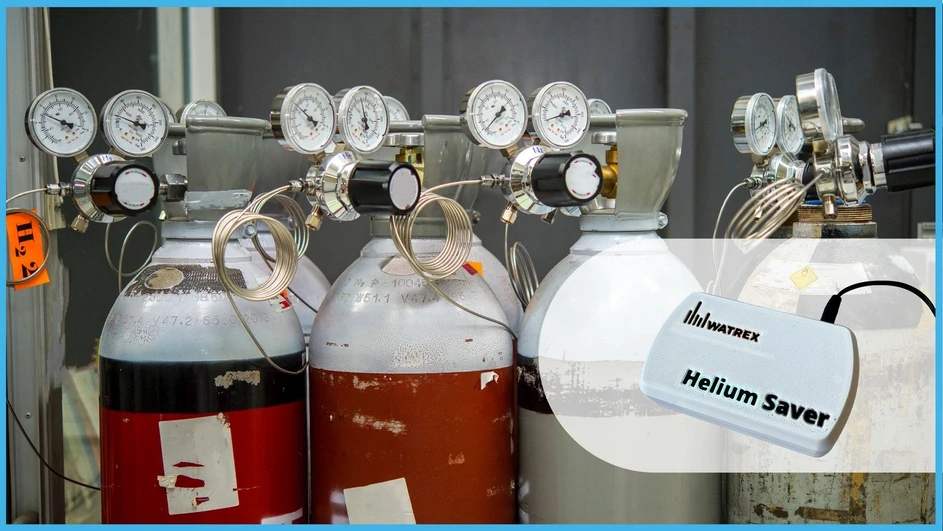
Watrex: Helium Saver from Watrex Praha
From the perspective of modern green chromatography, this represents a major challenge. Helium is a non-renewable and strategically limited resource, and its waste during non-productive phases of operation is unsustainable in the long term. Contemporary approaches to sustainable chromatography therefore do not aim to replace helium at any cost, but rather focus on optimizing its use deploying helium only where it is analytically truly necessary.
Supply Disruptions and Price Volatility: The Everyday Reality of GC Laboratories
Over recent decades, repeated disruptions in helium supply, significant price fluctuations, and increasing pressure from other industrial sectors—particularly cryogenics, medicine, and the semiconductor industry—have become common. These sectors consume helium in large volumes and often receive priority in distribution.
For analytical laboratories, this has several direct consequences:
- increased operating costs due to rising prices,
- uncertainty in planning routine analyses,
- the need to limit GC system operation during periods of shortage,
- pressure to seek alternative operational strategies.
Especially problematic is the fact that a substantial portion of helium consumption in laboratories does not directly contribute to the analytical value of measurements, but merely serves to keep systems in an operational state.
Green Chromatography: Efficient Use Instead of Replacement
While switching to alternative carrier gases (e.g., nitrogen or hydrogen) may be suitable in some applications, it is not always technically or validation-wise feasible—particularly for established GC methods. Green chromatography therefore increasingly relies on the concept of intelligent carrier gas management, which makes it possible to:
- preserve helium for analytical runs,
- minimize its consumption during non-productive modes,
- eliminate human error associated with manual gas switching.
This is precisely where automated technological solutions come into play.
Model Calculation of Helium Savings in a Typical GC Laboratory
To illustrate the potential for savings, consider a model GC laboratory with the following parameters:
- helium flow rate: 1.5 mL/min
- instrument operation: 24 hours per day
- analytical runs: 8 hours per day
- non-productive modes (standby, waiting, stabilization): 16 hours per day
Daily helium consumption without optimization:
- 1.5 mL/min × 60 × 24 = 2.16 L helium/day
Of this:
- analytical runs: 0.72 L/day
- non-productive operation: 1.44 L/day
If helium is replaced by nitrogen during non-productive modes via automatic switching:
➡ helium savings: approx. 67% of daily consumption
At a helium price (including logistics and cylinder rental) of, for example, CZK 400–600 per m³, and with several GC systems in operation, annual savings can reach tens of thousands of Czech crowns per instrument while also improving operational stability during periods of limited helium availability.
Automated Solution: Helium Saver™ in the Context of Green Chromatography
Helium Saver™ from Watrex Praha is an intelligent device designed for automatic switching between helium and nitrogen based on predefined operating modes. Helium is used exclusively during analytical runs, while during non-productive phases the system is automatically switched to nitrogen.
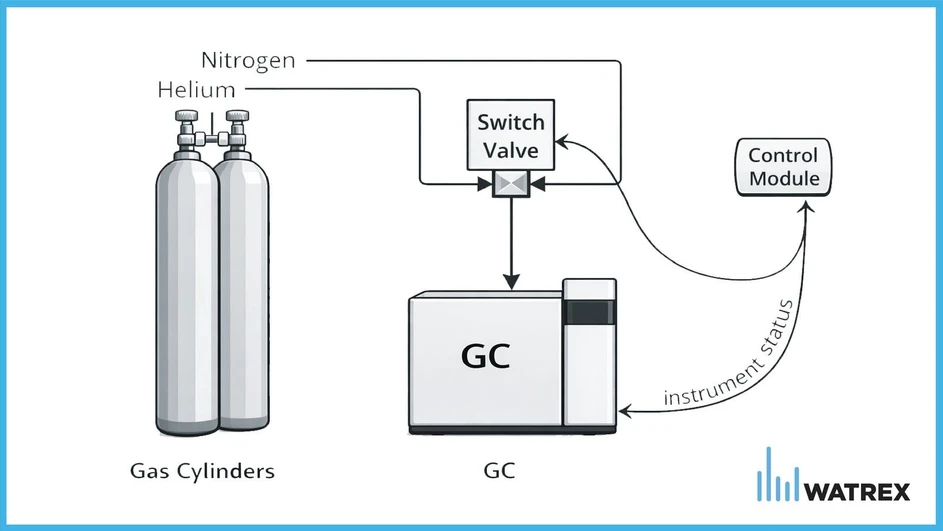 Watrex: Fig.2: Typical Helium Saver connection
Thanks to its modular design (Control Module, Switching Valve, and Manual Switch) and universal interface, Helium Saver™ can be integrated into GC systems from various manufacturers without major modifications to the instrumentation.
From a green chromatography perspective, this solution represents a practical compromise between sustainability, economic efficiency, and preservation of analytical data quality.
Conclusion
Increasing pressure on helium availability and the sustainability of laboratory operations is forcing analytical laboratories to reconsider traditional models of gas chromatography operation. Intelligent management of helium consumption enables significant reductions in costs and environmental burden without the need to modify validation protocols or analytical methodologies.
Automated solutions such as Helium Saver™ demonstrate that the principles of green chromatography can be successfully applied even in routine GC practice.
Are you interested in Helium Saver? Feel free to contact us at [email protected] for more information or a non-binding quote.