Iron Deficiency Is Associated with Increased Circulating Fatty Acids and Unfavorable Body Composition in Women with Obesity
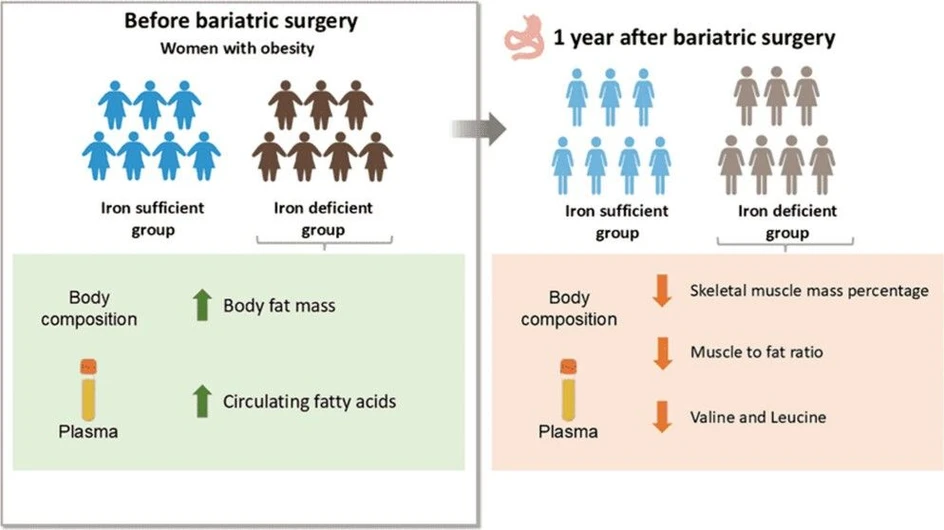
ACS Nutr. Sci. 2026, 1, 1, 28–35: Graphical abstract
This study examines the impact of iron deficiency on body composition and metabolism in women with obesity. Iron-deficient individuals exhibited higher fat mass, elevated circulating fatty acids, and a reduced muscle-to-fat ratio prior to bariatric surgery.
One year post-surgery, the iron-deficient group showed lower skeletal muscle mass and continued unfavorable body composition, alongside reduced amino acid levels. These findings suggest that iron deficiency exacerbates metabolic dysfunction and negatively affects obesity-related outcomes.
The original article
Iron Deficiency Is Associated with Increased Circulating Fatty Acids and Unfavorable Body Composition in Women with Obesity
Jessica Monteiro Volejnik Pino, Ana Paula de Oliveira Ferreira, Raquel da Silveira Campos, Marcos Mônico-Neto, Vitória Fernandes da Silva, Melissa Yumi Kato, Gabriel Trigo Pereira, Isabella Mendes Borghetti, Thais Regiani Cataldi, Thales Delmondes Galvão, Lia Rita Azeredo Bittencourt, Sergio Tufik, and Kil Sun Lee*
ACS Nutr. Sci. 2026, 1, 1, 28–35
https://doi.org/10.1021/acsnutrsci.5c00006
licensed under CC-BY 4.0
Selected sections from the article follow. Formats and hyperlinks were adapted from the original.
Iron deficiency is one of the most common nutritional deficiencies. Although children and women in reproductive phase are the most well-known demographic groups affected by iron deficiency, increased prevalence of iron deficiency in the population with obesity has also been reported. (1−3) The cause of iron deficiency in obesity appears to involve both insufficient dietary iron intake and poor dietary quality and the secondary effects of hormonal and metabolic changes that occur in obesity. (4−6)
Iron plays essential roles in several vital functions, such as oxygen transport, cellular respiration, and energy production. Thus, inadequate intake of the micronutrient or problems in its homeostasis for a prolonged period can impair several physiological functions. In fact, changes in systemic iron homeostasis are known to affect the endocrine functions, (7) including the secretion of adipokines. In humans, for instance, serum ferritin has been reported to be negatively correlated with serum adiponectin levels. (8−10) Bioavailability of iron is also important for cardiac and renal function (11) and glycemic control, (12) and iron deficiency is known to be related to the pathogenesis of diabetes and its complications. (2,13) Moreover, hepatic iron plays a key role in the synthesis of cholesterol and fatty acids. Elevated hepatic iron levels enhance the expression of several enzymes in the cholesterol biosynthesis pathway, such as HMG-CoA reductase, leading to increased hepatic cholesterol content. (14) A transcriptomic study further demonstrated a significant upregulation of genes involved in cholesterol synthesis in response to high iron intake, highlighting the importance of iron in this metabolic process. (15)
Considering the importance of iron in cardiac function and metabolic homeostasis, the most affected physiological functions in obesity, it is plausible to hypothesize that iron deficiency could worsen the clinical prognosis of obesity. Indeed, our previous study demonstrated that women with grade III obesity had lower iron levels compared to those with grade I or II obesity. (16)
Despite the potential negative impact of iron deficiency on metabolism and its consequences for noncommunicable chronic diseases such as obesity, few studies have examined the metabolic profile of individuals with both iron deficiency and obesity. Therefore, the aim of this study is to investigate the impact of iron deficiency on the profile of circulating metabolites in women with obesity. We also evaluated how an iron deficiency influences the response to bariatric surgery, a procedure increasingly used to treat obesity.
2. Materials and Methods
2.5. Analysis of Plasma Metabolic Profile by Gas Chromatography Mass Spectrometry (GC/MS)
Derivatized samples (1 μL of each) were injected in splitless mode into a gas chromatograph (8890GC Agilent Technologies, Santa Clara, CA, USA) equipped with a capillary column of fused silica, measuring 20 m in length, 0.18 mm of internal diameter and 0.18 μm of film thickness (Agilent J&W Scientific, Santa Clara, CA, USA). The initial temperature of the column was 80 °C, which was maintained for 2 min and then increased by 15 °C/min up to 305 °C. The injection started 300 s after initiating data acquisition at a temperature of 280 °C, with a flow of 20 mL/min. The column effluent was introduced into the ion source of the mass spectrometer TOFMS (Pegasus BT, Leco, St. Joseph, MI, USA). The temperature of the ion source was 250 °C, the electron beam was 70 eV, and the ionization current was 2.0 mA. The detector voltage was fixed at 1500 V, and 20 spectra/s were acquired in the range of 45–800 m/z. Three sets of alkanes (C12–C28) were run at the beginning, middle, and end of the samples to test the performance of the GC-MS and calculate the retention index. The coefficient of variation of the retention time, retention index, and peak intensity is shown in Supporting Information, Table 1.
2.6. GC/MS Data Processing
GC/MS data were processed using the ChromaTOF for BT, v 1.2.0.6, in which baseline correction, deconvolution, retention-time correction, and retention-index calculation were carried out. The alignment of peaks and identification of metabolites were performed using the NIST library, version 2.4 (2020). Only those features with a total ion count above 250 that presented at least three matching peaks and a score equal to or higher than 800 were considered as valid metabolites. In addition, only metabolites that were consistently detected in at least 5 of 7 samples of at least one group were included in the further data analysis (Supporting Information, Figure 1A,B). Supporting Information, Figure 1C and D show, respectively, the number of metabolites that were not detected in each sample and the total peak intensity of each sample. The peak intensity of each metabolite was normalized to a total peak intensity. Due to a technical issue during the GC/MS run, one sample from the postoperative iron-sufficient group (IS) was excluded from the metabolomic analysis. Thus, the final analysis included 7 participants in the iron-deficient (ID) group and 6 in the postoperative IS group.
3. Results
First, the effect of iron deficiency was evaluated in preoperative samples. Principal component analysis (PCA) was able to cluster and distinguish the ID group from the IS group (Figure 2A). Principal component 1 (PC1) and principal component 2 (PC2) together were responsible for a 47.8% variation of the metabolomic profile. Figure 2B and Supplementary Table 5 show the metabolites that were increased or decreased in the ID group compared to the IS group in presurgical condition. Amino acids and related metabolites showed random behavior, with some increasing and others decreasing in the ID group compared to the IS group. However, all fatty acids or their conjugation had increased abundance in the ID group, while propanedioic acid, a precursor for fatty acid synthesis, also known as malonic acid, had a lower abundance in the ID group (Figure 2B, Supplementary Table 5). Since the plasma samples were collected in the fasting state, increased circulating fatty acids may indicate a higher rate of lipolysis in the ID group.
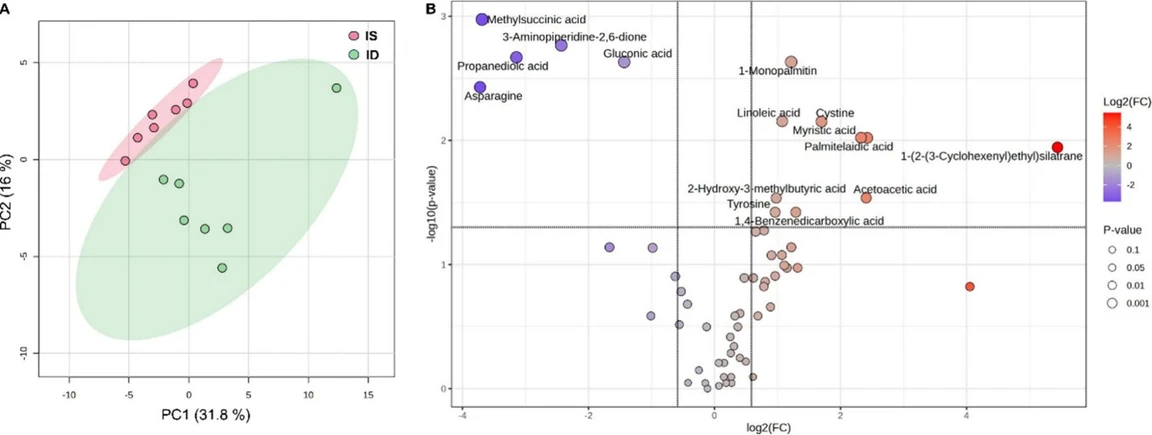 ACS Nutr. Sci. 2026, 1, 1, 28–35: Figure 2. Metabolomic differences between preoperative iron sufficient and iron deficient groups. (A) After principal component analysis, a scatter plot was constructed using principal components (PC) 1 and 2, which respectively explained 31.8% and 16% of the variation of the metabolomic data. Red dots represent women in the iron sufficient group (IS) and green dots represent women in the iron deficient group (ID) at the presurgery moment. Ellipses indicate a confidence interval of 95%. (B) Volcano plot shows log 2 of the fold change calculated as a ratio of ID/IS in x-axis and −log 10 of p-values in the y-axis. Blue dots indicate metabolites with a lower abundance and red dots represent metabolites with an increased abundance in the ID (n = 7) group compared to the IS (n = 7) group.
In the fasting state, adipose tissues are the main source of circulating fatty acids. Therefore, we evaluated the relationship between body fat mass and total circulating fatty acid levels calculated by summing the relative abundance of all free and conjugated fatty acids detected in GC/MS. Total fatty acid levels showed a weak positive, nonsignificant, correlation with body fat (rho = 0.28, p = 0.3 Figure 3A) and a negative correlation with serum iron, but not with serum ferritin (rho = −0.57, p = 0.04 and rho = −0.46, p = 0.10, Figure 3B,C). Additionally, body fat mass was negatively correlated with serum ferritin, but not with serum iron (rho = −0.48, p = 0.08 and rho = 0.62, p = 0.08; Figure 3D,E). These data suggest that ID in obesity is associated with an increase in circulating fatty acids during fasting. Moreover, systemic iron deficiency reduced iron availability in adipose tissue (Supplementary Figure 3), which may contribute to altered lipid mobilization under fasting conditions.
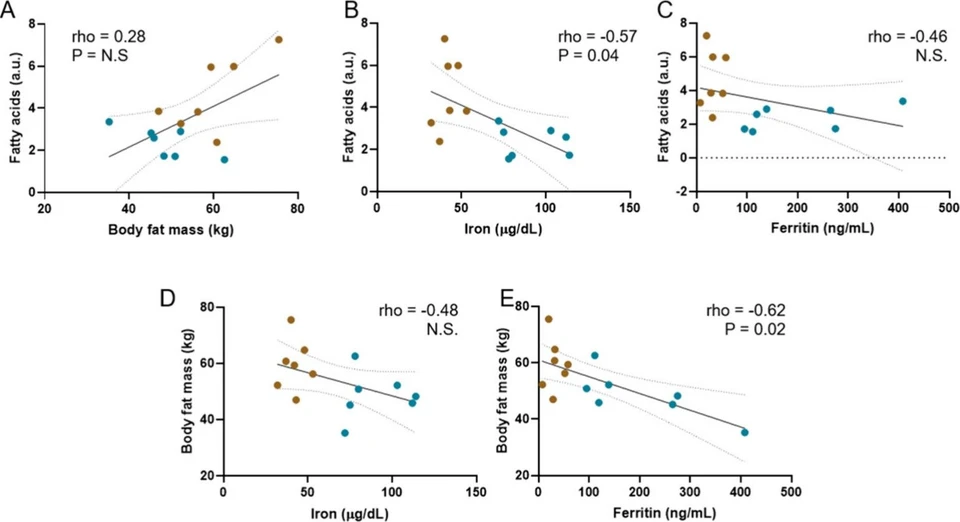 ACS Nutr. Sci. 2026, 1, 1, 28–35: Figure 3. Relationship between circulating fatty acids, body fat mass and iron status in presurgery moment. Pearson correlation analysis was performed using presurgery data of total circulating fatty acids with body fat mass (A), serum iron (B), or serum ferritin (C). Correlation between body fat mass and serum iron (D) or serum ferritin (E) was also evaluated. Brown dots represent samples of the ID group (n = 7) and blue dots represent samples of the IS group (n = 7). Solid line shows linear relationship and dotted line represent 95% confidence interval.
4. Discussion
Iron deficiency is a frequent comorbidity of obesity and may arise due to several interconnected factors, such as chronic low-grade inflammation, which increases hepatic hepcidin production and reduces intestinal iron absorption. (19) Inadequate diets, with low iron intake and poor nutritional quality, which also contribute to aggravating this condition, in addition to the secondary effects of hormonal and metabolic changes associated with obesity. (4−6) In this study, we showed that women with obesity and concomitant ID accumulate more body fat and circulating fatty acids compared with those with normal iron status.
The accumulation of fatty acids under iron-deficient conditions is a biochemically expected consequence, as the catabolism of fatty acids depends on the mitochondrial electron transport chain, which requires iron as a cofactor. However, the fact that elevated levels of circulating fatty acids can exacerbate obesity-related pathological symptoms is not typically considered in clinical management and treatment strategies. One reason this marker is rarely used in clinical practice is the lack of standardization in measurement, and absence of well-established reference ranges. (20)
Previous studies corroborate our findings that iron deficiency is associated with significant changes in lipid metabolism. In animal models, iron deficiency led to increased levels of fatty acids in the liver and serum, especially linoleic acid. (21) On the other hand, another study demonstrated that high levels of ferritin are associated with greater mobilization of fatty acids and insulin resistance in obese women, increasing the systemic availability of fatty acids. (22) Thus, both iron deficiency and excess can deregulate lipid metabolism. In this context, the increase in circulating fatty acids can accumulate in insulin-sensitive organs, such as the liver and muscles, impairing insulin signaling and increasing the risk of insulin resistance. (23,24) Therefore, assessing and controlling iron levels in obesity can help minimize related complications.
Regarding the effect of preoperative iron deficiency on the outcome of bariatric surgery, both the IS and ID groups showed weight loss one year after surgery. However, the ID group presented a lower percentage of skeletal muscle mass (PSMM) and muscle-to-fat ratio (MFR) compared to the IS group. These findings are consistent with the literature, which points to a relationship between iron deficiency and lower muscle mass. (25) Moreover, in this study, significant reduction of leucine and valine was observed only in the ID group, although the levels of these amino acids were not significantly different between the ID and IS groups in postsurgical condition. Nevertheless, we have not assessed iron status in postsurgical samples, but it is known that bariatric surgery itself increases risks for micronutrient deficiency. (19,26,27) Even though all participants received postoperative nutritional supplementation to prevent such deficiencies, including iron, it is difficult to distinguish presurgical ID effects on postsurgical measures.
The literature data are somewhat contradictory with regard to the effect of branched chain amino acids (BCAA). In general, it appears that increased BCAA is harmful in unhealthy conditions such as diabetes and obesity. (28) Specially, valine metabolite, 3-hydroxyisobutyric acid, is known to cause glucotoxicity and impairment of insulin signaling in muscle of mice fed with high fat diet. (29) Interestingly, the ketogenic metabolite of BCAA, 2-hydroxy-3-methylbutyric acid, was increased in the ID group compared to the IS group in presurgical conditions (Supplementary Table 5). On the other hand, in healthy conditions, higher levels of BCAA can prevent sarcopenia. (30,31) Indeed, we observed moderate correlation between postsurgical skeletal muscle mass and leucine levels. Significant reduction in valine and leucine observed after surgery in the ID group might have contributed to the lower postsurgical SMM percentage and muscle-to-fat ratio in that group.
A limitation of our study is the small sample size. However, due to the lack of a gold standard for diagnosis of ID in obesity, the sample was selected based on strict inclusion and exclusion criteria. Our results demonstrate that preoperative iron deficiency is associated with changes in body composition and lipid metabolism, which may aggravate conditions related to obesity. To our knowledge, while previous studies have described the association between obesity and iron deficiency and the impact of bariatric surgery on iron status, (19) there is limited evidence on the effects of iron deficiency both before and after surgery. Our findings provide novel insights and reinforce that proper diagnosis and management of ID in this population may improve overall health and the effectiveness of weight loss strategies.