PFAS emissions from functional textiles using micro-chamber and thermal desorption coupled to two-dimensional gas chromatography-time of flight mass spectrometry (TD-GC×GC-TOF MS)

Journal of Chromatography A, Volume 1733, 2024, 465219: Fig. 1. Example GC×GC-TOF MS colour plots showing PFAS elution region (Blue box). (a) PFAS standard mix: 1 PFHxA; 2 PFNA; 3 PFDA; 4 PFUnDA; 5 5:2 FTOH; 6 4:2 FTOH; 7 PFDoDA; 8 PFTrDA; 9 6:2 FTOH; 10 7:2 FTOH; 11 PFTeDA; 12 PFHxDA1; 13 8:2 FTOH; 14 PFHxDa2; 15 PFODA; 16 10:2 FTOH, (b) a representative emission profile of a moisture barrier of a unused firefighter turnout jacket manufactured in 2011 and (c) the filtered version of that chromatogram showing only peaks which have passed the PFAS expression of the same sample.
The goal of this study is to investigate the emission of per- and polyfluoroalkyl substances (PFAS) from firefighter turnout gear jackets. Using a micro-chamber setup combined with thermal desorption and comprehensive two-dimensional gas chromatography-time-of-flight mass spectrometry (TD-GC×GC-TOF MS), the researchers characterized volatile PFAS released from different layers (outer shell, moisture barrier, thermal liner) of both new and used jackets at 38 °C.
The study aims to identify potential exposure pathways by analyzing emission patterns and comparing chemical profiles across different gear conditions. Particular focus was placed on fluorotelomer alcohols (FTOHs), where older jackets emitted more 8:2 and 10:2 FTOHs, and a newer jacket showed higher levels of 6:2 FTOH. The work contributes to understanding PFAS behavior in textiles and informing risk assessment of these persistent chemicals.
The original article
PFAS emissions from functional textiles using micro-chamber and thermal desorption coupled to two-dimensional gas chromatography-time of flight mass spectrometry (TD-GC×GC-TOF MS)
Rocio Aranda-Rodriguez, Ariadne Piperakis, Jonathan Grandy, Laura McGregor, Nadin Boegelsack, Hannah Calder, Matthew Edwards, William Papas, Jasper Che, Sam Shields
Journal of Chromatography A, Volume 1733, 27 September 2024, 465219
https://doi.org/10.1016/j.chroma.2024.465219
licensed under CC-BY 4.0
Selected sections from the article follow. Formats and hyperlinks were adapted from the original.
Per- and polyfluoroalkyl substances (PFAS) represent a diverse class of synthetic chemicals characterized by a carbon backbone with hydrogen atoms substituted by fluorine, often featuring terminal functional groups such as carboxylic acids, sulfonic acids, and alcohols [1]. Since their introduction in the 1950s, PFAS have found widespread industrial use due to their exceptional hydrophobic and lipophobic properties and their robust chemical and thermal stability [2,3]. According to the CompTox Database, 15,000 unique PFAS are produced at large scale to supply to industries such as firefighting products, electroplating, textiles and consumer products [[2], [3], [4]].
PFAS are released into the environment throughout their life cycle, including production, usage, and disposal [5]. This is an important issue, as PFAS and their degradation products are persistent pollutants that are challenging to remove from the environment and are highly mobile once released. Thus, they have been rightfully named “forever chemicals”. Additionally, they are known to bioaccumulate within the body and have been linked to various adverse health effects, including developmental and reproductive toxicity, immune system disruption, and cancer [[6], [7], [8], [9]]. However, assessment of occupational exposure to PFAS is challenging due to its widespread use and diverse applications [10]. Among susceptible populations, firefighters emerge as particularly high-risk, since they are regularly exposed to an array of toxic chemicals such as combustion products and aqueous film forming foam used as a suppressant [11,12]. As reports show, firefighters have higher serum concentrations of PFHxS, PFOS, PFOA, and PFDA than the general population [[13], [14], [15]], which suggests that they have higher exposures to PFAS than the general population [16,17]. In general, firefighters’ turnout gear comprises three functional layers. The outer layer (OL) contains aramid blend fibres treated with a durable water repellent (DWR) that often contains side-chain polyfluorinated compounds to form fluorinated polymers. The middle layer is the moisture barrier (MB), which is designed to prevent water, chemical and pathogen intrusion. The MB is constructed with a flame-resistant aramid-mix bound to a porous polymer film made of expanded polytetrafluoroethylene (ePFTE). The inner-dermal facing layer, or thermal liner (TL), provides temperature and heat management and is not typically reported to have been treated with any PFAS.
Initial investigations of the comparison of total organic fluorine between new and used turnout gear have unveiled a marked reduction of fluorine content in the OL and a significant increase in the TL. These findings suggest the mobility of fluorinated compounds from MB or OL to the TL over time, potentially heightening dermal exposure risks [18,19]. Moreover, a recent comprehensive investigation by Muensterman et al. has revealed that each layer of firefighters' turnout gear contains a higher proportion of volatile PFAS than non-volatile PFAS [20], particularly fluorotelomer alcohols (FTOHs) and fluorotelomer acrylates (FTAc). Additionally, other functional textiles treated with fluorinated polymers for weather resistance also emit volatile PFAS when exposed to rain, sun, and domestic washing [21]. This finding further strengthens the notion that firefighters may be routinely exposed to PFAS released from their turnout gear and occupational environment. However, the extent of such exposure remains unknown.
The PFAS emission profile from turnout gear is likely variable across the different temperatures firefighters encounter during their work. The complexity of the functional textiles used in the different layers of the firefighter turnout gear and the changes in composition over time due to contamination further complicates the issue. Increased compound coelution in 1D GC and high background signal in MS, causing interferences, can compromise the reliability of PFAS identification, emphasizing the importance of utilizing advanced separation techniques and high-resolution mass spectrometry. Comprehensive two-dimensional gas chromatography (GC×GC) has recently unveiled complex material emissions profiles by employing two columns with different stationary phases, boosting chromatographic resolution [22]. This technique, when coupled with TOF MS, offers the advantage of acquiring high resolution full mass range spectra at high acquisition speeds, making it suitable for non-targeted screening applications [23]. However, its application to volatile PFAS emission in functional textiles remains largely unexplored.
The objectives of this proof-of-concept study were to evaluate the emission profile of firefighters' turnout gear after being heated to 38 °C. The experiments utilized the enhanced separation capacity of two-dimensional gas chromatography (GC×GC) followed by time-of-flight (TOF) mass spectrometry to screen for PFAS and other semi-volatile organic compounds (SVOCs). Additionally, a preliminary examination of PFAS emissions from different layers of the turnout gear (i.e., moisture barrier, outer layer, and thermal liner) was conducted, which determined that volatile PFAS were present in both new and used textiles. This study demonstrates the feasibility of using GC×GC-TOF-MS for comprehensive analysis of PFAS emissions from firefighter gear, providing valuable insights into potential exposure risks.
2. Experimental
2.5. GC×GC-TOF MS method
GC×GC analysis was carried out on an 8890 GC system (Agilent Technologies, Santa Barbara, USA) coupled to a BenchTOF2 time of flight mass spectrometer (SepSolve Analytical, Peterborough, UK). All GC×GC separations were performed using an INSIGHT-Flow reverse fill/flush flow modulator (SepSolve Analytical, Peterborough, UK). The column set consisted of a mid-polarity column in the first dimension, 30 m x 250 µm x 0.25 µm Rtx-200MS (Restek, Canada), and a non-polar column in the second dimension, 6.5 m x 320 µm x 0.25 µm Rxi-17Sil MS (Restek, Canada). Bleed line restrictor and transfer line capillaries were 1.63 m x 100 µm and 1.0 m x 180 µm, respectively. The GC×GC oven program started at 35 °C (held for 3 min) and then ramped to 275 °C at 3 °C/min (held for 5 min). The loop dimensions were 36.3 cm x 0.53 mm ID, resulting in a loop volume of 80 μL. The modulation period was 5.0 s with a flush time of 300 ms. The calculated flow rate in the second-dimension column was 20.5 mL/min, with 4.27 mL/min of this flow sent to the TOF MS. The transfer line temperature was set at 260 °C, ion source temperature at 280 °C, ionization voltage of 70 eV and filament voltage of a 1.8 V. The TOF was operated across a mass range of 35 to 800 m/z at a rate of 50 Hz.
3. Results and discussion
3.1. Screening of PFAS from functional fabrics
The analysis of a PFAS standard mix confirmed the GC×GC elution pattern of the target analytes, with all PFAS eluting in a distinct band early in the second dimension (Fig. 1a). The structured ordering of GC×GC chromatograms (whereby chemical classes elute in defined bands) provides an additional level of confirmation of the presence of PFAS via the expected second-dimension retention time and their known mass spectral characteristics. Using this information, filtering expressions were created using simple coding language to search chromatograms for peaks that pass the 2tR and mass spectral qualifiers (i.e. m/z 69, 95 and 131). In Fig. 1b the emission profile resulting from the thermal desorption of a swatch of TL material is depicted showing the many features readily observed outside the blue PFAS region. In contrast, Fig. 1c shows a filtering expression applied to the same chromatogram with only PFAS peaks passing the expression. It is worth noting that the resolving power of GC×GC separates the PFAS away from other species that would have otherwise coeluted if 1D GC was used.
Journal of Chromatography A, Volume 1733, 27 September 2024, 465219: Fig. 1. Example GC×GC-TOF MS colour plots showing PFAS elution region (Blue box). (a) PFAS standard mix: 1 PFHxA; 2 PFNA; 3 PFDA; 4 PFUnDA; 5 5:2 FTOH; 6 4:2 FTOH; 7 PFDoDA; 8 PFTrDA; 9 6:2 FTOH; 10 7:2 FTOH; 11 PFTeDA; 12 PFHxDA1; 13 8:2 FTOH; 14 PFHxDa2; 15 PFODA; 16 10:2 FTOH, (b) a representative emission profile of a moisture barrier of a unused firefighter turnout jacket manufactured in 2011 and (c) the filtered version of that chromatogram showing only peaks which have passed the PFAS expression of the same sample.
Applying the filtering expression to all 18 fabric samples allowed the PFAS composition to be easily compared across all fabric types (Table 1). Based on the area count normalized by the weight of the material, a few patterns can be observed. Fluorotelomer alcohols (FTOHs) were the main PFAS class emitted from the functional layers at 38 °C, followed by three fluorotelomer (meth)acrylates (FT(MA)ACs) and one perfluoralkane sufonamidoethanol (N-methyl pefluorobutane sulfonamidoethanol or MeFBSE). These initial results led us to further investigate the 6:2, 8:2, and 10:2 FTOH quantities in the textiles using standard quantitation methods (Section 3.3)
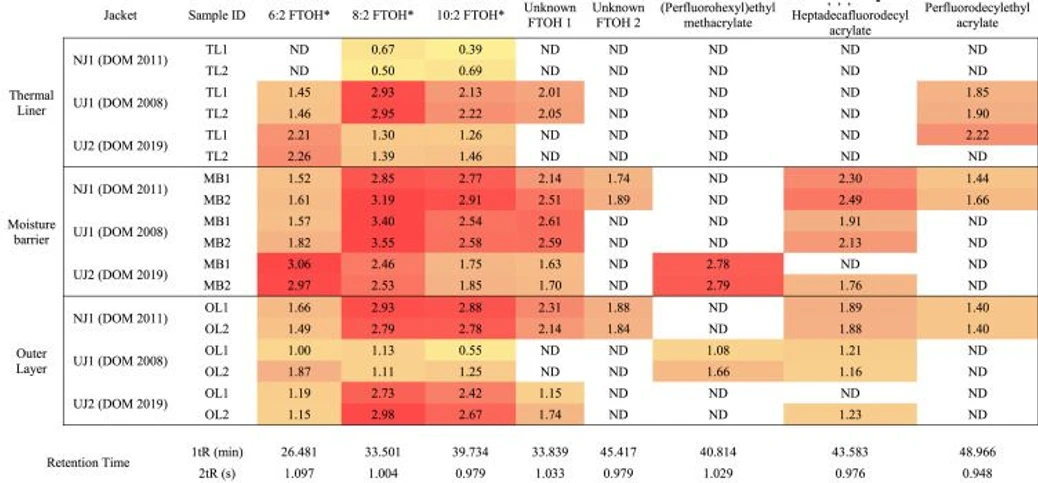 Journal of Chromatography A, Volume 1733, 27 September 2024, 465219: Table 1. List of PFAS tentatively identified in the functional fabrics, where. A heat map was applied to the normalized peak areas (normalized to sample weight and log10 scaled).
3.4. Implications
Although exposure assessment of PFAS from jackets is outside the scope of this study, we presented the foundation for emission test experiments using targeted and non-targeted analysis. We demonstrated that PFAS are emitted from all the layers of the firefighter jacket at 38 °C for one hour. These values represent the worst-case scenario regarding skin temperature and duration of exposure. Direct dermal contact with the substance in the textile, migration through sweat production, and possible inhalation exposure are possible routes of exposure to PFAS from clothing treated with a durable water repellent (DWR) or polytetrafluoroethylene (PTFE). During fire suppression, inhalation exposure may be unlikely since the self-contained breathing apparatus is used.
Moreover, the base layer worn beneath the jacket could play a significant role in minimizing direct dermal contact and the risks of dermal adsorption as a route of exposure are under investigation. Recent studies have modeled the partitioning of neutral PFAS (volatiles and semi volatile PFAS) from the gas phase to the skin surface, specifically the stratum corneum. They identified 11 PFAS that can potentially be dermally absorbed from the gas phase [30], however, additional data is needed to validate the model. Undoubtedly volatile PFAS can be released into the air after laundering or emitted to the gas phase during storage or use. This reiterates the need for emission test studies, which are important in evaluating the contribution of chemical off-gassing from textiles to the indoor environment.
4. Conclusions
Firefighter turnout gear is constructed with functional textiles that provide thermal, physical and biological protection. PFAS have been quantified in all the functional layers of the turnout gear (outer layer, moisture barrier and thermal liner), however, compound identification often relies on solvent extraction, which may not truly represent exposure in the field. This work confirms that fluorotelomer alcohols and fluorotelomer acrylates are emitted at 38 °C from some of the layers of the unused and used firefighter turnout gear. The use of TD-GC×GC-TOF MS allowed the extraction, separation, and identification of PFAS and other VOCs from the functional textiles. The structured ordering of the resulting chromatograms enabled the PFAS to elute as a distinct band, well-separated from other matrix interferences. A second filtering using the fragment ions typical of PFAS, CF3 (m/z 69), C3H2F3 (m/z 95) and C3F5 (m/z 131), allow further confidence in PFAS assignment. Additionally, the comprehensive nature of GC×GC–TOF MS provided non-targeted screening of the entire sample, enabling other compounds of concern to be monitored. and tentatively identified using the NIST23 database. PFAS emitted from the fabrics show trends related to wear (unused vs. used) and layer type (TL, MB, OL). This work highlights the value of expanding our understanding of volatile emissions from functional textiles and other textiles treated with polymeric PFAS. Improved comprehension of exposure pathways will facilitate devising effective exposure mitigation strategies. It can also inform disposal and management practices for PFAS-containing textiles to minimize environmental impacts such as soil, water, and air contamination.