Developing and Demonstrating a Lab Method for Quantifying Hair Exposure to Environmental Tobacco Smoke with a Forensic Perspective
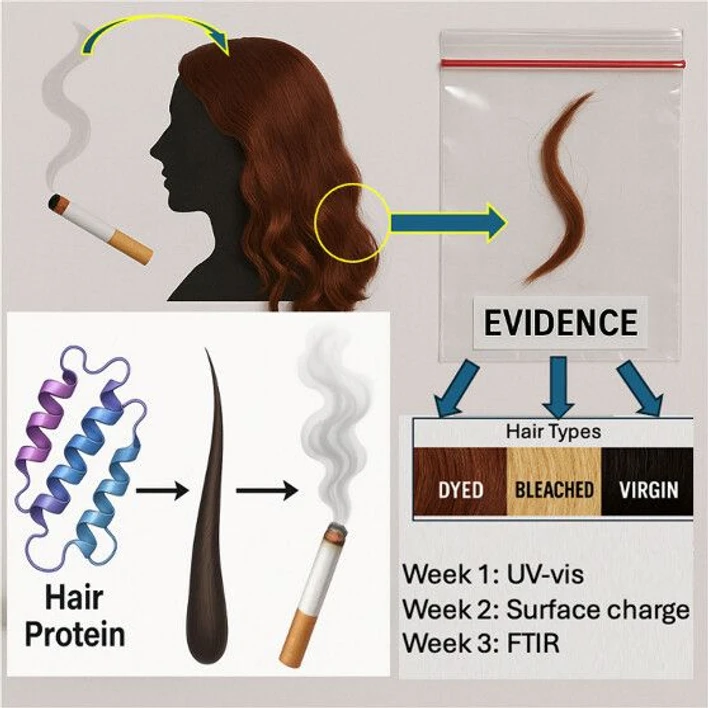
J. Chem. Educ. 2026, 103, 1, 479–487: Graphical abstract
This study introduces a forensic laboratory module designed to quantify environmental tobacco smoke (ETS) exposure in human hair. Using controlled smoke exposure and analysis by UV–Vis spectroscopy, FTIR spectroscopy, and zeta potential measurements, students investigated how untreated, dyed, and bleached hair differ in their capacity to adsorb ETS residues.
Implemented over three weeks, the module included pre- and postlab assessments to evaluate learning outcomes. Results showed measurable improvements in student understanding, technical skills, and application of forensic analytical techniques. The experiment provides a practical teaching tool for forensic chemistry while demonstrating how chemical treatments influence hair’s interaction with environmental contaminants.
The original article
Developing and Demonstrating a Lab Method for Quantifying Hair Exposure to Environmental Tobacco Smoke with a Forensic Perspective
Tanique Z. Jones, Christopher J. Trejo, Somayeh Mohammadi, and Hamidreza Sharifan*
J. Chem. Educ. 2026, 103, 1, 479–487
https://doi.org/10.1021/acs.jchemed.5c00479
licensed under CC-BY 4.0
Selected sections from the article follow. Formats and hyperlinks were adapted from the original.
In forensic chemistry education, a reliable noninvasive lab module to assess cannabis and environmental tobacco smoke (ETS) exposure is critical as many crime scenes are associated with smoke and drug consumption. (1,2) Traditional lab methods, such as blood and urine analysis, are costly, often unfeasible in many institutes and require lengthy ethical approval processes, moreover, they provide only a snapshot of recent exposure and may not reflect long-term accumulation. (3,4) Hair analysis, on the other hand, can provide a comprehensive overview of an individual’s exposure over weeks to months, making it an invaluable tool in forensic chemistry education. (5−7) This study aims to develop a robust lab module that enables students to effectively understand hair exposure to ETS, with a specific focus on the differential retention of smoke residues in untreated, dyed, and bleached hair. We developed an experimental setup that can be further commercialized and utilized in educational settings for forensic and environmental studies. Through teaching forensic chemistry over four years, the lead author identified the need of a lab module in forensic chemistry education to be affordable, reliable, and noninvasive for students to assess environmental exposures that play a role in legal and investigative contexts. (8,9)
ETS, commonly referred to as secondhand smoke, poses significant health risks and remains a pervasive issue in public health. (10−12) The detrimental effects of ETS exposure, including respiratory illnesses, cardiovascular diseases, and various cancers, are well-documented. (13) However, accurately quantifying an individual’s exposure to ETS, particularly in forensic contexts, presents unique challenges. Previous research highlights that ETS residues, specifically nicotine and its metabolites, serve as significant forensic markers in cases involving exposure assessments or custody disputes due to their persistence and detectability in biological matrices such as hair. (14,15) Hair, as a biological matrix, offers a distinctive advantage for assessing long-term exposure to environmental pollutants, (16) including tobacco smoke, narcotics, and marijuana. (17) This is due to its ability to incorporate and retain various substances over extended periods, providing a historical record of exposure. (18,19) Unlike blood or urine, which reflect recent exposure, hair analysis provides a longer window of detection, making it possible to assess chronic exposure to ETS. (20) In addition, using the hair supply for the forensic teaching lab is low-risk and cost-effective. Further, this technique is particularly useful in cases where long-term exposure needs to be demonstrated. Hair collection is a noninvasive procedure, easily performed without causing discomfort or distress to individuals. (21,22) This is especially advantageous in forensic contexts where minimal invasiveness is preferred. Hair has the unique ability to incorporate and retain nicotine and other smoke residues over time. (23,24) By examining untreated, dyed, and bleached hair, this lab module can empower students to differentiate hair treatments role in the adsorption of ETS components, enhancing the accuracy of exposure assessments. (25,26) This Lab module is flexible and integrable to improve understanding of the impact of cosmetic treatments on the absorption of environmental toxins. Through this experiment, instructors can design various forensic scenarios, including criminal investigations, workplace exposure assessments, and custody disputes where ETS exposure might be a relevant factor. (27) It provides forensic experts with a robust tool to support their findings with scientifically validated data. (28) This innovative approach enhances the forensic toolkit, allowing for more accurate and comprehensive exposure assessments.
Experimental
UV–Visible Spectroscopy Analysis
The concentration of smoke residues in the hair samples was quantified using UV–visible (UV–vis) spectroscopy (PerkinElmer) after extracting the adsorbed residues by rinsing the exposed hair samples with methanol three times. The resulting methanol extracts were scanned using a full wavelength range of 200–700 nm. Among the observed spectra, the absorbance at 280 nm was specifically monitored using second-order derivative processing.
The selection of 280 nm was based on its established association with strong π–π* transitions of aromatic compounds such as nicotine and polyaromatic hydrocarbons, which are prominent components of tobacco smoke. This wavelength consistently showed peak absorbance in our extracts across different hair types and exposure conditions, making it a reliable indicator for quantifying smoke residue deposition.
To ensure measurement accuracy, a baseline scan using deionized water was performed prior to sample analysis to subtract background noise. Spectra were collected at room temperature using a 2.5 nm sampling interval, fast scan speed, and 5.0 nm slit width. The UV–vis absorbance data at 280 nm were used to evaluate the extent of smoke residue adsorption on virgin, dyed, and bleached hair. Comparative analysis of these spectra provided insight into how cosmetic treatments influence the hair’s capacity to retain environmental smoke contaminants.
Zeta Potential Measurement
Hair samples were then cut into small pieces (<1 cm in length) using scissors to facilitate grinding. The cut hair pieces were placed into a mortar and a small amount of liquid nitrogen was added to freeze the hair, making it brittle and easier to grind. The pestle was used to grind the frozen hair into a fine powder until a uniform consistency was obtained. 0.1 g of the hair powder was weighed using an analytical balance and transferred to a clean 15 mL polypropylene tube. To prepare the suspension, we added 10 mL of deionized (DI) water to the tube containing the hair powder and sonicated the suspension for 10 min to ensure uniform dispersion. The suspension was then centrifuged at 3000 rpm for 5 min to remove any large aggregates, and the supernatant was collected for zeta potential measurement. The hair suspension supernatant was transferred to the sample cell of the analyzer. Zeta potential measurements (n = 3) were performed using Malvern Zetasizer (Malvern, UK). The data was analyzed to determine the average zeta potential of the hair powder suspension, and the values for untreated hair were compared with those for dyed and bleached hair.
FTIR Analysis
The changes in functional groups of hair samples before and after smoke exposure were evaluated using FTIR at room temperature. The FTIR analysis adhered to the ASTM E1252 standard procedure, (29) employing the Thermo Scientific Nicolet iS5 FT-IR Spectrometer. (30) During the linear scan mode, the sampling depth varied across the spectrum. With an optical velocity of 0.47 cm/s, the Fourier frequency ranged from 470 to 940 Hz, covering a spectral range of 400 to 3000 cm–1.
Results and Discussion
As shown in Figure 2, the absorbance values recorded at the wavelength of 280 nm indicated potential absorption of nicotine and tar components with a positive correlation to the time of exposure within a 60 min interval. Hair treated with permanent dye displayed the highest levels of smoke residue deposition across all exposure intervals. The UV–visible absorbance spectra revealed a significant increase in smoke residue absorption compared to virgin and bleached hair, by 1.8 and 3.2 times higher at 60 min, respectively.
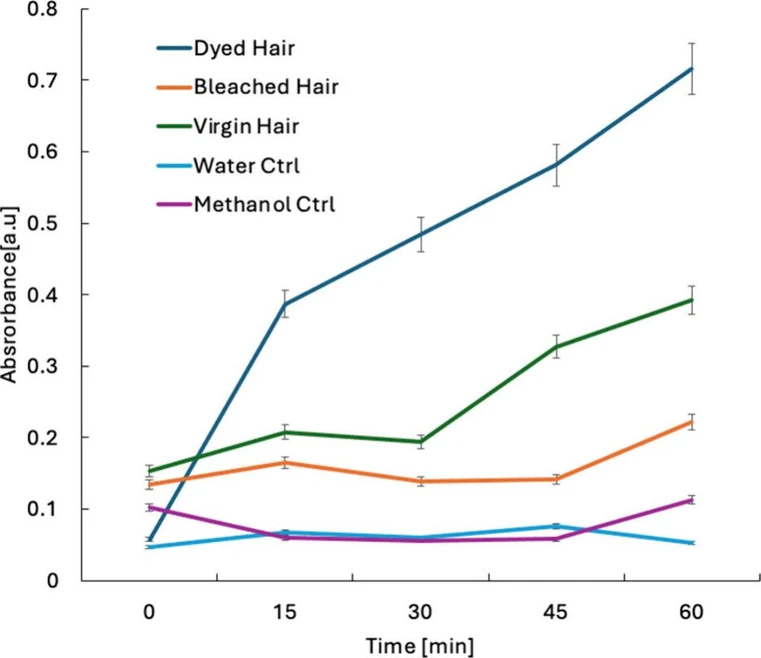 J. Chem. Educ. 2026, 103, 1, 479–487: Figure 2. Absorbance of smoke residues dissolved in methanol from different hair types over time. The graph shows the absorbance 280 nm corresponding to nicotine and tar components on hair within 15, 30, 45, and 60 min.
Figure 3 shows the impact of cigarette smoke on untreated, dyed, and bleached hair samples using FTIR spectroscopy. This technique allowed students to investigate molecular-level changes in hair composition after exposure to ETS, providing a hands-on opportunity to connect theory with application. Figure 3A presents FTIR spectra of untreated hair (black line) and smoke-exposed untreated hair (red line). After exposure, noticeable new peaks and shifts in transmittance intensities emerge, indicating chemical alterations. Changes were especially prominent in the 3000–2800 cm–1 region (C–H stretching of alkanes) and the 1700–1500 cm–1 range (Amide I and II bands), which reflect modifications to the protein backbone of hair. These spectral changes served as real-time evidence of environmental interaction with biological samples. Figure 3B shows similar comparisons for dyed hair, where exposure to smoke caused intensified shifts in the 3500–3200 cm–1 region (O–H and N–H stretching vibrations) and 1600–1500 cm–1 (Amide II region). These alterations suggest chemical interactions between dye constituents and smoke residues. The elevated response in dyed hair indicates a higher reactivity due to prior chemical treatment.
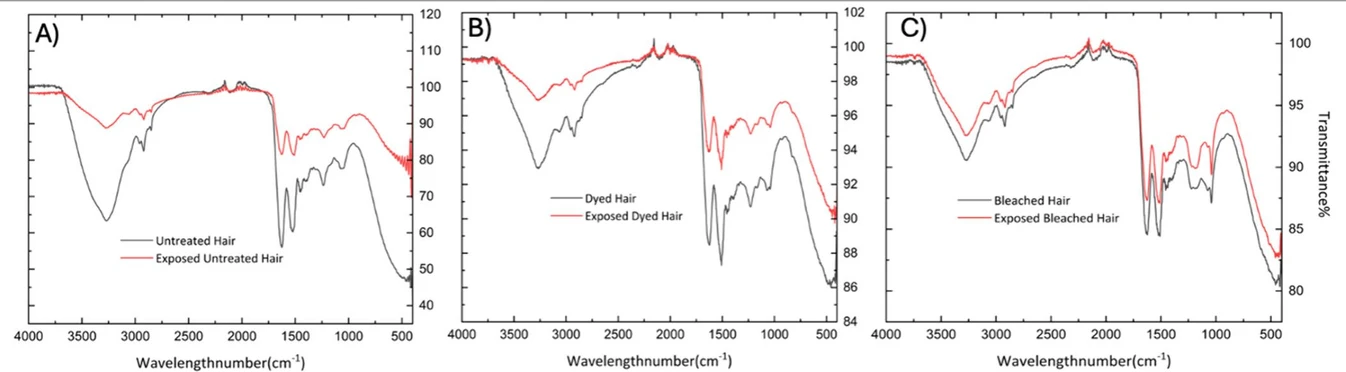 J. Chem. Educ. 2026, 103, 1, 479–487: Figure 3. FTIR spectra of hair samples exposed to cigarette smoke. (A) Untreated hair compared to untreated hair exposed to cigarette smoke. (B) Dyed hair compared to dyed hair exposed to cigarette smoke. (C) Bleached hair compared to bleached hair exposed to cigarette smoke.
Figure 3C compares bleached hair before and after smoke exposure, with changes spanning 500–3200 cm–1. The broadening of peaks in the O–H stretching region and changes in Amide I and II bands point to structural degradation and protein damage induced by the dual effects of bleaching and smoke exposure. The increased porosity of bleached hair likely enhances its susceptibility to smoke residue adsorption. From an educational standpoint, this FTIR module reinforced critical analytical thinking by guiding students through spectral interpretation of real biological samples. Rather than working with abstract compounds, students explored how cosmetic alterations change a material’s chemical behavior and how forensic tools like FTIR can detect those changes. By comparing spectra across different hair conditions, students practiced identifying functional groups and recognizing patterns in complex data sets, skills directly transferrable to forensic, biomedical, and environmental chemistry fields.
Furthermore, this hands-on experience emphasized the interdisciplinary nature of forensic chemistry, combining biology, toxicology, and analytical instrumentation. Students gained confidence in interpreting real-world data and understanding how molecular-level changes relate to broader questions about environmental exposure and personal history, key themes in modern forensic investigations. This lab taught FTIR instrumentation also illustrated its power in addressing societal and legal questions through science.
Conclusion
This work delivers a practical, noninvasive laboratory module that quantifies hair exposure to environmental tobacco smoke while building core forensic-analytical competencies. Using controlled smoke exposure coupled with UV–visible spectroscopy, FTIR, and zeta potential measurements, students were able to detect and interpret chemical signatures of ETS on untreated, dyed, and bleached hair. Across techniques, cosmetic treatment was a decisive factor: treated hair exhibited distinct surface chemistry and structural changes that altered residue interactions and detectability. In our pilot, dyed hair frequently showed higher methanol-extractable residues by UV–Vis, whereas bleaching produced marked shifts in functional groups and more negative surface charge, indicating treatment-dependent mechanisms of adsorption and retention. These complementary observations reinforce the evidentiary value of multimodal analysis in exposure assessment and demonstrate how matrix history (cosmetic treatment) must be considered in forensic interpretation.
Pedagogically, the module achieved measurable learning gains. Pre/post assessments showed increased familiarity with forensic hair analysis, improved confidence with instrumental methods, and stronger capacity to translate spectra and surface-charge data into defensible conclusions. Because the workflow uses accessible instrumentation, clearly defined safety practices, and inexpensive materials, it is readily scalable for undergraduate teaching laboratories and adaptable to varied forensic scenarios (e.g., custody disputes, workplace exposure, scene reconstruction). Future iterations should incorporate quantitative calibration for specific ETS markers (e.g., nicotine/cotinine), broaden donor hair diversity and treatment histories, examine repeated/longer exposures and alternative smokes (e.g., cannabis), and evaluate decontamination protocols. Method validation across cohorts and institutions, coupled with structured interpretation frameworks, will further strengthen reliability and courtroom utility. Overall, the module integrates authentic forensic inquiry with robust analytics, providing a transferable teaching and investigative tool for assessing individual ETS exposure in hair.