Quantitative Assessment of Chemical Modifications of Macromolecules through Counterion Measurement
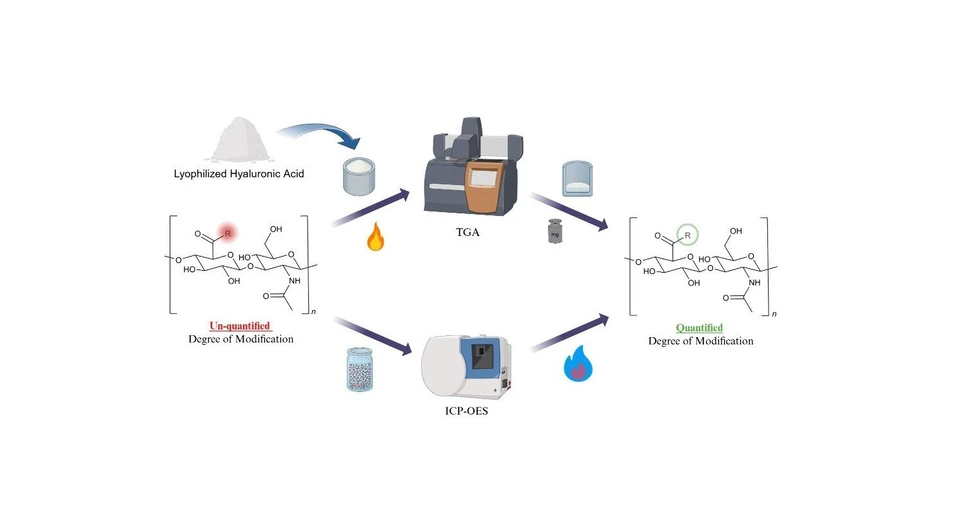
Chem. Mater. 2026, 38, 1, 442–453: Graphical abstract
This study introduces a counterion-counting strategy to quantify the degree of chemical modification in hyaluronic acid derivatives. By measuring the loss of sodium counterions associated with unmodified carboxylate groups, the approach provides a universal, label-free method for assessing macromolecular modifications.
The concept was implemented using thermogravimetric analysis and ICP-OES, offering complementary advantages for insoluble and soluble samples, respectively. Results showed strong agreement with conventional NMR and UV–Vis assays, demonstrating the method’s reliability for biomaterial development and quality control.
The original article
Quantitative Assessment of Chemical Modifications of Macromolecules through Counterion Measurement
Christos Leliopoulos, Hamidreza Mokhtari, Shima Tavakoli, Vitalii Shtender, Cecilia Persson, and Oommen P. Varghese*
Chem. Mater. 2026, 38, 1, 442–453
https://doi.org/10.1021/acs.chemmater.5c02871
licensed under CC-BY 4.0
Selected sections from the article follow. Formats and hyperlinks were adapted from the original.
Extracellular matrix (ECM)-derived biomaterials are widely used in biomedical applications ranging from injectable aesthetic fillers to tissue-engineering hydrogels and drug-delivery platforms. (1−3) Across these diverse uses, there is a pressing need for accurate, reliable, and straightforward methods to track chemical modifications in such biomaterials. This need is further amplified by stringent medical device regulations that mandate precise documentation and rigorous control of every chemical modification during product development. (4,5)
Among ECM-derived biomaterials, hyaluronic acid (HA) has gained prominence for its exceptional biocompatibility, biodegradability, and functional versatility. (6−8) HA is one of the most abundant macromolecules in human ECM that is widely used to develop biomaterials for tissue engineering and drug delivery. This macromolecule is generally used in its sodium salt form (sodium hyaluronate, NaHA) due to its superior water solubility, stability, rapid dissolution, and ease of formulation compared to the nonionized acid form. (9) Since HA can be chemically modified at specific sites, typically at the carboxylate group or primary hydroxyls, it is commonly used to design hydrogels or nanogels or to attach therapeutics and other biologics via bioconjugation. By choosing the modification site and degree, engineers can optimize the mechanical strength, degradation rate, biocompatibility, processability, and swelling behavior to suit a given application. (10)
One of the most interesting features of HA is its defined stoichiometry with one carboxylate group per disaccharide, which enables straightforward assessment of chemical changes when analytical signals are distinct. When relevant signals are weak, absent, or overlapping, quantifying the DoM becomes difficult. DoM affects viscosity, cross-link density, degradation kinetics, and biological performance, therefore an efficient method to determine precise DoM is imperative. (11,12) Despite this need, quantitative measurement of DoM in chemically modified macromolecules remain challenging. To address this challenge, Fourier transform infrared (FTIR) spectroscopy, nuclear magnetic resonance (NMR), and UV-visible (UV-Vis) spectroscopic methods are routinely pursued to quantify DoM, however, such tools sometimes have practical limitations. (13) FTIR could be used to identify new functionalities, but it remains largely qualitative. Quantification by NMR should, in principle, directly provide information on chemical modifications, however for large polymers peak broadening and signal overlap can obscure key resonance frequencies, and low DoM can approach instrument detection limits. When quantitative NMR is attempted, reliance on internal or external standards introduces user-to-user variability. (14) Spectroscopic analysis by UV-Vis offers an alternative approach, provided a UV-active chromophore is incorporated. If primary label could not be quantified, secondary labeling methods are commonly introduced such as trinitrobenzenesulfonic acid (TNBS) or Ellman’s reagent for thiol modifications, followed by calibrations that are somewhat cumbersome and error-prone. (15)
These analytical hurdles increase once hydrophobic substituents are introduced. Molecules tend to self-assemble, shortening T2 and suppressing 1H NMR signals, while energy-transfer processes lower UV or fluorescence readouts. (16) Stability and solubility constraints amplify the problem further yielding nanoparticles and hydrogels that may not fully dissolve, which undermines solution-based spectroscopic analysis and makes postsynthesis characterization unreliable. These challenges create a significant quantification gap, particularly for complex modified polymers in solid form or as hydrogels. Often, the final intended product is a cross-linked hydrogel, which is impractical to characterize with traditional solution-phase methods.
To address this gap, we developed a modification-agnostic approach that focuses on “what remains unmodified” in HA rather than on the modifications themselves. Unlike conventional assays that directly detect the introduced modifications, our strategy indirectly gauges the modification level via the remaining carboxylate content. This provides a single, universal readout applicable to a wide range of chemical modifications. Specifically, we leverage the native form of HA as a sodium salt that could be quantified using different analytical techniques. If the carboxylate group is chemically modified, it loses its negative charge and releases its associated Na+ counterion. The number of unmodified sodium carboxylate (COO– Na+) groups remaining in the macromolecule could be used to infer the DoM, as we have shown recently. (17) To determine the amount of sodium salt, we implemented two complementary analytical techniques, namely, thermogravimetric analysis (TGA) and inductively coupled plasma optical emission spectroscopy (ICP-OES).
TGA is a standard thermal analysis technique that measures changes in sample mass as the temperature is ramped under controlled conditions. It provides insight into thermal stability and composition, and is routinely used to characterize polymer decomposition behavior, residual solvent or moisture content, and the presence of additives. (18) Historically, quantitative TGA can be performed by measuring either the mass loss (e.g., volatile components that vaporize or burn off) or the mass of inorganic residue remaining after full decomposition. (19) In our previous work we demonstrated that TGA could be used to determine the number of bound Na+, however the initial protocol could not be implemented to all types of chemical modifications. (17) Here, we introduce an improved TGA workflow that overcomes those limitations, which enables robust quantification of Na+ residue for determining the DoM.
ICP-OES is another powerful technique for quantifying elements in a sample. It uses an extremely hot argon plasma to excite atoms, causing each element to emit light at characteristic wavelengths. By measuring these emission lines, ICP-OES could detect and quantify elements with high sensitivity. (20) ICP-OES analysis is routinely used to monitor metal content, for example to check for residual catalysts, verify the loading of metal-based additives, or ensure compliance with impurity limits. In the biomedical field, it is commonly applied to measure trace metals in raw materials, assess leachable metals from products, and verify batch-to-batch consistency. (20) Quantitation is achieved by calibrating against standards and using internal references to correct for any instrumental drift or matrix interference. With a linear response over several orders of magnitude and detection limits often in the low parts-per-million to parts-per-billion range, ICP-OES provides a robust, high-throughput means of determining the sodium content in our modified HA samples. By translating the measured ion content to the amount of carboxylate groups, this technique, like TGA, could enable developing a reliable method to determine the DoM for various carboxylate modifications.
In this study, we exploited both TGA and ICP-OES as complementary techniques to determine DoM in HA by measuring the free sodium carboxylate and performed side-by-side comparison with other established quantification methods. This study reports the application of ICP-OES as a tool for determining the DoM in macromolecules that is compared directly with TGA analysis. Our side-by-side analysis of two methods opens possibilities to determine the molecular structure of biopolymers without any complicated sample preparation or manipulation.
2. Experimental Section
2.4. Procedure for TGA Analysis
Building on our previously reported workflow, (17) the TGA protocol was adapted for this study as follows. Thermal analyses were performed on a TGA/DSC 3+ (Mettler Toledo AB, Stockholm, Sweden) equipped with an autosampler, SDTA sensor, large furnace, and XP5U balance (compatible with crucibles up to 900 μL and sample masses up to 5 g). Samples of 15–20 mg were weighed into alumina crucibles (300 μL) fitted with lids to minimize loss. The 300 μL pan was selected to avoid dense packing and foaming from decomposition gases. Although larger masses improve signal-to-noise, they could introduce thermal gradients in this pan, and slower decompositions. Extended segment durations were therefore used to ensure thermal equilibration. The instrument was calibrated with TGA-specific weights (CarePac, class E2, Mettler Toledo), and drift/noise tests confirmed performance within manufacturer specifications. A sample mass at or above the USP-recommended minimum of 1.7 mg was targeted (≈10× the balance’s stated accuracy under ideal conditions, 0.17 mg).
2.5. Procedure for ICP-OES Analysis
Elemental quantification was performed by inductively coupled plasma–optical emission spectroscopy (ICP-OES; Avio 200, PerkinElmer, Shelton, USA) operated with a cross-flow nebulizer. Samples were prepared in 5% (v/v) HNO3 as either 5 mg in 1.5 mL or 10 mg in 3.0 mL, yielding an initial concentration of ∼ 3.33 mg mL–1. Prior to analysis, solutions were diluted with 5% (v/v) HNO3 (the same was used as a blank and a washing solution in the ICP-OES measurements) by a predefined dilution factor (DF = 2.0 or 2.5), giving final working concentrations of ∼ 1.33–1.67 mg mL–1. All solutions were passed through 0.45 μm PES syringe filters before introduction. Calibration curves were prepared in 5% (v/v) HNO3 from certified standards (see Materials). Target levels (mg L–1 = ppm) were: Na+ 0 (blank), 50, 75, 100; K+ 0, 1, 3, 6; Ca2+ 0, 0.1, 0.5, 1.5, 3.0; Mg2+ 0, 0.005, 0.05, 0.5; minor on-run adjustments were made only if needed to bracket sample responses and 2-point background adjustment was applied to the blank spectra. Quantification used a least-squares linear-through-zero fit, accepted when r ≥ 0.99995 (99.995%). Na+ was measured in radial view; K+, Ca2+, and Mg2+ were measured in axial view. Analytical wavelengths (per Syngistix first-choice lines, verified for interferences) were: Na+ 589.592 nm; K+ 766.490 nm; Ca2+ 317.933 nm; Mg2+ 285.213 nm. Spectral processing used peak-area integration with ≥ 3 data points per peak. Each sample was acquired in ≥ 3 technical replicates (typically n = 3–6). Results are reported as mean ± SD, with replicate precision (RSD) taken from the experimental data set, RSDs were generally ≤ 3%, with occasional higher values at the low end of an element’s working range.
2.6. FTIR Analysis of TGA Residues
The TGA pellet-shaped residues were collected from the alumina crucibles, gently ground to a fine powder, and analyzed by FTIR on an IRTracer-100 spectrometer (Shimadzu). Spectra were recorded from 4000 to 400 cm–1 at 4 cm–1 resolution with 45 coadded scans per sample. A fresh background was acquired before each measurement and spectra were baseline-corrected. Reference spectra of Na2CO3 and Na2SO4 were obtained under identical conditions for comparison.
3. Results and Discussion
3.4. Determination of DoM Using TGA
To determine the DoM, the amount of residue obtained was quantified and characterized. When N2-ramp TGA method was employed, the expected DoM obtained from other reference characterization techniques matched the obtained data, however, it failed for compounds bearing hydrazide functional groups. Interestingly, when we modified the TGA protocol with air instead of N2 we could solve this artifact, indicating the impact of different decomposition pathways under N2 and air.
When N2-ramp and air-ramp method were employed, as anticipated, we observed sample decomposition and a final residue that was used to calculated DoM. To illustrate the principle behind the TGA method (Figure 2), we showcase one unmodified NaHA and one HA modification (HA-CDH) as representatives, measured by the air-ramp TGA method. Both traces display characteristic thermal features: initial moisture loss up to 150 °C, followed by the main oxidative decomposition step, and finally establishing a stable inorganic plateau corresponding to the Na2CO3 residue. The same principles also apply to N2-ramp TGA. A representative NaHA run gives a terminal residue of 13.26% (cohort mean 13.24 ± 0.08%, n ≥ 3), whereas a representative HA-CDH run yields 11.23% (cohort mean 11.20 ± 0.04%, n ≥ 3). These results support the DoM premise and show that chemical modification produces a clear and highly reproducible decrease in the inorganic residue that remains after the organic char has fully decomposed to Na2CO3.
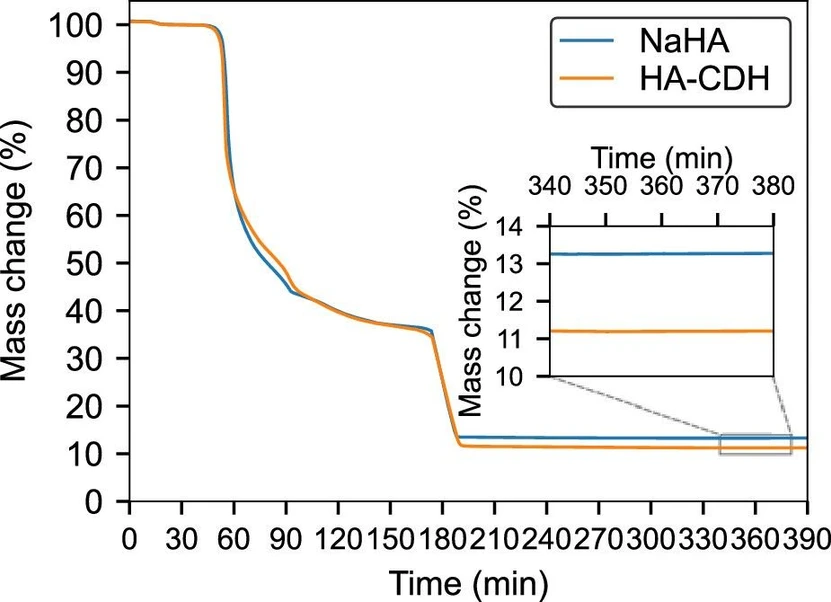 Chem. Mater. 2026, 38, 1, 442–453: Figure 2. Air-ramp TGA profiles of unmodified NaHA (blue) and HA-CDH (orange). The inset highlights the difference in final Na2CO3 residue mass (340–380 min).
3.5. Determination of DoM Using ICP-OES
By ICP-OES quantification, the measured counterion fractions for unmodified NaHA are compared with the theoretical number needed to neutralize all COO– groups in the same dry mass (Figure 4, Table S5). ICP-OES analysis indicated that there was predominantly Na+ that accounts for 96.32 ± 0.88%. We also observed traces of K+ (∼2%) that brings the total to 98.54 ± 1.35%. Surprisingly, we also observed minute traces of bivalent ions namely Ca2+ and Mg2+ (∼0.35%) that give a total of 99.23 ± 1.24% of the theoretical value. The remaining ∼ 0.78% is most likely due to the uptake of atmospheric moisture during ICP-OES sample preparation, which slightly dilutes the digest. Because this bias is consistent across samples, it cancels in the ratio used in the calculations. It is worth mentioning that this error is likely not instrumental, since the concentration of the elements measured was well above the detection limit of 1 ppb (Na+, K+) and 0.1 ppb (Ca2+, Mg2+). In order to find the DoM, we need to derive eq 5 and 6 to obtain eq 7. We convert ion mass concentrations to mole-equivalents of charge by dividing by molar mass and weighting by ionic valence, dilution and digest volume are included so the term is proportional to the total charge.
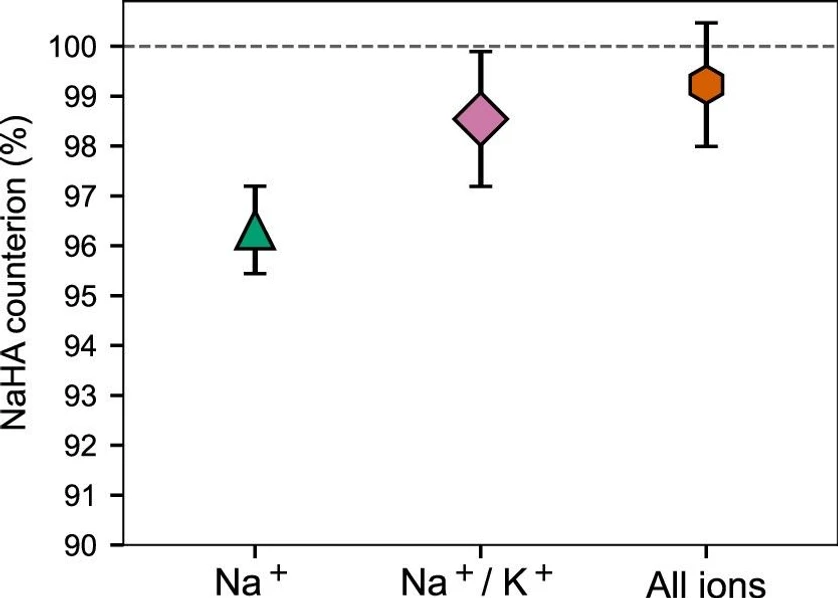 Chem. Mater. 2026, 38, 1, 442–453: Figure 4. ICP-OES quantification of counterions in unmodified NaHA. Symbols represent the mean ± SD (n = 7) of the theoretical carboxylate charge neutralized by the indicated cation subsets. The dashed line indicates 100% theoretical neutralization.
4. Conclusions
In this work, we demonstrate that bound counterion quantification could be used as an effective strategy to determine the DoM in macromolecules. As a proof-of-concept, we developed different HA derivatives, having a diverse variety of functional groups and properties to showcase this concept. By measuring the residual sodium associated with unmodified carboxylate groups, both TGA and ICP-OES yielded DoM values in close agreement with conventional NMR and UV-Vis analyses. Each technique provides complementary strengths, ICP-OES delivers high sensitivity for soluble samples and multielement analysis, whereas TGA permits reliable quantification in insoluble or cross-linked materials (gels). We found that certain functional groups (such as thiols and hydrazides) could introduce systematic errors under standard TGA conditions, however, our optimized thermal protocol addresses this issue and ensures accurate results across different HA derivatives. Overall, the counterion-based method is a robust, straightforward tool for assessing chemical modifications in HA, providing a universal-label free strategy to improve the characterization and quality control of modified HA, and other biomaterials.