In Vitro Antibacterial Potential of Pinus nigra-Thymus serpyllum Essential Oil and Antibiotic Combinations
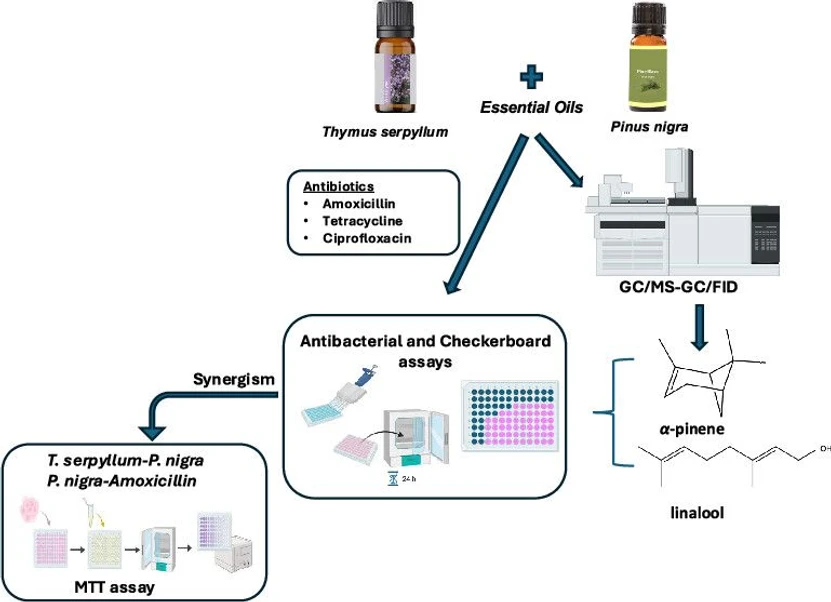
ACS Omega 2025, 10, 50, 61528–61534: Graphical abstract
This study evaluates the in vitro antibacterial potential of Pinus nigra and Thymus serpyllum essential oils, individually and in combination, against 12 human pathogens. Antimicrobial activity and synergistic interactions were assessed using microdilution and checkerboard assays, with additional testing alongside ciprofloxacin, amoxicillin, and tetracycline.
The oil combination showed strong synergy against Enterococcus faecalis and Staphylococcus epidermidis, while P. nigra combined with amoxicillin was synergistic against Streptococcus mitis. Major oil components were characterized by GC/MS and GC/FID, and cytotoxicity testing confirmed no toxicity for synergistic combinations. These findings highlight the potential of essential oil–antibiotic combinations in antibacterial strategies.
The original article
In Vitro Antibacterial Potential of Pinus nigra-Thymus serpyllum Essential Oil and Antibiotic Combinations
Sümeyye Elif Kahya*, Ayşe Esra Karadağ, Betül Demirci, and Fatih Demirci*
ACS Omega 2025, 10, 50, 61528–61534
https://doi.org/10.1021/acsomega.5c07183
licensed under CC-BY 4.0
Selected sections from the article follow. Formats and hyperlinks were adapted from the original.
Thymus serpyllum L. (Lamiaceae) is commonly known as a ‘wild thyme’, and is originally from Eastern Mediterranean regions, where also a monograph of the dried flowering aerial parts in the European Pharmacopoeia exists as Serpylli herba, which is widely used in Europe. (1) Carvacrol was reported as the main component in T. serpyllum, with variable amounts of thymol, linalool, linalyl acetate, borneol, 1,8-cineole, germacrene D, p-cymene, γ-terpinene, myrcene, and β-caryophyllene, respectively. The content varies significantly based on the species, genetic variation, developmental stage, origin, and cultivation conditions, so its chemotype diversity occurs. (2,3) Its preparations are traditionally used for treating colds, rheumatism, sciatica, and its stimulating, disinfectant, and immune-stimulating effects. (4,5)
Pinus nigra JF Arnold (Black pine) is a diverse species which belongs to the Pinaceae family, present throughout the Mediterranean region. (6) The species is divided into seven subspecies: Pinus nigra subsp. dalmatica (Vis.) Franco, P. nigra subsp. laricio Palib. ex Maire, P. nigra subsp. nigra, P. nigra subsp. pallasiana (Lamb.) Holmboe, P. nigra subsp. salzmannii (Dunal) Franco, P. nigra f. seneriana (Saatçioglu) Kandemir & Mataraci, and P. nigra var. yaltirikiana Alptekin. (7) Black pine is recognized for its genetic, morphological, phenotypic, and biochemical diversity. The chemical composition of essential oils varies among different origins and subspecies, with the abundance of monoterpenes such as α-pinene, β-pinene, limonene, δ-3-carene, and β-phellandrene among others. (8,9) Biological activities such as antibacterial, antifungal, and antioxidant are reported within traditional medicine. (10)
Antimicrobial resistance can be classified as one of the clinical and economical devastating impacts globally. Pathogens such as Staphylococcus aureus and Pseudomonas aeruginosa are frequently listed as priority pathogens by the World Health Organization, because they rank as leading causes for infections acquired in communities along with hospitals worldwide. (11,12) According to the One Health approach, the spread of resistant strains constitutes a significant threat to human, animal, and environmental health. Consequently, new research for new innovative antimicrobial agents such as essential oils and combinations withdraw attention as a sustainable strategy. (13)
The combination of conventional antibiotics with EOs enhances their effectiveness, positioning EOs as promising alternatives to synthetic antimicrobial agents for combating resilient infections, where recent studies demonstrated synergistic activity in specific combinations. (14,15) Synergistic effects have significant advantages, such as the drug combination exerting a more substantial impact than the sum of the drugs’ effect, lower toxicity, and reduced side effects. (16)
In this present study, to achieve synergistic antimicrobial activity T. serpyllum and P. nigra essential oil combinations were systematically evaluated. The checkerboard method was used to evaluate the binary combinations of the essential oils and their individual combinations with tetracycline, amoxicillin, and ciprofloxacin, respectively. In addition, based on the GC/MS and GC/FID verification results, the combinations of the major components geraniol and α-pinene were evaluated against pathogenic microorganisms. To the best our knowledge, the combination of T. serpyllum and P. nigra essential oils, tetracycline, amoxicillin, ciprofloxacin, major components geraniol and α-pinene, respectively, were evaluated for the first time. Also, the active combinations were further assessed for their potential toxicity using the in vitro MTT assay.
2. Result and Discussion
2.1. Phytochemical Analysis
The detailed chromatographic analyses represent the relative percentages (%) calculated from FID data which are listed in Table 1. GC-FID and GC/MS analyses of the commercial essential oils verified 20 and 46 compounds, representing 92% and 97.2% of the essential oils, respectively. The main compounds for P. nigra oil were characterized as α-pinene (73.8%), trans-verbenol (4.4%), α-pinene oxide (2%), camphene (1.7%), limonene (1.7%), verbenone (1.6%), and β-pinene, respectively. The main compounds for T. serpyllum were geraniol (19.3%), p-cymene (12.9%), α-thujone (6.6%), linalool (6.4%), carvacrol (5.7%), geranyl acetate (5.6%), geranyl formate (4.3%), and camphor (3.7%), respectively. T. serpyllum and P. nigra essential oil (see Suppl. For Chromatograms in Figure S1 and S2).
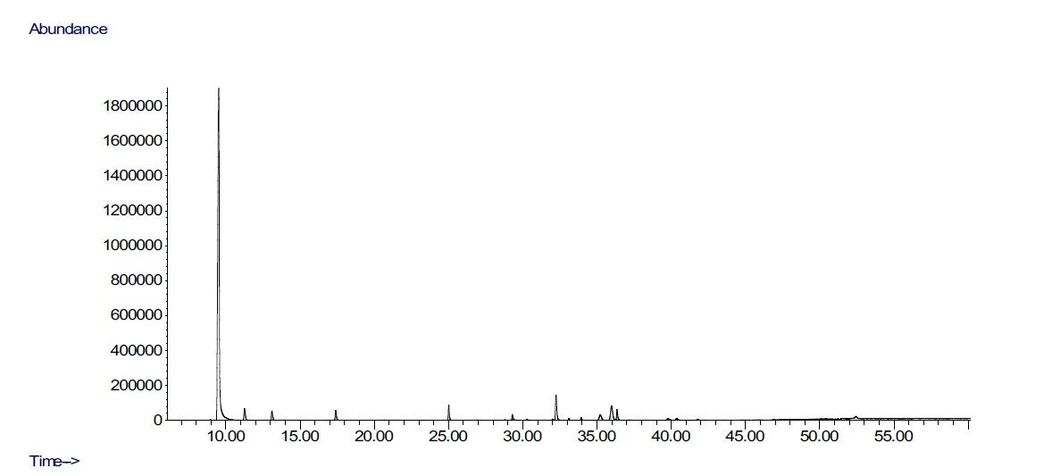 ACS Omega 2025, 10, 50, 61528–61534: Figure S1. GC/MS Chromatogram of P. nigra essential oil
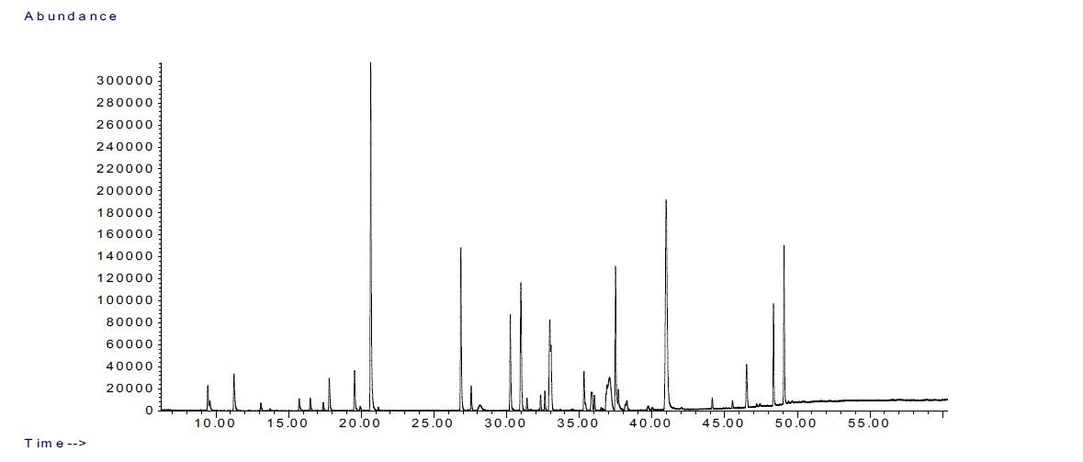 ACS Omega 2025, 10, 50, 61528–61534: Figure S2. GC/MS Chromatogram of T. serpyllum essential oil
In a previous study, T. serpyllum essential oil reported 10 different chemotypes, namely: carvacrol, 1,8-cineole/caryophyllene oxide, p-cymene, geraniol, linalool, trans-nerolidol, γ-terpinene, α-terpinol acetate, linalyl acetate, and thymol. (17−19) Among all, the most common chemotypes of T. serpyllum were suggested as the carvacrol and thymol type. (3,20) Paaver et al. (19) observed four chemotypes (trans-nerolidol, caryophyllene oxide, myrcene, and borneol) growing in Estonia. Another study reported that T. serpyllum chemotypes are thymol, caryophyllene oxide, τ-cadinol, β-cubebene, geraniol, geranyl isobutyrate, and 1,8-cineole from Hungary. In this present study, the utilized commercial T. serpyllum essential oil can be classified as geraniol chemotype, in agreement with previous reports in varying concentrations. (17,21)
The major compound of commercial P. nigra essential oil was reported as α-pinene, according to phytochemical analyses. (22,23). Regarding the Pinus essential oils in previous reports; α-pinene (44.98%), β-pinene (14.27%), germacrene D (9.63%), limonene (6.93%), and β-caryophyllene (5.58%), respectively was identified in the P. nigra needle oil. (22) In another study, the main components of pine essential oil were reported as α-pinene (45.93%), germacrene D (27.50%), (E)-caryophyllene (8.13%), and β-pinene (6.90%). (23)
When compared with literature data, the chemical compositions and major compounds showed consistency to previous studies.
2.4. Toxicity Assay
In vitro toxicity tests of the combinations with synergic effects were performed on the HEK293 cell line using the MTT method to evaluate selectivity. According to the FIC values, the combinations of P. nigra-T. serpyllum and P. nigra-amoxicillin were selected for the toxicity evaluation of the essential oils and amoxicillin alone. When the concentrations determined based on the FIC values, all combinations showed higher cell viability compared to the individual MIC values. Based on the data obtained from the cell culture toxicity, a reduction was observed in the combination studies.
According to Nikolić et al. (21) the wild thyme oil, which contains thymol as its major constituent, showed relatively less in vitro cytotoxic activity against four human tumor cells. Deb et al. (40) reported the T. serpyllum essential oil with antiproliferative activity against HL-60 cells (promyelocytic leukemia).
In this present study, designed combinations of commercial essential oils were systematically inhibited the pathogenic microorganism. The utilization of the particular commercially available essential oils, and their combinations with other components for preventing microbial resistance may be applicable.
3. Conclusion
Essential oils with known quality exert new biological and pharmacological activities that carry a utilization potential other than aromatherapy applications. Antimicrobial activity studies using essential oils and their major constituents targeting resistant bacteria may lead to the discovery of new drug leads with potential treatment of various microbial diseases. P. nigra and T. serpyllum oil combinations may have future potential as antimicrobial natural agents. The oil and antibiotic combinations offers a variation enabling relatively higher activity at lower concentrations. Also, combinations of major or minor constituents may not always responsible for synergistic activities, which should be evaluated carefully in depth. The effective combinations may form a basis for future research on upper respiratory tract infections as well as other microbial diseases.
However, more detailed studies, including in vivo experiments should be conducted. In addition further research must be performed to explore the use of combinations for the cosmetics and food industries with appropriate design.
4. Material and Methods
4.2. GC/FID and GC/MS Analysis
The GC-MS analysis was carried out with an Agilent 5975 GC-MSD system. Innowax FSC column (60 m x 0.25 mm, 0.25 μm film thickness) was used with helium as carrier gas (0.8 mL/min). GC oven temperature was kept at 60 °C for 10 min and programmed to 220 °C at a rate of 4 °C/min, and kept constant at 220 °C for 10 min and then programmed to 240 °C at a rate of 1 °C/min. Split ratio was adjusted at 40:1. The injector temperature was set at 250 °C. Mass spectra were recorded at 70 eV. Mass range was from m/z 35 to 450.
FID detector temperature was set to 300 °C. To obtain the same elution order with GC-MS, simultaneous autoinjection was applied on a duplicate of the same column applying the same operational conditions. Relative percentage (%) of the separated compounds were calculated from the FID chromatograms.
Identification of the essential oil components were carried out by comparison of their relative retention times (RRT) with those of authentic samples or by comparison of their relative retention index (RRI) to series of n-alkanes. Computer matching against commercial (Wiley GC/MS Library, MassFinder Software 4.0) and in-house “Başer Library of Essential Oil Constituents” built up by genuine compounds and components of known oils were performed. (41)