ISC 2026 Short Course 2 - The Analytical Procedure Lifecycle Approach: from Procedure Design to Performance Assessment using AQbD Principles

International Symposium on Chromatography: ISC 2026 Short Course 2 - The Analytical Procedure Lifecycle Approach: from Procedure Design to Performance Assessment using AQbD Principles
ISC 2026
The International Symposium on Chromatography (ISC) represents the oldest conference series on separation science. ISC symposia have been organised since 1956 in each even year. ISC is one of the premier meetings series for discussion of all modes of chromatography and separation science with a broad coverage of techniques and applications.
The major focus of the symposium will be on the impact of chromatography and separation science to meet the needs of the pharmaceutical, environmental, food and health industry, as well as science and medicine. The symposium programme will reflect these themes and highlight new challenges and emerging opportunities for the science and marketing of separation and detection systems and methods.
As an integral part of the scientific programme of lectures and poster sessions, an international exhibition and vendor seminars on instrumentation and services for chromatography, separation science and mass spectrometry will be organised. ISC 2026 will provide the perfect forum for attendees from academia, industry and government research institutions for scientific exchange and networking.
ISC 2026 SYMPOSIUM KEY DATES
6-10 SEPTEMBER 2026
- 15 January 2026: Opening of Early-bird Registration & Abstract submission
- 11 March 2026: Deadline for abstract submission (orals)
- 21 April 2026: Sending acceptance letters (orals)
- 15 May 2026: Deadline of early-bird registration and payment & Author registration deadline (orals)
- 1 June 2026: Preliminary detailed program on web
- 1 June 2026: Deadline for abstract submission (posters)
- 16 June 2026: Sending acceptance letters (posters)
- Authors who submit their abstracts with a poster preference by 5 May 2026 will be notified of the outcome by 12 May 2026 and will have the opportunity to register at the early-bird rate until 15 May 2026.
- 30 June 2026: Author registration deadline (posters)
- 30 July 2026: Deadline for abstract submission (late-breaking posters)
- without the possibility of competing for the Best Poster Award
- 11 August 2026: Sending acceptance letters (late-breaking posters)
- 18 August 2026: Author registration deadline (late-breaking posters)
- 25 August 2026: Deadline for late registration & payment
- 6-10 September 2026: Symposium
REGISTRATION
ABSTRACT SUBMISSION
SCIENTIFIC PROGRAM
SHORT COURSES
SC 2 The Analytical Procedure Lifecycle Approach: from Procedure Design to Performance Assessment using AQbD Principles
🗓️ SUNDAY, 6 SEPTEMBER 2026
🕗 8:30 – 11:45
Not only the pharma and biopharmaceutical industry, but also academic laboratories, are increasingly embracing risk-based approaches such as the analytical procedure lifecycle approach to enhance analytical procedure management, as highlighted in recent guidelines such as USP <1220> and ICH Q14/Q2(R2). These guidelines emphasize the integration of Analytical Quality by Design (AQbD) principles to ensure robust, reliable, and fit-for-purpose analytical procedures throughout the procedure lifecycle.
This course offers a comprehensive overview of the Analytical Procedure Lifecycle (APLC) framework, emphasizing best practices for procedure design and the application of quality risk management principles in analytical procedure management.
Key topics include:
- defining Analytical Target Profile (ATP) performance requirements
- utilizing enhanced approaches and risk assessment tools (e.g., Design of Experiments (DoE) and modelling tools) for procedure design
- performing advanced robustness assessments
- establishing the Method Operable Design Region (MODR) and develop analytical control strategies.
The assessment of analytical methods performance according to ICH Q14 and ICH Q2(R2) is also discussed, from response function evaluation to accuracy and precision either in a traditional or enhanced validation approach. The question about appropriate statistical intervals to be used for this task is answered, proposals are given to estimate procedure performance in routine use according to the recent revision of USP <1225> “Validation of analytical procedures”.
The course highlights practical approaches, supported by case studies, to demonstrate the real-world implementation of these concepts for small and large molecules. Additionally, a brief overview of Stage 3—Procedure Performance Qualification and Ongoing Performance Verification—will be presented, including discussions on recent guidelines such as USP <1221>.
Lecturers
Jean-Marc Roussel
- Jean-Marc Roussel holds a PhD in Analytical Chemistry and has been an associate to Paris-Saclay university for 12 years. With almost 40 years’ experience in the development and statistical assessment of analytical methods, he is an independent consultant since 2002 and is deeply involved in the concept of Analytical Methods Life Cycle, particularly as co-designer of NeoLiCy® software for statistical evaluation of analytical methods. He is with the United States Pharmacopeia (USP), Pharmaceutical Analysis Lifecycle and Data Science Experts Committee, and with several experts’ committees from the French Society for Pharmaceutical Sciences and Techniques (SFSTP) and A3P association.
 ISC 2026: Jean-Marc Roussel
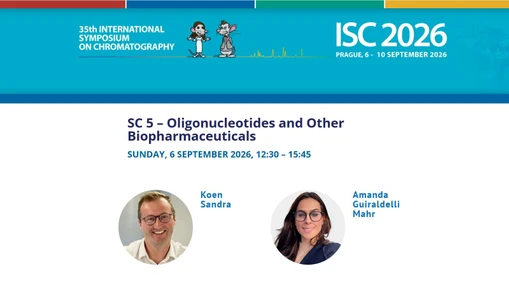
Amanda Guiraldelli Mahr
- Amanda Guiraldelli Mahr is a senior scientist at the RIC group in Belgium, specialized in chromatographic and LC-MS strategies for biopharmaceutical and small molecule analysis. With more than 17 years of experience in analytical development, she leads the design and qualification of procedures for release testing, stability studies, and structural characterization of monoclonal antibodies, peptides, and oligonucleotides, with strong expertise in SEC, IEX, RPLC, HILIC, HIC, and high-resolution MS workflows. She drives the implementation of ICH Q2(R2), Q14, and Analytical Quality by Design (AQbD) principles in collaboration with global biopharmaceutical partners. Amanda serves as a member of the United States Pharmacopeia (USP) Pharmaceutical Analytical Lifecycle and Data Science Expert Committee and is a board member of the ECA Analytical Quality Control Group. Before joining RIC, she spent more than 12 years at USP, where she worked both as a Senior Scientist – leading method development and validation projects, impurity analysis by LC-MS/GC-MS, and reference standards characterization by LC-HRMS – and as a Scientific Affairs Manager, contributing to major standards such as <1220> and <1225> and driving initiatives in AQbD, predictive modeling, and analytical procedure lifecycle management. She holds a bachelor’s degree in Pharmacy–Biochemistry and a Ph.D. in Analytical Chemistry, and has been a visiting scientist at TU Berlin and Leiden University, focusing on LC-HRMS-based protein analysis.
 ISC 2026: Amanda-Guiraldelli-Mahr