News from LabRulezGCMS Library - Week 12, 2026
LabRulez: News from LabRulezGCMS Library - Week 12, 2026
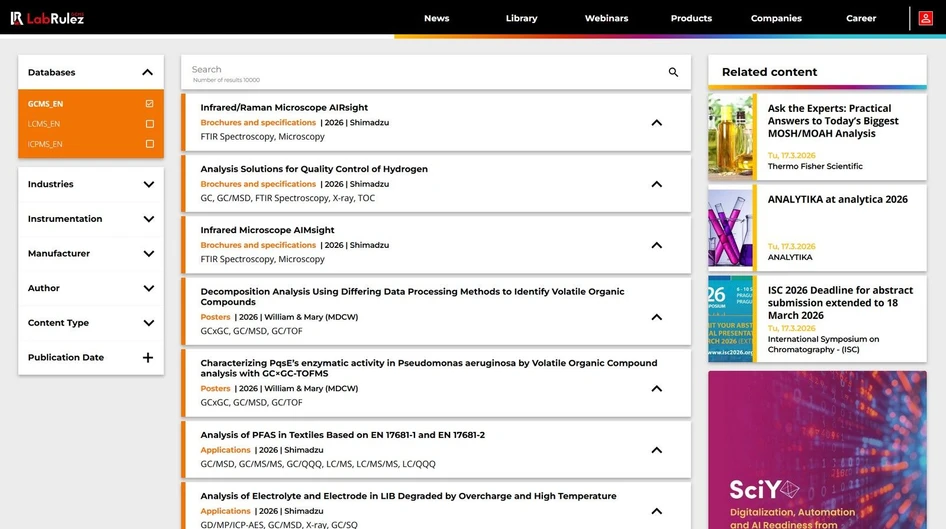
Our Library never stops expanding. What are the most recent contributions to LabRulezGCMS Library in the week of 16th March 2026? Check out new documents from the field of the gas phase, especially GC and GC/MS techniques!
👉 SEARCH THE LARGEST REPOSITORY OF DOCUMENTS ABOUT GCMS AND RELATED TECHNIQUES
👉 Need info about different analytical techniques? Peek into LabRulezLCMS or LabRulezICPMS libraries.
This week we bring you posters by Agilent Technologies / ASMS and MDCW / William & Mary, application note by Shimadzu and other document by Thermo Fisher Scientific!
1. Agilent Technologies / ASMS: Analysis of Extractables and Leachables in Catheters Using Accurate Mass Libraries and High-Resolution GC/MS and LC/MS
- Poster
- Full PDF for download
Materials used in the production of medical devices contain substances that have the potential to leach from the devices. Extractables and leachables (E&L) represent a range of structurally diverse compounds including antioxidants, UV absorbers, dyes, catalysts, plasticizers and polymer degradation products. Therefore, both liquid and gas chromatography techniques coupled with mass spectrometry detectors (LC/MS and GC/MS) are utilized to achieve a comprehensive chemical characterization. Application-specific accurate mass libraries combined with an efficient screening workflow, helps to increase confidence in compound identification that saves time on reviewing data while focused on E/L relevant compounds. In this study, we analyzed catheters extracts using high-resolution MS and performed data analysis using accurate mass libraries.
Experimental
Catheters from three suppliers were used in this study. Catheter A was made from PVC, and did not include DEHP, DINP, BPA or natural rubber latex. Catheter B was made with natural rubber latex base and silicone elastomer coating, and there was no claim to be phthalate or BPA free. Catheter C was a silicone-coated latex catheter made with natural rubber latex base and no DEHP or BPA. E&L standards were obtained from AChemTek. Catheters were extracted with ethanol:water 1:1 solvent at 37 ˚C for 24 and 48 hours as well as 7 days and analyzed using GC/Q-TOF and LC/Q-TOF systems. The GC/MS analysis was performed using the 8890 GC coupled to the 7250 Q-TOF and the new Agilent low bleed DB-5Q column.
Results and Discussion
Accurate Mass E&L Library for GC/Q-TOF
To create a new Agilent accurate mass E&L Personal Compound Database Library (PCDL) for GC/Q-TOF, over 400 spectra have been collected for E&L compounds. All accurate mass fragment ions in each spectrum have been annotated with formulas based on accurate mass information and isotope ratios (Figure 3). The fragment formula annotations were then verified and converted to the theoretical m/z.
Conclusions
- A combined workflow for the analysis of extractables and leachables by high-resolution GC/MS and LC/MS was developed using catheter extracts.
- Both GC/MS and LC/MS techniques were necessary to cover a comprehensive list of E&L compounds. Although several E&L compounds were detected by
both GC/MS and LC/MS, in most cases hydrocarbons, most plasticizers, and some antioxidants were more amenable to GC/MS.
2. MDCW / William & Mary: A sustainable approach to nontargeted analysis using hydrogen as a carrier gas for GC×GC
- Poster
- Full PDF for download
Comprehensive two-dimensional gas chromatography (GC×GC) is a separation technique used to separate complex mixtures based on two different retention mechanisms, usually polarity and volatility. A nontargeted approach is commonly used for a separation technique such as GC×GC. This type of approach means that instead of looking for one or two specific components and disregarding the rest of the sample, the whole sample can be viewed exhaustively. This approach is more applicable for forensic cases especially, where the identity or composition of the sample is unknown. It is also a more sustainable approach because only one run is needed to have the full characterization of a sample instead of needing to run a sample multiple times with a different target analyte each time.
EXPERIMENTAL
- LECO’s Pegasus BT4D instrument was used for this project.
RESULTS
AGREEprep Comparisons: The overall scores for the two methods were 0.44 and 0.52 for helium and hydrogen, respectively. This means that the hydrogen method is more sustainable than the helium method. The criteria breakdown in Figure 6 shows the 10 different criteria used to score the methods, including sample throughput, sample preparation steps, and sustainable material usage, namely carrier gas choice.
CONCLUSIONS
The Restek EZGZ Method Translator can be used to provide three possible hydrogen methods for any given helium method. After inputting the values of a helium method, the respective hydrogen values are given for three possible methods, each prioritizing something different: translate, efficiency, and speed. The translate method was chosen as the best choice.
The hydrogen method achieved a higher score on the AGREEprep metric, meaning that this method is more sustainable that the helium method. This better score is solely due to the carrier gas change – everything else in the methods stayed constant.
Hydrogen as a carrier gas allows for higher sample throughput and faster run times. It can also be a renewable resource, made through the electrolysis of water in a laboratory using a generator.
A nontargeted approach is inherently greener than a targeted approach because instead of re-running a sample multiple times to analyze a different component each time, the whole picture was captured from the beginning and can be looked at through a different lens to analyze a new component.
3. Shimadzu: Analysis of PFAS in Textiles Based on EN 17681-1 and EN 17681-2
- Application note
- Full PDF for download
User Benefits
- Combining LCMS and GCMS enables the determination of PFAS below threshold limits in textiles.
- Spike recovery test shows good percentage recoveries of all compounds (70–130 %) that are at or below the EU POPs threshold limit (25 ppb).
- LabSolutions software offers integrated control over GCMS and LCMS for more efficient testing and data analysis.
Per- and polyfluoroalkyl substances (PFAS) are used in a wide range of applications because of their useful properties, such as heat resistance and water repellency. However, PFAS are also extremely stable substances that resist degradation and accumulate in the environment, which has led to concerns about their effects on humans. Since eliminating sources of PFAS is essential to prevent them from accumulating in the environment and in living organisms, many countries are passing laws that restrict the production, distribution, and use of PFAS in products. For example, the EU POPs Regulation sets a permitted threshold of up to 0.025 mg/kg (25 ppb) for certain PFAS (including PFOA, PFOS, and PFHxS) in substances, mixtures, and products1).
EN 17681 is a European standard that describes methods for determining PFAS in textiles. The EN 17681 standard is divided into two parts according to the target compounds and methods. EN 17681-1 describes an LC/MS/MS method that targets ionic PFAS, and EN 17681-2 describes a GC/MS(/MS) method that targets certain semi-volatile and volatile neutral PFAS. A 2025 revision of EN 17681-1 changed the sample preparation method for more efficient PFAS extraction2),3).
This Application News describes the analysis of the target compounds shown in Table 1 based on the EN 17681-1 and EN 17681-2 standards, using both LC/MS/MS and GC/MS/MS.
EN 17681-1 (LC/MS/MS) Analysis Conditions
Analysis was performed using the LCMS-8050RX triple quadrupole mass spectrometer (Fig. 1, left). The analysis conditions used are shown in Table 3. Analyzing PFAS necessitates caution because PFAS can leach from the analytical system, the mobile phase or other sources. PFAS contamination from the system was minimized by attaching a delay column between the mixer and autosampler. The mobile phase was also prepared using PFAS grade reagents.
EN 17681-2 (GC/MS(/MS)) Analysis Conditions
Analysis was performed using a GCMS-TQ8050 NX triple quadrupole mass spectrometer (Fig. 1, right) that was equipped with a boosted efficiency ion source (BEIS). The BEIS optimizes the electron beam focus for maximum ionization efficiency, enabling reliable analysis of PFAS at very low levels. The analysis conditions used are shown in Table 4.
Results from Analysis of Ski Wear
Old ski clothing was used as a sample. The results obtained from analyzing this sample by the EN 17681-1 (LC/MS/MS) method are shown in Fig. 11. To investigate the effect of the EN 17681- 1:2025 update, analysis was performed using both the preupdate (EN 17681-1:2022) and post-update (EN 17681-1:2025) sample preparation methods. The alkaline hydrolysis treatment used by the EN 17681-1:2025 method dramatically increased the amounts of NMeFOSE, 6:2 FTOH, 8:2 FTOH, and 10:2 FTOH that were detected, and these compounds were detected at levels above the upper limit of their respective calibration curve ranges. This shows that PFAS extraction is improved by using the updated EN 17681-1:2025 sample preparation method. Of the 33 compounds targeted by the LC/MS/MS method, 20 were detected in the sample.
Analyzing the sample by GC/MS/MS using the EN 17681-2 method detected 8 out of the 12 compounds targeted by the EN 17681-2 method. Of these, 8:2 FTOH and 10:2 FTOH were detected at levels above the upper limit of their respective calibration curve ranges (Fig. 12).
Conclusion
The analysis of PFAS in textiles was performed according to EN 17681-1 and EN 17681-2 standards, utilizing the LCMS-8050RX and GCMS-TQ8050 NX systems. By combining LC/MS/MS analysis and GC/MS analysis, all target compounds were successfully measured at levels of 25 ppb or less. Spike recovery test at the EU POPs threshold limit (25 ppb) also demonstrated good percentage recovery (70–130 %) for all compounds. Results also showed that PFAS extraction was improved by using the EN 17681-1:2025 sample preparation method, which was updated in 2025.
4. Thermo Fisher Scientific: Fast on-line monitoring of flare gases
- Other document
- Full PDF for download
Measurement of flare gas streams by process mass spectrometry
Process mass spectrometry (MS) is particularly suited to the measurement of flare gas streams because it offers accurate, fast, multicomponent analysis. Table 1 shows an example of a flare gas stream containing hydrogen, nitrogen and hydrocarbons up to C6. Analysis of these eleven components will typically be performed in just 20 seconds, allowing one mass spectrometer to monitor more than one flare, depending on the distances involved. Alternatively, one MS can be used to measure process streams and flare streams, even though the composition and concentrations may be very different.
Advantages of magnetic sector MS
Thermo Fisher Scientific manufactures both quadrupole and magnetic sector mass spectrometers. Over thirty years of industrial experience have shown the magnetic sector based analyzer offers the best performance for industrial online gas analysis. Thermo Scientific™ Prima PRO process mass spectrometers (Figure 1) offer ideal capabilities for industrial gas analysis.
Key advantages of magnetic sector analyzers include improved precision, accuracy, long intervals between calibrations and resistance to contamination. Typically, analytical precision is between 2 and 10 times better than a quadrupole analyzer, depending on the gases analyzed and complexity of the mixture.
Neutral gas atoms and molecules are first converted into positively charged ions in the Prima PRO MS ion source. This is an enclosed type for high sensitivity, minimum background interference and maximum contamination resistance. It is a high-energy (1000 eV) analyzer that offers extremely rugged performance in the presence of gases and vapors that have the potential for contaminating the internal vacuum components. Prima PRO MS has a proven track record of monitoring high percent level concentrations of organic compounds without experiencing drift or contamination.
Ions are then accelerated through a flight tube, where they are separated by their mass to charge ratios in a magnetic field of variable strength. Since the magnetic sector mass spectrometer produces a focused ion beam at the detector, the peak shape obtained is ‘flat-topped’ and uniform response is observed over a finite mass width. As the height of the peak is directly proportional to the number of ions striking the detector it is also directly proportional to the concentration of the component being measured. As long as the measurement is taken anywhere on the peak’s flat top, high precision analysis will be observed.
The Prima PRO MS’ ability to measure over a wide dynamic range is critically important if the varying composition levels in flare gas are to be measured accurately. The Prima PRO MS has been independently evaluated by EffecTech UK, an independent specialist company providing accredited calibration and testing services to the energy and power industries for gas quality, flow and total energy metering. It is accredited to internationally recognized ISO/IEC 17025:2005 standards; this specifies the general requirements for the competence to carry out tests and/ or calibrations, including sampling.
Summary
Magnetic sector MS, as evidenced by the Prima PRO process MS performance, provides fast, accurate on-line analysis of flare gas composition. The inherent power of magnetic sector mass spectrometry, combined with the flexibility of GasWorks software, enables one Prima PRO MS to monitor not only flare gas streams, but also multiple process streams. Root cause fault analysis is therefore greatly facilitated, by comparing the detailed composition data from the flare gas stream with that of the various process streams. As well as complete compositional analysis, Prima PRO MS provides accurate fuel gas properties, including LHV, HHV, density, specific gravity, Wobbe Index, stoichiometric air requirement and CARI. This ensures waste gases are burnt to complete combustion and unburned pollutants are not emitted from the flare.