Thermal Dry Reforming of Bio-Oil Model Compounds
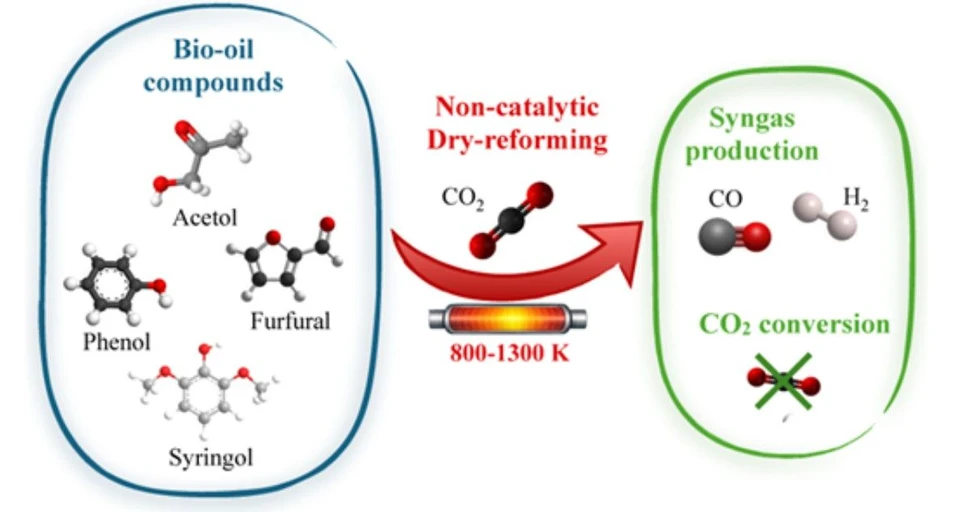
Energy Fuels (2026) 40 (26): 14024–14035.: Graphical abstract
This study examines the thermal dry reforming of representative bio-oil compounds and hydrocarbons in a tubular flow reactor over 800–1350 K. Online micro-GC, GC–MS, and Karl Fischer titration were used to characterize gaseous and liquid reaction products and evaluate the transition from thermal decomposition to dry reforming.
Dry reforming became dominant above approximately 1200–1300 K, depending on the feedstock, leading to high hydrogen yields and CO₂ conversion. The results demonstrate that feed composition strongly influences reforming behavior and provide valuable insights for optimizing hydrogen production and biomass-derived fuel conversion processes.
The original article
Thermal Dry Reforming of Bio-Oil Model Compounds
Maria Virginia Manna* ; Davide Amato; Giovanni Fabozzi; Giovanni Battista Ariemma; Pino Sabia; Raffaele Ragucci; Mara de Joannon
Energy Fuels (2026) 40 (26): 14024–14035.
https://doi.org/10.1021/acs.energyfuels.6c01305
licensed under CC-BY 4.0
Selected sections from the article follow. Formats and hyperlinks were adapted from the original.
The European and global tendency of recent years of moving toward renewable and sustainable energy sources has led to the consideration of alternative technologies. (1) Apart from the standard renewable energy sources such as wind and solar energy, biomasses are getting more attention, given also the many possible valorization routes that they can undergo. (2) A promising valorization treatment for biomass is pyrolysis, which can be considered carbon neutral under specific operational conditions and proper product utilization. (3) Lignocellulosic biomass pyrolysis is a thermochemical process that converts the organic material of the biomass under an inert atmosphere, producing a solid carbonaceous product (biochar or char), a condensable fraction (bio-oil), and a gaseous phase (made principally by CO2, CO, H2, and CH4). Pyrolysis products have many possible utilizations, with bio-oil and gas being targeted recently for clean hydrogen and syngas production. (4−7) In particular, if biomass pyrolysis is coupled with bio-oil dry reforming, it is possible to produce hydrogen while consuming CO2, moving the whole valorization chain from carbon neutral to carbon negative. (8, 9)
Pyrolysis bio-oil is a complex mixture (15, 16) of oxygenated compounds characterized by different chemical functionalities (e.g., ketones, aldehydes, carboxylic acids), aromatic compounds (e.g., monomers and oligomers of phenolic compounds, PAHs, and furans), water, and low concentrations of hydrocarbons. Given its nature, information about hydrocarbon reforming is not easily transferred to bio-oil. Moreover, pyrolysis bio-oil dry reforming is still a developing topic, thus, the available scientific literature is scarce. Applications of catalytic steam reforming, (17) catalytic partial oxidation (POX) combined with steam reforming, (18) and combined catalytic steam/dry reforming (19, 20) have been tested. The use of catalysts for reforming is common since it allows for better product yields while also lowering the operating temperature. Many types of metal-based catalysts have been considered, such as Ni/Al2O3 and Ni/La2O3 catalysts, (9) Pt, Pd, Rh supported on alumina and ceria/zirconia catalysts, (21) and biochar-supported catalysts such as Ni-biochar. (4) However, the use of catalysts poses two main issues: on one hand, metal-based catalysts often require critical raw materials, which are subject to recent European and global regulatory policies. (22) On the other hand, catalytic processes suffer from catalyst deactivation due to phenomena such as sintering and coke formation and deposition. (23) Catalyst deactivation is particularly relevant when bio-oils or heavy hydrocarbon mixtures are considered as feedstocks due to their higher tendency to form coke. (24) In this regard, noncatalytic reforming is an appealing solution for the valorization of pyrolysis bio-oil providing new pathways to improve the yield of valuable gases and mitigate the environmental impact of CO2 emissions while avoiding the depletion of critical raw materials. This is advantageous especially when advanced combustion processes, such as MILD combustion, (25) can be coupled with thermal dry-reforming to sustain it with low-calorific-value fuels. For example, this is the case where pyrolysis and dry reforming belong to the same process pipeline. (26)
Fundamental studies are required to identify the operating conditions ensuring significant feed conversion into syngas and a relevant degree of CO2 capture. Given the complexity of bio-oil, it is necessary to develop a methodical study using surrogate compounds to gain insight into the reaction mechanism and the optimal operating conditions for noncatalytic dry reforming. The use of bio-oil model compounds is a consolidated practice, and several representative compounds have been tested in catalytic reforming processes either in blends (27, 28) or as pure compounds. (29−32)
In the present work, four compounds commonly found in bio-oil derived from the pyrolysis of lignocellulosic biomass have been chosen as model compounds, namely, acetol (C3H6O2), (33) furfural (C5H4O2), (15) phenol (C6H6O), (34) and syringol (C8H10O3). (35) These compounds are the simplest representatives of bio-oil compound classes: ketones, furans, phenols, and syringols, respectively. Pure model compounds and mixtures of them were used as feeds for dry reforming experiments, exploring the effect of temperature on the system evolution in the range 800–1300 K. Methane (CH4) and propane (C3H8) were also considered as benchmark model hydrocarbons and were analyzed under the same operational conditions.
2. Methodology
The exhaust gases are fed to a condenser and cooled to 283 K. The condensed liquid phase is then collected and characterized offline, while the dry gases are analyzed by online microgas chromatography (Agilent 990 Micro GC). The gas analysis system was calibrated by using specific gas mixtures containing known concentrations of H2, O2, N2, CO, CH4, CO2, and C2.
The experiments were repeated twice for each feed, and the estimated experimental error varies between 10%–15% of the reported concentrations.
For each test, the collected liquid was analyzed following the methodology used for bio-oil characterization in previous studies. (36) Briefly, the condensed liquid phases were analyzed for water concentration by carrying out Karl Fischer (KF) titration using a Metrohm Omnis KF Titrator. The condensed liquid samples were also analyzed with an Agilent 7890A gas chromatography system (GC) coupled with a mass spectrometer (MS) 5975C-VLMSD (GC–MS). The detailed description of the analysis method is reported in previous work. (36) Compound identification is carried out by matching the obtained spectra with the National Institute of Standards and Technology (NIST) library. The results are reported in terms of the area percentage of the identified compounds with respect to the total area of revealed compounds. The compounds with a quality match of less than 80 were not considered in the characterization, but they were still included in the total area calculation.
3. Experimental Results
3.1. Acetol and Acetol/Phenol Mixture
For acetol (Figure 1), the concentrations of H2 and CO increase monotonically for temperatures above 850 K. In particular, the slope of the CO concentration profile becomes steeper for temperatures higher than 1250 K. Methane is also formed over the investigated temperature range and shows a nonmonotonic behavior, with a maximum around 1050 K. Other hydrocarbons, such as C2H2 and C2H4, are also detected, although at relatively low concentrations (reported in the Supporting Information). Regarding CO2, its concentration slightly decreases in the temperature range of 850–1200 K. This behavior can be mainly attributed to changes in the total number of moles and the condensation of water and any heavier compounds. For temperatures above 1200 K, the CO2 concentration decreases sharply, reaching complete consumption at 1350 K. The observed trends suggest that at temperatures below 1200 K, acetol decomposition is the dominant process, leading to the formation of CO, H2, CH4, and CxHy species, while CO2 remains largely unaffected. The dry reforming process becomes significant above 1200 K, as indicated by the rapid CO2 consumption, the increased slope of the CO and H2 concentration profiles, and the decrease in CH4 and other hydrocarbon concentrations.
 Energy Fuels (2026) 40 (26): 14024–14035: Figure 1. CO, H2, CO2, and CH4 concentrations for acetol and acetol/phenol mixture as a function of the temperature. Experimental error 10–15%.
The acetol-phenol mixture exhibits a similar overall behavior, although with different concentrations of H2, CO, and CH4 due to the different elemental compositions and stoichiometries of the fuel mixture. In this case, the onset of the dry reforming process is even more pronounced, as evidenced by the increased slopes of both the CO and H2 concentration profiles. At complete CO2 conversion, a higher production of H2 and CO is observed. The comparison between acetol and the acetol-phenol mixture indicates that the presence of phenol does not influence the onset temperature of the dry reforming process significantly.
The composition of the liquids condensed during acetol reforming does not change drastically, as reported in Figure 2A. A more complete characterization is reported in Table S1 of the Supporting Information. As the reaction temperature increases, the amount of unreacted acetol slightly decreases from 92.3% to 87.2% of the total chromatogram area. At low temperature (823–923 K), the other identified compound is 4-hydroxy-4-methyl-2-pentanone, accounting for 2.4% of the total area. At temperatures in the range 923–1073 K, acetoin is also present in the condensed liquids, and 4-hydroxy-4-methyl-2-pentanone area decreases to 1.1%. Both these compounds retain the same chemical functionality as acetol (═O and –OH groups) while increasing the length of the hydrocarbon base chain, passing from 3 carbon atoms for acetol to 4 and 6 for acetoin and 4-hydroxy-4-methyl-2-pentanone, respectively. At temperatures above 1073 K, the presence of acetoin increases reaching roughly 4%. Neither acetoin nor 4-hydroxy-4-methyl-2-pentanone is reported to be produced by the direct reaction of acetol. (39) However, Wang et al. (40) postulated a formation mechanism for acetoin that starts from acetol decomposition intermediates. It is likely that 4-hydroxy-4-methyl-2-pentanone is formed through an analogous mechanism.
 Energy Fuels (2026) 40 (26): 14024–14035: Figure 2. GC–MS analysis of the liquid products collected during the reforming of acetol (a) and acetol-phenol mixture (b).
Analysis of the condensed liquid through filtration revealed no solid particles at any investigated temperatures.
The water content (Table S1) of the collected liquids increases with the temperature from 5.3 to 11.9 wt %. Water formation during dry reforming of acetol could be attributed to the cleavage of the hydroxy group during thermal decomposition, which is a more favored reaction than RWGS for water formation, in particular at lower temperatures. No significant amount of liquid was collected above 1200 K.
The addition of phenol to acetol increases the complexity of the collected liquids (Figure 2b), whose detailed composition is reported in Table S1. In the temperature range 823–923 K, the main compounds are the unreacted reagents (acetol and phenol accounting for 54.8% and 37.8% of the total area, respectively) together with small amounts of the same products identified for pure acetol dry reforming (4-hydroxy-4-methyl-2-pentanone and acetoin). The presence of phenol anticipates the appearance of acetoin, which is detected at higher temperatures in the case of a pure acetol. Moreover, traces of aromatics (benzene and pyrene, directly derived from phenol pyrolysis (41)) and phenol-derived esters (acetic acid phenyl ester) are found. As the reaction temperature increases, the amount of unreacted acetol decreases, reaching 9.0% at 923–1073 K and 4.1% over 1073 K. In contrast, the relative abundance of unreacted phenol greatly increases, reaching 88.4% of the total chromatogram area at temperatures higher than 1073 K. This indicates that as the reforming temperature increases, the amount of unreacted phenol greatly exceeds the amount of unreacted acetol. While no quantitative evaluation of the unreacted reagents was possible, the low amount of collected liquid at high temperatures suggests that both phenol and acetol are mostly converted into other products. Small quantities of species derived from phenol decomposition are detected as reforming temperature increases. Between 923 and 1073 K, substituted phenols such as p-cresol and 2-methyl-phenol are identified. A further increase in the reaction temperature causes an increase in their relative abundance, and other polycyclic aromatic hydrocarbons are also formed (e.g., naphthalene). Differently from what was observed for pure acetol, the percentage of both acetoin and 4-hydroxy-4-methyl-2-pentanone decreases as reforming temperature increases. The water concentration of the collected liquids (Table S1) follows the same increasing trend with temperature observed for pure acetol with slightly lower values, ranging from 4.9 to 10.0 wt %. The decrease in the water concentration with respect to pure acetol is due to the lower overall reactivity of the added phenol. Also in this case, the condensed phase collected at the reactor outlet is negligible for T > 1200 K.
4. Conclusions
The dry reforming of bio-oils represents a promising strategy for carbon capture and valuable gas production with the potential to contribute to CO2 emission reduction. In this study, for the first time, this potential was investigated through experimental tests conducted on representative bio-oil components, selected based on a comprehensive literature review, in order to examine the behavior of the feedstock/CO2 system in terms of hydrogen yield, CO production, and the degree of CO2 conversion. In particular, acetol, phenol, furfural, and syringol and their mixtures were selected, and hydrocarbons like propane and methane were also considered as benchmarks. The behavior of the stoichiometric compound/CO2 mixtures was tested as a function of the temperature from 800 K up to 1350 K. The results show that the process evolved through two stages. At low temperature, the feed is mainly converted by thermal decomposition, forming H2, CO, CH4, small hydrocarbons (C2H2, C2H4), and heavier species, collected in the condensed phase. At higher temperatures, dry reforming is activated, as suggested by the sharp decrease of the CO2 concentration and reduction of CH4 and C2Hx species, while H2 and CO show a more pronounced increase.
The thermal dry reforming is activated at above 1300 K for methane, while the identified bio-oil components and propane were shown to be effectively converted into syngas via the dry reforming process at lower temperatures, in particular above 1200 K. This activation temperature remains essentially unchanged when considering pure compounds or mixtures of different compounds, while some variations are observed in the hydrogen yield, maximum CO2 conversion, and H2/CO ratio.
CO2 conversion of more than 50% was achieved, with values up to 100% for acetol and acetol/phenol mixture and for propane. Acetol and acetol/phenol mixtures also exhibit the highest hydrogen yields, approaching 100% at the highest temperatures, while furfural shows a lower reactivity. The addition of syringol to furfural enhances hydrogen production, particularly at elevated temperatures. However, it leads to a decrease in CO2 conversion, suggesting that the syringol decomposition pathways may partially compete with the activation of the dry reforming reaction. The evaluation of the experimental H2/CO confirms that, in the case of acetol-based and furfural systems, the high-temperature chemistry is controlled by the dry reforming reaction since the H2/CO is close to the ratio to the theoretical stoichiometric value (based on the dry reforming reactions). Conversely, for the furfural-syringol mixture, at high temperature, H2/CO is higher than the theoretical stoichiometric value.
Overall, the results demonstrate that bio-oil model compounds can be effectively converted into syngas via noncatalytic dry reforming at lower activation temperatures than methane, with CO2 conversion levels and hydrogen yields that are dependent on the molecular structure of the feed. Complete CO2 conversion and hydrogen yields approaching 100% were achieved for acetol-based feeds, while furfural-based systems showed lower but still significant performance, limited by the lower reactivity of the aromatic ring.
The influence of operating conditions such as residence time, the mixture composition, and the feed/CO2 ratio deserves further attention.