GCMS
More information
WebinarsAbout usContact usTerms of use
LabRulez s.r.o. All rights reserved. Content available under a CC BY-SA 4.0 Attribution-ShareAlike
Manufacturer
Other
Other
Various authors of applications, presentations, posters, products, offer bazaar, etc...

Distributor
Thermo Fisher Scientific (EMEA)
Thermo Fisher Scientific Inc. is the world leader in serving science, with annual revenue of approximately $40 billion. Our Mission is to enable our customers to make the world healthier, cleaner and safer.
VUV Analytics VUV Detector for TRACE 1600 Series GCThermo Scientific VGA-100 and LUMA VUV detectors for TRACE 1600 GC deliver accurate hydrocarbon speciation, impurity detection, and trace-level analysis with speed and reliability.
Features

VUV Analytics VUV Detector for TRACE 1600 Series GC

Precision, clarity, and confidence from VUV spectroscopy in GC

VUV detectors paired with the Thermo Scientific TRACE 1600 Series GC conquer the challenge of complex mixtures, co-eluting compounds, and isomer differentiation for accurate hydrocarbon speciation, impurity detection, and trace-level detection.

Gas Chromatography (GC) is evolving, and VUV (Vacuum Ultraviolet) technology is at the forefront of this transformation. Now available on the TRACE 1600 Series GC, VUV spectroscopy, through VUV Analytics VGA-100 detector and the LUMA detector, provides accuracy in hydrocarbon speciation, impurity detection, and trace-level analysis.

Greater accuracy, automation, and confidence in your GC analysis

Traditional GC detectors struggle with complex mixtures, co-eluting compounds, and isomer differentiation. VUV spectroscopy overcomes these limitations by using absorption-based detection, capturing unique molecular fingerprints for each compound.

How VUV technology works

VUV detection provides qualitative and quantitative spectral information for most gas phase compounds. 

Broad-spectrum absorption: VUV detectors measure how molecules absorb light in the vacuum ultraviolet range (120–240 nm), revealing unique spectral signatures.

Automated compound ID: To reduce errors and improve analysis speed, VUV software automatically deconvolutes overlapping peaks. unlike traditional GC detectors.

Quantitative and qualitative insights: VUV enables compound identification and quantification in a single run by analyzing complete spectral data.

Principle of operations

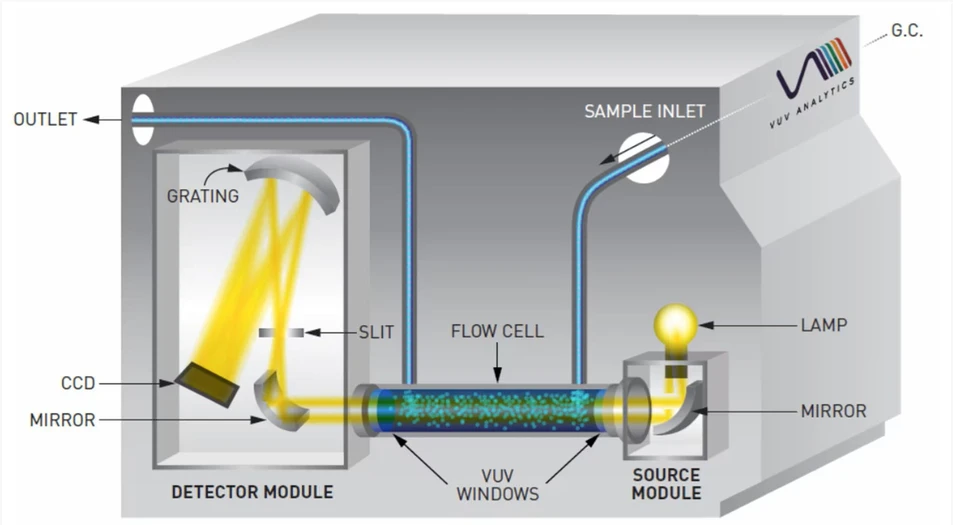
  1. Sample injection in the GC: A sample is injected into the GC system and separated into its components as it travels through the GC column.
  2. Elution from the analytical column: The separated components elute from the GC column and enter the VUV detector.
  3. VUV light source: A deuterium lamp as VUV light source emits light in the vacuum ultraviolet range (typically 120-200 nm).
  4. Flow cell: The eluted components pass through a flow cell where they are exposed to the VUV light.
  5. Analytes absorption of VUV light: As components pass through the flow cell, they absorb VUV light at specific wavelengths. Each compound has a unique absorption spectrum in the VUV range.
  6. Analytes detection: Photodiode array detector measures the intensity of the transmitted VUV light. The decrease in light intensity corresponds to the absorption by the analytes.
  7. Data processing: Detector sends the signal to a data processing system, which converts the absorption data into a chromatogram.

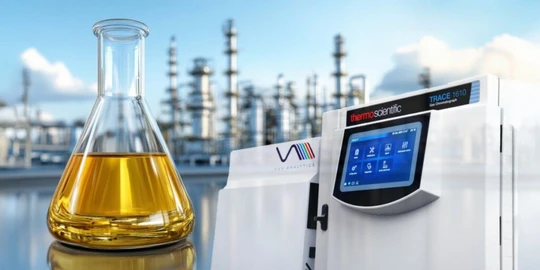
Thermo Scientific  VUV Detector for TRACE 1600 Series GC.Thermo Scientific VUV Detector for TRACE 1600 Series GC.

VUV for petrochemical and refining

  • PIONA analysis: Accurately classify paraffins, isomers, olefins, naphthenes, and aromatics with automated deconvolution for fast, confident hydrocarbon speciation and group type analysis in complex fuels.
  • Fuel quality control (ASTM D8071): Ensure compliant, efficient fuel characterization using VUV’s spectral fingerprints, delivering fast, automated analysis for gasoline and other fuel blends.
  • Sulfur & nitrogen speciation: Detect and speciate sulfur and nitrogen compounds at trace levels in fuels, ensuring regulatory compliance and protecting product quality.

VUV for pharmaceutical and chemicals

  • Residual solvent analysis: Faster, more sensitive detection of residual solvents, ensuring compliance with USP <467> and reducing reanalysis with precise, automated detection.
  • Impurity profiling in APIs: VUV absorbance provides greater selectivity and lower detection limits than traditional GC detectors, ensuring reliable impurity profiling in even the most complex APIs.
  • Trace-level contamination detection: Identify unknown contaminants at low levels in pharmaceuticals, chemicals, and environmental samples with enhanced selectivity and sensitivity.

Benefits of upgrading to GC-VUV

Hydrocarbon speciation

  • Distinguish paraffins, olefins, naphthenes, and aromatics (PONA) effortlessly
  • Eliminate misidentification errors common with FID and MS
  • Automate peak integration and classification

Trace impurity detection

  • Detect sulfur, nitrogen, and oxygen compounds at trace levels
  • Ensure compliance with regulatory standards in fuels and pharmaceuticals
  • Identify unknown contaminants in a single run

Analysis and workload

  • Decrease complex calibration standards requirement
  • Automated spectral deconvolution = less manual processing
  • Improved lab efficiency and throughput

Which detector is right for you?

VGA-100 and LUMA detectors integrate seamlessly with the TRACE 1600 Series GC, offering plug-and-play installation, intuitive software, and superior analytical performance.

Thermo Scientific  VUV Detector for TRACE 1600 Series GC.Thermo Scientific VUV Detector for TRACE 1600 Series GC.

  • VGA-100 detector
  • LUMA detector
Manufacturer
Other
Other
Various authors of applications, presentations, posters, products, offer bazaar, etc...
Distributor
Thermo Fisher Scientific (EMEA)
Thermo Fisher Scientific Inc. is the world leader in serving science, with annual revenue of approximately $40 billion. Our Mission is to enable our customers to make the world healthier, cleaner and safer.
Other projects
LCMS
ICPMS
Follow us
More information
WebinarsAbout usContact usTerms of use
LabRulez s.r.o. All rights reserved. Content available under a CC BY-SA 4.0 Attribution-ShareAlike