Setting Target Measurement Uncertainty
Eurachem: Setting Target Measurement Uncertainty
Measurement results are only fit for purpose if the measurement uncertainty (MU) is reliable and has a magnitude small enough for the intended use. The target MU is the maximum admissible uncertainty defined for a specific measurement goal.
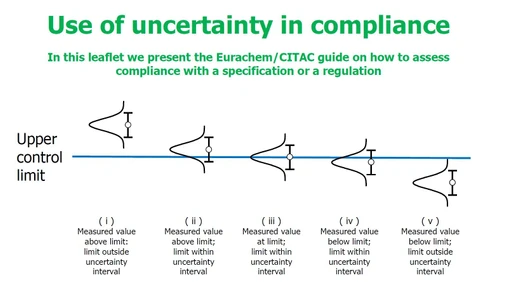
In compliance assessment, the MU should be small enough to enable identification of deviations from compliance relevant to the interests to be protected (such as public health or industrial productivity). Too large an uncertainty would not provide the required protection, while an uncertainty that is too small could mean the use of unnecessary expensive measurements.
The Eurachem/CITAC guide on ‘Setting and Using Target Uncertainty in Chemical Measurement’ suggests how to set upper boundaries for the uncertainty based on the intended use of the result [1].
The impact of the MU on decisions is illustrated in a fictional scenario.
 Eurachem: Setting Target Measurement Uncertainty
Mr. Reis is a farmer planning to sell oranges to a juice producer. The juice producer checks oranges for thiabendazole pesticide residues and Brix level (degrees Brix provides a measure of orange juice sweetness). The producer only accepts oranges with thiabendazole residues below 1 mg kg-1 and a Brix level above 55 °Bx, paying more if the Brix level is above 65 °Bx.
Mr. Reis contracted Laboratory C to analyse his oranges before shipping them to the producer knowing that the customer also checks the oranges in its laboratory. Mr. Reis was very happy with the results provided by Laboratory C although the pesticide residue analyses were expensive.
The producer accepted the oranges but decided to pay less than expected.
After asking the juice producer, the detailed results of both laboratories were compared. This showed that although the results were metrologically compatible they supported different decisions on the oranges’ price.
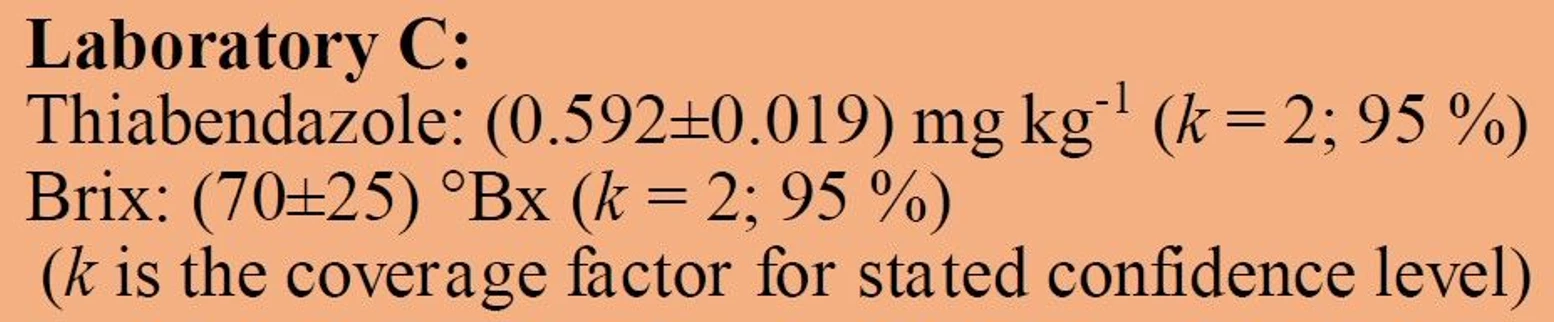 Eurachem: Setting Target Measurement Uncertainty - Laboratory C
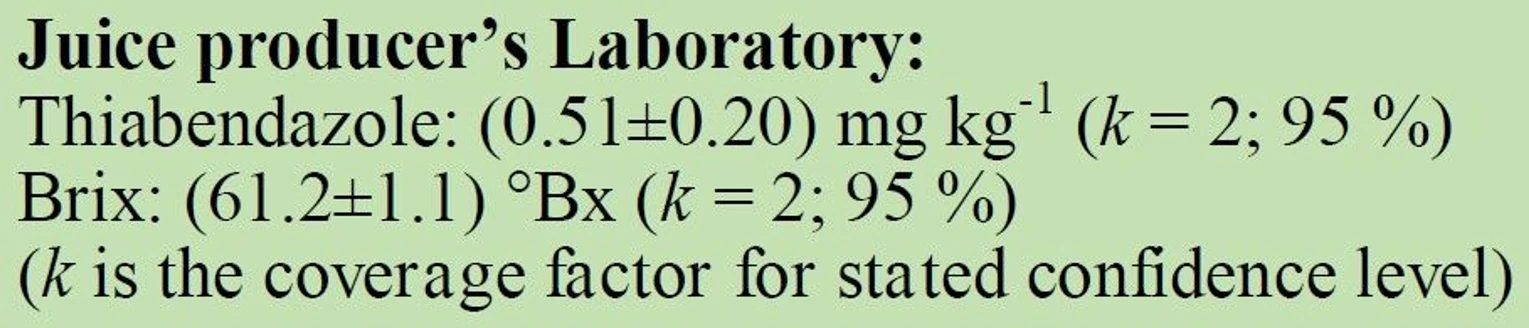 Eurachem: Setting Target Measurement Uncertainty - Juice producers Laboratory
The measurement of thiabendazole residues performed by Laboratory C is associated with an extremely low uncertainty making measurements more expensive than necessary. However, the uncertainty associated with the determination of the Brix level is too large, making compliance decisions too uncertain.
Measurement results are only fit for the intended use if the measurement uncertainty (MU) is smaller than a maximum acceptable value (i.e. the target MU).
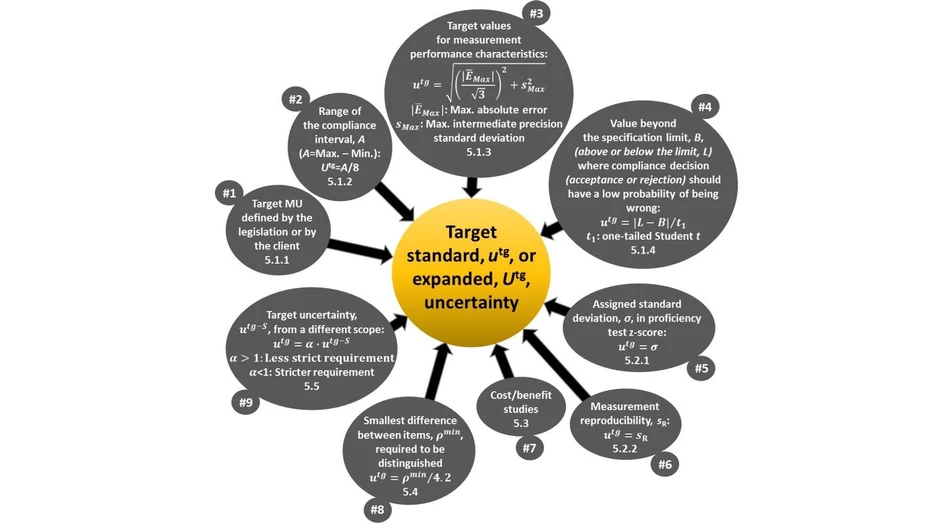
Even if the customer or the regulator does not define the target MU, the laboratory should define it to decide if the measurement is fit for the intended use. The Eurachem/CITAC guide [1] suggests the use of different indicators of the measurement quality requirement to define the target MU. Information used to define the target MU is presented from the most likely to become harmonised to the ones supported with less adequate data. The following figure presents this hierarchy of adequacy with numbers from #1 to #9.
Eurachem: Setting Target Measurement Uncertainty
Approaches to defining the target MU described in the Eurachem/CITAC Guide, where utg and Utg represent the target standard and expanded uncertainties, respectively. (the numbers in the bottom of the circles identify the sections of the Guide)
[1] R. Bettencourt da Silva, A. Williams (Eds.) Eurachem/CITAC Guide: Setting and Using Target Uncertainty in Chemical Measurement, (2015). ISBN 978-989-98723-7-0.