Important information to our customers concerning the quality of measurements

Eurachem: Important information to our customers concerning the quality of measurements
Do you use results of chemical analyses as a basis for your decisions and judgements?
Those of us working in accredited laboratories or dealing with issues concerning the quality of measurements, would like to inform you about some important changes concerning the way the results of measurements are presented. These changes make it easier for you as an end-user to make correct decisions.
Nobody is perfect!
Results of analyses cannot be perfect! We hope this does not come as a big surprise to you. We use the term measurement uncertainty to describe this lack of perfection.
The analytical process
In each step of the analytical work, from sampling to the final measurement, deviations from the true value occur and measurement conditions vary. We take measures and perform controls regularly to assure that these deviations and variations together are small enough to make sure the end result fulfils your requirements. When we don’t have full information about all of the steps, e.g. when sampling and initial sample preparation are performed by you as a customer, you can assist us by providing detailed information about how that work was performed. Our experts are ready to advise on all matters regarding sampling. Please contact the laboratory beforehand.
 Eurachem: The analytical process
Results should be fit-for-the-purpose
The accuracy of the results must of course not be too low nor too high since this would increase the costs. It should be fit for the intended purpose. If you are unsure on what level of accuracy you need, do not hesitate to contact the laboratory.
Uncertainty and limiting values
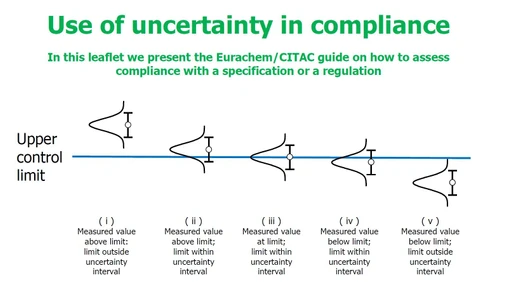
Many analyses are made to assure that limiting values are not exceeded. Without information about the measurement uncertainty it may appear to be very easy to make decisions, but these decision may be incorrect, with, e.g. economical consequences when rejecting instead of accepting a product, judicial consequences when returning a verdict of guilty instead of not guilty, or medical consequences when carrying out an unnecessary treatment. There are numerous examples!
 Eurachem: Uncertainty and limiting values
With a realistic measurement uncertainty the information included in the result becomes much more useful.
It will be easier to compare results
Most laboratories have until now chosen not to state measurement uncertainty in the test report. Instead, such information has only been given when the customer has asked for it
In the future, information about the measurement uncertainty will appear more frequently in the test report. It is also possible that you will bump into new and unfamiliar quality terms. This is due to the fact that there are new international guides and standards describing a common and partly new terminology. One of the objectives is to make it easier for you as a customer to compare test results.
What could it look like?
When reporting the test result we will give the normal information about what we have measured. When the results are followed by uncertainty statements, they are presented as intervals within which the true values are expected to lie with a certain level of confidence (usually 95%). In the example below the lead content is 1.65 ± 0.15 mmol·kg-1, that is between 1.50 and 1.80. The measurement uncertainty is also often reported relatively, in %.
- Total lead content (Pb): 1.65 mmol·kg-1
- Measurement uncertainty: 0.15 mmol·kg-1 (9.1%)
The stated uncertainty is an expanded measurement uncertainty (U). It was obtained by multiplying the combined standard uncertainty uc with a coverage factor k equal to 2. This corresponds approximately to a 95 % confidence interval.
All’s well that ends well...
The requirements for a consistent way of reporting test results are increasing. Therefore, those of us involved in measurements are eager to assure ourselves that we understand your needs. You will notice this in your contacts with us before, during and after the test assignment. We hope that you will be satisfied with the final result.
 Eurachem: All’s well that ends well...