How Mass Spectrometry Actually Works: The Quadrupole Explained
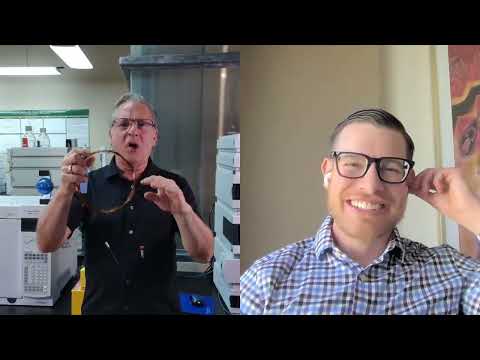
- Photo: Concentrating on Chromatography: How Mass Spectrometry Actually Works: The Quadrupole Explained
- Video: Concentrating on Chromatography: How Mass Spectrometry Actually Works: The Quadrupole Explained
In this episode of Concentrating on Chromatography, we sit down with Dr. Lee Polite from Axion Training Institute to break down one of analytical chemistry's most powerful yet misunderstood techniques: gas chromatography-mass spectrometry (GC/MS).
What You'll Learn:
- Why GC and MS are the "perfect pair" – and what happens when you try to use MS alone
- The electron gun: how molecules get ionized and why they become positively charged (not negatively!)
- The magnetic sector vs. quadrupole: from first principles to modern mass filtering
- Why Dr. Lee uses the "corkscrew trajectory" analogy – and why it actually works
- The cars and boats analogy: how fragmentation creates a unique molecular fingerprint
- Scan mode vs. SIM (Selected Ion Monitoring): when to use each for identification vs. sensitivity
- Real-world forensics: detecting pesticides in spinach and cocaine in hair follicles
- Triple quad GC/MS and Multiple Reaction Monitoring (MRM): the future of trace analysis
Why This Matters:
Over 2 million chromatographs operate worldwide, yet most users don't truly understand how they work. Dr. Polite has trained more than 14,000 professional scientists at Axion Labs to move beyond "pushing buttons" to genuinely comprehending the science. This conversation is designed for undergraduate students, academic researchers, and anyone preparing for analytical chemistry roles in pharma, environmental testing, or forensics.
🎤 Dr. Lee Polite is a leading authority in analytical chromatography education and founder of Axion Training Institute, a real working laboratory where scientists come for hands-on GC and LC training. With nearly 30 years of experience and a PhD under Harold McNair (one of the grandfathers of modern chromatography), Dr. Polite is passionate about making complex instrumentation accessible to students and professionals alike.
Video Transcription
Mass spectrometry has a reputation for being one of the most intimidating analytical techniques. According to Dr. Lee Polite, however, that reputation is undeserved. During a recent interview, the founder of Axion Analytical Labs shared how decades of teaching scientists—from undergraduate students to forensic chemists and even lawyers—have convinced him that virtually anyone can understand GC/MS when the concepts are explained correctly.
His approach relies less on equations and more on analogies, transforming complex physical principles into familiar everyday experiences.
The biggest misconception about mass spectrometry
"The first obstacle isn't the science—it's the belief that you'll never understand it."
That is the misconception Dr. Polite encounters most often. Students frequently enter chromatography or mass spectrometry courses assuming the subject is too complex for them.
His advice is simple: suspend that disbelief.
Rather than viewing GC/MS as one enormous complicated system, he encourages learners to see it as a collection of simple processes connected together. Once each individual step becomes clear, the entire instrument suddenly makes sense.
Teaching more than 14,000 scientists
Dr. Polite founded Axion Analytical Labs nearly three decades ago. Although it operates as a fully functional chromatography laboratory, its primary mission is education.
Scientists spend five days in the laboratory learning chromatography hands-on—disassembling instruments, rebuilding them, troubleshooting problems, and developing a practical understanding of how the technology works.
Over the years, Axion has trained more than 14,000 scientists, along with hundreds of attorneys who need to understand analytical chemistry for courtroom testimony. Dr. Polite believes curiosity matters far more than formal education.
Why every GC needs a mass spectrometer—and every mass spectrometer needs a GC
One of the interview's clearest explanations addresses a question many beginners ask:
Why do we combine gas chromatography with mass spectrometry?
The answer lies in the strengths and weaknesses of each technique.
Mass spectrometers excel at identifying pure compounds, but they struggle with complex mixtures. Real-world samples—environmental extracts, food, pharmaceuticals, forensic evidence—are almost always mixtures.
Gas chromatography solves this problem by separating the mixture into individual components before they reach the mass spectrometer.
As Dr. Polite summarizes:
GC provides the separation power. Mass spectrometry provides the identification power.
Without chromatographic separation, overlapping compounds generate confusing spectra that are difficult—or impossible—to interpret correctly.
Explaining chromatography with a shopping mall
Perhaps Dr. Polite's most famous teaching analogy compares chromatography to walking through a shopping mall.
Imagine two people standing on a moving walkway. One walks straight through the mall, while the other repeatedly leaves the walkway to browse clothing stores, shoe stores, and accessory shops.
Although both entered together, they exit at different times.
Chromatographic separation works in exactly the same way. Every compound enters the column simultaneously, but molecules interact differently with the stationary phase. Those with stronger interactions spend more time "shopping" and therefore elute later.
The analogy immediately illustrates retention time without requiring advanced chemistry.
How can a mass spectrometer "weigh" molecules?
Another concept that often confuses students is molecular weight determination.
Since molecules are far too small to weigh directly, mass spectrometers first convert neutral molecules into ions using electron impact ionization.
Once charged, the ions can be manipulated by electric or magnetic fields.
Dr. Polite introduces the concept by first describing the historical magnetic sector instrument before moving to the quadrupole mass filter used in most modern GC/MS systems.
His explanation replaces intimidating mathematics with a simple idea: only ions having the correct mass-to-charge ratio can successfully travel through the quadrupole and reach the detector.
Fragmentation: the molecular fingerprint
Simply measuring molecular weight rarely identifies a compound uniquely.
The real power of GC/MS comes from fragmentation.
High-energy electrons break molecules into characteristic fragments that create a unique mass spectrum—a molecular fingerprint.
To explain this process, Dr. Polite asks readers to imagine a car packed with explosives. After the explosion, investigators identify the vehicle by examining scattered components such as wheels, doors, and the steering wheel.
Mass spectrometry works the same way.
Each fragment contributes evidence that allows software libraries, such as NIST, to determine compound identity with remarkable confidence.
Scan mode versus SIM mode
The interview also explores the practical difference between scan acquisition and Selected Ion Monitoring (SIM).
Scan mode records a complete mass spectrum and is ideal for identifying unknown compounds.
SIM, on the other hand, focuses only on a few selected ions, dramatically increasing sensitivity.
Using pesticide analysis as an example, Dr. Polite demonstrates how compounds that are almost invisible in full-scan chromatograms become obvious when monitored using SIM.
Why triple quadrupoles dominate trace analysis
For laboratories measuring contaminants at parts-per-trillion concentrations, triple quadrupole instruments provide another major advantage.
Instead of monitoring only a single ion, tandem MS follows a specific fragmentation pathway—known as a transition—greatly reducing background interference.
This Multiple Reaction Monitoring (MRM) approach enables highly selective quantification of pesticides, PFAS, pharmaceutical residues, and numerous other trace contaminants in extremely complex samples.
The chromatography lesson many users forget
One message appears repeatedly throughout the interview:
Most GC/MS problems are actually chromatography problems.
Poor separations inevitably produce poor mass spectra.
Dr. Polite argues that successful mass spectrometry begins with understanding chromatography fundamentals rather than relying on sophisticated detectors to compensate for inadequate separations.
Looking ahead
When asked about the future of mass spectrometry, Dr. Polite predicts continued improvements in sensitivity, smarter software, and increasing use of artificial intelligence.
AI could assist laboratories by automatically recognizing problematic chromatographic peaks, identifying developing instrument issues, and simplifying interpretation of increasingly complex datasets.
Yet despite these technological advances, he believes the fundamentals remain unchanged.
Scientists who understand chromatography, ionization, fragmentation, and data analysis will continue to benefit regardless of how instrumentation evolves.
Final thoughts
After teaching analytical chemistry for more than 30 years, Dr. Lee Polite remains convinced that mass spectrometry is not inherently difficult.
The challenge is rarely the science itself—it is finding the right explanation.
By combining memorable analogies with practical laboratory experience, he demonstrates that one of analytical chemistry's most powerful techniques can also be one of its most approachable.
This text has been automatically transcribed from a video presentation using AI technology. It may contain inaccuracies and is not guaranteed to be 100% correct.
Concentrating on Chromatography Podcast
Dive into the frontiers of chromatography, mass spectrometry, and sample preparation with host David Oliva. Each episode features candid conversations with leading researchers, industry innovators, and passionate scientists who are shaping the future of analytical chemistry. From decoding PFAS detection challenges to exploring the latest in AI-assisted liquid chromatography, this show uncovers practical workflows, sustainability breakthroughs, and the real-world impact of separation science. Whether you’re a chromatographer, lab professional, or researcher you'll discover inspiring content!
You can find Concentrating on Chromatography Podcast in podcast apps:
and on YouTube channel