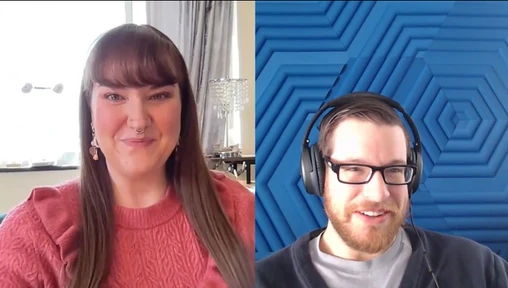
How Separation Science Is Taught vs. How It’s Actually Used
- Photo: Concentrating on Chromatography: How Separation Science Is Taught vs. How It’s Actually Used
- Video: Concentrating on Chromatography: How Separation Science Is Taught vs. How It’s Actually Used
🎤Natasha Le
What do students really learn before they ever touch an analytical instrument? And is chemistry education keeping up with the pace of modern chromatography, mass spectrometry, and sample preparation?
In this episode of Concentrating on Chromatography, David speaks with instructor Natasha Le about the realities of teaching chemistry and separation science to today’s students—many of whom are pursuing careers in medicine, pharmacy, dentistry, and healthcare rather than research.
Natasha shares what students struggle with most, why many learners become focused on grades instead of understanding the science, and where the gap exists between textbook chemistry and real-world lab workflows.
Topics include:
- When students first encounter separation science concepts
- Why chromatography is often taught without being labeled as such
- The challenge of teaching critical thinking vs. “button pushing”
- How mass spectrometry differs in the classroom vs. real labs
- Why sample prep skills matter more than students realize
- Can universities keep up with rapidly changing analytical technology?
- What separates a good chemistry student from a great one
If you work in chromatography, mass spectrometry, lab education, or are preparing for a career in analytical chemistry, this conversation offers a valuable look at how the next generation is being trained.
Video Transcription
Separation science forms the backbone of countless analytical techniques used across chemistry, biology, pharmaceuticals, and environmental science. Yet despite its importance, many undergraduate students encounter its principles long before they ever hear the term "separation science."
In this interview, Natasha Le, a junior professor at La Sierra University, shares her perspective on teaching chemistry to future healthcare professionals. She discusses where students first encounter separation science, why they often fail to recognize its significance, and how chemistry education could better prepare them for careers both inside and outside the laboratory.
From Graduate Student to Chemistry Instructor
Natasha Le recently transitioned from graduate school into academia, where she now teaches several foundational chemistry courses. Her responsibilities include General Chemistry, Introduction to Chemistry, and Organic Chemistry Laboratory, giving her the opportunity to introduce students to many of the concepts that underpin analytical chemistry.
Although her courses are not formally described as "separation science," they provide the theoretical and practical building blocks that students will later rely on in analytical laboratories.
"I've been teaching the foundations of separation science concepts like polarity, melting point, boiling point, and solubility. Those ideas appear throughout general chemistry, analytical chemistry, and organic chemistry."
The accompanying laboratory courses reinforce these concepts through practical exercises. Students perform classic separation techniques such as:
- Liquid-liquid extraction
- Distillation
- Thin-layer chromatography (TLC)
- Miniature column chromatography
- Compound characterization using IR spectroscopy
- Nuclear magnetic resonance (NMR) spectroscopy
- Melting point determination
Rather than simply learning analytical theory, students experience firsthand how chemists isolate, purify, and identify chemical compounds. These laboratory exercises establish the conceptual framework that later supports more advanced analytical techniques.
Teaching Future Healthcare Professionals
Unlike many chemistry departments whose students primarily pursue research careers, La Sierra University serves a somewhat different population.
The institution maintains a close relationship with Loma Linda University, a healthcare-focused university, and many students continue their education there after graduation.
As a result, the majority of Natasha's students are preparing for professional healthcare careers rather than academic research.
These include students pursuing careers in:
- Medicine
- Dentistry
- Pharmacy
- Physician Assistant programs
- Pathology Assistant programs
- Physical Therapy
- Veterinary Medicine
- Nursing
Only a relatively small number eventually pursue graduate studies leading to PhD research positions.
Interestingly, the department itself reflects this emphasis. Although chemistry remains the underlying discipline, many students choose Biochemistry as their major because it aligns more closely with careers in medicine and healthcare.
This educational environment naturally shapes how chemistry is taught. Laboratory skills must prepare students not only for research but also for clinical and healthcare applications where analytical thinking plays an equally important role.
Learning Separation Science Without Knowing Its Name
One of the interview's most thought-provoking observations concerns terminology.
According to Natasha, students begin learning separation science almost immediately during their chemistry education—but they rarely realize that's what they're studying.
Instead, concepts such as polarity, intermolecular interactions, solubility, and molecular properties are introduced individually as part of general chemistry.
"There's no class called Separation Science. There's no textbook chapter called Separation Science."
Students therefore build the necessary scientific foundation without recognizing how these seemingly independent topics eventually connect into chromatography, spectroscopy, sample preparation, and instrumental analysis.
General chemistry introduces the underlying principles.
- Analytical chemistry expands on these concepts.
- Organic chemistry laboratories allow students to apply them experimentally.
Yet throughout this progression, the broader discipline often remains unnamed.
Natasha believes this represents a missed educational opportunity. If students understood earlier that these concepts belong to a larger scientific field, they might better appreciate both their relevance and their career potential.
Could Separation Science Become Its Own Course?
When asked where chemistry education could improve, Natasha points to a surprisingly simple idea: make separation science visible.
Rather than teaching individual concepts in isolation, she suggests introducing students to separation science as a coherent discipline with its own methods, applications, and career opportunities.
"I think we should talk to students more about actually classifying it as separation science so they know that's what they're being trained in."
This becomes especially important for students at institutions where healthcare professions dominate career planning.
Many students never consider careers in analytical chemistry, instrument development, pharmaceutical analysis, or industrial research—not because they lack the ability, but because they are largely unaware these professions exist.
A dedicated course focused on Separation Science or Applications of Separation Science could expose students to these possibilities while connecting theoretical chemistry to real-world analytical challenges.
Although La Sierra University already offers an Instrumental Analysis course covering modern analytical instruments, Natasha believes students would also benefit from a course emphasizing practical applications and the broader role of separation science across multiple industries.
Beyond the Laboratory Techniques
For Natasha, one of the central goals of chemistry education is helping students understand that laboratory techniques are not isolated exercises performed solely to complete coursework.
Instead, they represent transferable scientific skills used daily by researchers, analytical chemists, pharmaceutical scientists, and laboratory professionals.
Recognizing this broader context can fundamentally change how students engage with chemistry.
Rather than seeing chromatography, spectroscopy, or extraction as individual laboratory exercises, students begin to understand them as essential tools that underpin modern scientific discovery.
That shift—from completing an assignment to appreciating its real-world purpose—may be one of the most valuable lessons an instructor can offer.
The First Real Challenge: Interpreting Data Instead of Following Instructions
Many students quickly become comfortable performing laboratory procedures. They can carry out an extraction, develop a TLC plate, or assemble a small chromatography column simply by following the laboratory manual. According to Natasha Le, however, the real learning begins when students move beyond executing protocols and start interpreting analytical results.
She observes that this transition typically occurs in Organic Chemistry, where students begin analyzing infrared (IR) and nuclear magnetic resonance (NMR) spectra.
"That's when I really start seeing students get confused."
Unlike chromatography experiments that often involve following a sequence of prescribed steps, spectral interpretation requires students to think critically about the data they have collected. Rather than simply obtaining a result, they must determine what the data actually reveal about the structure of a molecule.
This shift from procedural work to analytical reasoning represents one of the most significant milestones in undergraduate chemistry education.
Learning to Think Like a Chemist
Natasha explains that many laboratory exercises can be completed successfully without fully understanding the underlying scientific principles.
One example she highlights is the classic experiment in which students separate the pigments found in spinach using chromatography.
Students generally perform the experiment correctly by following the written protocol, yet many never stop to consider why the pigments separate or what the chromatogram actually demonstrates.
As she explains:
"They really could just follow the steps and not really have to think."
The laboratory therefore teaches valuable technical skills, but the scientific significance of the experiment may remain hidden unless instructors actively encourage students to interpret and question their observations.
By contrast, techniques such as IR and NMR spectroscopy leave much less room for passive participation. Students must evaluate spectra, identify characteristic features, and justify their conclusions in laboratory reports. For many, this is the first time chemistry requires genuine analytical thinking rather than procedural accuracy.
Sample Preparation: An Essential but Underappreciated Skill
Another area Natasha believes students often underestimate is sample preparation.
Throughout introductory chemistry laboratories, students repeatedly perform tasks such as:
- Preparing solutions
- Making serial dilutions
- Calculating concentrations
- Preparing buffers
- Carrying out titrations
Although these exercises may appear routine, they mirror the activities performed every day in research laboratories.
Natasha recalls repeatedly using exactly these calculations throughout her own graduate research.
"Those dilution calculations—I did those every day in graduate school."
Similarly, buffer preparation and concentration calculations form part of countless analytical workflows across pharmaceutical, environmental, clinical, and academic laboratories.
Yet undergraduate students rarely appreciate that they are already developing practical laboratory skills with genuine professional relevance.
Instead, many see these exercises simply as classroom assignments designed to earn marks rather than as preparation for future scientific careers.
Research Changes Everything
While formal laboratory courses provide an important foundation, Natasha believes the most valuable practical experience comes through undergraduate research.
Students who join research groups begin working on authentic scientific problems rather than carefully scripted teaching exercises.
Instead of processing one demonstration sample, they may prepare dozens of experimental samples, optimize protocols, troubleshoot unexpected results, and appreciate how sample preparation influences the quality of the final data.
Research also exposes students to an entirely different mindset.
Rather than simply completing a laboratory exercise, they begin asking questions such as:
- Is this protocol producing reliable results?
- How can the method be improved?
- Why did this experiment fail?
- How does sample preparation influence data quality?
This transition marks an important step toward becoming an independent scientist.
As Natasha explains, research allows students to understand how sample preparation fits into real applied science, rather than existing only as an isolated laboratory technique.
Can Universities Keep Pace with Analytical Innovation?
Analytical chemistry evolves remarkably quickly.
New chromatographic techniques, advances in mass spectrometry, innovative software, and increasingly sophisticated instrumentation appear every year. Keeping educational programs aligned with these developments presents a significant challenge for universities.
Natasha believes instructors are constantly trying to update their teaching, particularly in upper-level courses where there is greater flexibility to introduce emerging technologies and current research.
However, she also points to a practical limitation shared by many institutions: budget.
Modern analytical instruments represent major investments, and universities cannot realistically replace laboratory equipment every time a new generation of technology becomes available.
"We can't keep getting the most recent technology... every campus and every department is struggling financially."
Consequently, educators often need to strike a balance between teaching timeless scientific principles and exposing students to the latest analytical developments.
Teaching the Technology You Don't Own
Although acquiring every new instrument may be impossible, Natasha argues that universities can still prepare students for future technologies.
When laboratories cannot provide hands-on access to the latest instrumentation, instructors increasingly rely on:
- Current scientific literature
- Recent research publications
- Discussions of emerging analytical techniques
- Examples from modern industrial applications
This approach allows students to understand where analytical chemistry is heading, even if they cannot yet operate the newest systems themselves.
By introducing recent developments through lectures and scientific publications, educators help students recognize how rapidly the field continues to evolve.
The emphasis therefore shifts from learning a particular instrument to understanding the scientific concepts that remain relevant regardless of technological advances.
Classroom Mass Spectrometry vs. Real Laboratories
Mass spectrometry offers another example of the gap between academic instruction and professional practice.
At the introductory level, Natasha explains, students receive relatively little direct exposure to mass spectrometry. Spectroscopic techniques such as IR spectroscopy are introduced much earlier, while mass spectrometry generally appears in more advanced chemistry courses.
Even then, the educational environment differs substantially from research laboratories.
In teaching laboratories, students might analyze:
- One sample
- Two or three replicate measurements
- A single spectrum for interpretation
Professional laboratories operate on an entirely different scale.
Researchers routinely process tens, hundreds, or even thousands of samples while continuously interpreting spectra, optimizing methods, and validating analytical results.
Consequently, undergraduate laboratories provide only a snapshot of how analytical instrumentation is actually used in research and industry.
The objective is not to reproduce industrial workflows but rather to introduce the scientific principles that students will later apply in much larger and more complex analytical settings.
Building Foundations Before Specialization
Throughout the interview, Natasha repeatedly returns to one central idea:
Undergraduate chemistry should build strong scientific foundations rather than attempt to teach every possible analytical technique.
Students first learn the underlying concepts.
They then practice these concepts through carefully designed laboratory exercises.
Only later—through research, graduate study, or industrial experience—do they encounter the scale, complexity, and flexibility required in professional analytical laboratories.
For educators, the challenge is therefore not simply introducing more technology. It is ensuring that students understand the scientific principles well enough to adapt as analytical instrumentation continues to evolve.
Connecting Theory with Hands-On Instrumentation
One of the biggest challenges in chemistry education is helping students bridge the gap between theoretical concepts and practical laboratory work. Interestingly, Natasha Le believes this transition is not as abrupt as it may appear.
In her experience, students learn the theory and practice almost simultaneously. During lectures they study the scientific principles behind techniques such as infrared (IR) and nuclear magnetic resonance (NMR) spectroscopy, while laboratory sessions allow them to apply those concepts to real samples.
Rather than treating theory and practice as separate stages, the curriculum introduces both in parallel. Students learn how spectra are generated, how they should be interpreted, and then immediately apply that knowledge during laboratory exercises.
However, Natasha notes that understanding the scientific concepts and truly appreciating what is happening during an experiment are not always the same thing.
"Sometimes they're just acting according to the instructions in the lab manual—not really thinking about the theories behind what they're doing."
She recalls examples from organic chemistry laboratories where students correctly carried out reaction protocols and even recorded reaction mechanisms in their notebooks, yet never fully connected those mechanisms to the chemical transformations actually occurring in their experiments.
The procedures were completed correctly, but the deeper scientific understanding was sometimes missing.
When Following Instructions Isn't Enough
Laboratory manuals are designed to help students perform experiments safely and consistently. While this structured approach is essential for beginners, Natasha believes it can unintentionally encourage a "recipe-following" mindset.
Students often become so focused on completing every step exactly as written that they lose sight of the purpose behind the procedure.
A simple example illustrates this well.
If the laboratory instructions recommend preparing approximately half a liter of an ice bath, some students will carefully measure exactly 500 mL, treating the value as if it were a critical analytical parameter.
For an experienced chemist, however, the precise volume of an ice bath is far less important than understanding why the ice bath is needed in the first place.
Moments like these immediately reveal whether students truly understand the experiment or are simply reproducing a protocol.
Natasha believes this distinction is especially important before students begin working with sophisticated analytical instrumentation.
Understanding why measurements are being performed—and what information they are expected to provide—is ultimately more valuable than memorizing operational procedures.
Understanding the Instrument Before Touching It
When asked what she wishes every student knew before operating an analytical instrument, Natasha's answer is remarkably straightforward:
She wants students to understand what is happening inside the instrument.
Rather than approaching an instrument as a black box that automatically produces results, students should appreciate:
- The scientific principles behind the measurement
- What information the instrument actually provides
- Why the measurement is useful
- How the generated data should be interpreted
- How to operate and maintain the instrument responsibly
Courses in Instrumental Analysis play an important role here because they explain the physical principles governing analytical techniques rather than simply demonstrating how to operate them.
For Natasha, this conceptual understanding transforms students from instrument operators into analytical scientists capable of interpreting data critically and troubleshooting experiments when problems arise.
She also emphasizes something much simpler—but equally important.
Students should learn to treat scientific instruments with care and respect, recognizing both their complexity and their value within the laboratory.
What Makes a Great Chemistry Student?
Academic success certainly requires dedication, but Natasha believes that excellent chemistry students possess qualities extending well beyond good grades.
Naturally, curiosity, motivation, and a willingness to invest time are important in any discipline. Chemistry, however, introduces an additional challenge.
Students must learn to distinguish between concepts that require detailed understanding and those that are intentionally simplified at the introductory level.
General chemistry necessarily presents broad models of chemical behavior. As students progress into organic chemistry, analytical chemistry, physical chemistry, and biochemistry, those simplified models become increasingly sophisticated.
According to Natasha, outstanding students recognize this progression.
Rather than becoming frustrated by every unanswered question, they understand that some details will be explored later in their education.
"Know when it's okay not to fully know all the tiny little details—and understand the bigger picture."
Being able to move comfortably between broad concepts and detailed scientific explanations is, in her view, one of the defining characteristics of successful chemists.
Are Students Learning to Think—or Just to Push Buttons?
One of the interview's most thought-provoking discussions concerns a question that resonates throughout modern science education:
Many students—particularly those preparing for competitive healthcare programs—face enormous academic pressure. Their primary objective is often achieving the grades required for admission to medical, dental, pharmacy, or other professional schools.
As a result, laboratory work can become highly task-oriented.
Students focus on:
- Completing every protocol correctly
- Avoiding mistakes
- Earning the highest possible grade
While these are understandable priorities, Natasha worries they sometimes come at the expense of genuine scientific curiosity.
Students become exceptionally good at following instructions, yet spend less time asking questions such as:
- Why does this experiment work?
- What do these results actually tell me?
- Could the experiment be improved?
- What broader scientific problem am I helping to solve?
For her, these questions represent the true heart of scientific education.
Curiosity and Achievement Go Hand in Hand
Natasha believes there is a common misconception among students.
Many assume that taking time to understand the broader scientific context somehow distracts from achieving high grades.
She argues exactly the opposite.
Students who genuinely engage with the science tend to understand concepts more deeply, retain knowledge more effectively, and ultimately perform better academically.
"I don't think they realize that understanding the bigger picture and appreciating it will actually help them get an A anyway."
Rather than viewing curiosity and academic performance as competing priorities, Natasha sees them as mutually reinforcing.
Developing genuine interest in chemistry not only makes learning more enjoyable—it also produces stronger scientists.
Looking Beyond the Classroom
Throughout the interview, one message remains remarkably consistent.
Chemistry education is not simply about preparing students to complete laboratory exercises.
It is about teaching them how to think scientifically.
That means recognizing patterns in experimental data, questioning unexpected observations, understanding why analytical techniques work, and appreciating the role these methods play in solving real-world problems.
Separation science, spectroscopy, sample preparation, chromatography, and analytical instrumentation are ultimately tools.
Their value depends not only on technical proficiency but also on the ability of scientists to interpret results critically and apply them thoughtfully.
For Natasha, cultivating this mindset is one of the most rewarding—and most important—responsibilities of a chemistry educator.
Final Thoughts
Natasha Le's perspective offers an insightful reminder that chemistry education extends well beyond teaching laboratory techniques or instrument operation. Students may first encounter separation science through concepts such as polarity, solubility, chromatography, or spectroscopy, but their long-term success depends on understanding how these ideas fit together within the broader landscape of analytical science.
Her experience also highlights a challenge faced by many educators: balancing the need to teach practical laboratory skills while encouraging critical thinking, scientific curiosity, and conceptual understanding. As analytical technologies continue to evolve, these foundational skills will remain just as important as familiarity with the latest instrumentation.
Whether students ultimately pursue careers in healthcare, academic research, pharmaceutical development, or analytical laboratories, learning to ask why—rather than simply how—may be the most valuable lesson chemistry education can provide.
This text has been automatically transcribed from a video presentation using AI technology. It may contain inaccuracies and is not guaranteed to be 100% correct.
Concentrating on Chromatography Podcast
Dive into the frontiers of chromatography, mass spectrometry, and sample preparation with host David Oliva. Each episode features candid conversations with leading researchers, industry innovators, and passionate scientists who are shaping the future of analytical chemistry. From decoding PFAS detection challenges to exploring the latest in AI-assisted liquid chromatography, this show uncovers practical workflows, sustainability breakthroughs, and the real-world impact of separation science. Whether you’re a chromatographer, lab professional, or researcher you'll discover inspiring content!
You can find Concentrating on Chromatography Podcast in podcast apps:
and on YouTube channel