MS Interpreter for EI Accurate Mass Data, Correlating Structure to m/z
- Photo: James Little: MS Interpreter for EI Accurate Mass Data, Correlating Structure to m/z
- Video: James Little: MS Interpreter for EI Accurate Mass Data, Correlating Structure to m/z
The integration of MS Interpreter within NIST 26 provides an efficient way to evaluate fragmentation pathways and verify structural assignments for accurate-mass EI GC-MS data. Rather than relying solely on library match factors, users can directly compare measured accurate-mass spectra with proposed molecular structures, helping determine whether observed fragment ions are chemically reasonable.
This workflow is particularly valuable when confirming library identifications, comparing alternative candidate structures, or evaluating user-proposed compounds. By combining accurate-mass measurements with fragmentation analysis, MS Interpreter provides an additional level of confidence during compound identification.
What is MS Interpreter?
MS Interpreter is a structure-based fragmentation analysis tool integrated into the NIST Mass Spectral Library software.
It enables users to:
- Compare an accurate-mass spectrum with a proposed structure.
- Predict likely fragmentation pathways.
- Assign elemental formulas to fragment ions.
- Evaluate molecular ion accuracy.
- Determine whether observed fragments are chemically plausible.
Unlike a conventional library search, which ranks candidate compounds based primarily on spectral similarity, MS Interpreter explains why fragments appear in the spectrum.
Sending Accurate-Mass Spectra from the Chromatogram Window
One of the most convenient features of NIST 26 is the ability to send spectra directly from the Chromatogram Window to MS Interpreter.
After chromatogram processing:
- Select the chromatographic peak of interest.
- Right-click the result.
- Choose Send to MS Interpreter.
The software automatically transfers:
- the accurate-mass spectrum,
- the proposed library structure,
- and the associated library identification.
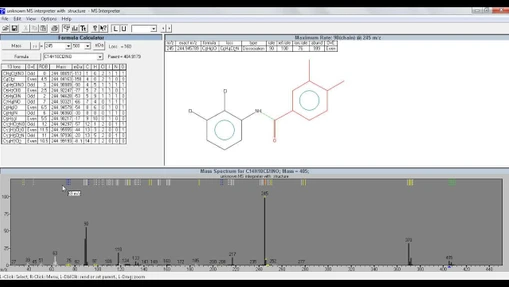
The lower pane displays the measured accurate-mass spectrum, while the upper pane contains the proposed molecular structure from the library entry.
This direct transfer allows immediate evaluation of how well the proposed structure explains the measured fragmentation pattern.
Interpreting Fragment Ions
Once the spectrum and structure have been loaded, individual fragment ions can be examined interactively.
Selecting any annotated ion allows MS Interpreter to:
- calculate its elemental composition,
- estimate the fragmentation pathway,
- determine the mass error,
- compare the theoretical and measured masses.
For example, the molecular ion can be inspected to verify its mass accuracy. In the demonstration, the molecular ion showed an error of only 0.6 ppm, providing strong evidence that the elemental composition was correctly assigned.
The same approach can then be applied to every major fragment within the spectrum.
Understanding Different "Send to MS Interpreter" Options
NIST 26 provides several ways to transfer information to MS Interpreter, each intended for a different purpose.
Sending the lower chromatogram spectrum transfers:
- the accurate-mass spectrum,
- the associated library structure.
This is the recommended workflow for evaluating accurate-mass EI data.
Sending information from the upper text section transfers only the spectrum without any structure.
This option is useful when users intend to evaluate their own proposed structures rather than the library hit.
Understanding the difference between these options ensures that the correct information is available for fragmentation analysis.
Comparing Alternative Library Candidates
The highest library match is not always the correct identification.
Closely related structural isomers often produce nearly identical EI spectra, making differentiation based solely on match factors difficult.
NIST 26 allows users to investigate alternative candidates by:
- opening the Library Search window,
- selecting another library hit,
- copying its structure,
- pasting the structure into MS Interpreter,
- comparing fragmentation with the measured spectrum.
This workflow allows users to determine whether a lower-ranked candidate provides a more chemically reasonable explanation for the observed fragmentation.
Copying Structures from Library Search
Alternative structures can be transferred directly from the Library Search Window.
The workflow is straightforward:
- Perform a library search.
- Select any candidate spectrum.
- Copy the molecular structure to the Windows clipboard.
- Open MS Interpreter.
- Paste the structure.
The accurate-mass spectrum remains unchanged while the proposed structure is replaced, allowing direct comparison between multiple candidate molecules.
This approach is especially valuable when several library hits produce similar match factors.
Evaluating User-Proposed Structures
MS Interpreter is not limited to library entries.
Users can also evaluate completely new structures that are absent from the NIST library.
The workflow consists of:
- Creating or editing a structure using an external chemical drawing program (for example ChemSketch).
- Copying the structure to the Windows clipboard.
- Sending the accurate-mass spectrum to MS Interpreter.
- Pasting the user-generated structure into the structure window.
The software then attempts to explain the observed fragmentation using the newly proposed molecule.
This capability makes MS Interpreter particularly useful for research applications involving unknown compounds, newly synthesized molecules, degradation products, or metabolites that are not yet represented in commercial spectral libraries.
Using Structure Editors Efficiently
When evaluating structural variants, users rarely need to draw molecules from scratch.
Instead, an existing library structure can be:
- exported to a structure editor,
- modified,
- copied back into MS Interpreter.
Even relatively small structural changes—such as relocating a methyl group or modifying branching—can then be evaluated rapidly.
This significantly accelerates comparison of structural hypotheses.
Fragmentation Alone May Not Resolve Isomers
One important conclusion demonstrated in the presentation is that accurate-mass fragmentation alone is not always sufficient to distinguish closely related isomers.
Several candidate structures may generate nearly identical:
- molecular ions,
- fragment ions,
- fragmentation pathways.
In these situations, additional chromatographic information becomes essential.
The presenter recommends combining MS Interpreter results with:
- retention time,
- preferably retention index (RI),
- chromatographic behavior.
Retention indices provide an independent identification parameter that complements accurate-mass spectral interpretation and frequently allows confident discrimination between structural isomers.
Practical Applications
MS Interpreter is particularly useful when:
- confirming chromatogram identifications,
- evaluating lower-ranked library matches,
- testing alternative structural hypotheses,
- interpreting fragmentation pathways,
- investigating unknown compounds,
- supporting accurate-mass EI GC-MS identification,
- combining fragmentation analysis with retention indices.
Rather than replacing library searching, MS Interpreter serves as a complementary tool that helps explain why a proposed identification is chemically consistent with the observed spectrum.
Summary
The integration of MS Interpreter into NIST 26 significantly enhances the interpretation of accurate-mass EI GC-MS data by linking measured fragment ions directly to proposed molecular structures. Users can quickly transfer spectra from the Chromatogram Window, compare alternative library candidates, evaluate user-generated structures, and investigate fragmentation pathways without leaving the NIST environment.
While accurate-mass fragmentation provides valuable structural evidence, the presentation also demonstrates that closely related isomers may still produce nearly indistinguishable spectra. For this reason, combining MS Interpreter with chromatographic information—particularly retention indices—offers the highest confidence for compound identification in routine and research GC-MS workflows.