Tracking Microplastics and Their Associated Chemical Additives in Plant Tissues: A Pyrolysis GC-MS Approach to Identification, Quantification, and Translocation Mechanism
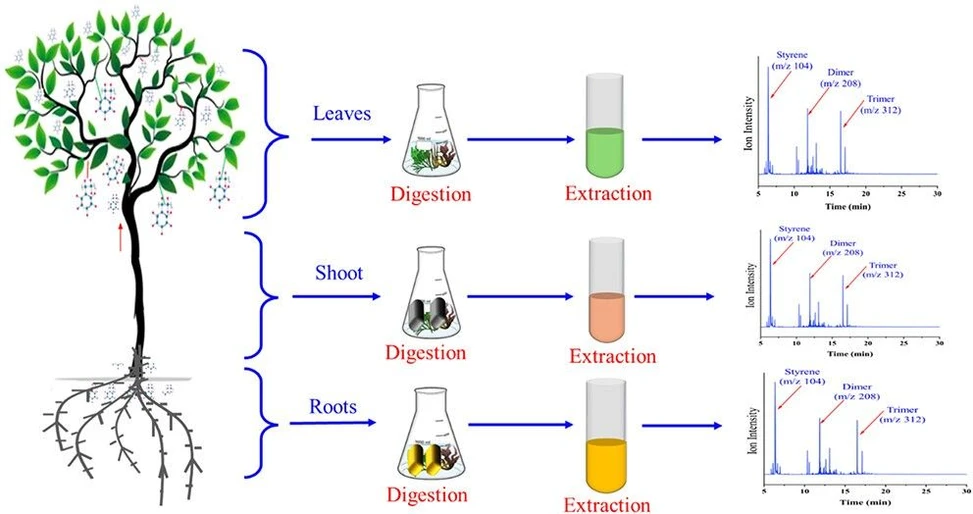
ACS Omega 2026, 11, 8, 13137–13148: Graphical abstract
This study presents a Py-GC-MS-based method for detecting and quantifying polystyrene microplastics and associated chemical additives in basil plants. Following acid digestion and extraction, microplastics were characterized by SEM and quantified using characteristic styrene trimer pyrolysis products, achieving low detection limits and high analytical precision across roots, shoots, and leaves.
The results confirmed the uptake and translocation of microplastics within plant tissues, with evidence suggesting passive transport driven by concentration gradients. The developed workflow provides a robust approach for studying microplastic accumulation in crops and supports the development of standardized methods for analyzing microplastics in complex biological matrices.
The original article
Tracking Microplastics and Their Associated Chemical Additives in Plant Tissues: A Pyrolysis GC-MS Approach to Identification, Quantification, and Translocation Mechanism
Sarah A. Alotaibi, Gaddi B. Eshun, and Omowunmi A. Sadik*
ACS Omega 2026, 11, 8, 13137–13148
https://doi.org/10.1021/acsomega.5c08234
licensed under CC-BY 4.0
Selected sections from the article follow. Formats and hyperlinks were adapted from the original.
Microplastic pollution has become a significant environmental issue with potential risks to ecosystems worldwide due to its extensive use and improper management. (1) Micro/nanoplastics fragments (MP, 100 nm–5 mm) are generated with chemical additives/plastic additives from sources or aging degradation processes such as photooxidation, thermal, and UV exposure. (1−3) Microplastics used for commercial purposes are primary microplastics, and their fragmentation produces secondary microplastics. The effects of microplastics on plant ecosystems have attracted growing attention. Efforts to quantify MPs in plants remain limited due to a lack of techniques and instrumentation. The exact translocation mechanism of MPs through the plant is unclear, but some studies have suggested a mechanism of MP translocation. (2,4) The adverse effects of MPs on plants are the motivation for developing a reliable method for studying MPs in plants. This work focuses on using pyrolysis-coupled gas chromatography to identify and quantify polystyrene (PS) microplastics in basil plants.
Basil plants have significant anti-inflammatory, antibacterial, and antioxidant properties that aid digestion and help manage diseases such as age-related heart disease. (5) Furthermore, basil plants produce essential oils associated with eliminating the risk of cancer. (5) Basil plants are applied as an ingredient for food aroma, cosmetic products, and medicinal purposes. (6) The economic impact of the basil plant is significant around the globe, estimated to grow due to high demand. (7) Basil plants contribute US$47.96 to US$1,049.58 per kilogram of dry extract, making it a vital agricultural product. (7,8) Basil plants are composed of phenolic groups, linalool, methyl chavicol, and eugenol, belonging to the Ocimum genus. (5,9) Phenolic acids and flavonol glycosides are the main phenolic components in basil. Plastic products are vital components of human life. Microplastics such as PS (polystyrene), PE (polyethylene), PVC (polyvinyl chloride), (10) and PLA (polylactic acid) may possess adverse effects on plants. (11) Wu et al. have demonstrated the effect of PS MPs on peanuts. (10) MPs disrupt the growth and photosynthetic machinery of the plants. Thus, MPs demonstrate the multifaceted effects on edible produce, especially during the vegetative phase. (10) Basil plants are economically beneficial and widely cultivated plants. (12) We are motivated to investigate and identify MPs-affected basil plants.
Microplastic polymers have been identified and quantified in many environmental matrices. (12,13) For instance, PVC and PS microplastics have been identified and characterized in plants. (14) Polystyrene is an aromatic polymer composed of styrene monomer units. MPs resist degradation, and their toxicity is attributed to their size, high surface area, dispersion potential, and tendency to adsorb to other contaminants. (15,16) Various chemical additives are added to the plastic material during the manufacturing process to enhance the resultant plastic’s physicochemical properties. Diverse functional chemicals, such as fillers and heat stabilizers, are added to plastics. Pyrolysis gas chromatography–mass spectrometry (Py-GC-MS) is a specialized analytical tool for analyzing chemical additives and plastic materials.
To date, many conventional methods for MP analysis have been reported. Methods for characterizing microplastics include GC-LC-tandem MS and Fourier transform infrared spectroscopy (FTIR), and Raman spectroscopy. (17,18) However, the limitations of some instruments are not favorable for direct analysis owing to the low volatility of plastics. (19,20) Recently, the use of pyrolysis GC-MS (Py-GC-MS) and TED-GC-MS has proven successful for the degradation of plastics at high temperatures (e.g., 220 °C) into volatile organic chemicals that can then be identified and quantified. (21−23) Py-GC-MS is a reliable analytical method for characterizing the identity of volatile and nonvolatile compounds. The pyrolyzate is identified and quantified by using indicator ions in an MS spectrum generated from a chromatogram at a specific retention time. Molecular information about the polymer and its related additives provides evidence of degradation. During the pyrolysis of polystyrene microplastics, styrene monomer (24) indicator compounds are produced at 700 °C, while the dimer and trimer (24) pyrolyzates are generated at 500 °C. Sample preparation protocols that include digestion (hydrogen peroxide) and liquid extraction using solvents such as dichloromethane (DCM) are reliable approaches for extracting MPs in plant matrices for Py-GC-MS analysis. (25)
In this work, we report the Py-GC-MS characterization of polystyrene microplastics and their chemical additives extracted from basil plants. The extracted microplastic samples and chemical additives are further characterized using scanning electron microscopy (SEM) to determine the sizes of PS beads. FTIR analysis is performed to determine functional groups. Multishot Py-GC-MS was applied to identify and quantify polystyrene microplastics in basil plant samples. A standard calibration curve was generated because the MP concentration in basil plants was extremely low; thus, additional PS was spiked and standard addition was used to determine the PS concentration. This study demonstrates a straightforward approach for the extraction, identification, and quantification of polystyrene in basil plants using Py-GC-MS. This work proves the contamination of PS in edible plants.
2. Experimental Section
2.4. Pyrolysis Gas Chromatography–Mass Spectrometry
Analysis of plant samples using Pyrolysis–Gas Chromatography/Mass Spectrometry (Py-GC-MS) was performed with a Pyrolyzer (Pyroprobe 6150, CDS) linked to a gas chromatograph-mass spectrometer Agilent 8890 system. Multishot Py-GC-MS was applied for the identification and quantification of MPs in basil plants. The multishot Py-GC-MS technique comprises a thermal desorption step and a flash pyrolysis step to characterize the microplastic polymer, chemical additives, and matrix. The multishot pyrolysis conditions were optimized using a protocol reported (30) elsewhere with slight modifications. Briefly, the pyrolysis temperatures were selected based on an optimization comprising shots 1 (300 °C), 2 (350 °C), 3 (500 °C), and 4 (700 °C). From the optimizations, 500 °C was selected for Pyrolysis. The duration of the pyrolysis was 20 s. The pyrolysis product was transferred into the GC using split mode with a ratio of 10:1. The products of MPs from pyrolysis were separated using a nonpolar column HP-5MS (15 m × 250 μm × 0.25 μm), and an oven ramp temperature of 50 °C was maintained for 2 min, raised at 20 °C/min until 300 °C for 10 min. Mass spectrometry was operated in the electron impact mode. During the analysis, microplastics are fragmented into smaller particles using a mass spectrometer. Helium was chosen as the carrier gas, operated at 1 mL/min in a constant-flow mode. The GC-MS transfer line temperature was maintained at 280 °C. MS results were recorded over an m/z range of 40–500 in full-scan mode at a scan rate of 4 scans/s. The Electron Ionization (EI) operated at 70 eV with an ion source temperature of 230 °C. We added 0.025 mg of PVC as the internal standard to assess the instrument’s variability. Table 2 shows the specific conditions for multishot pyrolysis GC-MS measurements. Polystyrene, certified reference material (sample #5-PS-11k), was analyzed by Py-GC-MS as the positive control.
2.5. SEM Characterization
Microscopic evaluations of MPs were performed using a JEOL 7900F scanning electron microscope to determine their sizes and morphology. The sample prep for SEM entails the digestion and extraction of MPs. The basil plants contaminated with polystyrene were digested. DCM solvent was used to extract polystyrene microplastics from the basil plant matrix. One mL of the extracted MPs in DCM was dropped cast onto a specimen stub and dried for 24 h. The sample was sputter-coated to make its surface conducive to SEM visualizations.
2.6. FTIR Characterization
The IR spectra of MPs were recorded using an FTIR spectrometer (IR Tracer-100 Shimadzu Corporation, Ltd.). The scanning range was set from 400 to 4000 cm–1 at a resolution of 4 cm–1. PS extracted from basil plants was diluted using 10 mL of DCM for analysis. From the MPs in 10 mL of DCM, 1 mL aliquots were dropped onto KBr pellets, and the results were recorded with the IR Tracer. All samples were analyzed as KBr pellets after a background scan. Spectral data from experimental samples were compared with those of a reference standard to confirm and identify the functional groups present in the samples. The FTIR spectrum is plotted as wavenumber (cm–1) versus transmittance.
3. Results and Discussion
3.2. Identification of Polystyrene Microplastics in Basil Plants by Pyrolysis GC-MS
Polystyrene is a versatile polymer manufactured from styrene monomers/vinylbenzene. In this study, multishot Py-GC-MS was utilized to identify the extracted polystyrene from basil plants. Py-GC-MS characterizations reveal the identities of pyrolyzate compounds through specific indicator ions. Styrene trimer was utilized as the indicator compound for the analysis in this work. During pyrolysis, the sample is heated under inert conditions, where the polymer is fragmented into smaller molecules that are transferred via a gas phase and then analyzed by a gas chromatograph. The pyrolysis conditions are optimized, and after analyzing PS in basil plants, the resulting pyrogram (chromatogram obtained from pyrolysis) displays a fingerprint of the PS polymer through indicator ions. The multishot Py-GC-MS technique was utilized to identify and quantify MPs in basil plants. The multishot Py-GC-MS technique was selected for all analyses to detect different plastic materials at different temperature shots. Compounds such as diethyl phthalate, phthalic acid, phthalic acid ethyl pentadecyl ester, and di-n-butyl phthalate were detected at low signal intensities in temperature shots 1 (300 °C), 2 (350 °C), 3 (500 °C), and 4 (700 °C). respectively. It is suspected that the detected phthalate compounds are chemical additives. Nevertheless, it showed a higher signal intensity in temperature shot 4 (700 °C). Meanwhile, the styrene dimer and trimer were detected at shot 3 (500 °C). Since the identification and quantification of thermally degraded PS in basil plants are the focus of this study, the pyrolyzates from PS were analyzed in roots, shoots, and leaves. The TIC pyrogram of the PS in basil plants is displayed in Figure 1. The pyrolysis products of polystyrene are fragments into three major products, which include the styrene monomer, styrene dimer (3-butene-1,3-diyldibenzene), and styrene trimer (5-hexene-1,3,5-triyltribenzene). The indicator ion peaks of the styrene monomer, dimer, and trimer that identified PS microplastics were confirmed with the NIST microplastic library. Among the three pyrolysis products of polystyrene, the trimer was selected as the key pyrolysis product for detecting PS microplastics in basil plants. It is worth noting that the relative abundances of the three pyrolyzates depend on the pyrolysis temperature. It was confirmed that styrene was the predominant product across different pyrolysis temperatures, while the dimer and trimer were less abundant. The ratio of monomer, dimer, and trimer in polystyrene was reported to be 1:0.25:1 by Ishimura et al. (34) In our case, the pyrolysis of polystyrene in basil plants at 500 °C showed that the relative abundance, calculated from the peak intensities of the styrene monomer, dimer, and trimer, was 1:0.20:0.75, respectively. Since the styrene monomer serves as an indicator for other microplastics, such as PVC, the styrene trimer indicator compound was selected for quantification. The pyrolysis GC-MS investigations were performed on all digested samples to identify and quantify the presence of different MPs in the roots, shoots, and leaves. The recorded chromatogram of the plant samples is compared to the chromatogram of polystyrene, certified reference material (sample #5-PS), and standard data to identify specific MPs detected in the basil plant. The initial MPs analysis by Py-GC-MS showed low concentrations of PS present in the original digested samples.
 ACS Omega 2026, 11, 8, 13137–13148: Figure 1. Total ion chromatogram (TIC) of styrene trimer detected in the real (A) root, (B) shoot, and (C) leaf tissues of basil plants.
Figure 1A–C shows the chromatogram (signal intensity vs retention time) and Figure S1A–C represents the MS data signal vs mass-to-charge ratio (m/z). The MS data were obtained from the chromatogram. The instrument provides a chromatogram (intensity signal vs acquisition/retention time) after pyrolysis of each sample. From the recorded chromatogram, an MS spectrum is generated at the specific retention time corresponding to the microplastic of interest.
3.6. Scanning Electron Microscopy (SEM)
SEM analysis was conducted to assess the morphological characteristics, size distribution, and in situ localization of polystyrene (PS) micro/nanoplastics, following a previously described procedure. (49) As illustrated in Figure 5A–C, SEM micrographs confirm the presence of spherical PS particles in all examined plant compartments: leaves (A), shoots (B), and roots (C).
 ACS Omega 2026, 11, 8, 13137–13148: Figure 5. PS micro/nano plastic in the basil plant (A) leaves, (B) shoot, (C) root, (D) energy-dispersive X-ray (EDX).
Specifically, Figure 5A shows monodispersed, spherical PS structures within the leaf tissue, with an average particle size of 3–5 μm, as determined from size distribution histograms. In Figure 5B, it can be observed that the MPs are monodispersed and coalesce into large clumps due to their microstructures in the proximity. It is worth mentioning that hydrogen peroxide-based chemical digestion did not affect particle size and morphology; thus, the structural integrity of PS microplastics was not compromised. The selected digestion protocol was effective. Figure 5C reveals a dense accumulation of PS nanoplastics in root tissues, which appears greater than that in aerial parts, highlighting the roots as the primary site of uptake and further translocation via roots into the shoot. The difference in PS suggests that translocation of PS micro- and nanoplastics follows their concentration gradient from the roots to the leaves. Leaf tissues exhibited moderate particle presence, while the shoot showed minimal accumulation, suggesting limited vertical translocation through the vascular system. This observed gradient in PS concentration from roots to leaves indicates passive uptake and restricted systemic transport via xylem. Moreover, complementary energy-dispersive X-ray (EDX) spectroscopy (Figure 5D) confirmed the elemental presence of carbon (C) and oxygen (O), consistent with the chemical composition of polystyrene, thereby reinforcing the conclusion that PS micro/nanoplastics were absorbed and retained within plant tissues. Collectively, these findings support the hypothesis of root-mediated internalization of PS particles and their constrained upward mobility within the plant matrix.
4. Conclusions
Py-GC-MS is a robust and reliable instrument that provides precise identification and quantification of a myriad of microplastics with an indicator ion as its characteristic peak. The multishot Py-GC-MS technique provides significant insights that aid in assessing ecological consequences and developing effective mitigation strategies. To this end, we demonstrated a sample preparation protocol for the extraction and isolation of polystyrene microplastics from basil plants. An optimized method was developed to analyze polystyrene by using Py-GC-MS. MPs were extracted from plant samples via acid digestion and subsequent extraction methods followed by characterization using FTIR, SEM, and Py-GC-MS approaches. The Py GC-MS method identifies PS, the styrene trimer peak area, as a reliable and specific indicator ion that matches polystyrene. We combined standard addition and internal standard technique to quantify the concentration of the PS micro/nanoplastics in the roots, shoots, and leaves to be 4.7 μg in 100 g of root sample, 2.4 μg in 100 g of shoot sample, and 3.6 μg in 100 g of leaf sample. We also determined their MP recoveries (RSD, n = 5), LODs, and LOQs using calibration curves. Although this study illustrates the best sample preparation method for quantifying MPs, further research on various techniques is required to fully understand the mechanisms of MP uptake and translocation and their broader environmental implications.